
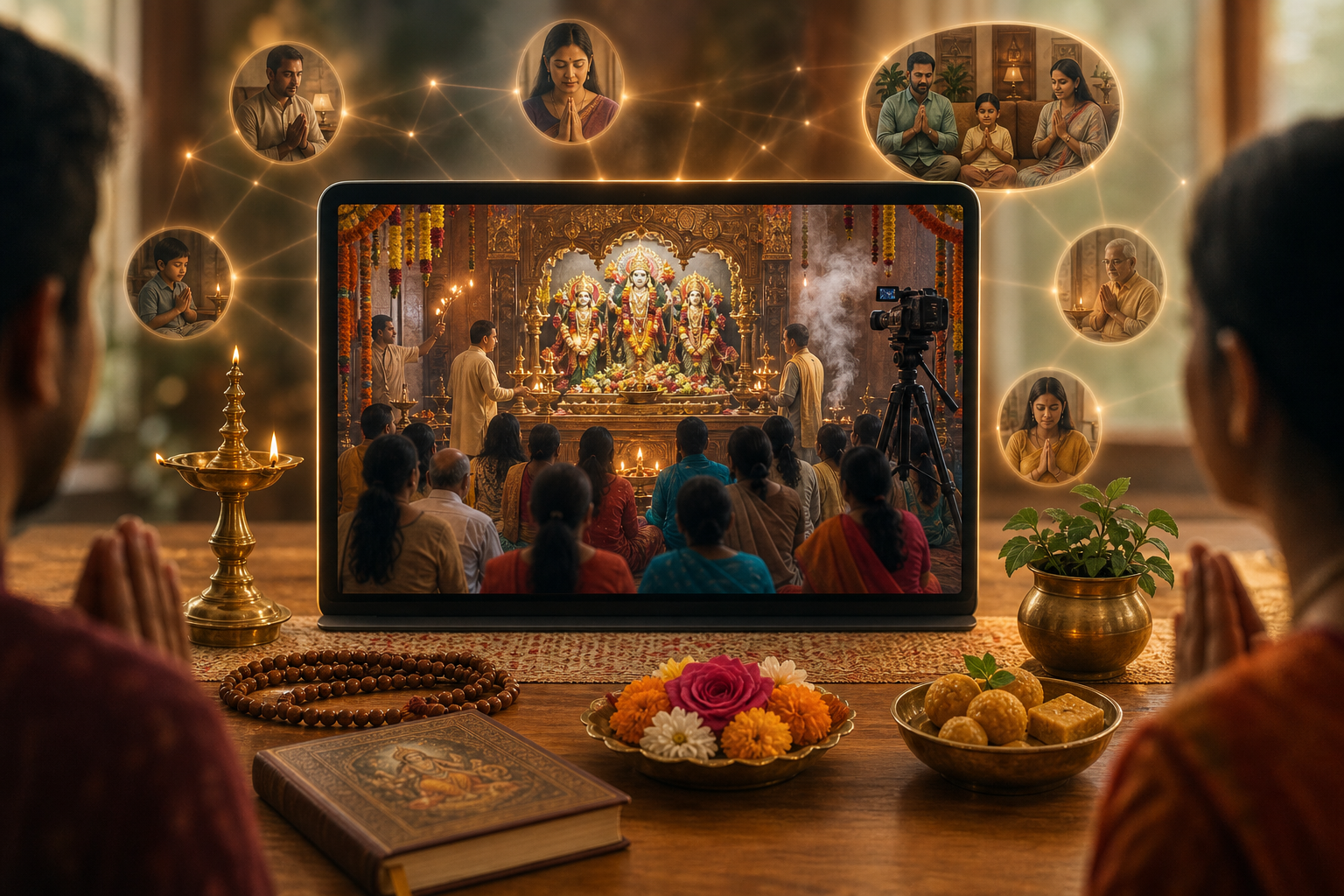
The listing titled ISKCON of DC Live Stream appears, in its original form, as a minimal media post built around a YouTube thumbnail. Even with such sparse source material, the subject points toward a significant contemporary religious practice: the use of live-streaming technology to extend temple worship, kirtan, scriptural reflection, and community participation beyond the physical walls of a mandir. In the case of ISKCON, this is not merely a convenience; it is a digital expression of bhakti, or devotional service, adapted to the needs of a geographically dispersed Hindu diaspora.
ISKCON, the International Society for Krishna Consciousness, was founded in New York City in 1966 by A. C. Bhaktivedanta Swami Prabhupada and is rooted in the Gaudiya Vaishnavism tradition. Its theology emphasizes devotion to Sri Krishna through hearing, chanting, remembrance, worship, service, and ethical discipline. The official ISKCON movement describes its public mission through teachings associated with the Bhagavad Gita, the Srimad Bhagavatam, the chanting of the Hare Krishna maha-mantra, vegetarian food offered as prasadam, and community-centered devotional life. More background is available through the official ISKCON website at iskcon.org.
A live stream from ISKCON of DC should therefore be understood as more than a broadcast of a religious event. It functions as a mediated darshan experience, a devotional archive, a teaching platform, and a form of social continuity for those who cannot attend temple in person. Families separated by work schedules, students away from home, elderly devotees, parents caring for children, and seekers unfamiliar with temple customs can all enter the rhythm of worship through a screen. The technology is modern, but the impulse behind it is ancient: to make sacred sound, sacred sight, and sacred remembrance available wherever sincere attention is present.
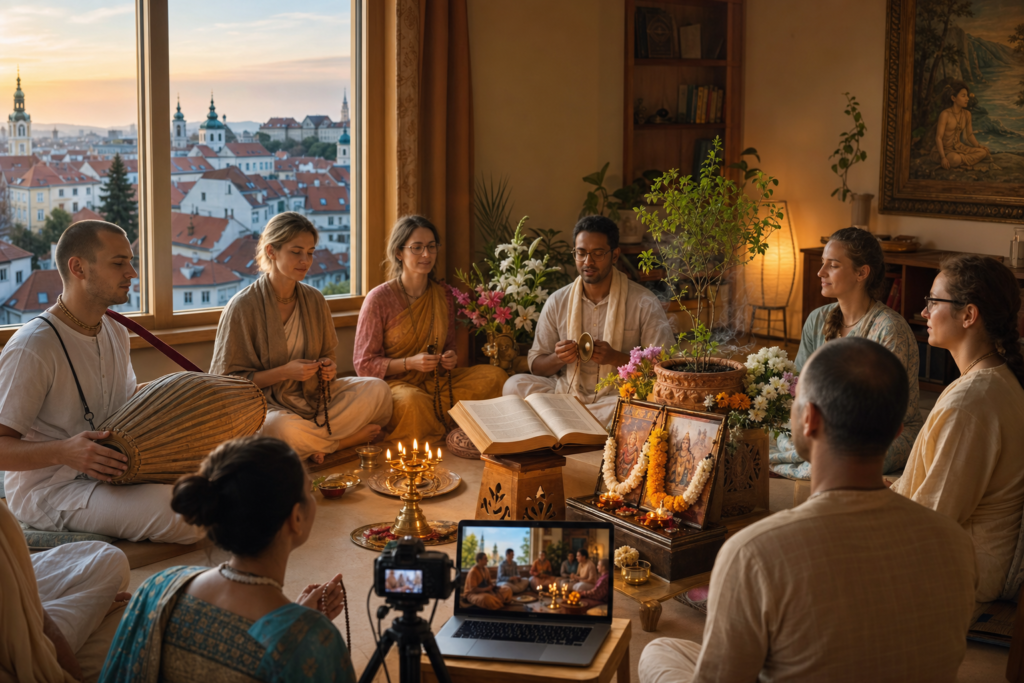
The central ritual vocabulary of such a stream usually includes kirtan, arati, mantra recitation, scriptural discourse, and the visual presence of the altar. In Gaudiya Vaishnava practice, sound is especially important because chanting is treated as a direct means of cultivating consciousness. The Hare Krishna maha-mantra is not presented merely as music or cultural performance; it is understood as a disciplined spiritual practice that joins voice, memory, emotion, and philosophical intent. A live stream allows this practice to reach participants who may be listening from a home altar, a work break, a hospital room, or a distant city.
The technical format of a temple live stream also reshapes how religious communities preserve memory. A physical event is bound by time and place, while a recorded or streaming event can be replayed, shared, indexed, embedded, and revisited. This changes the public life of a mandir. A lecture on Bhagavad Gita, a Janmashtami celebration, a Sunday feast discourse, or a morning arati can become part of an ongoing digital library. For younger audiences accustomed to video platforms, this format can make Hindu spiritual traditions more accessible without requiring the tradition to abandon its inherited discipline.
At the same time, digital darshan should not be confused with a full replacement for embodied temple life. The physical mandir offers sensory, social, and ritual dimensions that a screen can only approximate: the fragrance of incense, the sound of kartals and mridanga in shared space, the experience of standing with other devotees, the receipt of prasadam, and the informal conversations that sustain community. The live stream is best understood as an extension of temple life rather than a substitute for it. Its value lies in continuity, accessibility, and spiritual companionship across distance.
For the Hindu diaspora in the United States, especially in and around Washington, DC, such digital access carries added cultural significance. Temples often serve as centers of worship, education, language memory, music, food culture, intergenerational exchange, and community service. When these activities are streamed, the temple becomes visible not only to regular attendees but also to children, relatives abroad, curious neighbors, and first-time seekers. The result is a wider public window into Hindu culture and Krishna consciousness.
The emotional dimension should not be understated, even in an academic discussion. Many people encounter a temple live stream during moments of fatigue, uncertainty, displacement, or longing for familiar devotional sounds. The sight of the altar, the cadence of kirtan, and the steady repetition of mantra can create a sense of order in an otherwise fragmented day. This is one reason live-streamed worship has become meaningful across religious traditions: it gives structure to attention and offers a shared rhythm when physical gathering is difficult.
Within Sanatana Dharma, the practice of bhakti has always adapted to social conditions while preserving core principles. Oral recitation, handwritten manuscripts, printed books, public sankirtan, radio, television, websites, and video platforms all represent different historical channels for transmitting sacred learning. ISKCON’s adoption of live streaming fits within this larger pattern of religious communication. The medium changes, but the emphasis on shravana, kirtana, smarana, seva, and prasadam-centered community remains recognizable.
The broader dharmic context is also important. Hinduism, Buddhism, Jainism, and Sikhism differ in theology, metaphysics, ritual forms, and historical development, yet they share a deep respect for disciplined practice, ethical refinement, compassion, community service, and the transformation of consciousness. A constructive reading of ISKCON of DC’s live-streamed worship should therefore strengthen unity among dharmic traditions rather than encourage sectarian rivalry. The stream can be appreciated as one expression of a wider civilizational habit: preserving sacred knowledge through practice, sound, discipline, and community transmission.
There is also a practical educational benefit. A well-maintained live stream can help newcomers understand temple etiquette before visiting in person. Viewers can observe when people bow, how kirtan is led, how arati is performed, how lectures are structured, and how devotees respond to sacred images and sound. This reduces anxiety for first-time visitors and makes the mandir more approachable. For children growing up outside India, repeated exposure to these practices can create familiarity before formal philosophical study begins.
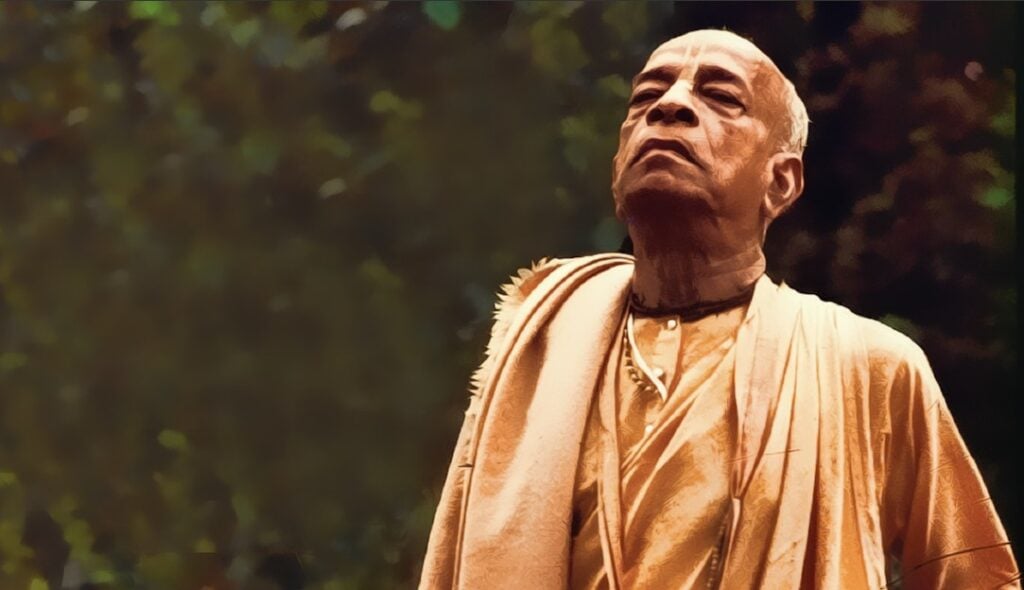
From a media perspective, the presence of a YouTube thumbnail in the original post reflects how contemporary religious visibility is often mediated by platform infrastructure. A thumbnail is small, but it carries the promise of access. It invites a viewer to move from passive browsing into active listening. For spiritual institutions, this creates both an opportunity and a responsibility: digital presentation should remain clear, dignified, accurate, and free from unnecessary promotional clutter. The purpose of the stream is best served when the technology quietly supports devotion rather than distracting from it.
The phrase ISKCON of DC Live Stream is therefore concise, but the subject is expansive. It speaks to the globalization of Gaudiya Vaishnavism, the lived realities of Hindu diaspora communities, the continuity of bhakti in modern media, and the enduring human need for sacred rhythm. A stream may begin as a simple video window, yet it can become a daily point of return for reflection, chanting, learning, and spiritual steadiness.
In its most meaningful form, the ISKCON of DC live stream is a bridge between temple and home, tradition and technology, local community and global participation. It demonstrates how dharmic traditions can remain rooted while becoming accessible to new generations. When approached with respect, attention, and humility, such a stream offers more than religious content; it offers a disciplined encounter with devotion, memory, and the living continuity of Krishna bhakti.
Inspired by this post on Dandavats.






Leave a Reply
You must be logged in to post a comment.