
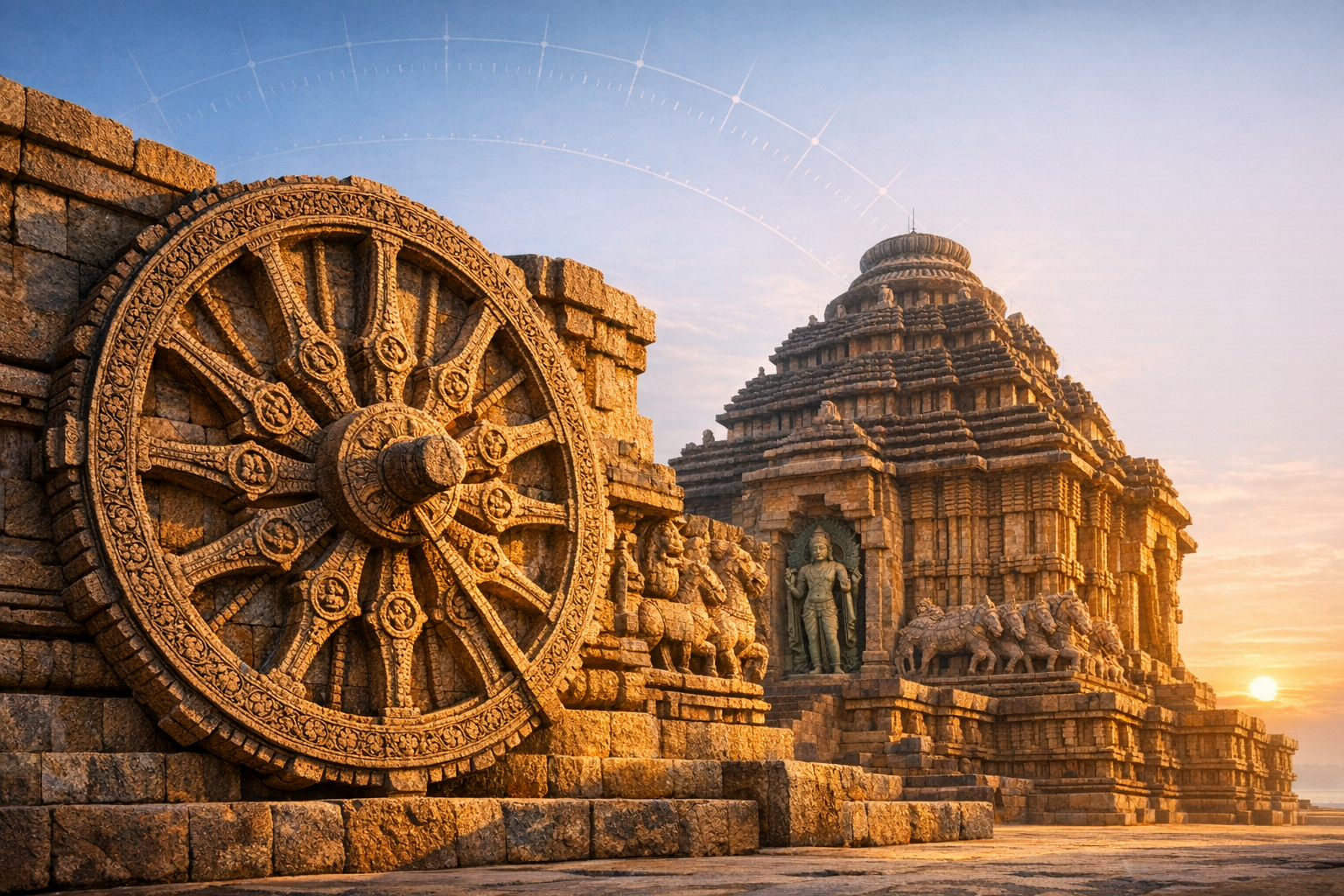
Konark Sun Temple, a 13th-century sanctuary dedicated to Lord Surya, stands at Konark, approximately 35 kilometres from Puri in Odisha. Commissioned by Eastern Ganga monarch Narasimhadeva I and substantially completed around 1250 CE, the monument synthesizes architecture, sculpture, astronomy, and devotion into one of the most studied examples of Kalinga architecture. Recognized as a UNESCO World Heritage Site, the complex continues to illuminate the history of ancient India and the artistic excellence of Odisha.
Positioned close to the Bay of Bengal, the temple faces due east to catch the first light of dawn, an orientation that underlines its solar dedication. The coastline, shifting sands, and the now-vanished course of the Chandrabhaga River frame the temple’s sacred geography and help explain both its original majesty and later conservation challenges.
Epigraphic and literary traditions attribute the project to Narasimhadeva I (r. c. 1238–1264), whose court patronized ambitious temple building after the consolidation of Kalinga. The Konark program is frequently interpreted as a statement of royal dharma—celebrating good governance, prosperity, and the triumph of order—integrated with the broader religious landscape that also includes Jagannath at Puri and Lingaraja at Bhubaneswar.
The masterplan famously visualizes the Sun God’s chariot in stone: seven straining horses drag a colossal platform ringed by twenty-four elaborately carved wheels. Each wheel measures roughly three meters in diameter and bears hubs, spokes, and minute rim markings. In the Kalinga typology, the now-ruined main sanctuary (rekha-deul) rose above the sanctum, the pyramidal assembly hall (jagamohana) survives substantially, and the open-air dance pavilion (natamandira) and ancillary structures articulate processional space across the complex.
Sculptural programs across plinths and walls move from the cosmic to the quotidian—processions, musicians, dancers, celestial beings, mithuna couples, wildlife, and narrative panels—mirroring the unity of sacred and social life in medieval Odisha. Three principal images of Surya, carved in chlorite and placed to receive light at different times of day, articulate the diurnal journey of the deity. The icon of Surya in high boots and a waist-belt recalls transregional aesthetic currents that had entered the subcontinent centuries earlier, yet is wholly absorbed into a local idiom.
Materials and structural systems reveal sophisticated engineering. Builders worked primarily with khondalite for wall masses, laterite in cores, and chlorite for doorframes and statuary requiring fine detail. Iron cramps and dowels knit stones into a resilient shell, while corbelled courses form soaring roofs in the jagamohana. The joinery, load distribution, and water-shedding profiles collectively demonstrate deep empirical knowledge of coastal climate.
The twenty-four stone wheels embody a grammar of time that scholars associate with ancient Indian astronomy. With eight principal spokes and subsidiary markings on the rims, individual wheels can be read as sundials when a vertical object casts a shadow, offering an experiential interface with the movement of the sun. The pairing of twelve daytime and twelve nighttime hours across the twenty-four wheels resonates with calendrical thinking, prahar divisions, and the cyclical logic central to dharmic cosmology.
This architectural timekeeping sits within longer scientific lineages that include the Surya Siddhanta and allied astronomical canons. While the temple is not an observatory in the modern sense, its alignments, reliefs, and modular proportions demonstrate a lived astronomy—celestial geometry encoded in stone so that devotees, artisans, and learned visitors could contemplate cosmic order alongside ritual practice.
Konark forms, with Bhubaneswar and Puri, a sacred triangle that many travelers to Odisha follow: Shiva (Lingaraja), Vishnu-Jagannath, and Surya. The triad symbolizes complementarity across sects and schools within the broader fold of Sanatana Dharma, reinforcing a cultural synergy in which multiple paths converge without erasing difference.
Ritual life continues to animate the site and its environs. During Magha Saptami, thousands gather at nearby Chandrabhaga beach before sunrise to take a holy dip and offer arghya to the rising sun, a practice that connects Vedic hymns, Ayurvedic regard for sunlight, and daily observances such as Surya Namaskar. The festival’s cadence underscores how the ‘Significance of Konark Sun Temple’ lies as much in living practice as in historic masonry.
Konark is equally a crucible of the performing arts. The open-air natamandira evokes the historical presence of maharis (temple dancers) and the evolution of Odissi, while the annual Konark Dance Festival gathers practitioners and audiences in a celebration of movement, rhythm, and bhava framed by the monumental backdrop.
Solar symbolism at Konark communicates across dharmic traditions. In Buddhism, metaphors of luminosity and the figure of Vairocana express radiant awareness; in Jain thought, the wheel’s cyclical time (kāla) and ethical clarity echo the chariot’s spokes of order; in Sikh scripture, verses such as “Gagan mai thaal, rav chand deepak” visualize the cosmos as a ceremonial lamp where the sun and moon are lights. Such resonances encourage a shared reverence for light, knowledge, and compassion—values that bind Hinduism, Buddhism, Jainism, and Sikhism in civilizational dialogue.
Regional memory preserves legends that humanize the colossal enterprise. The poignant tale of Dharmapada—an extraordinarily gifted youth who solved a crucial engineering problem and then sacrificed himself to save the workforce—speaks to the ethical imagination of the community. Another popular story recounts a massive lodestone at the temple’s summit that purportedly affected passing ships’ compasses; while unverified, it reflects the maritime milieu of Odisha and the awe Konark has inspired.
The temple’s partial ruin is the outcome of multiple forces: coastal storms, salt-laden winds, vegetation ingress, foundation distress in a shifting littoral zone, and periods of neglect. By the early twentieth century, the jagamohana threatened to collapse; the Archaeological Survey of India stabilized it with a protective sand fill and later introduced systematic documentation, desalination, and stone-consolidation programs. Inscription as a UNESCO World Heritage Site in 1984 catalyzed further conservation, including laser scanning, structural health monitoring, and research into the weathering behavior of khondalite.
For many visitors, time slows beside a wheel as fingers trace chisel marks left seven centuries ago and a shadow edges across a spoke. The experience is both scholarly and intimate—an encounter with proportions, iconography, and craftsmanship that invites reflection on how societies align ethical life with cosmic rhythms. Responsible visitation—respecting boundaries, minimizing touch on fragile carvings, and supporting heritage-friendly practices—helps ensure that this living classroom endures.
In sum, the Konark Sun Temple is an architectural masterpiece, a cosmogram in stone, and a beacon of unity. It fuses Kalinga architecture, ancient Indian astronomy, and devotional aesthetics into a coherent whole whose message is clear: the journey of the sun mirrors the journey toward insight. In honoring Surya at Konark, the civilization of Odisha offered the world a rigorously engineered, exquisitely carved meditation on time, light, and shared human aspiration.
Inspired by this post on Hindu Pad.







Leave a Reply
You must be logged in to post a comment.