Varanasi, also known as Kashi or Banaras, has long been celebrated as a city where sacred memory, ritual practice, and living devotion intersect. Within its intricate lanes resides the Kaudi Mata Temple, a modest yet profoundly cherished shrine for countless pilgrimsparticularly those from South Indiawho revere Kaudi Mata as a manifestation of Goddess Lakshmi and, in a distinctive local tradition, the sister of Lord Kashi Vishwanath. This temple’s quiet radiance mirrors the timeless spirit of another formative narrative in the Dharmic world: the devotion of Shabari in the Ramayana. Placed side by side, these two strandsKaudi Mata’s veneration and Shabari’s bhaktireveal how Varanasi’s sacred geography and the Ramayana’s ethical imagination together nurture a culture of spiritual equality, inclusivity, and unity-in-diversity across Dharmic traditions.
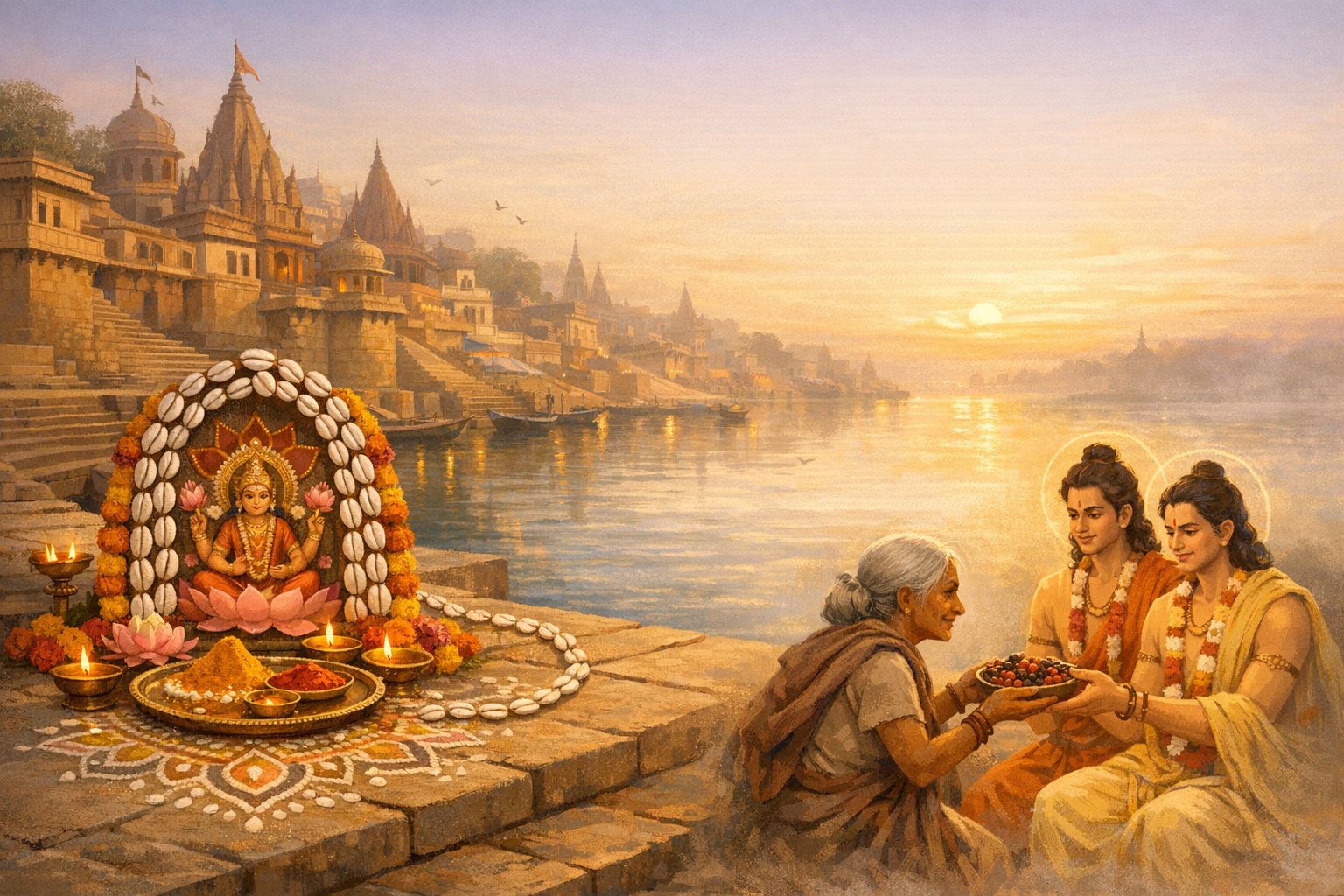
The name “Kaudi” evokes the cowrie shell, a traditional symbol of fortune and exchange once used as currency across large swathes of the subcontinent. In popular aesthetics and ritual symbolism, cowries appear alongside lotus motifs, turmeric, and kumkum during Lakshmi worshipsigns of auspiciousness and prosperity. Kaudi Mata, venerated as a Lakshmi svarupa, is thus associated in local memory with guardianship over everyday well-being, resourcefulness, and household prosperity. In Varanasi’s enduring devotional ecosystem, this form resonates particularly with South Indian pilgrims, whose own domestic and temple observancessuch as Varalakshmi Vrata and Karthika Masam practicesnaturally harmonize with the altar of Kaudi Mata.
Devotees often place cowries near the murti, offer simple naivedyam, and light lamps on Fridaystraditionally considered auspicious for Lakshmi worshipand during Deepavali and Dhanteras. These acts weave Kaudi Mata’s shrine into the larger Varanasi pilgrimage that typically includes darshan at Kashi Vishwanath, Annapurna Devi, Vishalakshi, and Kalabhairava. The Kaudi Mata Temple stands as a gentle reminder that Kashi’s spiritual experience is not limited to monumental shrines alone; it also flowers in the city’s countless intimate sanctums where community memory, household ritual, and regional traditions find a shared and welcoming home.
Local lore that regards Kaudi Mata as the sister of Kashi Vishwanath underlines a distinctly Kashi-like way of understanding sacred relationships. Rather than rigid theological formalism, Varanasi often foregrounds family metaphors and kinship idioms to describe the divine network of deities who inhabit the city. This idiom fosters spiritual intimacy and accessibility: the divine is not distant but kinone who understands, protects, and participates in the rhythms of everyday life. Such language also creates interpretive space for multiple forms of devotion to coexist, welcoming diverse Ishta-devata preferences without contradiction.
Within the broader Dharmic imagination, the narrative of Shabari in the Ramayana offers a complementary lens on spiritual equality. In Valmiki’s telling and in later retellings such as the Kamba Ramayanam and the Ramcharitmanas, Shabarian ascetic disciple in the hermitage of Matanga Rishi near Pampa Sarovarspends years in humble service and unwavering anticipation of Sri Rama’s arrival. When Rama and Lakshmana reach her ashram during their search for Sita, Shabari’s offering of forest berriestasted to ensure only the sweetest are servedbecomes a luminous emblem of bhakti where intention, love, and purity of heart outweigh formal ritual boundaries.
This episode, simple on the surface, is philosophically dense. It dramatizes the principle that the essence of dharma is not exhausted by external formalities; rather, it is animated by shraddha (faith) and bhava (devotional sentiment). Shri Rama’s acceptance of Shabari’s offeringcontrary to expectations shaped exclusively by external markers of status or ritual protocolreorients the reader toward a deeply ethical center of gravity: compassion, humility, sincerity, and inner cleanliness. In this sense, the Shabari narrative functions as a canonical statement of spiritual egalitarianism within the Ramayana’s moral universe.
Placed alongside the Kaudi Mata tradition, Shabari’s story underscores a shared insight: divine grace is not rationed by social standing, script, or geography. Just as Kaudi Mata’s shrine welcomes pilgrims from South India and beyond into a Lakshmi-centered ritual of household well-being, Shabari’s encounter reveals that the gates of Rama’s compassion open wherever devotion is authentic and self-effacing. Both strands, in their distinct registersone temple-centered, one narrative-centeredconverge on the same horizon: universal accessibility to the sacred.
In the living practice of Kashi, this inclusivity is not an abstract slogan but a practical ethos. The city’s pilgrimsfrom Tamil Nadu, Karnataka, Andhra Pradesh, Telangana, Kerala, and across the Hindi heartlandfollow overlapping routes, share prasada, exchange songs and stories, and participate in one another’s rituals with reverence. Mathas and dharmashalas maintained by communities from across Bharat further sustain this web, making Kashi a meeting place where regional textures are preserved even as a larger, pan-Indian devotional grammar emerges. The Kaudi Mata Temple participates in precisely this grammara gentle node in a vast network of sanctity.
Thematically, Kaudi Mata’s association with prosperity and Shabari’s offering of sweetness circle back to a common symbol: the rasa (taste) of devotion. In aesthetics and scripture alike, rasa is not merely sensory; it is a distilled experience through which the inner world touches the divine. The cowriesign of Lakshmi’s abundancesignals a caring order that dignifies everyday life; Shabari’s sweet berries symbolize the devotee’s yearning to give the very best to the Beloved. Both gestures illuminate a single insight: dharma ennobles ordinary materials and actions when animated by love and responsibility.
For contemporary readers and pilgrims, these narratives offer concrete guidance. In homes and temples, small daily observanceslighting a lamp on Fridays, offering a handful of grains on Dhanteras, reciting Sri Lakshmi Ashtottara, or reading a few verses from the Ramayanacan anchor ethical intention to regular practice. Similarly, cultivating hospitality, sharing food without hierarchy, and greeting fellow pilgrims with respect are direct continuations of the Shabari principle: the sacred is measured by care, not display.
These insights resonate across Dharmic traditions. In Buddhism, humility and dana (generosity) frame the lay path, reminding practitioners that intention precedes form. In Jainism, ethics of ahimsa and aparigraha dignify simplicity and mindful restraint, aligning closely with Shabari’s self-effacing service. In Sikhism, langar institutionalizes equality in practice, translating the spirit of non-discrimination into a daily, communal experience. The Kaudi Mata–Shabari tapestry thus offers a shared Dharmic grammardiverse in expression yet unified in purposerooted in compassion, responsibility, and reverence for every seeker’s dignity.
From an interpretive perspective, the Kaudi Mata tradition in Kashi also illuminates the concept of Ishta in Hindu philosophy: the freedom to approach the One through a chosen form, name, or path that aligns with temperament, lineage, and regional culture. For some, Ishta may be Sri Rama; for others, Goddess Lakshmi as Kaudi Mata or Annapurna Devi; for yet others, Vishalakshi, Shiva, or Kalabhairava. Kashi’s sacred ecology demonstrates that these diverse choices do not fracture unity; rather, they enrich it by enabling genuine participation rooted in familiarity and love.
South Indian pilgrims in particular have long found Kashi spiritually legible. Familiar puja paddhatis, availability of archakas conversant in different regional liturgies, and kinship ties between Varanasi mathas and Southern institutions all ease the transition from regional temple culture to Kashi’s broader sacred sphere. The Kaudi Mata Temple’s idiom of Lakshmi devotioncowries, lamps, turmeric, and kumkumthus feels immediately at home to those raised in devotional environments shaped by Varalakshmi Vrata, Fridays dedicated to Thiru Lakshmi, or Karthika Masam lamp-lighting traditions.
In narratological terms, Shabari’s story is often read as a threshold episode: a point where Rama’s journey toward Lanka acquires its ethical “north.” Through the acceptance of Shabari’s offering, the text reframes power not as force but as openness to devotion. This reframing has inspired centuries of bhakti poetry and practice, from songs that celebrate the Lord who chooses love over protocol to rituals that prioritize inclusion over display. Such motifs continue to inform how devotees in Kashi and elsewhere conceive of spiritual excellence: as kindness made consistent.
For those planning a Varanasi pilgrimage with an interest in the Kaudi Mata tradition, a thoughtful route might include darshan at Kashi Vishwanath, Annapurna Devi, Vishalakshi, and Kalabhairava, followed by visits to smaller shrines like Kaudi Mata that embody the city’s intimate devotional life. Many travelers integrate daily readings from the Ramayanaparticularly the Shabari episodeinto their itinerary, allowing the narrative’s ethical contour to shape the mood of their yatra. In this way, the pilgrimage becomes not only geographic movement but also moral alignment.
The historical arc of Kashi reinforces this synthesis of grandeur and intimacy. While major temples have risen, fallen, and been renewed across centuries, smaller shrinesmaintained by local families, guilds, or pilgrim trustshave preserved living lineages of practice. The Kaudi Mata Temple exemplifies how these micro-shrines can carry macro-meanings: sustaining household religion, cultivating inter-regional ties, and offering a doorway into a Lakshmi-centered ethic that dignifies work, caregiving, and community life.
Philosophically, both Kaudi Mata’s veneration and Shabari’s bhakti nourish a vision of society where worth is not assessed by wealth, caste, or scholarship alone, but by sincerity and service. This is consonant with the wider Dharmic affirmationVasudhaiva Kutumbakamthat sees the world as one family. The Kaudi Mata–Shabari pairing, therefore, serves not just as devotional inspiration but as a civic ethic: prosperity tempered by compassion, ritual refined by humility, and diversity held together by a shared commitment to dignity for all.
For students of religion and culture, the interweaving of a Varanasi temple tradition with a Ramayana episode illustrates how textual memory and spatial practice co-create meaning. The Kaudi Mata Temple is more than a site; it is a hermeneutic lens through which devotees read the city’s moral landscape. Likewise, Shabari’s story is more than an episode; it is a living script that informs how devotees approach darshan, offering, and fellowship. Together, they provide a framework to understand how Hindu Stories remain dynamically anchored in place, practice, and community.
In conclusion, Kaudi Mata of Varanasi and the eternal devotion of Shabari illuminate a shared teaching with contemporary relevance: spiritual life is strongest when prosperity serves compassion, when ritual welcomes humility, and when diversity of Ishta is embraced as a strength, not a challenge. This vision, long cultivated in Kashi’s lanes and in the Ramayana’s verses, continues to inspire unity across Hinduism, Buddhism, Jainism, and Sikhismeach tradition affirming, in its own voice, that the path to the sacred is open to all who walk it with love and responsibility.
Inspired by this post on Hindu Blog.