-
Divine Fury, Compassionate Shelter: Nakhayudha—Sacred Claws of Narasimha in Hindu Iconography

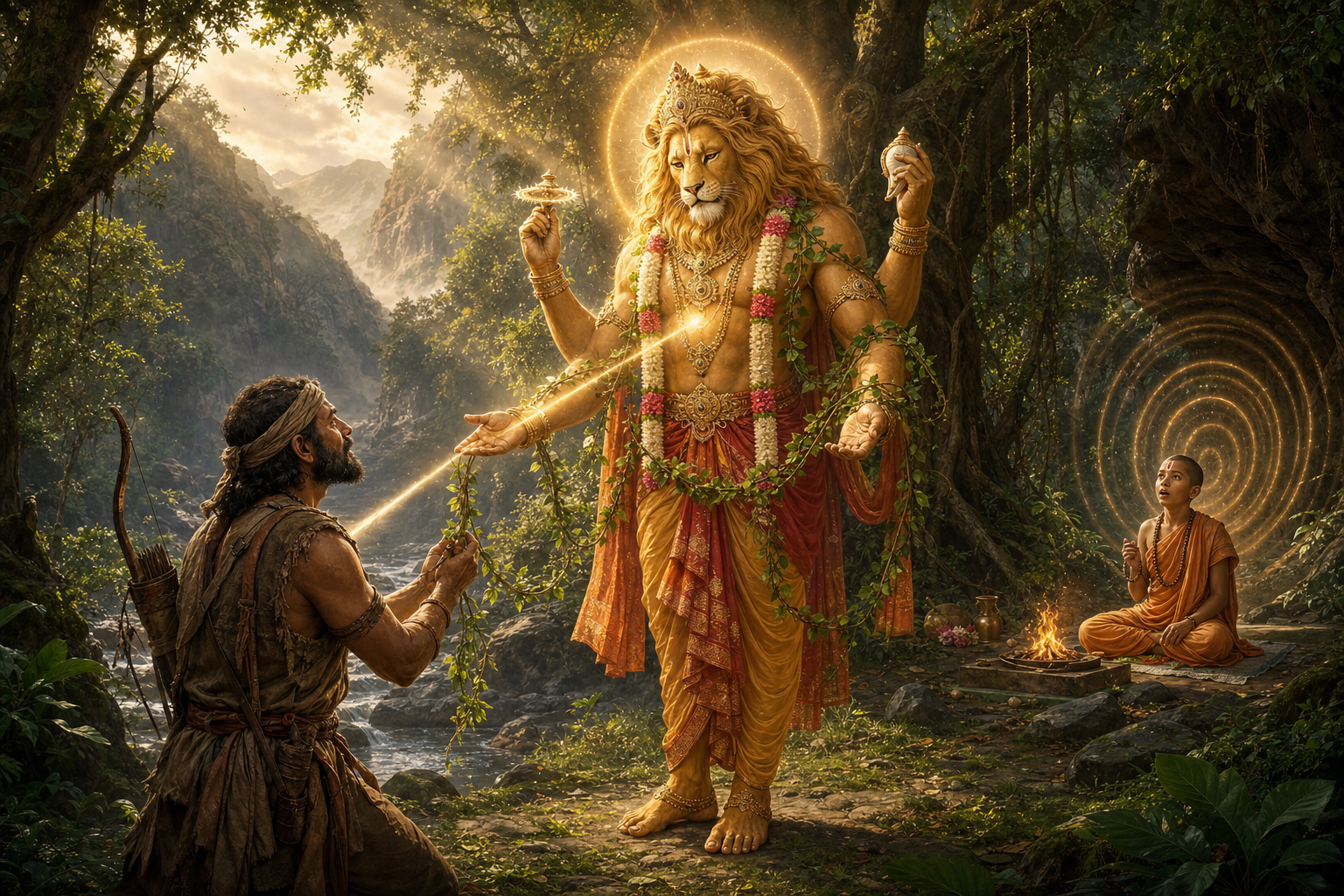
Nakhayudha—the sacred claws of Narasimha—embodies a unique class of natural, non-forged weaponry in Hindu iconography, expressing spontaneous divine protection without reliance on manufactured arms. This long-form exploration clarifies the mythic logic behind Hiranyakashipu’s boon and shows how Narasimha’s claws resolve each clause through liminality. It decodes the visual grammar defined by Shilpa Shastra and Vaishnava…
-
Revealing the Fifth Chapter: Sudarshana Chakra in Nrisimha Tapaniya Upanishad—Sacred Geometry and Dhyana

The Nrisimha Tapaniya Upanishad’s fifth chapter elevates Sudarshana Chakra from a divine symbol to a precise contemplative technology that unites mantra, yantra, and dhyana. By presenting the Chakra as a pivot of “auspicious seeing,” it refines attention, stabilizes ethical intent, and supports protective clarity in daily life. The analysis explains core mantras—including the Nṛsiṁha and…
-
Trust in Krishna’s Protection and the Dharma of Duty: Srila Prabhupada on Nrsimhadeva

This article analyzes the Vaishnava synthesis of divine protection and human duty through Srila Prabhupada’s assurance regarding prayers to Nrsimhadeva. It explains how confidence in Krishna’s guardianship aligns with the Bhagavad Gita’s ethics of disciplined action without attachment to results. It clarifies that surrender is not fatalism but a stance that deepens responsibility, courage, and…
-
Decoding the Fourth Khanda of Nrisimha Tapaniya Upanishad: Protective Mantra, Dhyana, Relevance

The Nrisimha Tapaniya Upanishad’s Purva section reaches practical culmination in its Fourth Khanda, which integrates mantra, nyasa, and dhyana into a coherent path of protection and insight. It presents the Nṛsiṁha Gāyatrī and allied formulas as tools that refine attention and dissolve fear at its root. The Khanda’s nyasa anchors awareness in the body, while…
-
Decoding the Fiery Compassion: A Deep Dive into the Third Chapter of Nrisimha Tapaniya Upanishad

The third chapter of the Nrisimha Tapaniya Upanishad unifies mantra, meditation, and Vedanta into a coherent path of fierce compassion and fearless insight. This deep dive decodes the Nrisimha mantraraja, explicates the bija kṣrauṁ, and clarifies how nyasa sacralizes the body as a field of realization. Readers gain a rigorous yet accessible guide to practice…
-
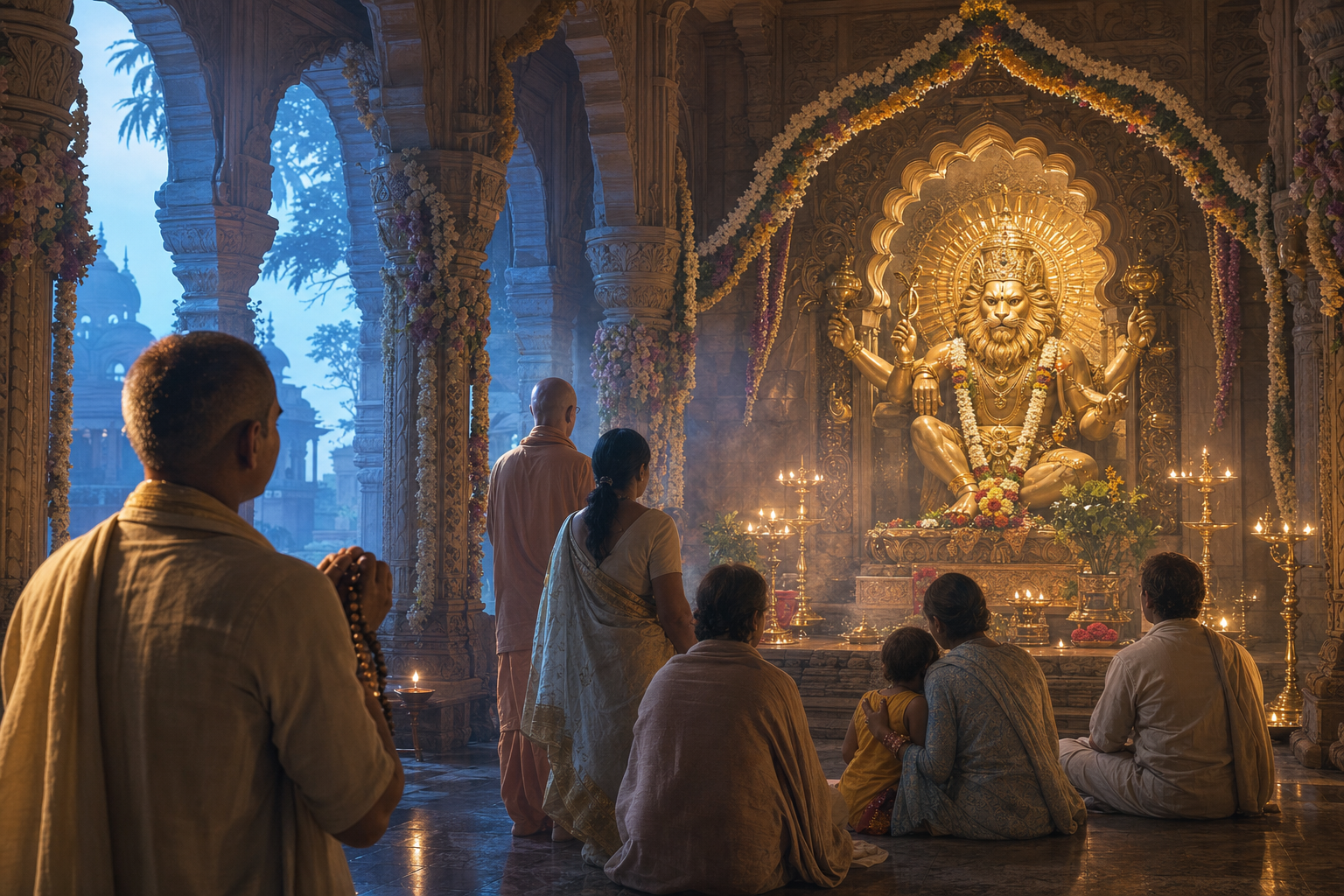
Awe-Inspiring Padalathri Narasimhar Temple: Pallava Rock-Cut Sanctum at Singaperumal Koil

Padalathri Narasimhar Temple (Singaperumal Koil) near Chennai is a rare Pallava-era rock-cut Vaishnava sanctuary carved into a red hill, with Lord Narasimha and Ahobilavalli Thayar presiding. The 8th‑century CE cave sanctum, later Dravidian additions, and continuous worship offer a compact study in South Indian temple architecture and living heritage. Devotees consistently describe the ascent as…
-
Decoding Nrisimha Tapaniya Upanishad: The Transformative Power of the Second Khanda Mantra

The second khanda of the Nrisimha Tapaniya Upanishad offers a rigorous account of mantra potency in the Tantric Vaishnava tradition. It presents the Nrisimha bija kṣrauṁ as the energetic heart of protective wisdom and details how dhyana, nyasa, and japa integrate to transform attention and behavior. Readers gain historical and philological context for the Upanishad’s…
-
Decoding the First Khanda of Nrisimha Tapaniya: Cosmogony, Anustubh Metre, Fearless Mantra Power

The first khanda of the Nrisimha Tapaniya Upanishad fuses cosmogony with mantra science in the anustubh metre, presenting a disciplined pathway from fear to fearless compassion. Readers gain a clear sense of the text’s Atharvavedic affiliations, its layered pedagogy (phonetics, metre, and meaning), and its integrative practice model involving japa, nyasa, and contemplative visualization. The…
-
Śrīmad Bhāgavatam 3.22.28 and Nṛsiṁha Caturdaśī: Timeless Dharma, Protective Grace, and Bhakti Power

Śrīmad Bhāgavatam 3.22.28 situates household vows within a God-centered ethic, showing how domestic life becomes a disciplined path of bhakti-yoga. Read alongside the devotional mood of Nṛsiṁha Caturdaśī, the verse underscores a unified principle: sincere vows invite protective grace. The Prahlāda–Nṛsiṁha narrative exemplifies devotion under trial and the Lord’s compassionate precision in safeguarding truth. Practical…
-
Mercy Beyond Boundaries: How Lord Narasimha’s Mayapur Grace Answers Prayers Through Nama

This article explores a widely shared testimony of Lord Nrisimhadeva’s mercy at ISKCON Mayapur, showing how, within Vaishnava theology, grace is believed to extend even beyond formal devotional identity. It situates the couple’s experience—pilgrimage, vrata, and heartfelt surrender on Nrisimha Caturdasi—in the broader bhakti framework that emphasizes the transformative power of nama. It explains how…
-
When the Deity Answers: An Offering, a Prayer, and the Astonishing Grace of Lord Narasimha

A devotee couple offered a crystal necklace to Lord Nrsimhadev and, after a simple prayer for guidance, found the Deity adorned with the same ornament the very next day. This account—situated within Vaishnava temple practice and the Bhakti Tradition—illustrates how ritual protocol, theological principles of reciprocity, and lived devotion intersect. The piece explains why offered…
-
When Devotion Meets Divinity: How Lord Nrsimhadeva’s Grace Manifests in Real Time

Across Sanatana Dharma, testimonies surrounding Lord Nrsimhadeva in Mayapur suggest that sincere petitions often meet with remarkable immediacy. This piece situates such “lilas” within a careful academic framework that distinguishes the authority of sastras from the experiential value of testimony. It explains how Bhakti Tradition principles—intention (sankalpa), remembrance, and mantra—shape perceptions of instant reciprocation, anchored…
-
Unraveling Nrsimhadev’s Missing Jewels: Sacred Trust, Heritage Security, and Hope

A sudden, disorienting phone call while abroad—“heart attack”—captures the vulnerability communities feel when sacred jewels of Nrsimhadev are reported missing. This analysis reframes the mystery as a call to stewardship, integrating ritual integrity with modern heritage preservation and temple security. Readers gain a practical blueprint: clear governance and SOPs, meticulous inventories with high-resolution documentation, conservative…
-
Fierce Compassion on Narasimha Caturdashi: Dharma’s Triumph, Prahlada’s Faith, Rituals and Meaning

Narasimha Caturdashi (Narasimha Jayanti) commemorates the man-lion avatara of Vishnu who restores dharma while protecting steadfast devotees, as outlined in the Bhagavad-gita’s verses on divine intervention. The Prahlada narrative from the Bhagavata Purana illustrates unwavering bhakti in the face of authoritarian suppression, framed not as sectarian conflict but as a timeless lesson in ethical resilience.…
-
Narasimha Iconography Decoded: Forms, Symbols, and Sacred Meanings in Hindu Temple Art

This long-form guide decodes the iconography of Narasimha—Hinduism’s half-lion, half-man avatar of Vishnu—across textual sources, temple sculpture, and living ritual. It details the major forms (Ugra/Kevala, Lakshmi-Narasimha, Yoga-Narasimha, Jvala/Krodha), their attributes and mudras, and how Shilpa Shastras and Agamas govern measurements and aesthetics. Readers learn to recognize narrative panels (pillar-theophany, twilight justice) and to interpret…
-
Narasimha Chaturdashi (Narasimha Jayanti) 2026: Date, Puja Timings, Rituals, and Deep Significance

Narasimha Chaturdashi (Narasimha Jayanti) in 2026 falls on April 30, aligned with Vaishakha Shukla Chaturdashi in the Hindu calendar. This comprehensive guide clarifies how to choose the correct observance day using the Madhyahna window, why parāṇa is taken after sunrise the next morning, and how regional panchang differences affect timing. It details a practical home…
-
Nrusimha Navaratri 2026: Definitive Dates, Daily Puja, Muhurtas, and Narasimha Jayanti Insights

Nrusimha Navaratri 2026 runs from 22 to 30 April, concluding with Narasimha Jayanti on Vaishakha Shukla Chaturdashi. This guide explains the lunar-tithi basis of the festival, how to align worship with local Panchang, and when to choose madhyahna or pradosha muhurta. It outlines a complete home puja vidhi, widely recited mantras and stotras, and practical…