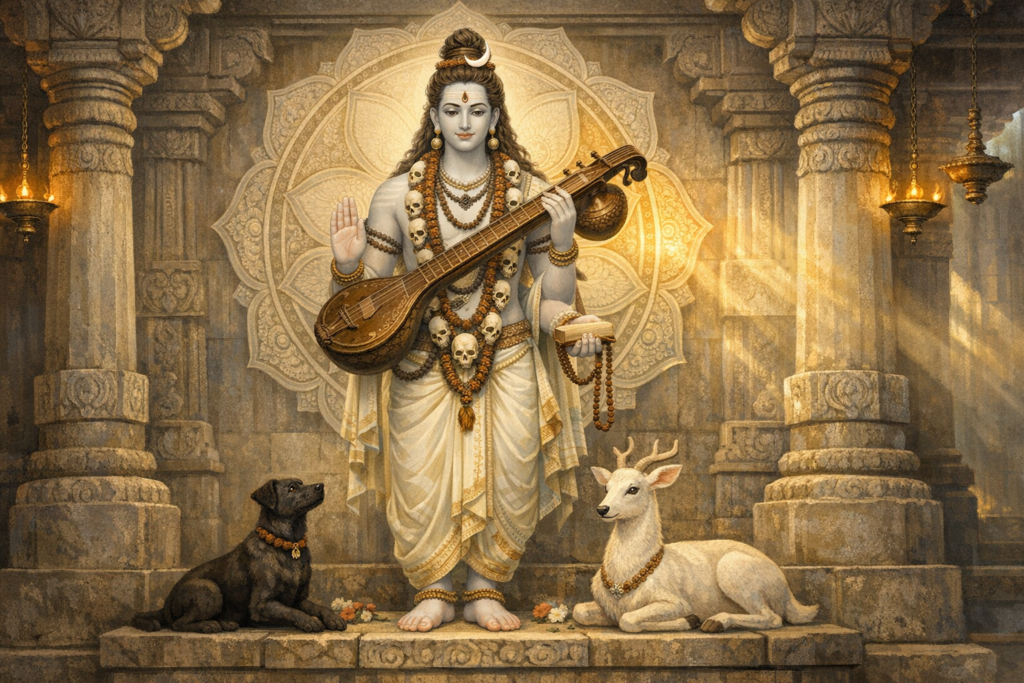
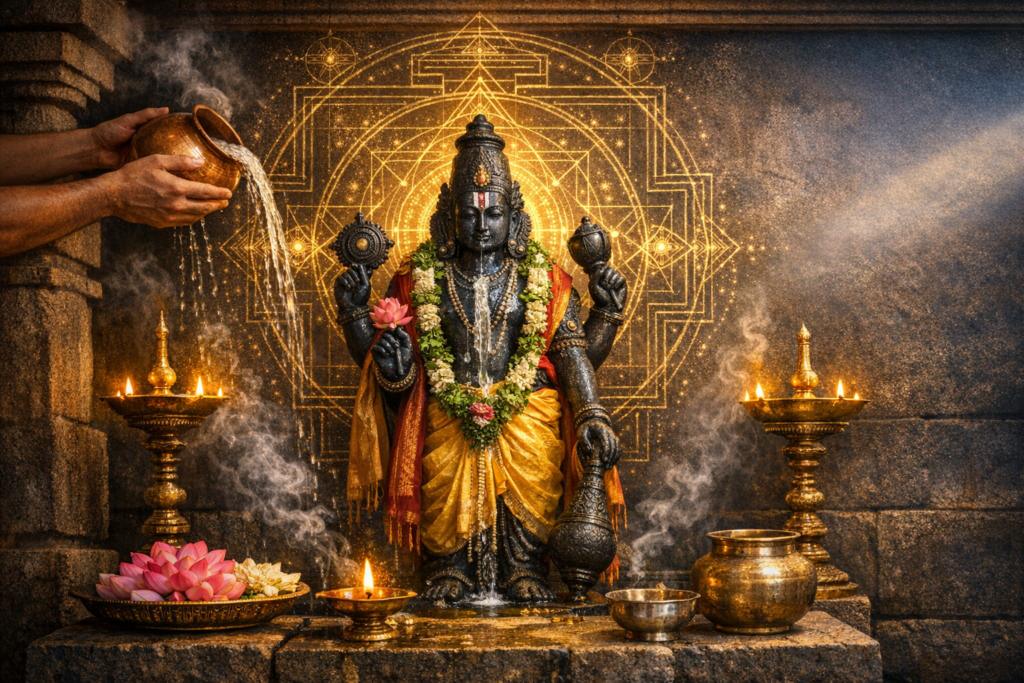
In Hindu mythology, few images are as astonishing—and as symbolically dense—as Sage Agastya raising a palmful of seawater and drinking the ocean dry. Read as part of the Vedic–Puranic vision of rta (cosmic order), this act is not spectacle but system repair. Placed alongside Bhagiratha’s penance and Ganga’s descent (Ganga avatara), the narrative discloses a single arc of disruption and restoration: adharma accumulates, the balance tilts, and sages, devas, and sacred waters act together to recalibrate the world.
At the heart of these interlinked episodes stands rta, the primordial principle invoked already in the Rg Veda as the law undergirding cosmos, seasons, speech, and moral life. Later expressed through the wide canopy of dharma, rta is safeguarded not by a solitary hero but by a choreography of powers—rishis through tapas, devas through valor ordered by ethics, and rivers through purity that sanctifies and sustains. In this ecology of order, Agastya and Ganga operate as complementary forces: yogic containment and compassionate release.
Sage Agastya, counted among the Sapta Rishis, is remembered in both northern and southern traditions—as Vedic seer, culture-bearer, and stabilizer of Earth’s equilibrium. Hymnic attributions in the Vedic corpus, the arresting of the Vindhya range’s upward surge, the southward journey to steady the world during Shiva–Parvati’s wedding, and the transmission of refined grammar and ritual to the Tamil country all converge on a single throughline: Agastya’s tapas functions as ballast for a world prone to imbalance.
The episode of ocean-drinking (samudra-pana) appears across Puranic and Itihasa traditions, with notable allusions in the Ramayana where even the Ocean (Samudra) recalls Agastya’s formidable ascetic power. In Purana retellings, the devas are imperiled by the Kalakeyas, a clan of asuras who, using the sea as a fortress, launch disruptive attacks yet remain unreachable. Warfare in such narratives is never merely strategic; it is moral hydraulics, requiring the right form of power, applied at the right locus, to drain the conditions that incubate disorder.
Invited by the devas to intervene, Agastya undertakes an act that only tapas can authorize: he drinks the ocean’s waters, not in anger but in service of rta, exposing the Kalakeyas to the rule of law. With the concealment removed, the devas defeat the asuric threat. Crucially, many tellings note that the waters do not immediately return to their former plenitude. This narrative hinge opens the way for a second, equally consequential intervention: the descent of Ganga.
The Ganga avatara is framed by another crisis: King Sagara’s sixty thousand sons, reduced to ash by the seer Kapila’s tapas, await liberation. Bhagiratha’s sustained austerity compels Shiva to receive Ganga in his matted hair, diffusing the river’s otherwise devastating force and channeling it into compassion. As Ganga traverses the terrestrial plane, she becomes Bhagirathi—the sanctifying current that, by touching the ashes, grants the departed their release and by reaching the sea, restores Earth’s hydrological wholeness.
Read together, these strands yield a coherent sequence across texts such as the Ramayana, the Mahabharata, and the Puranas: Agastya’s yogic containment dries the sea to reveal a hidden threat; Bhagiratha’s devotion invites Ganga’s merciful descent to heal ancestral suffering and, in many retellings, to re-fill the sea itself. Containment and release—two aspects of tapas and karuna—form a dialectic of restoration. Where ascetic energy constricts the field so truth can be seen, the river’s compassion expands the field so life can flow rightly again.
This dialectic illuminates why the tradition repeatedly casts sages and rivers as co-actors. Rivers are living beings in Hindu scriptures, their sanctity woven into ritual, law, and pilgrimage; sages are living instruments of discernment, their tapas the concentrating lens that burns through illusion. Together, they prosecute the pattern by which rta is recovered when violated: unveil the concealed, adjudicate the imbalance, and re-saturate the world with order.
The Agastya cycle extends beyond the sea-drinking motif to other acts of balancing. The Vindhya’s arrested ascent, sustained by a promise Agastya never rescinds, preserves North–South passage and cultural exchange. In Shaiva lore, when the northern hemisphere tilts under the weight of Shiva’s wedding assembly, Agastya moves south to stabilize Earth—a cosmogram of equilibrium through mindful presence. Even in temple memory—from the Tamil country to shrines such as Agastheeswara—Agastya’s name marks the geography of steadiness.
Symbolically, Agastya’s ocean-drinking is yogic pratyahara writ cosmic: the senses of the world withdraw so that what festers in the depths (the Kalakeyas as unregulated impulses) can be seen and resolved. Ganga’s descent is the complementary outflow, akin to anubhava of grace: after discipline has clarified the field, compassion irrigates it. The sea that is drunk in discipline is given back in mercy. Rta is thus not a static law but a living balance between firmness and tenderness.
From an interpretive-historical vantage, these stories also preserve an early intuition of interconnected waters. Hymns and narratives consistently treat rivers, rains, and seas as a single cycle under divine stewardship, with Varuna and Surya signifying governance of the waters. The mythic grammar allows cosmology, ethics, and ecology to be expressed in a shared idiom: when adharma blocks the currents of life, the waters recede; when dharma is restored, the currents return.
Across dharmic traditions, the imagery converges. Buddhism often speaks of the “ocean of samsara” to be crossed by wisdom and compassion; Jainism frames the tirtha as a ford—an ethical crossing crafted by Tirthankaras through restraint and insight; Sikh practice centers on remembrance (nam) that purifies like a living river, with sarovars enacting communal sanctification. In each case, discipline unveils, compassion restores. The Agastya–Ganga tandem belongs to this shared civilizational language of balance.
This unity matters today not only theologically but civically. Treating rivers as living beings—as Ganga is treated in Hindu scriptures—suggests a jurisprudence and ethic of care aligned with environmental stewardship. The story prefacing Ganga’s descent reminds that moral disorder has ecological correlates and that redress requires both incisive discipline (to expose harm) and generous restoration (to heal lands, waters, and communities).
The narrative’s textual matrix is broad. The Ramayana (especially Yuddha Kanda references to the Ocean’s fear of Agastya), the Mahabharata’s episodic mentions of Agastya’s powers, and Puranas such as the Skanda Purana and others enrich the motif with local color—names of asuras, ritual frames, and geographic markers that anchor cosmic drama in the subcontinent’s sacred geography. The persistence of the tale across sources signals its interpretive weight rather than a single canonical wording.
Geographically, memory-places of Agastya—hermitages, toponyms, and temples—dot the southern landscape, bearing witness to the southward transmission of Vedic learning and to the synthesis of Sanskritic and Tamil heritages. In such spaces, the ocean-drinking sage is less a miraculous outlier than a civilizational archetype: the one who steadies a world in flux so wisdom traditions can take deep root and flourish.
Placed back into the overarching arc, “When Agastya drank the ocean” becomes the hidden prologue that makes “When Ganga descended” not just possible but necessary. Agastya’s containment removes the veil; Bhagiratha’s devotion invites the cure; Shiva’s mediation tames the flood; Ganga’s sanctity restores the flow. The sea returns to itself, the ancestors find release, and rta shines again through the harmonized action of sages, gods, and sacred waters.
Read this way, the tale offers a compact syllabus for public ethics: confront what hides beneath the surface, rebalance with discipline, and then pour compassion until life can move freely. That this grammar is shared—by Hindu, Buddhist, Jain, and Sikh streams—underscores an abiding civilizational insight: unity in diversity is not a slogan but the very way balance is restored, again and again, in the moral and material worlds.
Inspired by this post on Hindu Blog.