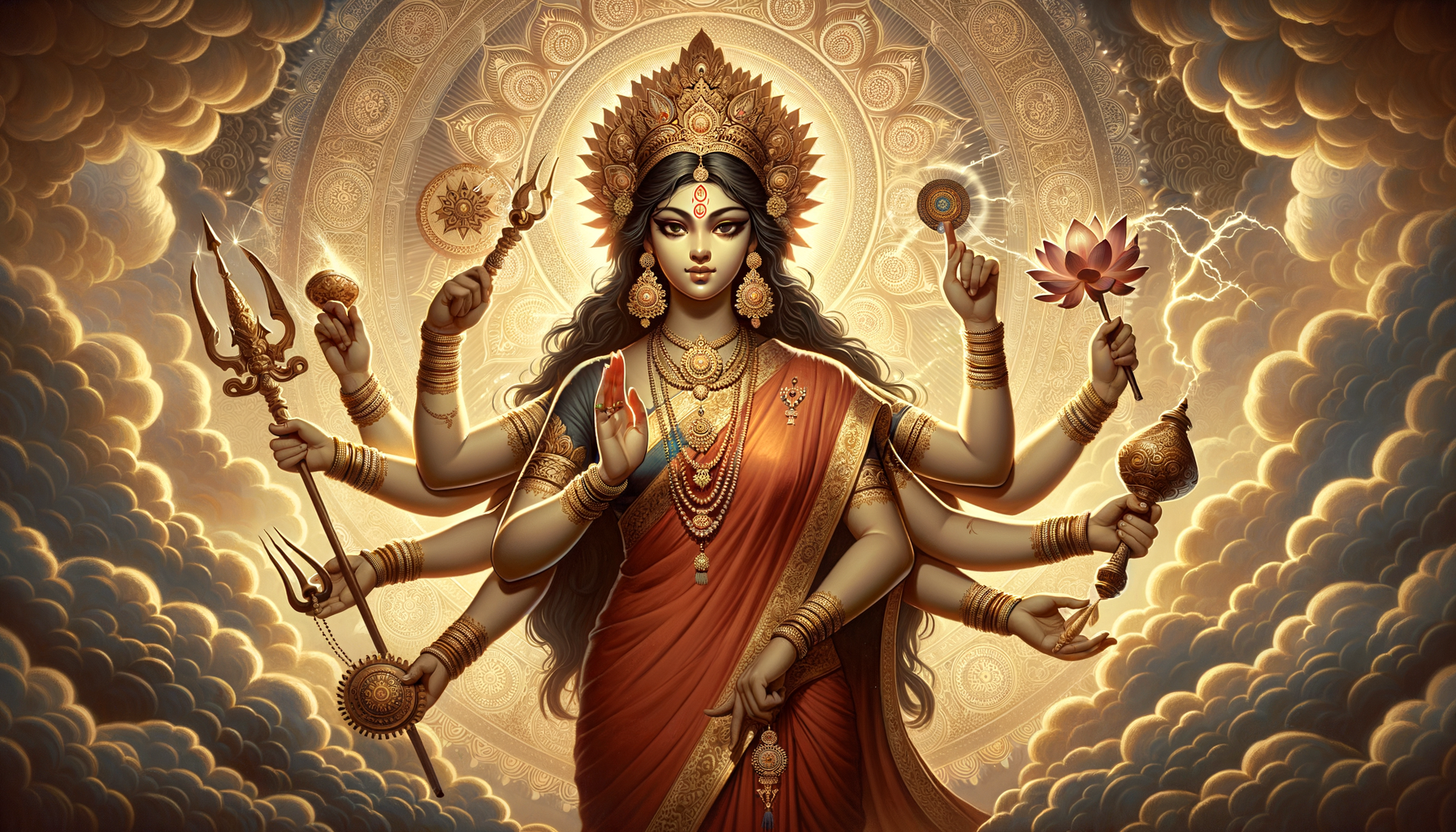
The thunderbolt (Vajra) held by Goddess Durga is among the most evocative symbols in Hindu iconography, embodying the indestructible energy of Shakti and the illuminating force of Dharma. Across the narrative of the Devi Mahatmyam in the Markandeya Purana, Durga is armed by the devas for the battle against Mahishasura; from Indra, she receives the Vajra, the celestial thunderbolt. This gift is not merely a weapon; it is a transmission of cosmic authority, clarity, and fearless compassion.
Scripturally, the Devi Mahatmyam emphasizes collective empowerment: each deity entrusts a distinctive power to the Divine Mother before the confrontation with Mahishasura, the buffalo asura, signifying the unity of the cosmos in the protection of Dharma. Indra’s offering of the Vajra infuses Durga’s mission with the essence of decisive action—lightning that pierces darkness and thunder that disperses fear. In this way, the Vajra in Durga’s hand crystallizes the shared guardianship of the gods in defense of truth and justice.
The Vajra’s lineage deepens its symbolism. In earlier Vedic and puranic traditions, Indra’s Vajra—fashioned from the selfless sacrifice of the sage Dadhichi—slays Vritra, restoring the free flow of the waters and the order of the world. When Durga wields the same power, the narrative layers converge: sacrifice, courage, and cosmic balance become facets of her protective role. The thunderbolt thus represents resolute discernment and the restoration of harmony in times of turmoil.
Symbolically, the Vajra conveys indestructibility (vajra as “diamond-hard”), sudden illumination (the flash of insight that dispels avidyā), and moral resolve (the unyielding stand against adharma). Thunder evokes the voice of Dharma—firm, clarifying, and protective—while lightning evokes the precision of insight. In the hands of Goddess Durga, these qualities become a compassionate force: power guided by wisdom and anchored in ethical responsibility.
For many devotees during Durga Puja, contemplation of the Vajra becomes a living practice: to meet injustice with courage, to shield the vulnerable, and to dispel confusion with clarity. Meditatively visualizing Durga’s Vajra can inspire steadfastness in daily life—whether confronting inner obstacles or addressing social challenges. The icon thus functions as a spiritual guide to align energy, intention, and action with Dharma.
Art and iconography across regions often depict the Vajra in one of Durga’s right hands, underscoring active protection and decisive initiative. Sculptors and painters accent the weapon’s geometry to suggest both solidity and radiant force, while liturgical recitation of the Chandi (Devi Mahatmyam) anchors the image in sound and meaning. Regional variations in depiction preserve the core symbolism: unbreakable insight marshaled for the welfare of all beings.
At a broader dharmic level, the Vajra resonates across traditions. In Vajrayana Buddhism, the Vajra (dorje) symbolizes indestructible wisdom and compassionate method. Jain teachings frequently extol vajra-like firmness in vows and ethical steadfastness. Sikh reflections on righteous courage and the defense of truth parallel the Vajra’s ethos of principled strength. While each tradition maintains its distinctive theology, the shared motif emphasizes unwavering commitment to truth, compassion, and responsibility—offering a basis for mutual respect and unity.
Contemporary relevance flows naturally from this symbolism. The Vajra in Durga’s hands invites disciplined clarity in leadership, resilience in community life, and the courage to bridge differences without compromising ethical principles. It signals power tempered by wisdom, urging collective action that is inclusive, measured, and protective of the common good—an ideal deeply consonant with the plural spirit of the Indian dharmic heritage.
Ultimately, the thunderbolt epitomizes divine empowerment entrusted to human responsibility: the capacity to cut through delusion and act for justice. Seen in this light, the Vajra becomes a beacon—reminding that true strength is indestructible only when guided by insight, compassion, and solidarity. In Goddess Durga’s hands, the thunderbolt is the promise that luminous wisdom can overcome even the most tenacious darkness.
Inspired by this post on Hindu Blog.