Prishnithe “speckled” or “dappled” onestands in Rigvedic hymnody as the celestial mother of the Maruts, the storm-gods who ride with Indra. Across the Vedas, this evocative name frames a theology of natural forces: lightning-slashed clouds, rain-laden winds, and the rhythmic terror and tenderness of the monsoon. Studying Prishni closely offers both philological precision and spiritual insight into Hindu scriptures and Vedic symbolism.
Philologically, the Sanskrit adjective pṛśni denotes “speckled/variegated,” a descriptor applied in Vedic diction to cows, clouds, and at times the earth itself. The term’s breadth signals a symbolic field: what is many-hued, many-voiced, and life-generating. The feminine Prishni is thus less a single icon and more a generative matrixvariegation as a principle of the cosmoswithin which the Maruts, “Rudras” of the atmosphere, take birth.
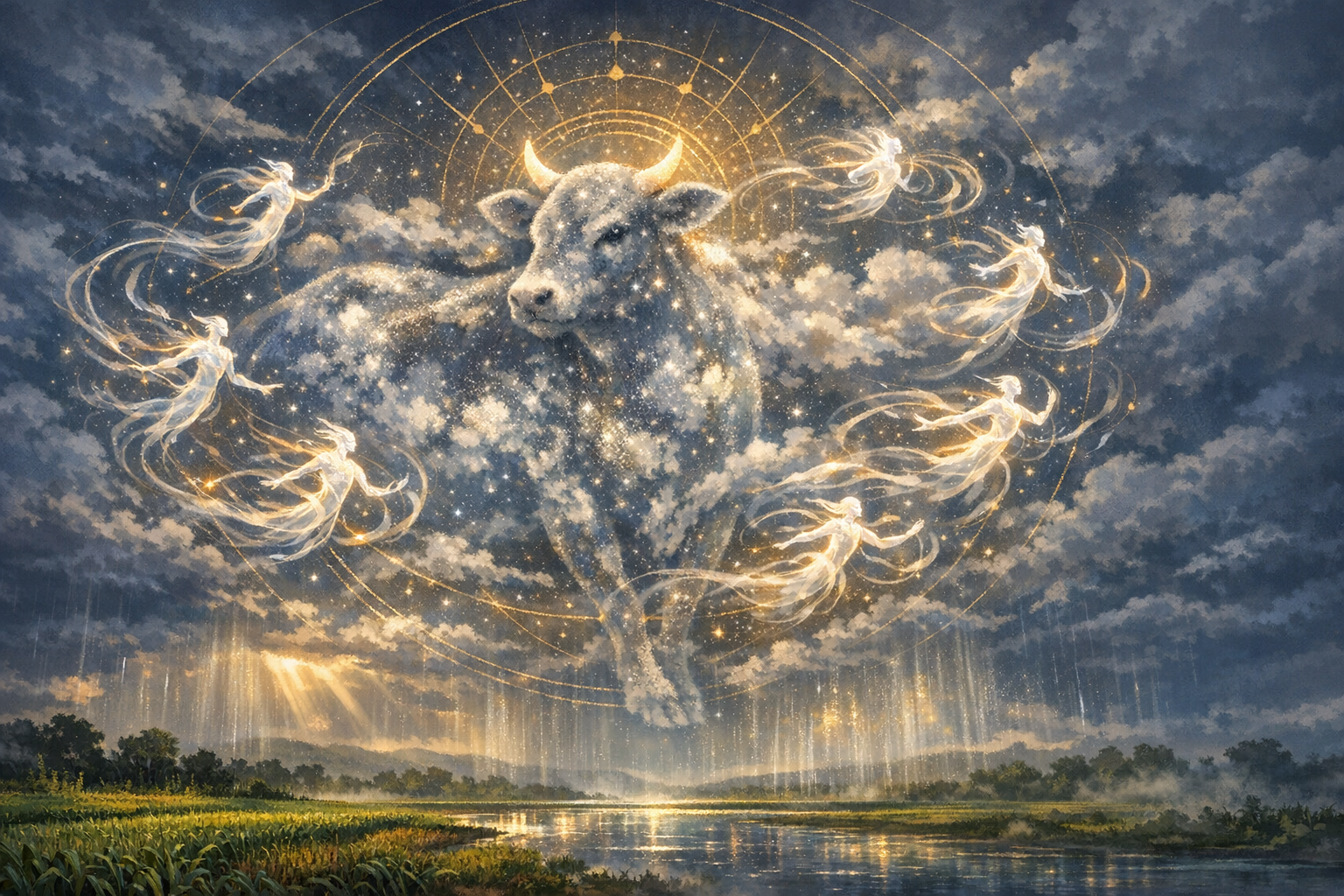
Rigvedic hymns to the Maruts portray them as radiant and fearsome, shaking mountains, quickening herbs, and strengthening Indra in battle; within these hymns Prishni appears as their mother, the generative womb from which the storm-host emerges. The image is concrete and ecological: the dappled sky and cloud-cow that bear the rains from which life returns.
In several Vedic strands the Maruts are cast as sons of Rudra; Prishni accordingly figures as Rudra’s consort in the mythic genealogy. The pairing is theologically elegant: Rudra, lord of the wild and the healing herb, fathers the storm-host; Prishni, the speckled matrix, births them. Together they encode the awe-and-aid paradox of weatherdangerous winds that also purify, irrigate, and renew.
Speckling is a sky word. Before the monsoon breaks, the heavens can look mottledpatchworks of cloud and light. In Vedic poetics the same pattern attaches to the sacred cow’s hide; milk, rain, and soma are cognate gifts. Prishni traverses these registers seamlessly: cow-cloud-earth, a triad of nurture through which the Maruts’ energy becomes harvest, health, and hymn.
In sacrificial liturgy, invoking the Maruts calls power, clarity, and vitality; naming their mother contextualizes that power as responsible and life-serving. Vedic ritual engineers the storm’s electricity into orderṛtaso that sovereignty, rain, and speech (vāc) align. Prishni as mother of the Maruts names the wellspring of that alignment.
Read ecologically, Prishni is the grammar of monsoon culture: unpredictable yet patterned, sometimes violent yet ultimately restorative. Farmers recognize the Maruts’ passage in wind-shifts and pressure drops; householders read it in relief at the first downpour. The “speckled” epithet affirms that reality’s texture is not uniformand that diversity is not a defect but a design.
Later Vedic and post-Vedic materials remember Prishni variablyat times as a cosmic cow, elsewhere as a divine consortwithout erasing the Rigvedic core: motherhood of the storm-host. Such fluidity is typical of Hindu scriptures, where names conserve motifs even as narratives migrate across Saṁhitā, Brāhmaṇa, and Purāṇa layers.
Purāṇic memory also preserves the name in a distinct register: Prishni and Sutapa are celebrated as parents of the divine “Prishni-garbha” in an earlier age, thematically reaffirming maternal creativity as a sacred constant. While this strand is not identical to the Rigvedic Prishni of the Maruts, the shared name keeps alive a theology in which nurture, protection, and cosmic order remain inseparable.
Unlike later goddesses with extensive iconographic corpora, Prishni remains largely an imaginal and verbal presence. When artists or teachers seek a form, the spotted cow, mottled cloud-bands, and rain-dark horizon often become her visual lexicondidactic tools that preserve Vedic symbolism without forcing a single standardized image.
Comparative philology hints that “speckling” is an old Indo‑European poetic resource for sky and cattle, yet the Rigvedic synthesis around Prishni is distinctively Vedic: storms humanized into the Marut host, maternity recast as atmosphere, and ritual binding raw weather to ethical order.
Across dharmic traditions, the motif of a dynamic, many-hued reality is a shared intuition: Hinduism’s ṛta and śrī balancing fearsome and fertile powers; Buddhism’s dependent arising describing the patterned emergence of phenomena; Jainism’s Anekantavada honoring many-sided truth; Sikh teachings celebrating kudrat and hukam through nature’s diversity. Prishni’s “speckled” field resonates with this plural ethos, encouraging mutual respect and unity in diversity.
For students and practitioners, contemplating Prishni can become a contemplative exercise: watch the dappled sky before rain, feel the wind’s shift, and recognize the Maruts’ vigor as a mother’s gift rather than a menace. Such attention deepens ecological humility and aligns devotion with stewardship.
Serious study benefits from triangulating Sanskrit philology, Vedic ritual studies, and environmental history. Reading multiple translations of Rigvedic Marut hymns alongside indigenous commentarial traditions clarifies how a single epithet“speckled”anchors a far-reaching theology of weather, welfare, and word.
Prishnispeckled goddess, celestial mother of the Marutsembodies the Vedas’ capacity to see the sacred in nature’s variegation. Attending to her name and narrative refines understanding of Hindu scriptures, supports dialogue within the broader dharmic family, and invites a reverent, practical engagement with the living sky.
Inspired by this post on Hindu Blog.