
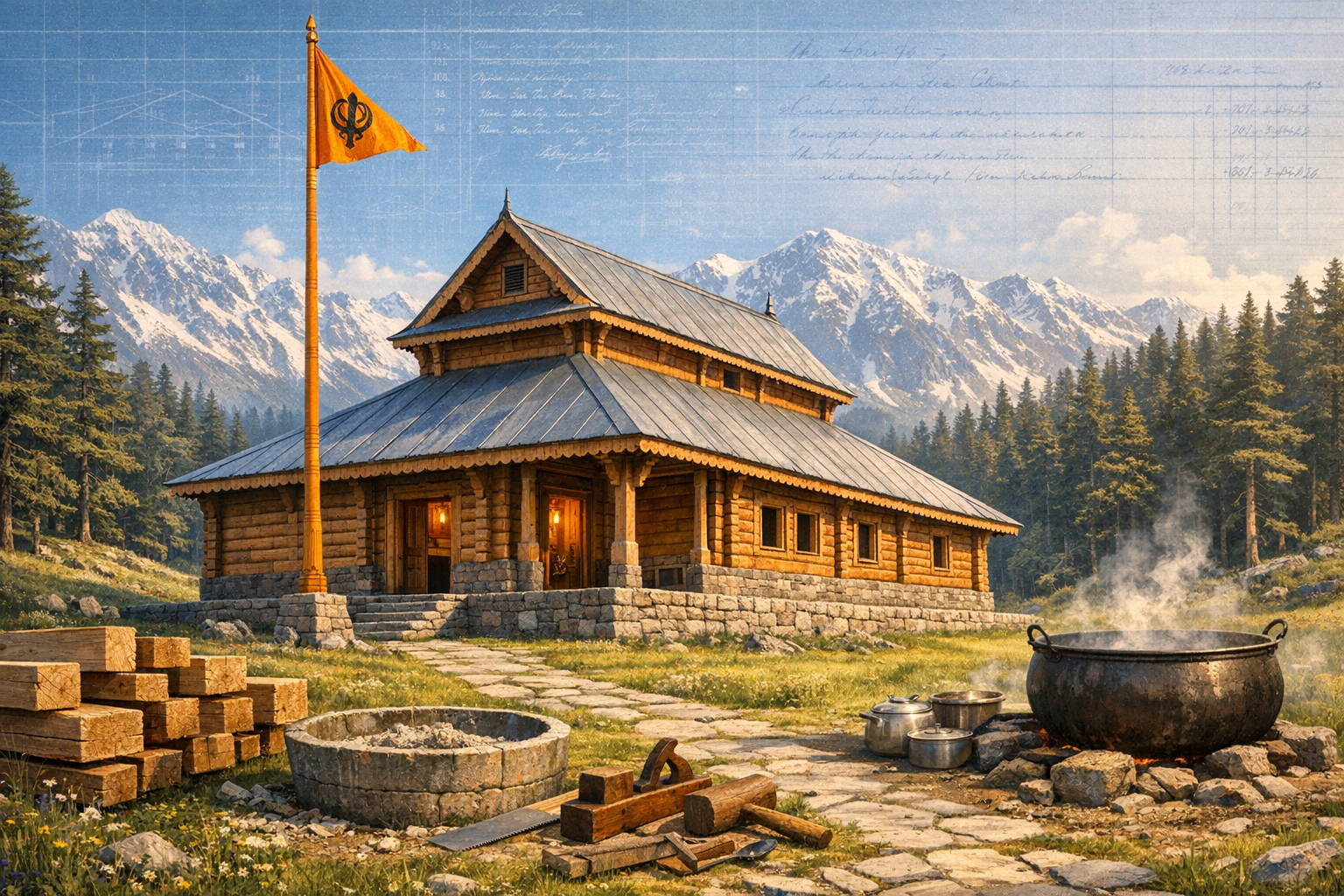
Gurdwara Singh Sabha in Gulmarg occupies a singular place in Sikh heritage, where alpine silence meets a living tradition of seva, sangat, and shabad-kirtan. The formative phase of 1924–1925 is closely associated in local memory with a community leader known as Bhai Vir Singh (Gulmarg), remembered for coordinating the institutional and architectural consolidation of the shrine during those crucial seasons. This figure should not be conflated with the renowned Punjabi littérateur and reformer Bhai Vir Singh (1872–1957); the Gulmarg association pertains to a locally-remembered sevadar and organizer whose work epitomized the practical ideals of the Singh Sabha movement in a high-Himalayan context.
To situate Gulmarg’s Gurdwara Singh Sabha historically, it is essential to read it through the lens of the wider Singh Sabha movement, which from the late nineteenth century emphasized scriptural literacy (Gurbani-centric education), institutional accountability, and community-led stewardship of gurdwaras. By the 1920s, this reformist current had diffused well beyond the urban centers of Punjab into frontier zones, cantonment towns, hill stations, and trade corridors, establishing Gurdwara Singh Sabha committees as durable units of local governance and devotional life.
Kashmir in the mid-1920s stood at the cusp of political transition, with the Dogra state’s administrative structures intersecting with British hill-station economies and regimental circulations. Gulmarg, a seasonal hub frequented by travelers, traders, pony wallahs, artisans, and soldiers, offered unique constraints and opportunities for religious institutions. In such terrains, gurdwaras served not only as sanctuaries of prayer but also as logistical centers of care—providing langar, shelter, and social mediation in alignment with sarbat da bhala.
Within this milieu, the Gurdwara Singh Sabha framework enabled structured decision-making through elected office-bearers, audited accounts, and defined portfolios for granthis, paṭhis, and sevadars. Oral recollections preserved in the sangat link the 1924–1925 phase to a wave of practical strengthening: stabilizing regular Guru Granth Sahib prakāsh and sukhasān, scheduling ardās and kirtan, systematizing langar provisioning, and consolidating a modest corpus fund raised from seasonal chanda and visiting Sikh regimental sangats. The managerial grammar—meeting minutes, receipts, and maintenance logs—reflected the movement’s emphasis on transparency and continuity.
The architectural language adopted at Gulmarg balanced spiritual symbolism with mountain engineering. Typical hill-station construction of the period favored a stone plinth to mitigate freeze–thaw cycles, deodar (cedar) timber superstructures for resilience and joinery strength, and steeply pitched roofs (often 35–45 degrees) to shed snow loads. Deep eaves, ventilated attics, and tin or shingle cladding reduced moisture ingress, while window placement maximized low winter sun and natural cross-ventilation. Within, the diwan hall’s unobstructed spans supported acoustics for Gurbani kirtan and accommodated congregational flow around the palki sahib with dignity and safety.
Between the summers of 1924 and 1925, project delivery followed the rhythm of Gulmarg’s short construction window. Timber procurement, lime-mortar preparation, and carpentry were sequenced to capitalize on dry weather, while winterized protections—such as skirting boards, floor insulation strategies, and protective porchways—were detailed to preserve the sanctity of the diwan hall during snowbound months. In this cycle, the locally remembered Bhai Vir Singh (Gulmarg) functioned as a practical catalyst, coordinating craftsmen, negotiating fair contracts, and ensuring that ritual needs remained paramount in all design choices.
Institutional discipline remained a parallel pillar. Consistent with Singh Sabha norms, the committee curated a ledgered account of offerings, langar purchases, routine repairs, and special expenditures (for example, the periodic repainting of the Nishan Sahib mast, patching of roof cladding after heavy snowfall, and maintenance of boundary elements). Governance emphasized consensus-building in the sangat, with decisions ratified after ardās, preserving the theological center of gravity while addressing everyday operational demands.
Ritual life at Gurdwara Singh Sabha Gulmarg harmonized daily nitnem with seasonal intensities. Alongside prakāsh, sukhasān, and kirtan, the sangat hosted akhand pāṭh during Gurpurabs and structured vārtā sessions to deepen understanding of Sikh itihās and rehat. Langar, anchored in the ethos of equality, extended to travelers and laborers of diverse backgrounds; in this way, the gurdwara’s doors operated as a civic commons as much as a sacred space, aligning devotion with social well-being.
In a region characterized by plural religious journeys, the gurdwara’s open hospitality embodied a living unity with the broader dharmic landscape. While grounded in Sikh maryāda, the institution’s care for all—regardless of background—resonated with shared Indic values of compassion, truth-seeking, and mutual respect. This spirit of coexistence complemented the local web of mandirs, Buddhist pilgrims in transit, and Jain traders on seasonal circuits, reinforcing a culture of harmony consistent with the ideal of sarbat da bhala.
The emblematic Nishan Sahib served both as theological marker and wayfinding device in Gulmarg’s dispersed topography. Its positioning optimized visibility across winter snowscapes and summer meadows, guiding the sangat and signaling sanctuary to wayfarers. The mast’s cyclical renewal—cleaning, repainting, and periodic fabric replacement—offered a tangible ritual of stewardship, binding aesthetics, safety, and sanctity into a single act of community care.
From a technical standpoint, the diwan hall’s envelope addressed high-altitude thermal stresses. Timber joinery accommodated natural movement due to diurnal temperature shifts; lime-based mortars balanced breathability with strength, curbing trapped moisture; and raised floor assemblies minimized ground dampness. Where stoves or braziers were used, flue paths and firebreaks were detailed with care, honoring both safety and the need for gentle warmth during predawn prakāsh and evening sukhasān.
Socially, the 1924–1925 period consolidated a matrix of support cutting across regimental networks, traders, and seasonal workers. Regiments with Sikh companies—attested in other hill stations across the Himalayas—often provided kirtan jathas or logistical help while on leave or transit. Traders contributed staples for langar, and local artisans offered in-kind seva, ensuring that religious observance and mountain livelihoods uplifted each other in a reciprocal cycle of generosity.
The locally remembered Bhai Vir Singh (Gulmarg) emerges in this milieu less as a solitary “founder” than as an enabling steward who synthesized people, materials, and maryāda into a coherent whole. Oral narrations portray a sevadar skilled at parchar and practical coordination, attentive to the Guru Granth Sahib-centered life of the institution while navigating the exigencies of a short building season and limited hill logistics. This profile, while distinct from the illustrious Amritsar-based writer of the same name, nonetheless mirrors the Singh Sabha movement’s characteristic fusion of learning, discipline, and actionable service.
The early choices made in 1924–1925 had long-term consequences for sustainability. Routine inspections after each snowmelt, scheduled repainting of timber exteriors, and lime wash cycles minimized decay. Financially, the committee’s practice of modest reserves and earmarked maintenance funds created resilience, enabling rapid response to roof damage or boundary wear without interrupting daily maryāda or langar commitments.
Heritage practitioners today would recognize in Gulmarg’s Gurdwara Singh Sabha an exemplary case of community architecture adapted to climate risk. Materials selection balanced local availability with lifecycle performance; form-making respected both ritual orientation and mountain safety; and governance systems embedded accountability in lived devotion. These principles remain instructive for conservation-led upgrades, seismic strengthening, and energy-sensitive improvements that do not compromise the sanctity of the diwan hall.
As a living institution, the gurdwara continues to embody Sikh heritage in Kashmir while contributing to the wider cultural tapestry of the region. Its story—especially the 1924–1925 consolidation linked to Bhai Vir Singh (Gulmarg)—illustrates how the Singh Sabha movement’s reformist clarity could be translated into the exacting realities of a Himalayan station, yielding a sanctuary where architectural prudence, institutional probity, and spiritual grace reinforce one another.
In sum, the foundational years at Gulmarg demonstrate how faith infrastructure in the Himalayas can be both technically sophisticated and theologically centered. By aligning climatic intelligence with the discipline of sangat and seva, the early stewards—foremost among them the locally remembered Bhai Vir Singh (Gulmarg)—secured a legacy that continues to nurture community, welcome travelers of many paths, and uphold the unity of dharmic traditions through open-hearted service.
Inspired by this post on SikhNet – News.








Leave a Reply
You must be logged in to post a comment.