
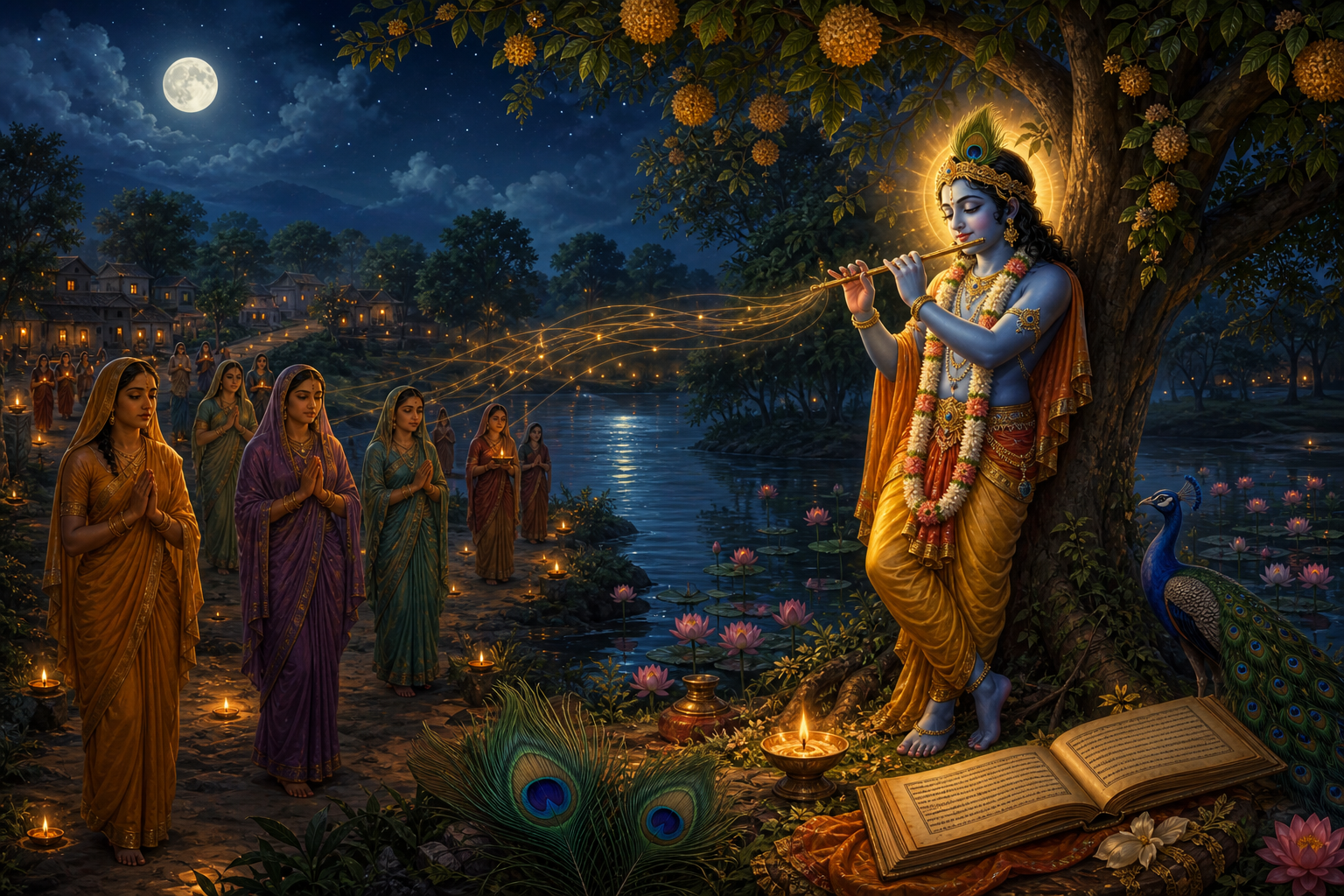
The verses of Srimad Bhagavatam 10.29.18-22 stand within one of the most spiritually charged passages of the Tenth Canto: the beginning of the Rasa-lila narrative, where the gopis of Vraja hear the flute of Sri Krishna and respond with complete absorption. These verses are not merely poetic descriptions of devotion; they are a theological study of longing, duty, surrender, and the highest form of bhakti. In the devotional tradition, especially within Vaishnava commentary, this section is approached with reverence because it presents divine love in its most concentrated and paradoxical form.
The setting is simple on the surface. Sri Krishna plays His flute in the autumn night, and the gopis leave their homes, families, and ordinary social responsibilities to come to Him. Yet the simplicity of the scene hides a profound spiritual drama. The gopis are not presented as careless or sentimental figures. Their movement toward Krishna represents the soul’s irresistible attraction to the Supreme, an attraction that transcends calculation while still raising serious questions about dharma, social order, and spiritual priority.
In verses 10.29.18-22, Krishna speaks to the gopis after they arrive. His words appear, at first glance, to discourage them. He reminds them of the obligations expected of women within their household life and suggests that they should return home. This is one of the reasons the passage requires careful reading. Krishna’s speech is not a rejection of devotion but a deepening test of its nature. The exchange allows the Bhagavatam to clarify the difference between ordinary attraction and pure devotional surrender.
The emotional force of these verses comes from a tension that many sincere practitioners can recognize in their own lives. Spiritual life often begins as attraction, but it matures through examination. A person may feel drawn to mantra, worship, scripture, temple life, seva, or the presence of a guru, yet that attraction must pass through the realities of responsibility, humility, discipline, and self-honesty. The gopis’ response to Krishna is therefore not escapism. It is the disclosure of a love that has already consumed the heart so completely that no external identity can stand apart from it.
The Bhagavata Purana consistently teaches that the highest devotion is not mechanical religiosity but wholehearted offering. This does not mean contempt for dharma. Rather, it reveals dharma’s highest purpose. Social duties, ritual practices, ethical conduct, and scriptural learning are meant to awaken loving remembrance of the Divine. When that remembrance becomes perfect, as in the case of the gopis, their lives become the standard by which devotion itself is understood.
Krishna’s instruction that the gopis return home has been read by traditional commentators as a sacred provocation. It draws out their inner state. If their love were superficial, they might retreat. If it were based on social imitation, they might become embarrassed. If it were based on self-interest, they might become angry. Instead, their devotion reveals dependence on Krishna as the very center of existence. Their longing is not for pleasure independent of Him; it is for service, presence, and complete belonging.
This is why the Rasa-lila is treated in the Vaishnava tradition as a subject for mature hearing. It is not a license for moral carelessness, nor is it a romantic episode in the ordinary sense. It is a scriptural revelation of prema-bhakti, divine love purified of selfishness. The gopis do not approach Krishna as consumers of spiritual experience. They come as those whose entire being has been reorganized by love. Their identity, emotion, memory, and action are all drawn toward Sri Krishna.
There is also a subtle teaching on the relationship between external duty and inner consciousness. In most lives, dharma protects the mind from chaos and selfishness. Duties toward family, society, teachers, community, and tradition cultivate steadiness. Yet the Bhagavatam also recognizes that the soul’s final duty is loving service to Bhagavan. The gopis embody the rare condition in which this final duty has become completely awakened. Their example should therefore inspire humility, not imitation.
For contemporary readers, these verses can feel both distant and immediate. The world of Vraja seems far removed from modern pressures, yet the central question remains familiar: what truly commands the heart? People often live divided between obligation and longing, public identity and private aspiration, routine and transcendence. The gopis show a state in which the heart is no longer divided. Their devotion is not fragmented by competing claims because Krishna has become the meaning behind every claim.
This teaching has relevance across dharmic traditions when approached with care. Hinduism, Buddhism, Jainism, and Sikhism each emphasize, in distinct ways, the transformation of ordinary consciousness and the movement beyond ego-centered living. In the Bhagavata tradition, this transformation is expressed as loving devotion to Krishna. In other dharmic vocabularies, one may speak of liberation from attachment, disciplined conduct, compassion, remembrance, truth, or surrender to the Divine Name. The shared insight is that human life becomes meaningful when it is oriented toward a reality greater than the restless ego.
The gopis’ devotion should therefore not be reduced to sectarian triumphalism. It is a jewel within Sanatana Dharma, and its beauty becomes clearer when it is read as a contribution to the broader dharmic understanding of spiritual intensity. Their love is radical because it is free from possessiveness. Their surrender is powerful because it is not passive. Their longing is sacred because it dissolves self-centeredness and reveals the soul’s dependence on the Supreme.
In these verses, Krishna also teaches by concealment. He does not immediately reward the gopis’ arrival with open praise. Instead, He speaks in a way that tests their steadiness. This divine concealment is a recurring feature of bhakti literature. The devotee may feel called, then challenged; invited, then tested; embraced, then apparently distanced. Such experiences are not always signs of rejection. In spiritual life, they can become the means by which longing becomes purified and devotion becomes deeper.
The emotional intelligence of the Bhagavatam is striking here. It knows that love must be examined. It knows that devotion can be confused with projection, attachment, social excitement, or the desire for mystical experience. By placing Krishna’s challenging words at the moment of the gopis’ arrival, the text prevents a shallow reading. The highest love is not proven by dramatic movement alone; it is proven by unwavering orientation toward service even when the Divine appears to resist easy possession.
Srimad Bhagavatam 10.29.18-22 also invites reflection on sacred sound. The entire episode begins with Krishna’s flute, a sound that reaches the gopis not merely through the ear but through the heart. In devotional practice, sound remains central: mantra, kirtan, japa, scriptural recitation, and attentive hearing. The flute call of Krishna becomes a symbol of the Divine summons that can enter ordinary life at unexpected moments. A person may be working, serving family, studying, or struggling quietly, and still hear inwardly the call toward a more surrendered life.
The gopis’ response is immediate because their hearts have already been prepared. This is an important point. Great spiritual response does not arise from nowhere. It is formed by repeated remembrance, affection, association, and inner refinement. In practical terms, devotion matures through daily practice. Hearing the Bhagavatam, chanting the holy names, honoring prasada, serving Vaishnavas, respecting all dharmic paths, and living with ethical restraint gradually make the heart capable of recognizing Krishna’s call.
These verses can also be read as a meditation on vulnerability before the Divine. The gopis come without bargaining power. They do not arrive with philosophical arguments, ritual qualifications, or worldly status. Their wealth is longing. Their strength is dependence. In a culture that often prizes control, this is a difficult lesson. Bhakti asks the heart to become honest enough to admit need, love, and surrender. Such vulnerability is not weakness; in the Bhagavatam, it is the doorway into the deepest form of spiritual strength.
At the same time, responsible interpretation is essential. The Rasa-lila should never be used to dismiss ethical life or social responsibility. The Bhagavatam itself is deeply concerned with dharma, compassion, truth, and self-control. The gopis are extraordinary precisely because their devotion is pure. For ordinary practitioners, the safe and authentic path is not imitation of their external actions but cultivation of their internal qualities: remembrance, humility, eagerness to serve, freedom from selfish desire, and complete trust in Krishna.
This distinction between imitation and aspiration is one of the most important lessons of the passage. To imitate is to copy the outer form without the inner qualification. To aspire is to honor the ideal while walking the path with sincerity and discipline. The gopis are not ordinary models of social behavior; they are supreme models of spiritual absorption. Their example asks practitioners to examine whether devotion is being practiced for recognition, comfort, and identity, or for genuine transformation of the heart.
The verses also reveal the Bhagavatam’s literary sophistication. Krishna’s speech operates on several levels at once. It sounds like social instruction, functions as a spiritual test, reveals the depth of the gopis’ devotion, and prepares the reader for the theological meaning of the Rasa-lila. This layered method is one reason the Bhagavatam has sustained centuries of commentary, recitation, art, music, and contemplative practice. Its narratives are not flat moral tales; they are spiritual architectures built to be entered repeatedly.
Within the broader arc of the Tenth Canto, this moment shows why Vraja-bhakti is held as uniquely intimate. Krishna in Mathura and Dvaraka may be seen as prince, statesman, protector, and teacher. Krishna in Vraja is encountered as the beloved center of existence, beyond calculation and awe. The gopis’ relationship with Him is marked by intimacy rather than formality. Their devotion is not less reverent because it is intimate; it is so complete that reverence has become love’s natural atmosphere.
For many readers, the most moving aspect of these verses is the sense that the Divine takes the devotee seriously. Krishna does not offer cheap consolation. He challenges, questions, and draws out the truth of the heart. This gives spiritual life dignity. The devotee is not treated as a passive recipient but as a participant in a relationship that demands sincerity. In that sense, the gopis’ encounter with Krishna becomes a mirror for every practitioner who has felt both called and tested on the path of bhakti.
The date associated with the class, June 20, 2026, places this discussion in a contemporary context, but the subject remains timeless. The questions raised by Srimad Bhagavatam 10.29.18-22 are not bound to one era: What is love when freed from selfishness? What is duty when understood in relation to the soul? What does surrender mean when it is not forced but awakened by beauty? How does sacred sound transform ordinary consciousness into remembrance?
The answer offered by the Bhagavatam is both tender and demanding. Love of Krishna is the highest fulfillment of the self, but it cannot be reduced to emotion alone. It requires purification, hearing, humility, association, and grace. The gopis demonstrate the destination; the practitioner begins with faithful steps. Each act of remembrance, each sincere chant, each moment of restraint, each gesture of service, and each respectful engagement with dharmic wisdom becomes part of that journey.
In this way, Srimad Bhagavatam 10.29.18-22 offers more than a devotional episode. It becomes a profound study of spiritual priority. The gopis remind the world that the heart finds its completion not in possession, status, or argument, but in loving surrender to the Divine. Their longing is not a rejection of life; it is life brought to its highest purpose. For those who hear these verses with patience and reverence, the flute call of Krishna continues to ask a quiet but decisive question: where does the heart truly belong?
Inspired by this post on Dandavats.





Leave a Reply
You must be logged in to post a comment.