
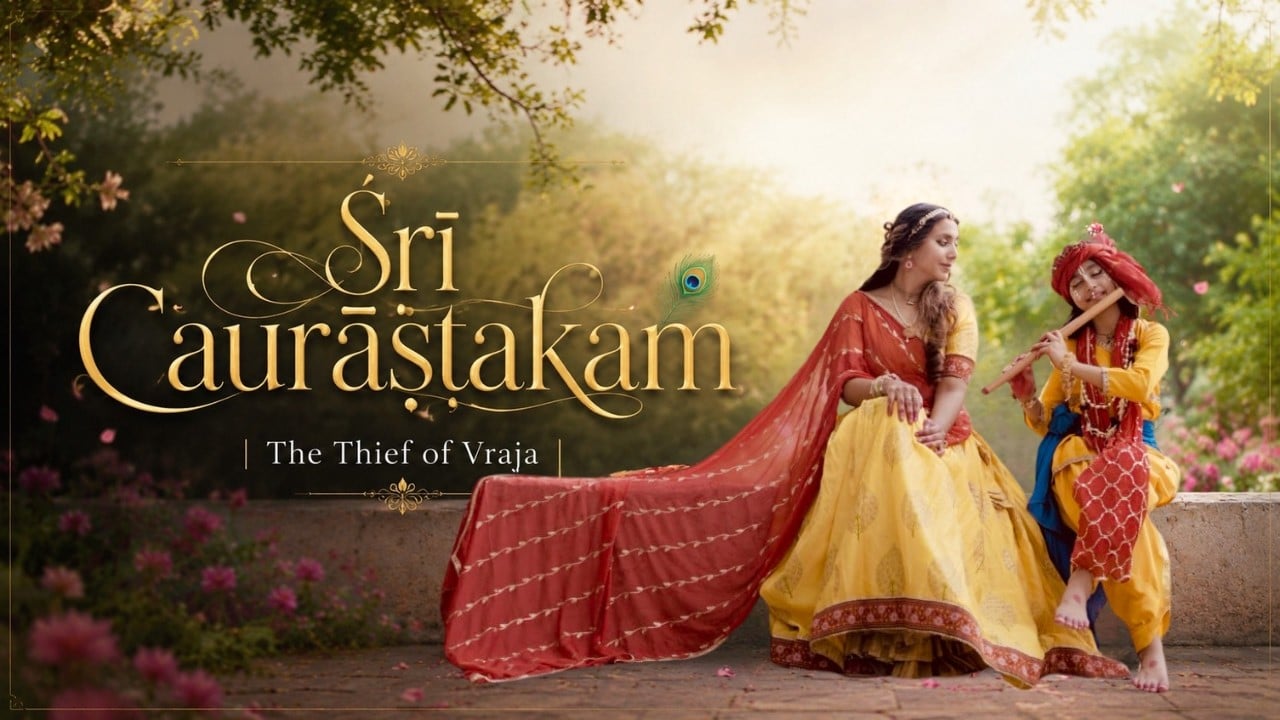
Śrī Caurāṣṭakam is an eight‑verse Sanskrit hymn that reveres Śrī Krishna as the tender yet subversive “Thief of Vraja.” A recent English musical rendition by Rasamayi Rādhe Dāsī—presented as the first of its kind—makes this classical bhakti text accessible to contemporary, global listeners without diluting its devotional force. The project frames a timeless poetic vision within a format suited to today’s audiences, drawing new attention to a compact work of profound theological and aesthetic sophistication.
Attributed to Śrīla Bilvamaṅgala Ṭhākura (also known as Līlāśuka), the hymn belongs to the rich corpus of medieval Vaiṣṇava poetry that shaped later Gaudiya Vaishnava practice. Bilvamaṅgala Ṭhākura’s reputation as a mystic poet—best known for Krishna‑karnāmṛta—anchors Śrī Caurāṣṭakam within a lineage that prizes intimate, affective devotion (prema‑bhakti) grounded in scriptural imagination and lived practice. The text’s lyrical compression and evocative imagery continue to inform recitation, contemplation, and musical interpretation across generations.
The organizing conceit of Śrī Caurāṣṭakam is theological paradox: divinity appears as a cora, a “thief” who steals butter, minds, and ultimately the devotee’s ego. In Vraja‑līlā, this sanctified “theft” signals an overriding grace that dissolves possessiveness and claims the heart (citta) for love of the Absolute. By reframing loss as liberation, the poem advances a nuanced spiritual psychology in which surrender becomes the surest protection and the deepest freedom.
Structurally, the aṣṭakam form concentrates meaning through iteration and refrain. Repeated invocations of the “thief” epithet create an anaphoric cadence that intensifies madhurya‑rasa while allowing complementary moods—vatsalya and sakhya—to surface through imagery of household play, pastoral intimacy, and ecstatic remembrance. The result is a compact devotional architecture whose prosody supports memorization, communal recitation, and contemplative savor (rasa‑āsvāda).
Although brief, the text resonates with the narrative universe of the Bhāgavata Purāṇa’s Vraja chapters, where Krishna’s butter‑stealing, playful transgressions, and irresistible charm educate the devotee in non‑attachment and loving service. In practice, Śrī Caurāṣṭakam often functions as both a preparatory invocation and a concluding seal in kīrtana settings, guiding attention from sensory multiplicity toward single‑pointed remembrance (smaraṇa). Its imagery—of hearts yielded, minds stilled, and burdens lifted—translates readily across languages without losing devotional intensity.
Rendering the poem in English carries distinct translational challenges: preserving semantic precision, communicating layered puns around cora, and transmitting the poem’s emotive charge. This project opts for a singable English lyric that privileges clarity and devotional immediacy, enabling first‑time listeners to follow the narrative movement while seasoned practitioners recognize familiar theological nuances. The result is an interpretive bridge that invites deeper engagement with Sanskrit literature and the wider bhakti tradition.
The production acknowledges its lineage and labor with explicit credits: Song — Śrīla Bilvamaṅgala Ṭhākura; Lyrics — Ramāi Manohara Dāsa; Mixed & Mastered By — Ankit Verma & Sachin; DOP — Sahil Capture's; Cast — Rasamayi. Such documentation situates the work within a living tradition where textual fidelity, musical craft, and visual storytelling collaborate to serve bhakti. Transparent crediting also supports scholarly citation and community recognition, strengthening the ecosystem that preserves and disseminates sacred music.
Musically, the arrangement foregrounds intelligible phrasing and a contemplative dynamic arc so that meaning leads melody rather than the reverse. By privileging text over virtuosity, the rendition invites the listener into śravaṇa‑kīrtana—hearing and singing as complementary disciplines—mirroring classical pedagogy in which careful listening matures into heartfelt utterance. This emphasis lends the performance a reflective tone that suits both personal meditation and congregational settings.
The hymn’s central insight—that inner bondage loosens when love displaces possessiveness—finds sympathetic echoes across dharmic traditions. Buddhist practice cultivates non‑grasping and boundless compassion; Jain ethics refine conduct through self‑restraint and friendship (maitrī); Sikh teachings elevate nām‑simran and sevā as pathways that dissolve egoic clinging. While metaphysical frames differ, the transformation of the heart toward humility, courage, and service provides shared ground for reflection and unity, advancing a vision of harmony among Hinduism, Buddhism, Jainism, and Sikhism.
For educators, cultural curators, and community leaders, an accessible English version of Śrī Caurāṣṭakam becomes a pedagogical bridge: it introduces Sanskrit literature, Gaudiya Vaishnava aesthetics, and kīrtana practice to learners who may not read Devanāgarī or study metrics, yet can still encounter the text’s beauty and ethical vision. Intergenerational settings—home satsangs, temple programs, and campus forums—are well suited to such a resource. The rendition also supports diaspora engagement, where English functions as a shared medium for study and devotion.
A practical way to engage the hymn pairs brief study with steady listening: read a reliable transliteration and meaning guide, listen to the English rendition attentively, and then re‑encounter the Sanskrit while observing how the “thief” motif interrogates subtle forms of pride, fear, and control. This loop of study, listening, and contemplation aligns with bhakti’s time‑tested triad of śravaṇa, kīrtana, and smaraṇa. Over time, the poem’s refrain works like a mantra, gently relocating attention from self‑possession to self‑offering.
Śrī Caurāṣṭakam thus stands as a small masterpiece of Sanskrit devotion whose modern English musical articulation extends its reach without compromising its soul. In honoring both source and songcraft, the project renews a classical insight for contemporary life: when the “Thief of Vraja” steals what was never truly ours to keep, what remains is freedom, friendship, and a love capacious enough to unite diverse spiritual journeys. In that sense, the hymn becomes not only a celebration of Krishna’s play but also a call to shared ethical and spiritual flourishing across the dharmic family.
Inspired by this post on Dandavats.










Leave a Reply
You must be logged in to post a comment.