
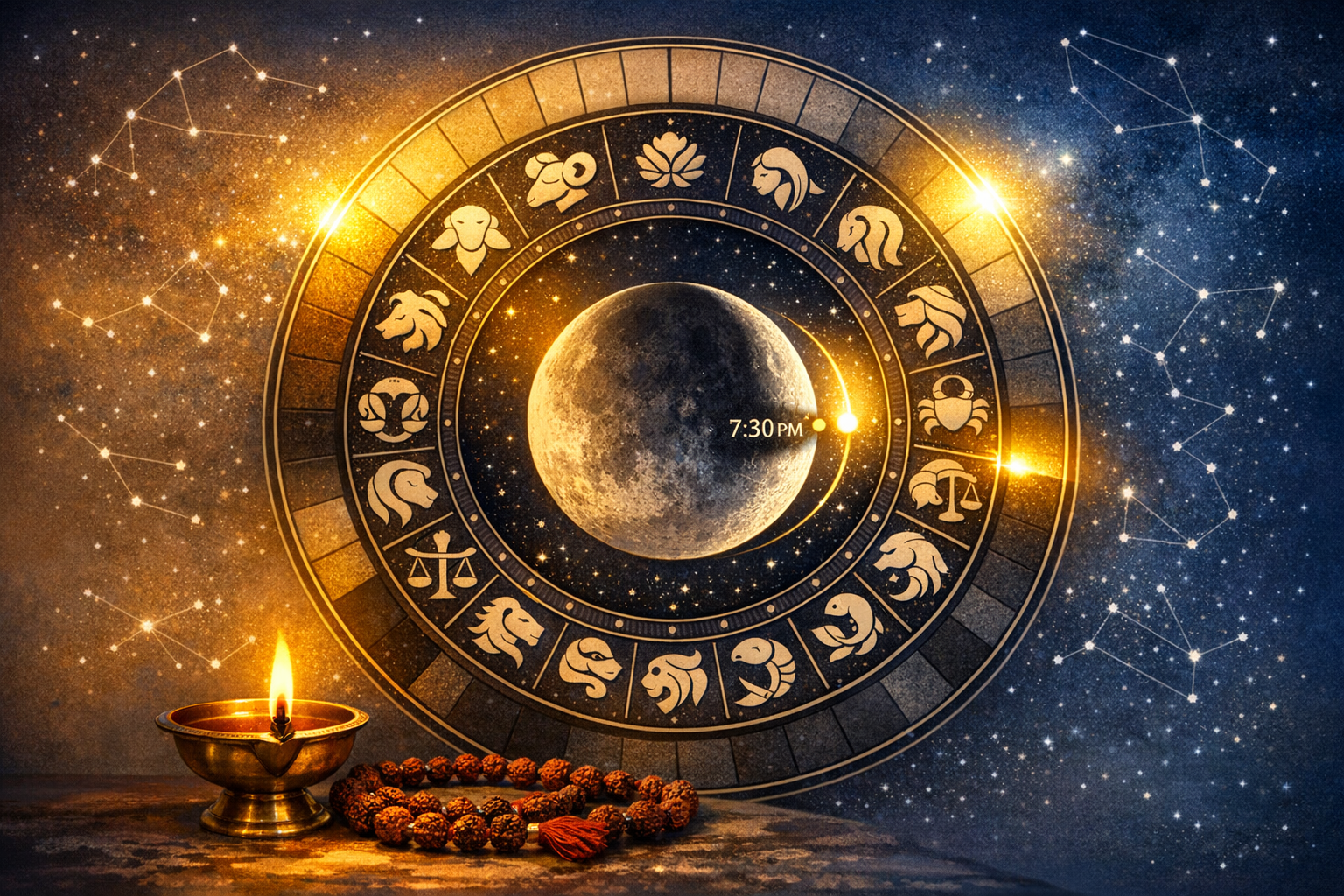
Tuesday, June 23, 2026 features a precise and meaningful transition in the Hindu Calendar (Panchang). In most regions, it is Shukla Paksha Navami (the ninth lunar day of the waxing Moon) until 7:30 PM; thereafter, Shukla Paksha Dashami (the tenth lunar day) prevails. Because Panchang calculations depend on local longitude, latitude, and sunrise, minor differences may appear across cities and almanacs; the structure outlined here aligns with widely used astronomical (drik) computations as followed in many Indian Panchang traditions.
Understanding this day through the five limbs of the Panchang—Tithi (lunar day), Vāra (weekday), Nakshatra (lunar mansion), Yoga, and Karana—enhances the clarity and confidence with which families and practitioners plan observances. The waxing half of the month, Shukla Paksha, is traditionally associated with growth, clarity, and outward momentum, and its ninth and tenth tithis carry distinct muhurta implications for daily life as well as ritual practice.
Technically, a tithi is defined by the angular separation between the Moon and the Sun in the sidereal (nirayana) zodiac. Each tithi spans 12 degrees of this separation. When the geocentric longitude difference of the Moon from the Sun crosses successive 12-degree thresholds, the tithi advances. Because the Moon’s motion is variable, tithis are not equal in clock time and may begin or end at any hour of the day. Festival determinations typically rely on the tithi prevailing at sunrise, whereas day-to-day muhurta work may use the exact start and end times; both methods are authoritative within their respective contexts.
Month naming around this date can vary by regional convention. North Indian (purnimanta) and South Indian (amanta) practices count months differently (ending on full moon vs. new moon), and years with adhik (intercalary) months—such as 2026—can shift the apparent mapping between civil dates and month names. This is normal and reflects the remarkable adaptability of the traditional calendar.
In classical muhurta, Shukla Paksha Navami is categorized among the rikta tithis (4, 9, 14), which are considered relatively lean for wealth-building ceremonies, marriages, and foundation-laying. Yet Navami is favorable for satvika pursuits—study, japa, dhyana, svadhyaya, and home worship. Falling on a Tuesday (mangalavāra), the day’s natural association with strength, discipline, and focused effort aligns well with Hanuman upasana and disciplined seva. Many households experience Navami as a contemplative bridge: devotion through the day, with forward-looking intent as the evening approaches.
After 7:30 PM, the arrival of Shukla Paksha Dashami brings an often-preferred window for initiating planned tasks. Dashami is generally deemed auspicious (purna) for administrative undertakings, correspondence, strategic planning, travel decisions, and skills training—especially when combined with a supportive Nakshatra and freedom from inauspicious day-part segments. On a Tuesday, Dashami’s constructive tone can be channeled into projects that benefit from clarity, resolve, and logistical order.
Good Time (Shubh Muhurat) selection on this date rests on universally applied principles that adapt to one’s location. Brahma Muhurta—roughly 1.5 hours before local sunrise—is ideal for meditation and mantra recitation. Abhijit Muhurat, centered on local solar noon (approximately 24 minutes before and after), often serves as a balanced, mid-day opportunity for auspicious starts if it does not coincide with Rahu Kaal. Toward late afternoon, Vijay Muhurat offers a compact, success-oriented interval; its exact span depends on the day’s sunrise and sunset and is best derived from a reliable Panchang or muhurta calculator.
Equally important are the day’s inauspicious segments: Rahu Kaal, Yamaganda, and Gulika Kaal. For Tuesday, the standard framework assigns these segments to fixed daylight octants: Rahu Kaal occupies the 7th part of the daytime, Yamaganda the 3rd, and Gulika Kaal the 4th. To compute exact local timings, divide the interval between your local sunrise and sunset into eight equal parts and map Tuesday’s octants accordingly (1 through 8). Activities requiring strong auspiciousness are typically deferred if they overlap these segments.
Nakshatra and Rashi refine muhurta selection. While the specific Nakshatra and Moon sign (Rashi) for June 23, 2026 will vary by location and ephemeris, their use follows common rules. Practitioners check Tarabala (the strength derived from the count of the day’s Nakshatra from one’s Janma Nakshatra) and Chandrabala (whether the day’s Moon sign is friendly to one’s natal sign). As a rule of thumb, Tarabala is supportive under Sampat, Kshema, Sadhana, Mitra, and Parama-Mitra counts; Chandrabala is typically favorable when the transit Moon is 1, 3, 6, 7, 10, or 11 signs from the birth Moon sign. Combining strong Tarabala and Chandrabala with a benefic weekday/Nakshatra mix often yields reliable results.
Yoga and Karana, the remaining Panchang limbs, add precision. A Yoga arises from the sum of the Sun’s and Moon’s longitudes; some Yogas (e.g., Siddha, Amrita) elevate auspiciousness, whereas others (e.g., Vyatipata, Vaidhriti) call for caution. Karanas, which are half-tithis, nuance short-duration undertakings—Bava, Balava, Kaulava, and Taitila are broadly constructive, while fixed Karanas (e.g., Shakuni, Chatushpada) are specialized and used with care. Because these values change within the day, local Panchang data should be consulted when timing high-stakes actions.
The lived experience of this date can be harmonized across dharmic traditions. Hindu households may emphasize Vishnu, Rama, or Krishna nama-japa during Navami, with a switch to practical beginnings under Dashami in the evening. Buddhist communities often align discipline with lunar progression through regular meditation cycles reminiscent of Uposatha discipline, while Jain families cultivate vrata, svadhyaya, and pratikraman in keeping with their own lunar observances. Sikh practice, shaped today by a primarily solar Nanakshahi framework yet historically intertwined with Bikrami lunar rhythms, demonstrates how calendrical wisdom can serve ethical living and seva across communities. The shared reliance on celestial cycles underlines a broader unity of purpose: to align inner intention with cosmic time for collective well-being.
Practical planning for June 23, 2026 can therefore follow a simple sequence. Use the day hours of Shukla Paksha Navami for worship, study, and preparation. After 7:30 PM, when Shukla Paksha Dashami prevails, initiate tasks that benefit from an auspicious start, provided they do not overlap Rahu Kaal and are supported by a favorable Nakshatra and Moon sign. If the activity is mission-critical, refine the choice with Abhijit Muhurat and confirm Yoga and Karana from a trusted, locality-specific Panchang.
In summary, June 23, 2026 offers a contemplative daytime under Shukla Paksha Navami and a pragmatic evening launchpad with Shukla Paksha Dashami. By respecting the Panchang’s technical underpinnings and thoughtfully integrating them into modern schedules, practitioners transform calendar knowledge into a living discipline—cultivating clarity, devotion, and purposeful action that resonate across Hinduism, Buddhism, Jainism, and Sikhism.
Inspired by this post on Hindu Blog.


Leave a Reply
You must be logged in to post a comment.