
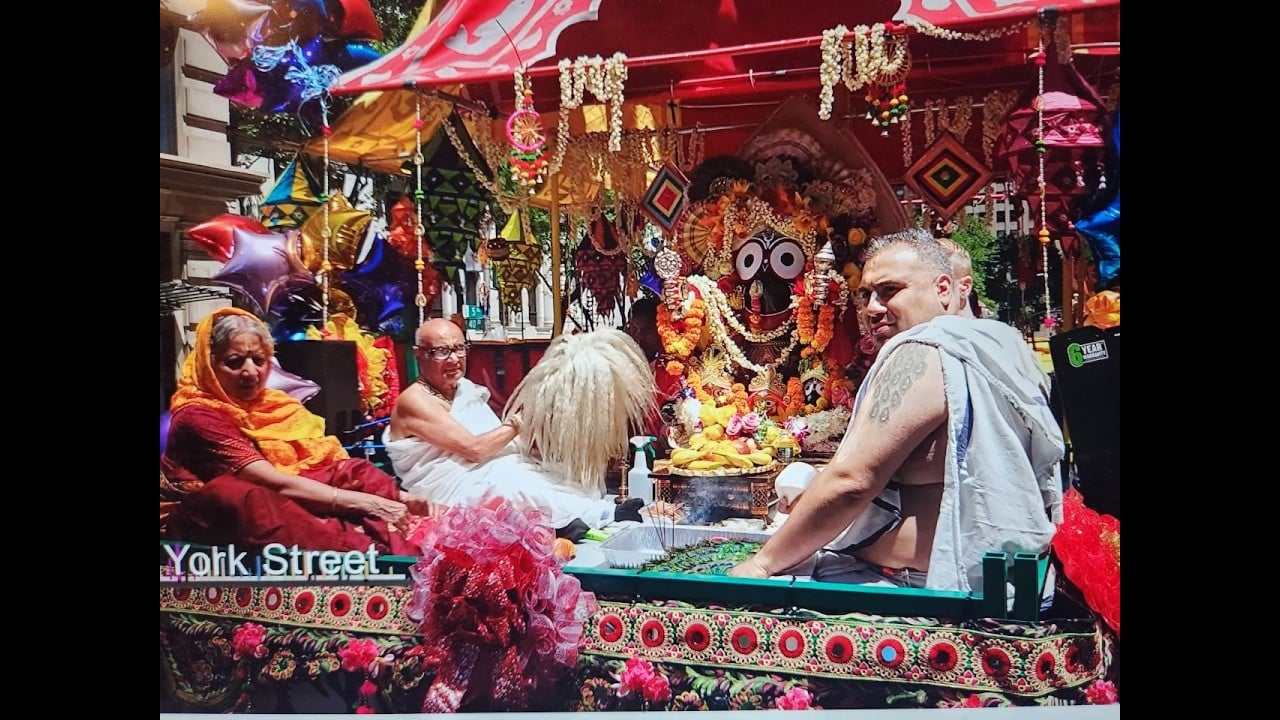
On Saturday, June 13, 2026, New York City will host the 51st Annual Hare Krishna Ratha Yatra—widely known as the Festival of Chariots—bringing a living strand of India’s sacred heritage onto Fifth Avenue. Organized by ISKCON (International Society for Krishna Consciousness), the procession typically advances down Fifth Avenue and culminates in an afternoon cultural festival at a downtown park (historically Washington Square Park, subject to permits), creating one of the city’s largest and most inclusive Hindu celebrations. The event unites devotional music, sacred processions, vegetarian food culture, and inter-community friendship in a format that welcomes everyone—Hindus, Buddhists, Jains, Sikhs, and friends of all backgrounds.
Ratha Yatra originates in Jagannath Puri (Odisha, India), where “Jagannath” signifies “Lord of the Universe.” The festival commemorates the annual journey of Jagannath, Baladeva (Balarama), and Subhadra from the main temple to the Gundicha Temple. In the classical tradition, this occurs on the second lunar day (Dwitiya) of the bright fortnight of Ashadha and is preceded by Snana Purnima, a ceremonial bathing, followed by a period of anasara (seclusion) and the Nabajaubana darshan (renewed public audience). The diaspora observance preserves the core symbolism—divine outreach to all beings—while adapting dates and logistics to local civic frameworks.
The modern global spread of Ratha Yatra is closely linked to Srila A. C. Bhaktivedanta Swami Prabhupada, founder of ISKCON in New York in 1966. The first public Ratha Yatra outside India was held in San Francisco in 1967, and the New York City Ratha Yatra began in 1976. The 2026 edition therefore marks the 51st year of the NYC procession—an enduring testimony to diaspora continuity, urban pluralism, and the vitality of Gaudiya Vaishnavism in a multicultural metropolis.
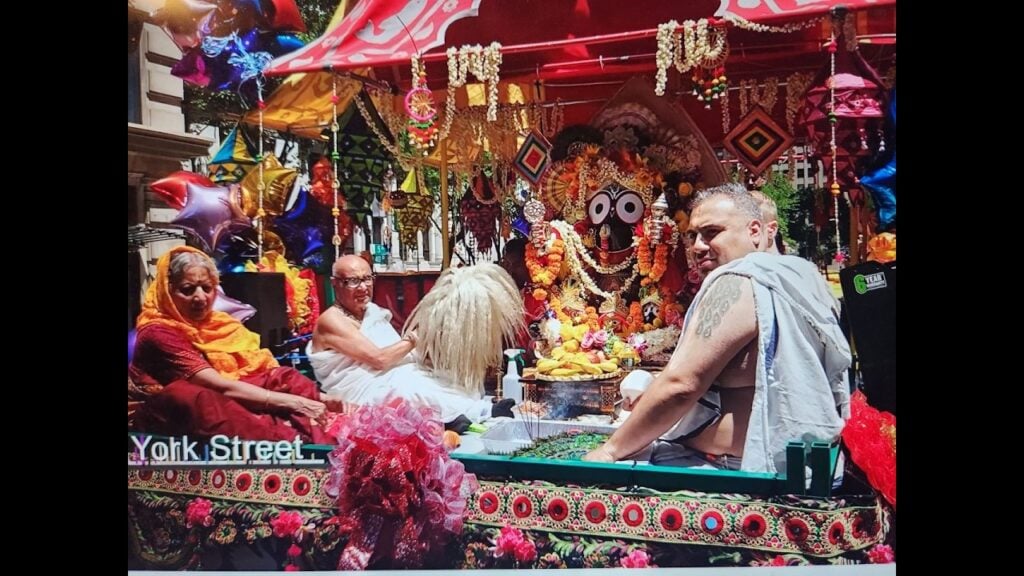
At the theological heart of the festival are three murtis (sacred images): Jagannath (a form of Sri Krishna), Baladeva, and Subhadra. In Puri, each rides a distinctive chariot with canonical proportions—Nandighosha (Jagannath), Taladhwaja (Baladeva), and Darpadalana/Devadalana (Subhadra)—traditionally with 16, 14, and 12 wheels, respectively. In New York, purpose-built chariots echo this iconography at urban scale, crowned by vibrant canopies and drawn by ropes as a public act of seva (service). The triad’s presence in the streets communicates a simple, profound idea: the divine meets humanity where it lives.
The procession’s sensory palette is unmistakable. Kirtan groups accompany each chariot with mridanga drums, kartals (hand cymbals), harmoniums, and jubilant call-and-response singing. The maha-mantra—“Hare Krishna, Hare Krishna, Krishna Krishna, Hare Hare / Hare Rama, Hare Rama, Rama Rama, Hare Hare”—becomes both soundtrack and spiritual practice. Volunteers guide rope-pulling for safety, and marshals coordinate movement along the avenue. The result is a carefully managed yet exuberant flow of music, motion, and collective devotion.
Ritual forms accessible to first-time attendees include darshan (a respectful audience with the deities) and the reception of prasadam (sanctified vegetarian food). Flower offerings and the sharing of garlands are common, and many visitors find the kirtan an inviting way to participate without prior preparation. In this way, Ratha Yatra functions as an open classroom of living tradition—welcoming onlookers into a participatory, non-sectarian devotional space.
Following the avenue procession, the cultural festival typically features classical and contemporary performances—Odissi, Bharatanatyam, kirtan ensembles, devotional theater—and booths for literature, children’s activities, and vegetarian cuisine. The programming emphasizes bhakti aesthetics and public education, providing approachable entry points for those new to Hindu traditions and meaningful depth for long-time practitioners.
Beyond denominational boundaries, the festival underscores values shared across dharmic traditions—ahimsa (non-violence), dana/seva (generosity and service), and satsang (community grounded in truth). These principles resonate with Hindus, Buddhists, Jains, and Sikhs alike and align with New York’s culture of interfaith respect. The Ratha Yatra thus serves as a civic forum for unity in spiritual diversity, celebrating many paths that converge on compassion, wisdom, and communal harmony.
Visitors planning to attend on June 13, 2026, benefit from early arrival near the starting blocks to observe chariot preparations and the first kirtans. Public transit is recommended due to anticipated street closures and crowds; lightweight attire, sun protection, refillable water bottles, and comfortable footwear support a full day of walking and standing. Family participation is common, and strollers are a familiar sight along the route; as with all large parades, keeping groups together and designating meeting points is prudent.
Event etiquette is straightforward. Prasadam is vegetarian; treating it with reverence is customary. When photographing, a simple gesture requesting consent shows courtesy—especially for close portraits near the deities or within kirtan circles. Rope-pulling is supervised; participants should follow marshal instructions at all times to maintain spacing and chariot stability. Litter reduction is both practical and respectful, reinforcing the ethic of stewardship.
Calendrically, the festival’s theological anchor is Ashadha Shukla Dwitiya, while diaspora organizers typically align the public event to an available summer weekend for permits, safety staffing, and visitor convenience. This synchronicity preserves the intent—bringing Jagannath, Baladeva, and Subhadra into the public square—while honoring the rhythms of a global city. The preceding traditional observances of Snana Purnima, anasara, and Nabajaubana provide narrative depth for educational booths and talks at the festival grounds.
From a philosophical perspective, Ratha Yatra externalizes a core Gaudiya Vaishnava insight: bhakti brings the transcendent near, not only within a sanctum but along the avenues of ordinary life. The chariot becomes a moving mandir, the street a sacred corridor, and the collective singing a form of yajna—specifically, sankirtana-yajna—where sound becomes offering. “Jagannath,” the “Lord of the Universe,” symbolically embraces all communities, erasing social distance through shared presence and song.
Community impact extends beyond devotional expression. The festival traditionally distributes thousands of plates of prasadam, encouraging plant-based, ahimsa-centered eating. It fosters volunteerism—stage management, safety marshaling, clean-up teams—and strengthens bonds across neighborhood associations, student groups, and interfaith partners. Coordination with city services (permitting, sanitation, transportation, medical support) exemplifies how a heritage celebration integrates responsibly with urban infrastructure.
Sustainability practices have steadily matured. Many booths now favor compostable serveware; water refill stations reduce single-use plastic; and vegetarian cooking curbs environmental footprint relative to meat-based menus. Attendees can contribute by bringing reusable bottles, sorting waste properly, and opting for mass transit. These small actions align spiritual reverence with ecological responsibility—an ethic shared across dharmic lineages.
Accessibility receives increasing attention. Parade routes and festival grounds typically include ADA-friendly viewing areas and rest spaces; volunteers assist with seating and navigation; and medical tents provide basic support. Clear signage, multi-lingual information, and family-friendly zones invite participation from elders, children, and first-time visitors, reinforcing the festival’s open, public character.
For those documenting the event, best practices include maintaining respectful distance from the chariots’ wheels and ropes, avoiding obstruction of marshals, and refraining from using drones unless explicitly authorized by city regulations. Capturing wide shots of the canopies, mid-range images of kirtan groups, and vignettes of intergenerational participation offers a balanced narrative of devotion and civic joy.
A brief historical note situates NYC within a global arc. Since 1967, the Festival of Chariots has appeared in major cities on multiple continents, translating a temple-centered ritual into inclusive public culture. New York’s 51st observance in 2026 stands at the confluence of that history and the city’s own legacy of pluralism—inviting renewed engagement with India’s intangible heritage through the language of music, service, and shared celebration.
In essence, the Hare Krishna Ratha Yatra in New York City embodies a timeless proposition: spirituality belongs not solely to sanctuaries but to streets where strangers become neighbors. The moving chariots, the cadence of kirtan, and the hospitality of prasadam transform Fifth Avenue into a corridor of welcome, understanding, and unity among dharmic traditions. As the 51st Festival of Chariots unfurls on June 13, 2026, the city’s public square once again becomes a space where devotion, culture, and community meet—open to all and faithful to the ideal of Jagannath, the Lord of the Universe.
Practical note: Exact step-off time, route, and festival-ground details are determined by city permits and organizer announcements each year; attendees are encouraged to verify final logistics closer to the date.
Inspired by this post on Dandavats.







Leave a Reply
You must be logged in to post a comment.