
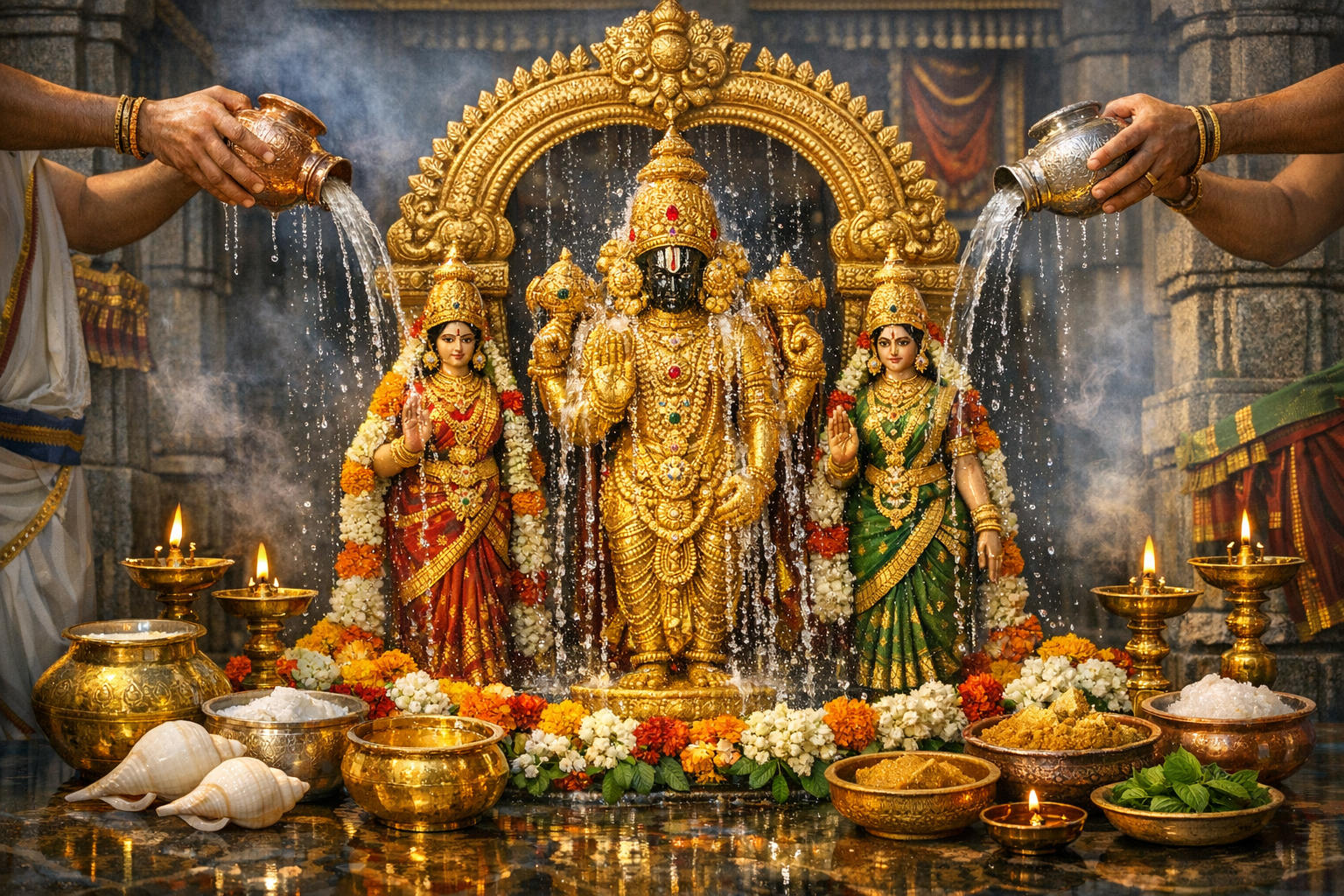
Jyeshtabhishekam, also known as Srivari Abhideyaka Abhishekam, is the three-day annual ceremonial bathing of the Utsava Murthis of Sri Venkateswara at the Tirumala Tirupati Venkateswara Temple. In 2026, this sacred observance is scheduled from 26 June to 28 June, aligned with Jyeshta Nakshatra in the lunar month of Jyeshta. The festival is one of Tirumala’s most venerated calendrical highlights, bringing together rigorous temple ritual, refined Agamic liturgy, and devotional fervor in equal measure.
The observance centers on Malayappa Swamy (the Utsava Murti of Srivari), accompanied by Sridevi and Bhudevi, and emphasizes the anointment and ritual strengthening of their Abhideyaka Kavacham (the protective golden armours). The term “Abhideyaka” encapsulates the protective and auspicious dimensions of the kavacham, while “Abhishekam” denotes the sanctifying bathing rite that revitalizes divine presence through mantra, water, and consecrated substances.
Situated within the Vaikhanasa Agama tradition followed at Tirumala, Jyeshtabhishekam weaves together a carefully sequenced liturgy that includes sankalpa, Vedic recitation, Snapana Tirumanjanam, and the re-adornment of the deities. The ritual focus is theological and technical: establishing, nourishing, and reaffirming the divine prana in the icon and its kavacha through well-defined acts of purification, invocation, and offering.
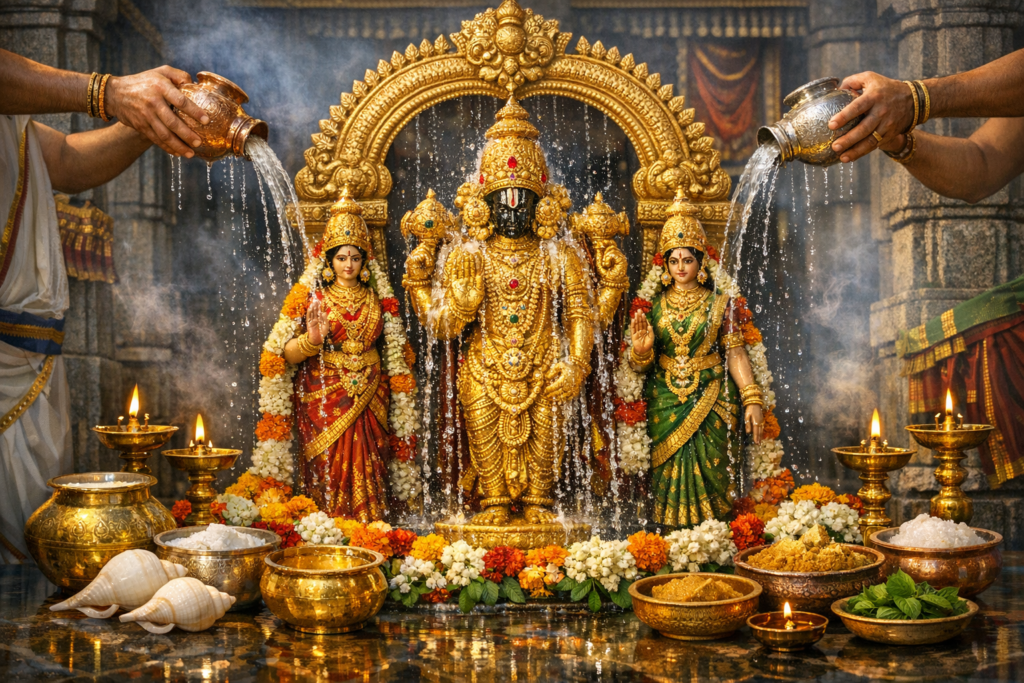
Across the three mornings, the priestly officiants perform Snapana Tirumanjanam with Panchamrita (milk, curd, ghee, honey, and sugar), tirtha sanctified in kalasas, sandalwood-infused waters, aromatic substances, and tulasi. The liturgy typically features recitations from Purusha Sukta, Sri Suktam, Bhu Suktam, Narayana Anuvakam, and Vishnu Sahasranama, maintaining the doctrinal cadence of Vaishnava worship as practiced at Tirumala.
The Abhideyaka Kavacham, removed and purified during the rites, is symbolically and ritually re-energized before being re-adorned on Malayappa Swamy, Sridevi, and Bhudevi. This cycle affirms a key tenet of temple worship: that the form, the armour, and the ornaments are outward vehicles of an inner and continuous divine presence that is sustained through mantra, mudra, and meticulously prescribed offerings.
For many pilgrims, Jyeshtabhishekam offers an emotionally resonant experience marked by the sound of conches, the cadence of Vedic chant, and the glimpse—often brief yet deeply moving—of the Utsava Murthis freshly anointed and radiantly ornamented. Families describe a quiet, shared awe as the first kalasa is poured; for elders, the festival sustains cherished memory; for children, it becomes a formative encounter with living tradition. Even those who witness the ceremony via SVBC broadcasts often speak of a palpable serenity transmitted through sight and sound.
The festival’s timing in Jyeshta maas under Jyeshta Nakshatra underscores an astrological consonance that is traditional in South Indian temple calendars. The lunar and stellar alignments serve not merely as markers but as frameworks within which the act of abhisheka becomes cosmologically attuned—a ritual echo of order, continuity, and protection in the life of the temple and its devotees.
Jyeshtabhishekam also resonates with the broader Dharmic family, reinforcing shared symbolism across Hinduism, Buddhism, Jainism, and Sikhism. Abhisheka, as consecrated anointment, has parallels in many Indic traditions: the ritual bathing of murtis in Hindu temples, jal-abhisheka of Jaina Tirthankara icons, ceremonial snana observances such as the Snana Yatra in Puri, and the sanctifying use of amrit in Sikh practice each reflect a common ethos of purification, blessing, and inner renewal. This shared grammar of sanctity strengthens inter-traditional understanding and unity.
As a temple event, Jyeshtabhishekam is devotional but also rigorously procedural. Preceding the festival, Ankurarpanam (the ritual sowing of sacred seeds) may be performed to symbolically germinate auspiciousness, while allied cleaning observances such as Koil Alwar Tirumanjanam—periodic temple purification—frame the festival within a larger cycle of ritual order and care for sacred space. These measures exemplify a consistent Agamic principle: the sanctum is nurtured through recurring purification, ornamentation, and re-consecration.
From a pilgrimage perspective, devotees generally assemble within the inner prakara, with darshan regulated by Tirumala Tirupati Devasthanam (TTD) protocols. Given that Jyeshtabhishekam falls in late June, when monsoon patterns may influence travel, pilgrims often prepare for fluctuating weather and longer queues. Conservative, temple-appropriate attire is expected, and the standard security and conduct guidelines of Tirumala apply.
An important aspect of Jyeshtabhishekam is its role in the living continuity of Srivari worship. Through the technical precision of the rites and the disciplined recitation of mantras, the festival transmits an unbroken ritual memory—what scholars of ritual studies might term a liturgical archive—handed down via guru–shishya parampara among Tirumala’s archakas and custodians.
For those studying South Indian Agamic practice, Jyeshtabhishekam provides a valuable case in applied Vaikhanasa procedure: the integration of specific substances and mantras with the functional theology of vigraha, kavacha, and alankara. In addition, the event’s timing by nakshatra, the aesthetic of ornamentation, and the sensory arc of sound, fragrance, texture, and sight collectively reinforce the principle that sacred experience is multi-sensory and carefully curated to mirror cosmic order.
In 2026, with Jyeshtabhishekam observed from 26 to 28 June, many will approach Tirumala to seek Srivari’s grace during this protective abhishekam. Whether in person at the temple or through broadcast darshan, the festival invites a steadying pause—an opportunity to realign life with rhythms of devotion, to cultivate inner clarity, and to participate in a pan-Indic language of sanctity that fosters unity across dharmic traditions.
As always, specific timings, access, and arrangements are governed by TTD and may be refined closer to the dates in accordance with the official Panchang and temple schedules. Pilgrims and students of ritual alike regard Jyeshtabhishekam as both a devotional anchor and a precise ceremonial handbook in motion—where theology and sentiment meet, and where protection, purity, and presence are renewed for the community.
Inspired by this post on Hindu Pad.






Leave a Reply
You must be logged in to post a comment.