
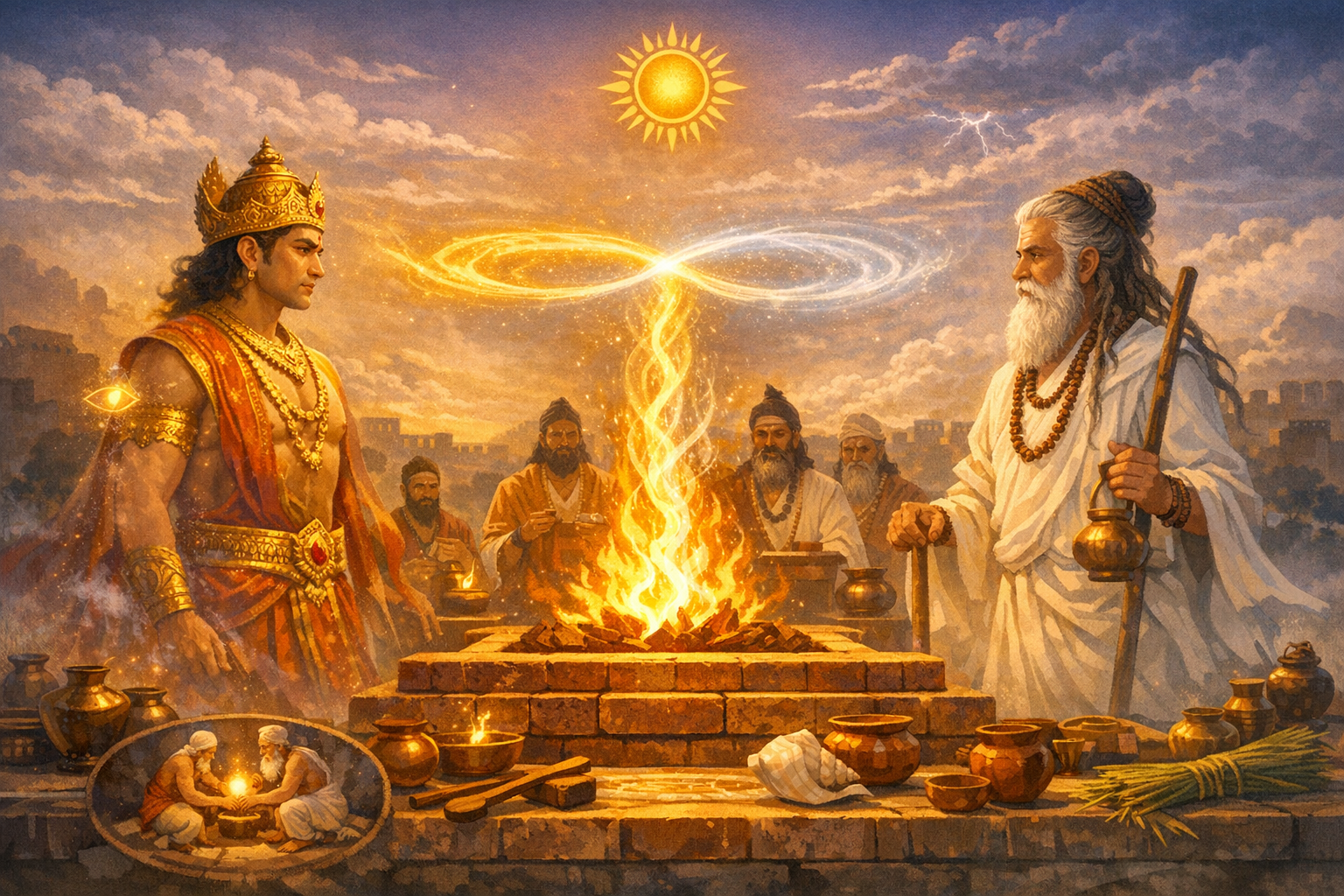
The narrative of King Nimi and Sage Vashishta, set within the illustrious Surya Dynasty (Suryavansha), offers a profound window into Vedic ritual practice, royal authority, and the ethics of commitment. It also explains, in striking mytho-historical detail, the origins of Videha and Mithila—lands later celebrated under the enlightened kings called Janaka. More than a dramatic clash between a monarch and a preceptor, the episode illuminates how dharma operates through choice, consequence, and cosmic reciprocity.
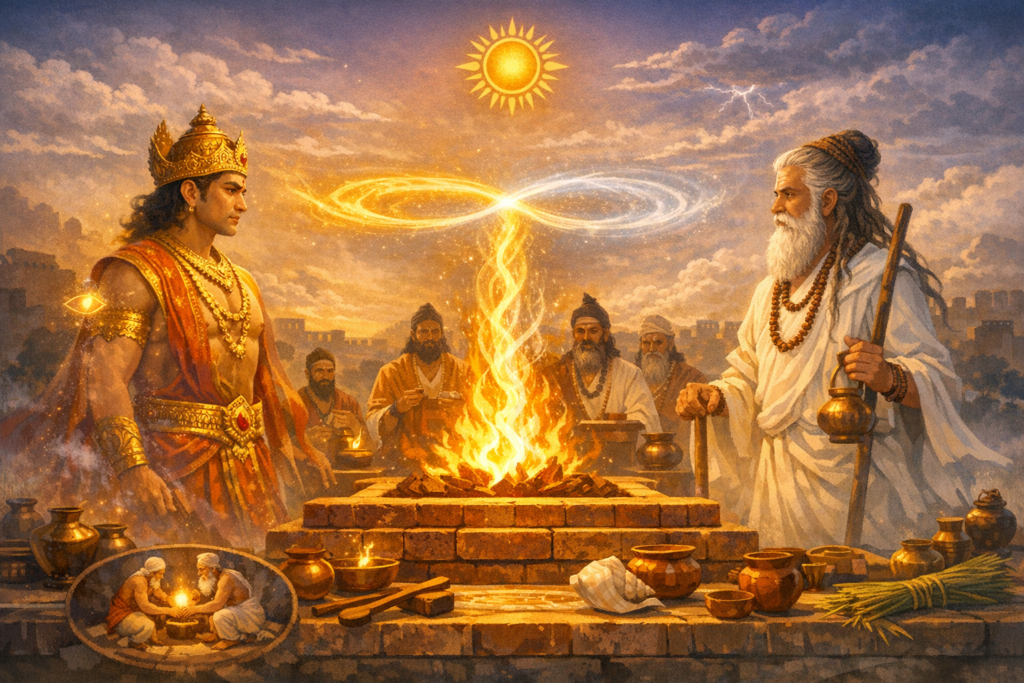
King Nimi, determined to conduct a grand Yagna (yajña) to invoke Indra and augment spiritual merit (puṇya and tejas), followed established convention by approaching the dynasty’s preceptor, the great Sage Vashishta, to preside as chief ṛtvij. Vashishta, however, had already pledged himself to another extensive sattra for Indra and therefore declined to take the role immediately. In the Vedic world, vows made to the devas and to ritual patrons are binding, and prioritization of prior commitments is itself part of the ethical fabric of dharma.
Undeterred by the potential delay and intent on fulfilling his royal vow, King Nimi turned to Kousika Rishi to preside over the sacrificial rites. Kousika Rishi, better known in later tradition as Vishvamitra, oversaw the ritual, which was undertaken with the full complement of Vedic officiants—Hotṛ (Rigvedic chanter), Adhvaryu (Yajurvedic liturgist responsible for the physical performance of the rite), Udgātṛ (Sāmavedic singer), and the overseeing Brahman priest who ensures textual and procedural precision. By all accounts, the Yagna was completed in accordance with srauta protocol.
When Vashishta learned that the rite had proceeded in his absence under another presiding sage, the situation escalated into a fateful exchange of śāpa (curses). In one widely preserved account (including Purāṇic genealogies and the Suryavaṁśa narratives of the Bhagavata Purana 9.13), Vashishta cursed King Nimi to become without a body—videha. In return, Nimi pronounced a counter-curse that deprived Vashishta, at least temporarily, of embodied life. The story thus enters a metaphysical register: actions and intentions reverberate through the moral cosmos, even when propelled by righteous aims.
The consequences for Nimi were both literal and symbolic. Becoming videha—bodiless—he refused to re-enter his corporeal frame when offered the chance by the devas. Various retellings add that Nimi took subtle residence on the eyelids of living beings, giving rise to the term nimisha, the measure of a “wink of the eye.” From this transformation emerges the name of the region, Videha, honoring the king’s unique state, and underscoring a central Vedic idea: identity can transcend the merely physical without losing its guiding potency.
Ritual specialists, unwilling to let the royal line perish, preserved Nimi’s body and, by churning (manthana) in a rite patterned on generative Vedic symbolism, brought forth a son named Mithi. Mithi founded Mithila, and the line of Videha flourished with rulers renowned as Janaka—an honorific that later culminated in the celebrated Janaka, father of Sita and interlocutor of the sage Yajnavalkya in the Brihadaranyaka Upanishad. Thus, a conflict born in the sacrificial arena paradoxically fertilized one of the most luminous strains of Indic philosophical kingship.
Vashishta’s own arc also reflects cyclical rebirth and renewal in Vedic myth. Some Purāṇic tellings recount that, due to the curse, he underwent a rebirth associated with Mitra and Varuṇa and the apsara Urvashi—a reminder that even the loftiest rishis move within cosmic law. Eventually restored to his august station, Vashishta continued to guide the Suryavansha, while the parallel ascent of Kousika Rishi toward the status of Brahmarshi (as Vishvamitra) underscored the possibility of profound spiritual transformation through tapas and insight.
Beyond its dramatic surface, the episode functions as a commentary on dharma’s complexity. Nimi’s resolve to fulfill his vow and Vashishta’s steadfast loyalty to a prior ritual commitment both align with duty. Yet the heat of honor and haste—kṣobha—tilted the balance toward conflict. In Vedic moral reasoning, intention (saṅkalpa), right means (samyak-sādhana), and right timing (kāla) co-determine the fruit (phala). Where these misalign, even righteous aims can precipitate karmic turbulence.
Understanding the ritual architecture amplifies the gravity of the decision-point. A royal-scale soma-Yagna or sattra demanded long durations, precise calendrical timing, and the orchestration of multiple liturgical streams. Indra-invoking sacrifices, by narrative convention, could span extraordinarily long periods, reinforcing why Vashishta’s prior pledge mattered. At the same time, a kṣatriya’s solemn vow to the devas carried its own urgency. The story thus dramatizes a classical ethical impasse: competing goods, limited time, and the need for transparent counsel.
Seen through a philosophical lens, Nimi’s videha state prefigures later Indian reflections on “bodilessness” not as annihilation, but as a mode of subtle identity. In the Upanishadic horizon where King Janaka shines, videhatva becomes an emblem for detachment from gross embodiment and ownership—what Advaita terms asanga and what the wider dharmic world associates with inner freedom (mokṣa). The unraveling of Nimi’s physical presence bequeaths a land and lineage dedicated to inquiry, virtue, and self-knowledge.
As a Hindu Story with roots in the Puranas, the narrative also resonates across dharmic traditions. The call for patience (kṣānti) and humility (alpa-garva) echoes the Buddhist pāramitā of forbearance; the insistence on clarity of vows and non-possessiveness recalls Jain anuvratas such as aparigraha; and the emphasis on honest duty and inner composure aligns with Sikh virtues like sabar (patience) and nimrata (humility). By foregrounding restraint, truthful speech, and commitment-keeping, the tale unifies shared dharmic ethics rather than dividing them.
In leadership terms, the episode offers contemporary insight. Institutions—sacred or civic—depend on unambiguous commitments, transparent timelines, and the willingness to consult stakeholders without ego. Nimi’s and Vashishta’s clash teaches that righteous objectives require procedural clarity; the presence of multiple qualified guides (Vashishta and Kousika Rishi) should ideally expand wisdom, not fracture it. Both king and sage stand as mirrors: when heat rises, discernment and dialogue cool it into justice.
The coexistence of Vashishta and Kousika Rishi in a single royal narrative is itself emblematic. Vashishta embodies enduring lineage wisdom, while Kousika (Vishvamitra) dramatizes the audacity of transformation—from kṣatriya power to Brahmarshi insight. Their trajectories, side by side, map an inner journey well-known to all dharmic paths: the ascent from ambition to tapas, from possession to offering, and from rivalry to realization.
Textual traditions present minor variations in sequencing and emphasis—expected in a corpus as layered as the Puranas and the epic genealogies. Yet the throughline remains steady: vows matter, time matters, and inner balance matters most. The cosmos in these stories is responsive, not random; it reflects back the quality of human intention with mathematical fidelity.
Ultimately, the “duel of curses” is less about retribution and more about revelation. It reveals how quickly zeal can harden into absolutism, and how recovery requires humility from all sides. It also reveals why Videha and Mithila, born from crisis, grew into sanctuaries of wisdom—nurturing a Janaka who would host some of the subcontinent’s most penetrating spiritual dialogues. Such is the paradoxical power of a Vedic tale: a conflict in the sacrificial arena becomes a seed for civilization’s higher learning.
Read as spiritual insight, scripture-informed lore, and ethical case study, the story of King Nimi and Sage Vashishta invites a unifying remembrance: dharma thrives where patience, clarity, and compassion converge. That message, woven through Hinduism’s sacred texts and shared across Buddhism, Jainism, and Sikhism, remains a timeless guide to harmonious living and wise action.
Inspired by this post on Hindu Blog.





Leave a Reply
You must be logged in to post a comment.