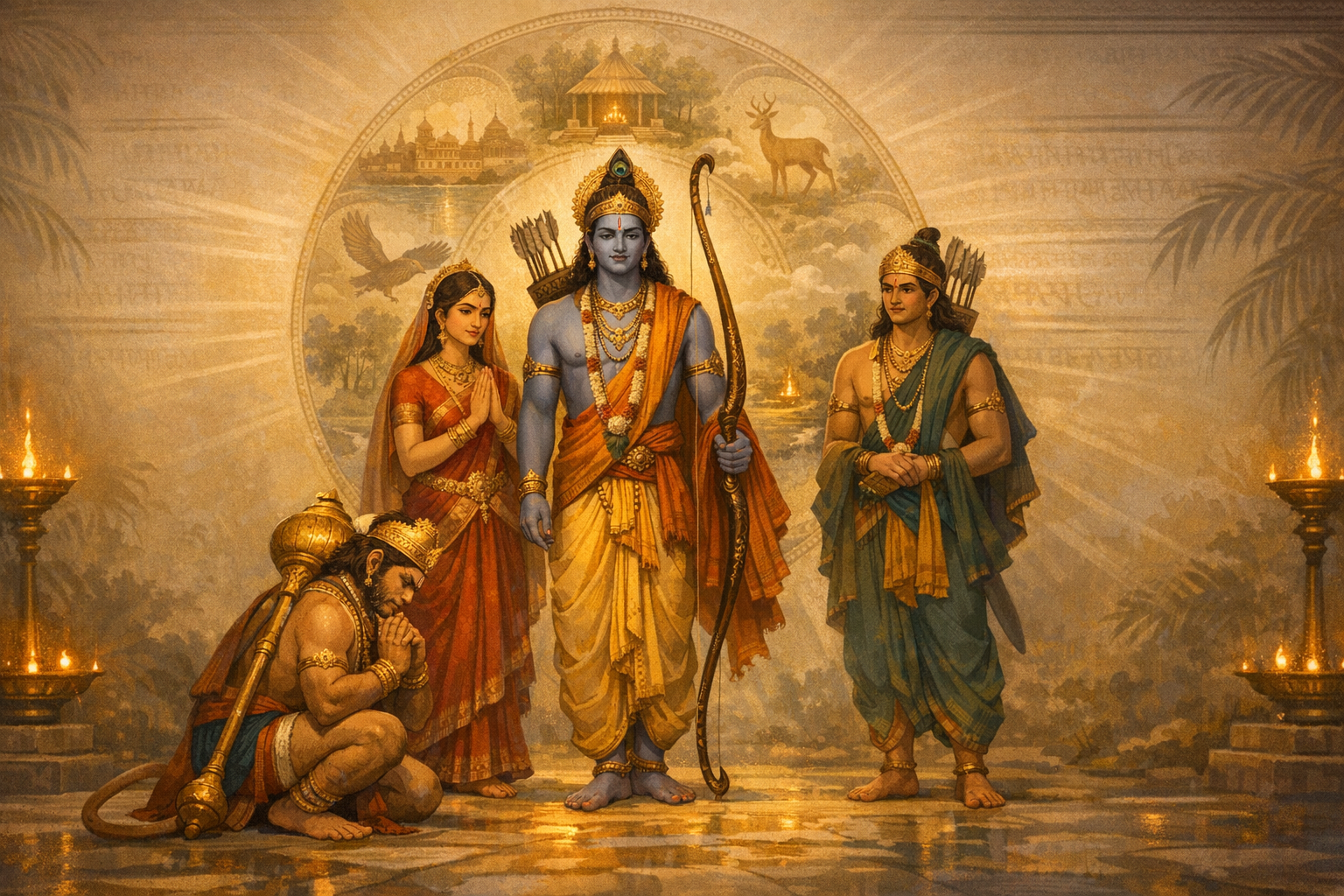
Rama (also reverently addressed as Sri Rama and Sriramachandra Moorthy) is venerated across the world as an avatara of Lord Vishnu; within the Ramayana tradition and Sri Rama Charitra he stands as the Maryada Purushottamathe exemplar of righteous conduct.
While regarded as the supreme Lord, he deliberately refrained from wielding divine powers for personal gain during his earthly life, choosing instead to model dharma through human restraint, courage, and compassion.
Primary knowledge of Rama Katha derives from the Valmiki Ramayana, traditionally structured into seven kandasBala, Ayodhya, Aranya, Kishkindha, Sundara, Yuddha, and Uttaraalongside later devotional retellings such as Tulsidas’s Ramcharitmanas, the Adhyatma Ramayana, Kamban’s Tamil Iramavataram, and regional adaptations across India and Southeast Asia.
Text-critical scholarship recognizes northern and southern Sanskrit recensions, with layers composed and redacted over centuries; this long textual evolution helped carry the ethical teachings of Lord Rama to diverse cultures while keeping the narrative’s core intact.
Born in Ayodhya of the Ikshvaku-Suryavamsa lineage to King Dasharatha and Queen Kausalya, Sri Rama shared royal upbringing with his brothers Bharata, Lakshmana, and Shatrughna, each embodying different dimensions of service, loyalty, and statecraft.
Training under sage Visvamitra, Rama protected Vedic yajnas, subdued Tataka, and released Ahalya from a curseepisodes that foreground the Ramayana’s synthesis of kshatra (valour) with karuna (compassion).
At the swayamvara of Sita in Mithila, Rama strung and broke Shiva’s great bow, thereby winning Sita’s hand; the allied marriages of Bharata–Mandavi, Lakshmana–Urmila, and Shatrughna–Shrutakirti consolidated bonds between the houses of Ayodhya and Videha.
In a turning point for the Sri Rama Charitra, Kaikeyi invoked two boons from DasharathaBharata’s coronation and Rama’s fourteen-year vanvas; Rama accepted exile without protest, upholding filial duty and state integrity over personal claim.
Bharata, rejecting the throne in moral solidarity, placed Rama’s sandals on Ayodhya’s throne and governed from Nandigrama as a regent, preserving the legitimacy and continuity of Rajadharma.
During forest life at Dandakaranya and Panchavati, Rama, Sita, and Lakshmana practiced austere simplicity; the rejection by Surpanakha, the conflict with Khara and Dushana, and the ethic of measured force illustrated the balance between protection and restraint.
The golden deer ruse by Maricha drew Rama away, enabling Ravana’s abduction of Sita; the valiant vulture-king Jatayu fell in her defense, symbolizing unhesitating sacrifice for dharma.
Searching southward led Rama and Lakshmana to Kishkindha, where an alliance with Sugriva promised mutual restorationSugriva to his kingship and Rama to Sita’s rescueif Rama confronted Vali’s unjust domination.
The Vali-vadha, debated in the tradition for its tactical concealment, is framed in many commentaries as an act of upholding dharma against a ruler who violated kinship ethics and the sanctity of refuge; this episode continues to spark rigorous ethical discourse.
Hanuman’s leap across the ocean, narrated in the Sundara Kanda, stands as a luminous portrayal of bhakti harnessed to courage and clarity; his discovery of Sita in Ashoka Vatika and his counsel of hope fortified the moral center of the Rama Katha.
The Setubandha to Lankaattributed in the tradition to the engineering prowess of Nala and Nila with the vanara senabecame a civilizational symbol of collective action, disciplined leadership, and problem-solving under adversity.
In the Yuddha Kanda, battles against formidable adversaries such as Kumbhakarna and Indrajit culminated in Rama’s victory over Ravana, aided by Vibhishana’s principled dissent; the triumph is celebrated as the vindication of dharma through just war (dharma-yuddha).
Sita’s Agni Pariksha, profoundly challenging to modern sensibilities, is interpreted across traditions as a testament to her purity and as an ordeal that reveals the tragic constraints of royal duty and public expectation in ancient polity.
Returning to Ayodhya in the Pushpaka Vimana, Rama underwent Sri Rama Pattabhishekam, inaugurating Rama Rajyaa classical idealization of governance marked by justice, prosperity, and compassionate order.
The Uttara Kanda confronts the burdens of kingship with stark honesty: persistent public rumor compelled Rama to ask Sita to reside in Valmiki’s ashrama, where she gave birth to Lava and Kusha; the sons later recited the Ramayana in their father’s court, stitching memory into governance.
At the close of the narrative, after the Ashvamedha and their eventual recognition, Sita returned to Mother Earth, and Rama, accompanied by his brothers, journeyed to the Sarayu, attaining the supreme abode of Vishnuan ending that re-centers the avatara within cosmic order.
Across the Sri Rama Charitra, the epithet Maryada Purushottama encapsulates a discipline of self-limitation: Lord Rama models how a sovereign subordinates personal emotion to Rajadharma, refuses to exploit divine advantage, and establishes ethical precedent through action, not decree.
Key ethical debatesVali-vadha, the Agni Pariksha, and Shambuka’s episodeare best read within the Ramayana’s layered textual history and political theology, where questions of rule of law, public trust, and social duty contend with intimate bonds.
Devotional practice complements this ethical lens: Rama-nama japa, Sundara Kanda parayana, and kirtana cultivate inner steadiness, framing Lord Rama not only as a historical-epic figure but as an abiding presence guiding everyday decisions.
Festivals such as Sri Rama Navami and Deepavali ritualize the arc from birth to victorious return, embedding the Rama Katha in the annual rhythm of communities in Ayodhya and far beyond.
Iconography typically depicts Kodanda Rama with Sita, Lakshmana, and Hanuman, communicating the unity of household virtue, fraternal loyalty, and devotional service as pillars of dharmic life.
Textual and artistic transmissions radiated across Asiathe Thai Ramakien, the Khmer Reamker, the Indonesian Kakawin Ramayana, and Laotian and Malay retellingseach honoring the Lord Rama narrative while reflecting local aesthetics and values.
Within Buddhism, the Dasaratha Jataka recounts Rāma-pandita as an exemplar of virtue; in Jainism, Vimalasuri’s Paumacariya (Prakrit Ramayana) reinterprets characters through Jain ethics; in Sikh scriptures, the divine Name ‘Ram’ resonates as a universal signifier of the One, emphasizing shared spiritual aspiration.
These interlinked traditions demonstrate a civilizational unity-in-diversity across Hinduism, Buddhism, Jainism, and Sikhism, where the Rama Katha becomes a common ethical vocabulary supporting mutual respect and harmony.
Modern readers often approach Lord Rama through leadership studies: decision-making under uncertainty, principled delegation, transparent succession, and crisis communication are repeatedly illustrated from Ayodhya’s court to the Kishkindha alliance.
The portrayal of Sita’s fortitude, Urmila’s unheralded sacrifice during the years of vanvas, and Tara’s wise counsel in Kishkindha broaden the Ramayana’s discourse on moral agency, emphasizing that dharma is sustained by both seen and unseen contributions.
Geocultural memory continues to animate sites such as Ayodhya, Chitrakoot, Panchavati, Rameshwaram, and Tirupati, weaving pilgrimage, temple worship, and study of scripture into the living practice of the Rama Katha.
Philosophically, the narrative integrates moksha-aimed devotion with a this-worldly ethic: it invites seekers to harmonize personal conduct with social responsibility, thereby aligning artha and kama within the overarching discipline of dharma.
That Lord Rama did not resort to spectacle or coercive miracles but to clarity, restraint, and lawful action explains his enduring appeal to householders, monks, civic leaders, and scholars alike.
In classrooms, satsangs, and civil society forums, the Ramayana offers a rigorous framework for ethics, empathy, and institution-buildingone that remains relevant from local governance to global diplomacy.
Read as scripture, literature, and lived ideal, the Rama Katha continues to illumine a path where courage bows to conscience, sovereignty bends to law, and devotion blossoms into compassionate service.
Inspired by this post on Hindu Pad.