
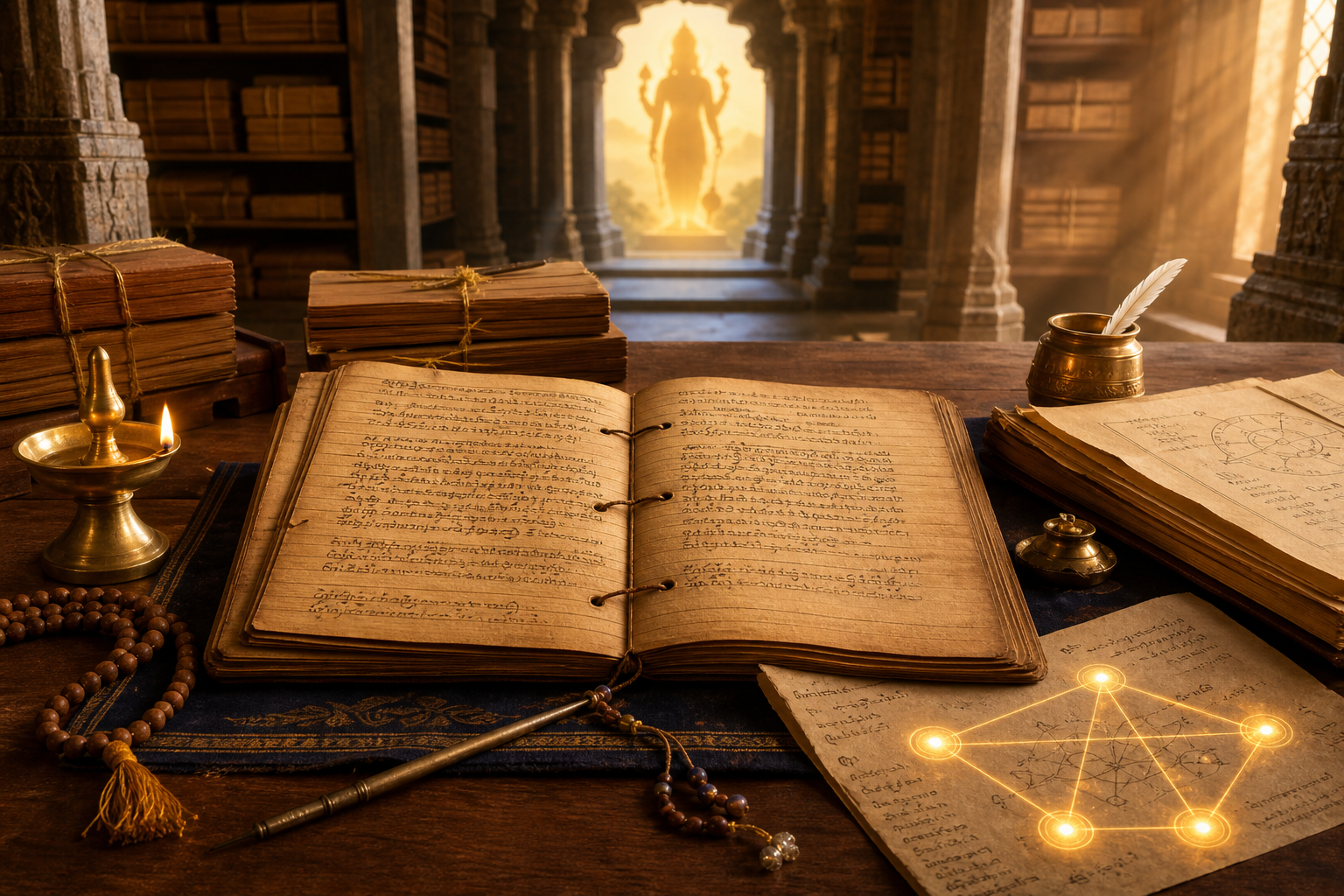
Nyayasudha occupies a commanding place in the intellectual history of Dvaita Vedānta. It is not merely a commentary in the ordinary sense of explanation; it is a rigorous philosophical defense of Madhvacharya’s Tattvavada, the realist school of Vedānta that affirms the enduring distinction between the Supreme Being, individual souls, and the world. Composed by Jayatirtha in the 14th century CE, Nyayasudha expands upon Madhva’s Anuvyākhyāna, itself a metrical exposition of the Brahma Sutras. In doing so, it turns a compact doctrinal foundation into one of the most sophisticated works of reasoning in the Hindu philosophical tradition.
The title Nyayasudha is often understood as “the nectar of logic,” a phrase that captures both the sweetness and the discipline of the work. Its sweetness lies in its devotion-centered vision of reality, where Vishnu or Narayana is presented as the independent Supreme Reality. Its discipline lies in the careful use of reasoning, scriptural interpretation, debate, inference, and philosophical analysis. The result is a text that can be read as theology, metaphysics, hermeneutics, and spiritual instruction at the same time.
To understand Nyayasudha, the broader setting of Vedānta must first be considered. Vedānta is built around the interpretation of the Prasthanatrayi: the Upanishads, the Bhagavad Gita, and the Brahma Sutras. Different Vedāntic traditions read these sources in distinct ways. Advaita Vedānta emphasizes non-duality, Viśiṣṭādvaita presents qualified non-duality, and Dvaita Vedānta defends a realist dualism in which God, the soul, and the world are not collapsed into one undifferentiated reality. Nyayasudha stands inside this grand conversation, not as an isolated sectarian text but as a major contribution to Indian philosophy.
Madhvacharya, the founder of Dvaita Vedānta, described his system as Tattvavada, the doctrine of reality or the realist viewpoint. This name is important because it reveals the philosophical confidence of the tradition. For Madhva, the world is not a mere illusion, the individual self is not ultimately identical with Brahman, and difference is not a temporary error to be overcome. Difference is real, meaningful, and essential to understanding existence. Jayatirtha’s Nyayasudha develops this insight with extraordinary precision.
The immediate source text of Nyayasudha is Madhva’s Anuvyākhyāna. Madhva had already written on the Brahma Sutras, but Anuvyākhyāna offered a poetic and philosophically dense restatement of his interpretation. Its compactness created the need for a deep explanatory tradition. Jayatirtha answered that need by producing a commentary that clarifies Madhva’s arguments, anticipates objections, responds to rival schools, and gives Dvaita Vedānta a formal dialectical structure. This is why Jayatirtha is honored as Ṭīkācārya, the master commentator.
Jayatirtha’s achievement was not limited to repeating Madhva’s views. He organized them, sharpened them, and placed them in conversation with the major philosophical traditions of his time. Nyayasudha engages Advaita Vedānta, Viśiṣṭādvaita, Nyāya, Mīmāṃsā, Sāṅkhya, Buddhist thought, and Jain philosophical positions. This engagement should be understood in its classical context: Indian philosophy developed through disciplined debate, where disagreement was a method of clarification. Nyayasudha represents that culture of śāstric inquiry at a high level.
The heart of Dvaita Vedānta is the distinction between svatantra and paratantra. The svatantra, the independent reality, is the Supreme Being alone. All other realities, including individual souls and matter, are paratantra, dependent realities. This does not make them unreal. Rather, their reality is meaningful precisely because they depend upon the Supreme. Nyayasudha repeatedly defends this distinction, showing how dependency does not erase existence but gives it theological and metaphysical order.
One of the most discussed doctrines in Madhva’s system is the pañcabheda, or fivefold difference. These five differences are between God and the individual soul, God and matter, one soul and another soul, soul and matter, and one form of matter and another. Nyayasudha treats these differences not as superficial appearances but as foundational truths. The world is prapañca, marked by plurality, and this plurality is not a defect in perception. It is the structure of reality as understood by Dvaita Vedānta.
This realist vision gives Nyayasudha its enduring philosophical force. Human experience presents difference everywhere: between persons, between moral choices, between devotion and indifference, between knowledge and error, between the finite and the infinite. Dvaita Vedānta argues that a philosophy that denies all such difference must explain why experience appears so consistently plural. Jayatirtha presses this point with logical care, insisting that scriptural interpretation should not violate valid experience, perception, and inference.
Nyayasudha therefore becomes a text about knowledge as much as about devotion. It accepts the importance of pramānas, the valid means of knowledge, especially perception, inference, and scriptural testimony. For Dvaita Vedānta, śabda or sacred testimony is indispensable in knowing what lies beyond ordinary perception, but it does not operate in hostility to reason. Jayatirtha’s method shows that faith and logic need not be enemies. The disciplined mind becomes a servant of spiritual truth.
The work also carries a strong hermeneutical purpose. The Brahma Sutras are famously brief, and their meaning has been debated for centuries. Madhva read them through the lens of a personal, supreme, attribute-filled Brahman identified with Vishnu. Nyayasudha defends this reading by examining wording, context, scriptural cross-reference, and philosophical consequence. Its concern is not only what a passage can be made to mean, but what interpretation best preserves the coherence of śruti, reason, and devotional experience.
The first major movement of the Brahma Sutras, traditionally associated with samanvaya or harmonization, becomes in Nyayasudha a defense of the unity of scriptural teaching. Jayatirtha argues that the Upanishadic statements, properly understood, point toward a supreme, personal, independent Brahman. Terms that appear ambiguous are interpreted in a way that preserves the supremacy, perfection, and independence of Vishnu. This is not presented as mere preference but as a reasoned claim about the deepest intention of Vedānta.
The second movement, associated with avirodha or non-contradiction, allows Jayatirtha to address apparent conflicts between scripture, reason, and rival philosophical systems. Nyayasudha examines competing explanations of creation, causality, agency, and the relation between God and the world. It rejects the idea that insentient matter can be the ultimate source of cosmic order, and it resists explanations that weaken divine agency. In this way, the text brings metaphysics into direct relationship with theology.
The third movement, associated with sādhana or spiritual means, shows that Nyayasudha is not an abstract logical exercise detached from life. Dvaita Vedānta places bhakti at the center of liberation. Knowledge, ritual action, ethical discipline, and meditation all receive meaning when oriented toward devotion to the Supreme. Liberation is not a self-generated intellectual triumph; it is dependent upon divine grace. This gives the text a deeply devotional atmosphere beneath its dense logical surface.
The fourth movement, associated with phala or the fruit of spiritual realization, concerns moksha. In the Dvaita understanding, liberation does not dissolve the individuality of the soul into absolute identity with Brahman. The liberated soul remains distinct, fulfilled, and dependent upon the Supreme. This preserves the relational character of devotion. The devotee does not vanish into the object of devotion; rather, the devotee realizes true dependence, true knowledge, and true participation in divine grace.
Nyayasudha is also important for its handling of debate with Advaita Vedānta. The text questions whether the doctrine of māyā can adequately explain the experience of plurality, moral responsibility, devotion, and scriptural instruction. If difference is ultimately unreal, then the distinction between seeker, teacher, scripture, ignorance, knowledge, and liberation becomes philosophically difficult. Jayatirtha develops these concerns with technical rigor, making Nyayasudha one of the central Dvaita responses to non-dualism.
At the same time, a dharmic reading of Nyayasudha should avoid reducing it to hostility between traditions. Indian philosophical traditions have often advanced through sharp disagreement while remaining rooted in shared commitments to truth, liberation, discipline, and sacred learning. Dvaita, Advaita, Viśiṣṭādvaita, Jainism, Buddhism, and other systems developed their own methods of reasoning, and their debates enriched the intellectual life of Bharat. Nyayasudha should be appreciated as part of this larger civilizational conversation.
This point is especially important in the present age. The goal of studying Hindu scriptures and dharmic philosophy should not be to inflame division but to deepen understanding. Nyayasudha defends Dvaita Vedānta with firmness, yet its existence also reminds readers that Sanatana Dharma has long made room for rigorous inquiry, multiple viewpoints, and disciplined disagreement. A tradition confident enough to debate is also a tradition confident enough to preserve diversity within a shared sacred horizon.
The literary quality of Nyayasudha deserves attention as well. Though the work is technical, it carries the marks of classical Sanskrit intellectual culture: compression, precision, layered meaning, and an expectation that the reader will think slowly. It does not flatter impatience. It asks for attention, repetition, and humility. For a modern reader used to quick summaries, this can feel demanding. Yet that demand is part of its value. Nyayasudha trains the mind to respect complexity.
Jayatirtha’s style is often praised for clarity, but clarity in this context does not mean simplicity. It means that difficult matters are handled in a disciplined order. Objections are stated, assumptions are tested, definitions are refined, and conclusions are defended. This gives Nyayasudha a pedagogical power. It teaches not only what Dvaita Vedānta holds, but how a serious philosophical mind should proceed when handling sacred texts and metaphysical claims.
The emotional force of Nyayasudha lies in its protection of relational spirituality. If the soul is real, if the world is real, and if God is supremely real, then devotion is not a provisional practice for the less philosophical. Bhakti becomes a truthful response to reality. Love, surrender, reverence, and grace are not symbolic lower steps to be discarded; they are central to the soul’s relationship with the Supreme. This makes Dvaita Vedānta especially powerful for devotees who experience spiritual life as relationship rather than abstraction.
In this sense, Nyayasudha bridges intellectual rigor and lived religion. It does not ask the devotee to choose between the temple and the philosophical classroom. The same reality worshipped through mantra, puja, and devotion is examined through logic, grammar, and metaphysics. Such integration is one of the strengths of Hindu philosophy. The sacred is not confined to emotion, and reason is not cut off from reverence.
The influence of Nyayasudha on later Dvaita literature was immense. Later scholars such as Vyāsatīrtha, Vijayindra Tirtha, Raghuttama Tirtha, Raghavendra Tirtha, and other Madhva thinkers worked within the intellectual world that Jayatirtha helped consolidate. His commentary gave later Dvaita philosophers a model of argumentation and a foundation for further debate. Without Nyayasudha, the later flowering of Dvaita dialectics would be difficult to imagine.
The text also belongs to the wider history of Sanskrit literature. It demonstrates that Sanskrit was not only a language of poetry, ritual, and mythology, but also a language of exact philosophical analysis. Works like Nyayasudha show how Indian scholars developed technical vocabularies for logic, epistemology, ontology, hermeneutics, and theology. This intellectual inheritance remains essential for anyone seeking a serious understanding of Indian Knowledge Systems.
Nyayasudha’s relevance today is not limited to traditional monastic study. It raises questions that remain philosophically alive. Is the world ultimately real? Is individuality meaningful? Can reason support devotion? How should sacred texts be interpreted when different traditions read them differently? What is the relationship between experience and revelation? These questions continue to matter because they shape how human beings understand identity, duty, worship, and liberation.
For contemporary Hindu society, Nyayasudha also offers a lesson in intellectual seriousness. Tradition is not preserved only by sentiment. It is preserved by study, argument, translation, teaching, and the willingness to engage difficult texts. A community that remembers its philosophical classics gains more than pride; it gains vocabulary, discrimination, and depth. Nyayasudha is one such classic that invites renewed attention from students of Hindu scriptures, Indian philosophy, Sanskrit literature, and Vedānta.
For readers from Buddhist, Jain, Sikh, and other dharmic backgrounds, the text can be approached as part of a shared culture of inquiry. While its conclusions are distinctly Dvaita and Vaishnava, its method belongs to the larger Indic habit of disciplined reflection. Dharmic traditions have often differed in metaphysics while sharing respect for sadhana, ethical refinement, liberation, and the transformation of consciousness. Nyayasudha adds one powerful voice to that many-sided inheritance.
Its study also encourages humility. No single summary can exhaust Nyayasudha, and no casual reading can capture its full architecture. The text emerged from a world where students trained for years in grammar, logic, scripture, and debate. Modern introductions can open the door, but the work itself asks for patient engagement. That patience is not a burden; it is the very discipline through which śāstra becomes transformative.
Nyayasudha remains a monumental literary and philosophical work because it gives Dvaita Vedānta both a voice and a method. It defends the reality of difference, the supremacy of Vishnu, the dependence of the soul, the meaningfulness of devotion, and the authority of the Brahma Sutras as read through Madhvacharya’s tradition. Its enduring power lies in the way it unites logic with devotion and scholarship with spiritual seriousness.
In the long history of Hindu philosophy, Nyayasudha stands as a reminder that faith need not fear reason and reason need not become spiritually barren. Jayatirtha’s work continues to challenge the mind, strengthen the devotional imagination, and preserve one of the most important streams of Vedānta. For anyone seeking to understand Madhvacharya, Dvaita Vedānta, or the intellectual richness of Sanatana Dharma, Nyayasudha remains indispensable.
Inspired by this post on Hindu Blog.






Leave a Reply
You must be logged in to post a comment.