
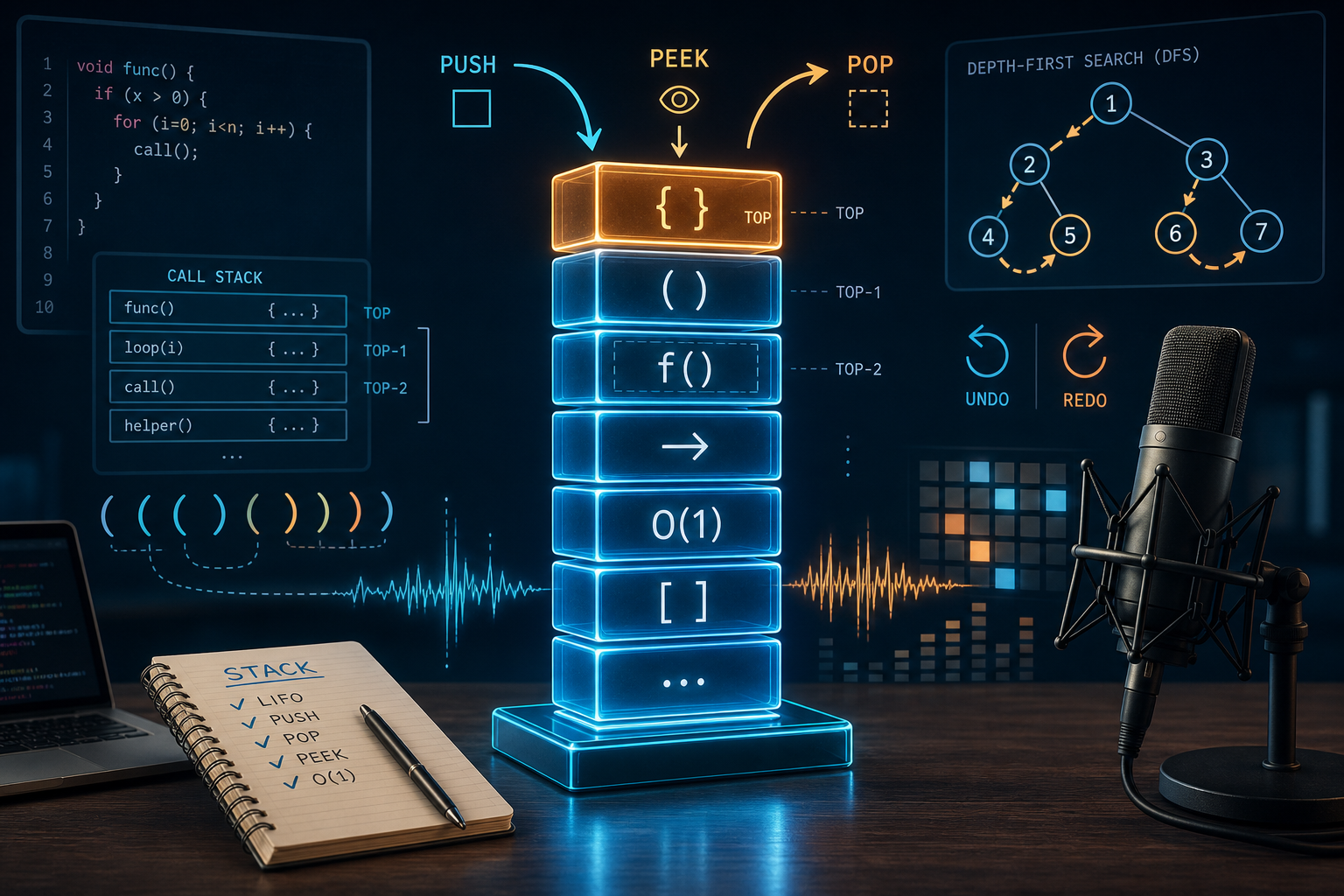
The phrase “Stack Attack Rap” points toward a useful and memorable way of teaching one of the most important ideas in computer science: the stack. Although the available source material contains only a video thumbnail and no transcript, lyrics, or explanatory article, the topic can still be developed accurately by focusing on the technical concept that gives the title its force. A stack is a structured collection of data governed by a simple but powerful rule: the last item placed onto it is the first item removed from it. This principle is usually called LIFO, meaning “last in, first out.”
In computer science education, the stack is often introduced through everyday metaphors. A pile of plates, a stack of books, or a set of trays in a cafeteria all communicate the same basic idea. The newest item is easiest to access because it sits on top. The older items remain below it until the newer items are removed. This concrete image helps learners grasp why stack operations are intentionally restricted and why those restrictions make the structure useful, efficient, and predictable.
The two central operations of a stack are push and pop. To push means to add an item to the top of the stack. To pop means to remove the item currently on top. A third common operation, peek or top, allows a program to inspect the top element without removing it. These operations are simple, but their simplicity is precisely what gives the stack its strength. In most implementations, push, pop, and peek run in constant time, often described as O(1), because the program does not need to search through the whole collection.
A stack can be implemented in several ways. In an array-based implementation, the stack is stored in contiguous memory, and a variable tracks the current top index. In a linked-list implementation, each node points to the next node below it, and the head of the list acts as the top of the stack. Both approaches preserve the same LIFO behavior, although they differ in memory management, resizing behavior, cache locality, and practical performance. This makes the stack a useful teaching bridge between abstract data types and concrete memory models.
The technical importance of stacks becomes clearer when examining the call stack. When a function calls another function, a new frame is pushed onto the call stack. That frame stores information such as local variables, return addresses, and execution context. When the function finishes, its frame is popped, and control returns to the previous function. This is why recursive functions depend so deeply on stack behavior. Each recursive call adds a new layer of context, and each return removes one layer until the base case is reached.
The same mechanism also explains the familiar error known as stack overflow. When a program keeps pushing frames onto the call stack without enough corresponding returns, available stack memory can be exhausted. This often happens in uncontrolled recursion, especially when a base case is missing or unreachable. The term is now widely recognized beyond its technical origin, but its original meaning remains precise: the stack has grown beyond its allocated capacity.
Stacks also appear in expression evaluation and parsing. Compilers and interpreters use stack-like logic to process parentheses, operators, function calls, and nested structures. For example, checking whether brackets are balanced is a classic stack problem. When an opening bracket appears, it is pushed. When a closing bracket appears, the program pops the most recent opening bracket and checks whether the pair matches. This method works because nested expressions naturally follow LIFO order.
Another major use case is undo and redo behavior. In many applications, recent actions are placed on a stack. When the user chooses undo, the most recent action is removed and reversed. A second stack can preserve undone actions for redo. Browser history, text editor commands, drawing tools, and workflow applications often rely on this conceptual pattern. The result feels intuitive to users because human correction frequently moves backward through recent steps in reverse order.
Educational rap, including a concept such as “Stack Attack Rap,” can be effective because rhythm supports memory. Technical vocabulary such as push, pop, peek, LIFO, overflow, recursion, and call stack can feel abstract when presented only through definitions. When these terms are arranged in a rhythmic structure, learners may retain them more easily. This does not replace rigorous study, but it can provide a memorable entry point into a difficult subject.
There is also a deeper pedagogical value in combining music with computer science. Programming is often treated as purely logical, but learning to program involves pattern recognition, repetition, timing, and emotional persistence. A rap format can make a technical idea less intimidating without making it less serious. The best educational content does not dilute the subject; it gives learners a doorway into it. Once the basic rhythm of LIFO is understood, more advanced topics become easier to approach.
The stack’s simplicity should not be mistaken for triviality. Many of the most reliable ideas in computational systems are powerful because they impose disciplined constraints. A stack does not allow arbitrary removal from the middle. It does not pretend to be a general-purpose list. It does one thing with clarity: it preserves a strict order of access. This is a valuable lesson for software design. Good systems often become robust by limiting what can happen, not by allowing every possibility at every moment.
From an academic perspective, the stack also introduces students to abstraction. An abstract data type is defined by behavior rather than implementation. Whether the underlying code uses an array, a linked list, or a language-provided collection, the stack remains a stack if it follows the expected operations and LIFO semantics. This distinction between interface and implementation is foundational for computer science, software engineering, and long-term maintainable programming.
The emotional appeal of a “stack attack” theme lies in the experience many learners share when first confronting programming. Concepts pile up quickly: variables, functions, loops, recursion, memory, syntax, and errors. A stack becomes more than a data structure; it becomes an image of learning itself. One idea is placed on top of another, and understanding often comes by unpacking them in reverse order. The student returns to the most recent confusion, resolves it, and then moves down to the next layer.
This makes the stack a particularly relatable subject for educational storytelling. The learner who understands push and pop can begin to see stacks everywhere: in nested browser pages, in command histories, in puzzle solving, in syntax checking, and in mental models of task management. The idea becomes a small but durable tool for organizing complexity. That is why stacks remain a standard topic in introductory computer science, data structures courses, technical interviews, and software design discussions.
A careful treatment of stacks should also mention their limits. A stack is not appropriate when frequent access to arbitrary elements is required. It is not a replacement for a queue, which follows FIFO, or “first in, first out,” behavior. It is not the same as a priority queue, which removes elements according to priority. Choosing a stack is therefore a design decision. It is correct when the problem naturally requires reversing order, tracking nested state, managing recent actions, or returning through layered execution contexts.
In practical programming, stacks may be explicit or implicit. An explicit stack is created by the programmer, often through an array, list, vector, or dedicated stack class. An implicit stack is maintained by the runtime system, such as the call stack used during function execution. Advanced programmers often convert recursive algorithms into iterative ones by managing their own explicit stack. This technique can reduce the risk of stack overflow and provide more direct control over memory and execution flow.
Depth-first search is a classic example. Recursive depth-first search relies on the call stack, while iterative depth-first search uses an explicit stack. Both approaches follow the same conceptual pattern: explore the most recently discovered path before returning to earlier alternatives. This behavior is useful in graph traversal, tree processing, maze solving, dependency analysis, and many search problems. The stack, therefore, is not merely a classroom abstraction. It is part of real algorithmic practice.
The cultural form of a rap can help communicate this technical reality. Rap often works through sequence, emphasis, repetition, and layered meaning. A stack works through order, discipline, repetition, and controlled removal. The parallel is not accidental. A strong educational performance can turn algorithmic vocabulary into a pattern that the mind can rehearse. For students who struggle with conventional textbook explanations, this kind of creative teaching can provide a second path into the same knowledge.
At the same time, technical accuracy matters. A catchy explanation should still distinguish clearly between stack memory and heap memory, between a stack as an abstract data type and the call stack managed by a runtime, and between stack overflow as a memory condition and ordinary program failure. These distinctions protect learners from oversimplification. Good educational media opens the door, but precise study builds the room behind it.
The enduring lesson of the stack is that disciplined order can make complexity manageable. In software, as in learning, not everything needs to be accessed at once. Sometimes the most effective method is to handle the most recent layer first, resolve it cleanly, and then return to what came before. That is the quiet power behind LIFO logic. Whether introduced through a lecture, a diagram, a code example, or a memorable “Stack Attack Rap,” the stack remains one of the clearest gateways into computational thinking.
Inspired by this post on Dandavats.
