

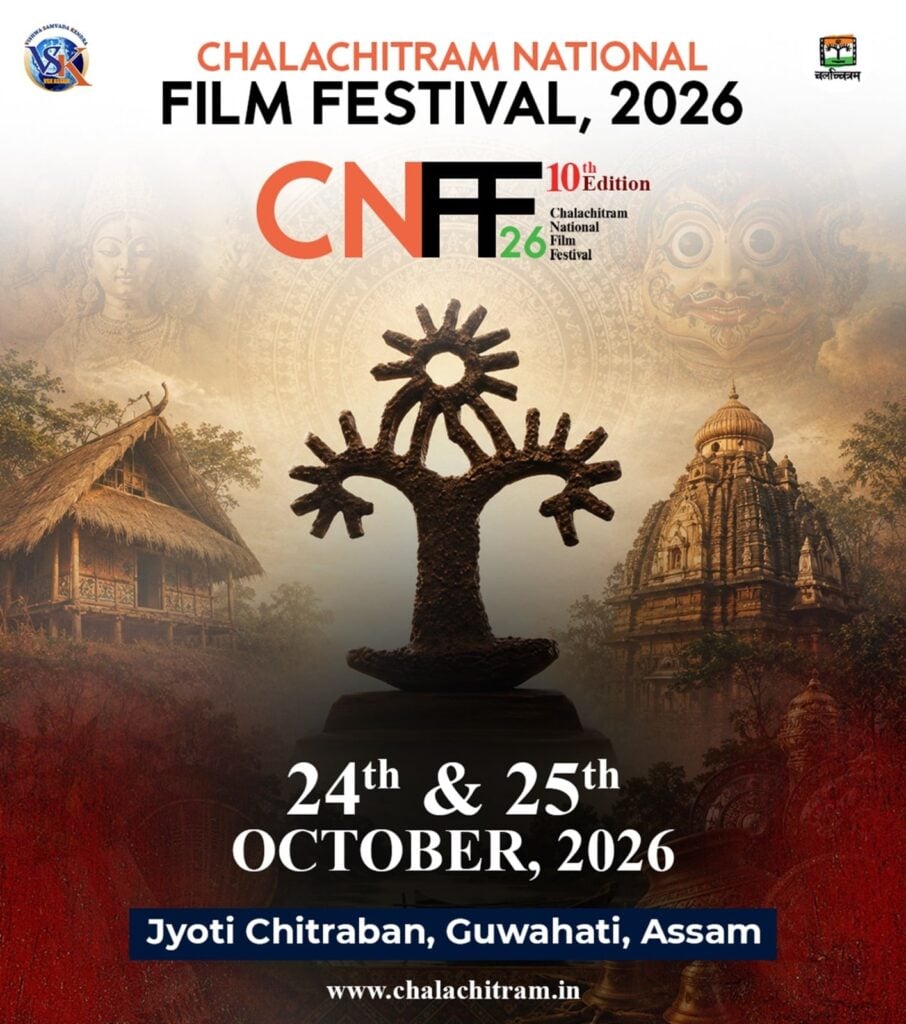
On 24 and 25 October 2026, Guwahati is scheduled to host the 10th edition of the Chalachitram National Film Festival, widely referred to as CNFF, at the Jyoti Chitraban film society premises in Kahilipara. The event occupies a distinctive space in the Indian cinema calendar because it is designed around short-duration films that engage with nationalism, civilisational memory, cultural heritage, social responsibility, and the lived traditions of Bharat. For film enthusiasts, cine critics, students, and producer-directors from eastern India and beyond, CNFF 2026 is therefore not merely a screening platform. It is a cultural forum where cinema becomes a method of remembering, questioning, documenting, and renewing a shared civilisational inheritance.
The festival is organised by Chalachitram, a subsidiary of Vishwa Samvad Kendra- Assam, and has developed under the mentorship of Bharatiya Chitra Sadhna. Its focus on short features and documentaries gives it a practical and democratic character. A one-minute film and a 25-minute documentary may differ in form, scale, and ambition, but both can carry a concentrated moral and cultural argument. This makes CNFF especially relevant for young filmmakers, independent creators, students of media, and first-time storytellers who may not yet have access to large production ecosystems but do have access to powerful local stories.
CNFF began in 2017 as the Guwahati Film Festival and was renamed in 2019 with the central theme of ‘Our Heritage Our Pride’. That phrase is important because it frames heritage not as nostalgia, but as a living intellectual and social resource. In the Indian context, heritage includes temples, manuscripts, textiles, music, oral traditions, social reform movements, indigenous festivals, family values, Yoga-meditation-Ayurveda, traditional sports, monuments, artisans, freedom movement heroes, epics and mythology, and the ethical imagination that has shaped communities across regions. A festival built around such themes naturally invites a wider discussion on how cinema can preserve memory without freezing society in the past.
The stated thematic range of the festival is broad. It includes Indian heritage, indigenous society, national integration and solidarity, arts and artisans, women empowerment, environment, land and people, tourism, handicrafts and textiles, wood carving, manuscript paintings, music and musicians, traditional sports, monuments and heritage sites, social reformers and pioneers, and the tea and oil industries. This range is significant because it reflects the layered nature of Bharat’s public life. Cultural nationalism, when treated seriously, is not a narrow slogan; it becomes a study of civilisational continuity, local knowledge, social cohesion, ethical responsibility, and the effort to connect regional experiences with a larger national consciousness.
The 2026 edition is expected to honour selected entries with trophies, certificates, and cash prizes in the presence of film personalities and cine-goers. A jury board consisting of artistes, critics, film-makers, writers, and other professionals is responsible for selecting the award-winning films. The award structure includes five recognitions in the North East India category, covering best short feature, best documentary, best director, screenplay, cinematography, and editing. The All India category includes awards for best short feature and best documentary. By separating regional and national categories, the festival acknowledges both the specificity of North-East India and the wider cinematic imagination of the country.
The eligibility framework also indicates the festival’s emphasis on recent and compact work. Entries are required to be between one minute and 25 minutes in duration and must have been produced between 1 September 2025 and 1 Sept 2026. The categories are open to both professionals and novice filmmakers. This openness matters because cultural documentation often begins outside formal institutions. A young person recording a fading folk performance, a local filmmaker capturing the loneliness of elders, or a student documenting a traditional craft may produce work that is modest in budget but substantial in cultural value.
Within India’s expanding festival landscape, CNFF stands alongside a wider network of film platforms such as MAMI Mumbai Film Festival, Great Indian Film and Literature Festival, Asia Livelihood Documentary Festival, Alpavirama South Asian Short and Documentary Film-fest, Bangalore Queer Film-fest, Brahmaputra Valley Film-fest, Jagran Film-fest, Jeevika Film-fest, Kalakari Film-fest, National Science Film-fest, Patna Film-fest, Rajasthan Film-fest, Tigerland India Film-fest, Verite Film-fest, and Vibgyor Film-fest. Each festival develops its own emphasis, audience, and institutional personality. CNFF’s distinctive contribution lies in its stated commitment to Bharat’s cultural heritage, national integration, and socially meaningful storytelling.
The previous edition, the 9th CNFF, offers useful insight into the festival’s evolving identity. It was inaugurated by Dr Sunil Mohanty, Asom khetra prachar pramukh of Rashtriya Swayamsevak Sangh, through the lighting of sacred lamps before portraits of Bharat Mata, Dr Bhupen Hazarika, Zubeen Garg, and Deepak Sarma. More than 30 short features and documentaries were screened across competitive and non-competitive categories. The films addressed difficult emotional and social subjects, including old-age loneliness, the search for dignity near the end of life, the meaning of death, family estrangement, fraud, greed, environmental concern, and the civilisational heritage of Bharat.
One of the most compelling aspects of the festival’s earlier programming was its attention to the elderly. Films that explore ageing in urban localities often carry an emotional force that cannot be captured through policy language alone. The loneliness of retired professionals, the quiet vulnerability of those living away from extended family systems, and the longing for companionship become cinematic windows into a changing society. In such stories, the erosion of family values is not treated as an abstract complaint. It is shown through rooms, gestures, silences, phone calls, medicines, rituals, and the fragile hope that someone will still arrive when needed.
The festival has also engaged with caste-based inequality and the struggle of under-privileged individuals seeking a dignified life. Such films are important in a cultural platform because heritage cannot be discussed honestly unless social wounds are also examined. A dharmic civilisational outlook is strengthened, not weakened, when it confronts injustice and supports dignity. Cinema can make that confrontation intimate. It can show how prejudice functions in daily life, how resilience forms under pressure, and how social reform requires both institutional attention and moral courage within families and communities.
Another notable area of concern has been the representation of slow learners and differently-able children. Films on such themes can expose audiences to emotional realities that are often overlooked in public conversation. The pain, patience, and tenderness surrounding children with different learning needs require a cinema of care rather than spectacle. When handled responsibly, documentary and short-feature formats can help viewers move beyond pity toward understanding. They can also encourage families, schools, and communities to develop more sensitive attitudes toward children whose abilities do not fit conventional expectations.
CNFF’s interest in indigenous and regional traditions gives the festival a strong cultural research dimension. Earlier entries reportedly explored matriarchal social patterns, ancient practices of magic that continue to fascinate young minds, the survival of traditional Assamese string puppetry, textile traditions across Bharat, and rural tales of malevolent spirits once widely heard in village life. These subjects are not peripheral to national culture. They are part of the archive of memory through which communities understand fear, celebration, marriage, work, nature, gender, death, and belonging.
The attention given to textiles, manuscripts, paintings, wood carving, folk songs, and ritual practices is particularly relevant in an age shaped by digital acceleration. Modern technology can help preserve cultural forms, but it can also flatten them into consumable images detached from their original contexts. A festival like CNFF can help restore context by encouraging filmmakers to document the people behind the craft: the artisan’s hand, the inherited technique, the regional vocabulary, the economic pressure, the apprenticeship system, and the spiritual or social meaning attached to the work. In this sense, cinema becomes both an art form and a method of cultural preservation.
The festival’s focus on youth also deserves close attention. Some earlier films addressed young people struggling with changing psychological needs, isolation from relatives, and uncertainty about studies and future careers. Yet these films reportedly carried a positive note, showing young characters renewed by unconditional affection from their nearest ones and prepared to move forward with responsibility and belonging. This is a crucial theme for contemporary Indian society. National integration is not sustained only by institutions; it is also sustained by emotionally healthy families, meaningful intergenerational bonds, and a sense that the individual has a place within society.
From an academic perspective, CNFF can be read as part of a broader movement in Indian cinema that seeks to move beyond metropolitan entertainment models. The short-film format is especially suited to regional storytelling because it allows intense observation without requiring commercial formulas. A 15-minute documentary on a dying craft, a 10-minute short feature on an abandoned elder, or a 20-minute film on an indigenous festival can create a lasting public record. Such works may not always receive mainstream distribution, but festivals give them visibility, criticism, and a community of viewers.
The presence of themes such as Yoga, Ayurveda, epics, mythology, national integration, women empowerment, environment, and family values also reflects the interwoven nature of dharmic traditions. Hinduism, Buddhism, Jainism, and Sikhism have each contributed to Bharat’s moral and philosophical landscape in distinct ways while sharing an emphasis on ethical discipline, self-reflection, compassion, duty, and the search for truth. A film festival rooted in cultural heritage can serve unity best when it presents these traditions as living streams of wisdom rather than as isolated identity markers. Such an approach supports dialogue, mutual respect, and civilisational confidence.
At the same time, a festival devoted to nationalism and heritage carries a responsibility to maintain artistic seriousness. National feeling is most persuasive when it is grounded in truthful storytelling, careful research, aesthetic discipline, and respect for human complexity. A film about Bharat’s heritage should not merely announce pride; it should show why that heritage matters. It should help viewers understand a manuscript’s journey, a musician’s training, a craftsperson’s struggle, a freedom fighter’s sacrifice, a family’s moral dilemma, or a village tradition’s fragile continuity. The strongest patriotic cinema is often the cinema that observes closely.
The closing ceremony of the 9th CNFF was attended by the then State legislative assembly speaker Biswajit Daimary, along with film personalities, dignitaries, and cine-goers. Representatives of the organising committee, including VSK Assam secretary Kishor Shivam, CNFF president Nava Thakuria, and secretary Bhagawat Pritam, expressed the hope that the festival would encourage budding filmmakers to use cinema for social change across the sub-continent. This hope aligns with the festival’s broader mission: empowering underprivileged sections, strengthening cultural confidence, and creating a sense of patriotism that is linked to service, memory, and responsibility.
CNFF 2026 therefore arrives with expectations shaped by both continuity and possibility. Its venue in Guwahati is meaningful because North-East India has a rich and diverse cultural world that is still underrepresented in much of national media. Assamese traditions, tribal communities, folk performance, music, crafts, ecological knowledge, and changing family structures offer filmmakers a vast field of inquiry. When such stories are placed in conversation with all-India themes, the result can deepen public understanding of Bharat as a civilisational mosaic held together by shared values, regional dignity, and cultural exchange.
The deeper value of CNFF lies in its ability to treat cinema as a civic and cultural act. A short film may begin as an artistic experiment, but it can become a document of memory, a critique of social neglect, a tribute to inherited wisdom, or a bridge between generations. In a time when public attention is fragmented, a focused festival dedicated to Indian cinema, cultural heritage, nationalism, and social change can remind audiences that storytelling remains one of the most powerful ways to protect continuity while engaging honestly with modern challenges. CNFF 2026 is thus positioned not only as a film festival in Guwahati, but as a significant platform for heritage-conscious filmmaking rooted in Bharat’s civilisational confidence.
Inspired by this post on Hindu Post.







Leave a Reply
You must be logged in to post a comment.