
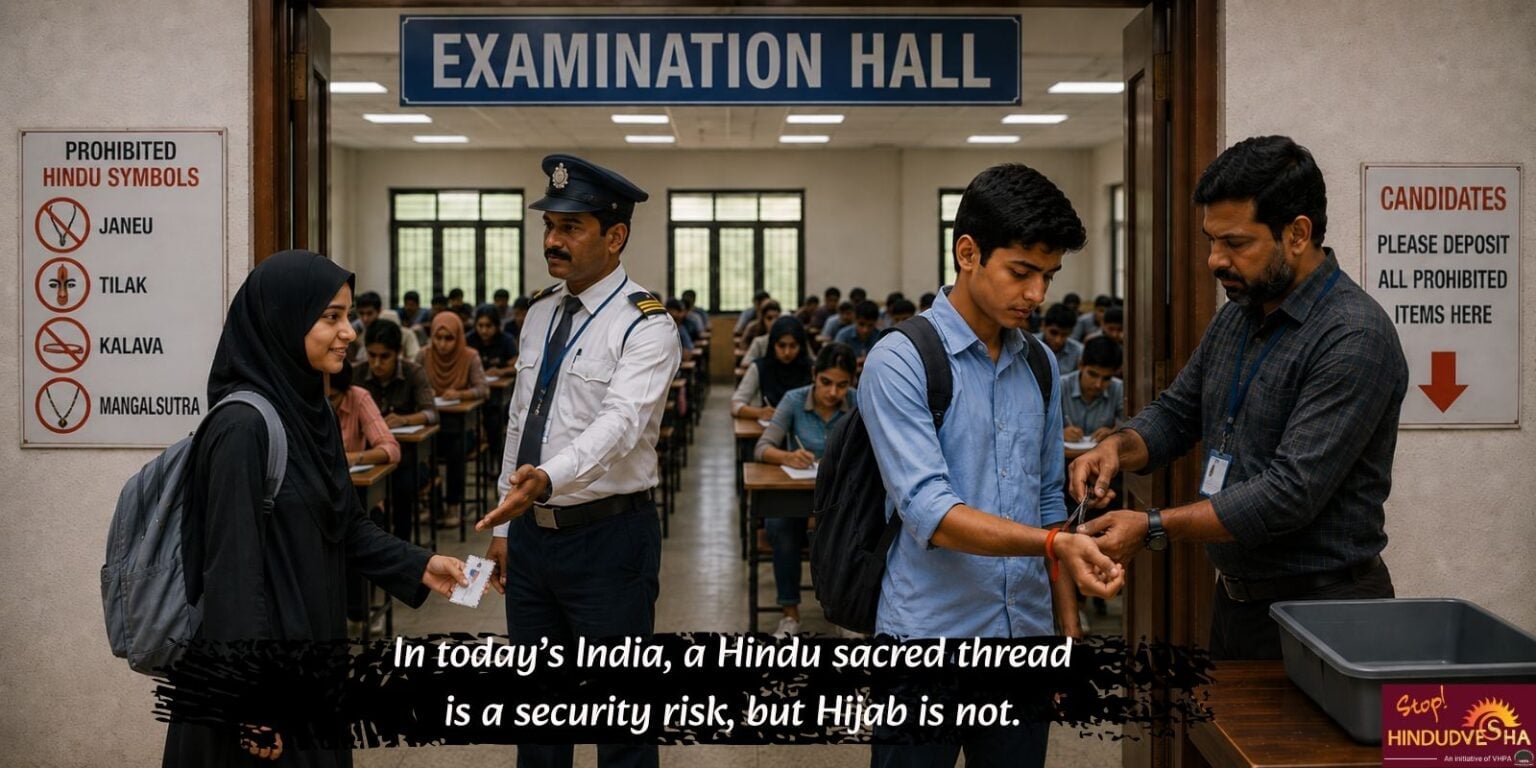
The Karnataka CET janivara row has become more than a dispute about examination-room frisking. It has raised a serious question about how public institutions in Bharat should balance security, equality, constitutional rights, and the lived reality of dharmic religious practice. Reports from Bengaluru stated that some students appearing for the Karnataka Common Entrance Test were asked to remove the Janeu, also known as Yajnopaveetha or janivara, and in some accounts the Kalava, before entering the examination hall. For students preparing for a high-pressure entrance test, such an instruction was not a minor inconvenience. It was a moment in which educational aspiration appeared to collide with religious identity.
The incident was reported from Krupanidhi PU College in Bengaluru during KCET 2026. Public reporting noted that the Karnataka Examinations Authority had prescribed dress-code and security protocols to prevent malpractice, including restrictions on electronic devices, certain clothing, and items that could be misused. Those goals are legitimate. Competitive examinations must be fair, secure, and credible. Yet the controversy arose because the sacred thread was reportedly treated as a prohibited object even though available public reports did not indicate that the KCET rules banned the Janeu or janivara as such.
That distinction matters. A security rule that is clear, published, proportionate, and applied uniformly can be defended as an administrative necessity. An improvised instruction at the gate, especially one that touches religious practice, carries a different meaning. It introduces uncertainty for students, humiliation for families, and distrust toward institutions. In an examination setting, where even a few minutes of anxiety can affect performance, asking a student to remove a sacred religious symbol can become a psychological burden as much as an administrative act.
The Janeu or Yajnopaveetha is not merely an ornament. In many Hindu traditions, it is associated with Upanayana, discipline, study, responsibility, and entry into a life of learning and spiritual observance. Its significance varies across regions, sampradayas, and communities, but its sacred character is widely understood. The Kalava, too, is often worn after puja, vrata, or temple worship as a marker of sankalpa, protection, and devotional continuity. These symbols are part of an embodied religious life, where faith is not restricted to private belief but expressed through daily practices, rites, food, dress, marks, threads, and inherited customs.
In that sense, the KCET controversy is not only about one sacred thread. It concerns the broader treatment of Hindu Religious Symbols in educational and state-regulated spaces. Tilak, vibhuti, rudraksha, mangalsutra, toe rings, kalava, and the Janeu all belong to a civilizational grammar in which the body becomes a site of remembrance, discipline, and belonging. A secular institution does not need to adopt these meanings as its own, but it must understand enough to avoid treating them casually as suspicious, disposable, or administratively inconvenient.
Article 25 of India’s Constitution protects freedom of conscience and the right freely to profess, practise, and propagate religion, subject to public order, morality, health, and other constitutional limitations. This framework does not create an absolute right to carry every object into every restricted venue. It does, however, require institutions to justify restrictions with care. When a religious practice is limited, the reason should be specific, necessary, and proportionate. A blanket or arbitrary demand at an examination gate fails that standard of institutional sensitivity, even when officials believe they are acting in the name of discipline.
The public response to the Karnataka incident also shows how deeply questions of dignity are tied to education. For many families, an entrance examination is the product of years of sacrifice. Parents rearrange finances, students give up sleep and leisure, and entire households move around the rhythm of coaching, revision, travel, and result anxiety. When a student is stopped at the gate over a sacred thread, the family does not experience it as a technical checkpoint alone. It can feel like a message that ancestral practice must be hidden, surrendered, or negotiated before participating in modern education.
Public reports later indicated that a committee examined the Bengaluru incident and found, prima facie, that staff at the centre had acted intentionally despite training on the dress code. The committee reportedly reviewed CCTV footage, heard from students and parents, and recommended that the centre not be used for future examinations. Reports also stated that staff members were suspended and police action followed. These developments are important because they show that the issue was not simply social-media outrage. It moved into formal institutional review, where accountability became necessary.
At the same time, the response should not be reduced to partisan rhetoric or communal accusation. A dharmic approach to public life requires firmness without hatred, clarity without exaggeration, and justice without collective blame. The objective should be better institutions, not deeper social division. Hinduism, Buddhism, Jainism, and Sikhism have all preserved visible and embodied religious practices in different forms. A fair public order in Bharat should be capable of respecting such practices while maintaining legitimate security standards.
The technical problem is not difficult to identify. Examination authorities often create lists of prohibited items to prevent cheating: electronic gadgets, Bluetooth devices, microphones, watches, paper slips, hidden notes, shoes or clothing styles that can conceal devices, and accessories that obstruct inspection. These rules are necessary in an era of sophisticated malpractice. But sacred threads and ordinary religious markers are not comparable to electronic devices. If there is a genuine concern, inspection can be visual, respectful, and non-invasive. Removal should be the last resort, not the default instruction.
Good policy can solve much of this conflict. Examination bodies should publish precise dress-code guidance in advance, including a section on religious symbols and customary articles. Staff should be trained to distinguish between prohibited devices and ordinary religious markers. Each centre should have a senior escalation officer who can decide sensitive cases quickly. Candidates should not be left to argue with gate staff minutes before an exam. Where inspection is necessary, it should be done respectfully, preferably in the presence of trained officials and without public humiliation.
Such protocols would protect both examination integrity and Religious Freedom. They would also protect staff from uncertainty. Many harmful decisions arise not from written policy but from poorly trained personnel improvising under pressure. A guard or invigilator who fears being blamed for malpractice may overreach. A student who fears losing entry may comply silently. A parent waiting outside may discover the issue only after the exam has begun. Clear rules reduce this friction and prevent avoidable conflict.
The controversy also invites a deeper discussion on Indian secularism. In theory, Indian secularism is not meant to erase religion from public life. It is designed to maintain equal respect, principled distance, and fair treatment among communities. In practice, however, public institutions often oscillate between excessive suspicion of visible religious identity and selective accommodation. This inconsistency produces resentment. A student wearing a Janeu, a Sikh student wearing articles of faith, a Jain student observing religious discipline, a Buddhist student carrying a symbol of devotion, or a Hindu student wearing vibhuti should all encounter a state that is disciplined, neutral, and informed.
Institutional neutrality does not require cultural illiteracy. A modern Indian institution should know the society it serves. Bharat is not a religiously empty public square. It is a civilization where temples, mathas, gurudwaras, Jain derasars, Buddhist viharas, festivals, vratas, samskaras, pilgrimage routes, and family rituals continue to shape social life. When institutions fail to understand this, they convert ordinary religious continuity into a governance problem. That is neither efficient nor secular. It is a failure of administrative imagination.
The phrase institutional bias should therefore be used carefully but not dismissed casually. Bias is not always a written order. It can appear as unequal sensitivity, uneven enforcement, careless language, or the assumption that some traditions are easier to inconvenience because they are expected to comply quietly. Hindu students and families often absorb such moments without formal complaint, partly because educational opportunity feels too precious to risk. The KCET row became significant because that silence broke and the incident entered public scrutiny.
There is also a pedagogical dimension. If education is meant to cultivate confidence, citizenship, and ethical intelligence, then schools and examination bodies must model fairness. Students learn from institutional behavior. When rules are transparent and humane, they learn trust. When rules appear arbitrary, they learn fear. When sacred symbols are handled respectfully, they learn that modern citizenship does not require cultural self-erasure. That lesson is especially important for young people negotiating both professional ambition and inherited dharmic identity.
The Janeu’s civilizational meaning adds further weight to this discussion. Upanayana has historically been associated with study, discipline, and responsibility. The Yajnopaveetha is linked to remembrance of duty, self-control, and the pursuit of knowledge. Even where social practice has varied and evolved, the symbol remains connected to learning. That a student might be asked to remove it before an entrance examination carries a painful irony. A marker historically tied to education was treated, at least in that moment, as an obstacle to education.
A mature society can acknowledge this hurt while also insisting on examination security. These are not opposing goals. The choice is not between cheating prevention and religious dignity. The real task is to design procedures that secure both. Many high-security environments across the world accommodate religious articles through screening, documentation, respectful inspection, and case-specific review. Indian examination authorities can do the same, especially when dealing with symbols that are common, visible, and culturally well known.
The incident should also encourage dharmic communities to document and communicate the meaning of their practices more effectively. Public institutions need training material that is concise, accurate, and non-polemical. Community organizations, scholars, temple bodies, and civil society groups can help create explanatory resources on Hindu practices, Sikh articles of faith, Jain observances, Buddhist symbols, and shared dharmic values. This would reduce ignorance at the point of enforcement and promote unity among dharmic traditions without turning every controversy into confrontation.
For policymakers, the path forward is practical. First, exam notifications should state that ordinary religious symbols such as Janeu, Kalava, rudraksha, tilak, vibhuti, mangalsutra, and comparable customary markers are permitted unless a specific security concern is recorded. Second, any inspection should be conducted with dignity. Third, removal of a religious article should require written authorization by a senior official and should be documented. Fourth, students should have a grievance mechanism that does not jeopardize their exam. Fifth, staff who violate policy should face proportionate accountability.
These measures would not privilege one community. They would create a general standard for fairness. The same principle can apply across religious traditions: permit what does not compromise security, inspect respectfully when necessary, restrict only with clear reason, and never humiliate a candidate. Such a framework is consistent with constitutional morality and with the dharmic value of dignity for every person.
The KCET controversy is therefore a warning and an opportunity. It warns that even routine administrative systems can wound citizens when cultural literacy is absent. It also offers an opportunity to build better rules that protect both merit and meaning. Bharat’s educational institutions should not force students to feel that success requires distance from their sacred inheritance. A confident republic can allow a student to enter an examination hall with preparation in the mind, integrity in conduct, and dharmic identity intact.
The lasting lesson is simple but profound: secular administration must not become spiritual indifference. Public institutions serve living communities, not abstract candidates stripped of memory, family, and faith. When a Janeu at an exam gate becomes a national debate, the issue is not the thread alone. It is the quality of justice woven into the institution that stands before the student.
Inspired by this post on Hindu Post.





Leave a Reply
You must be logged in to post a comment.