
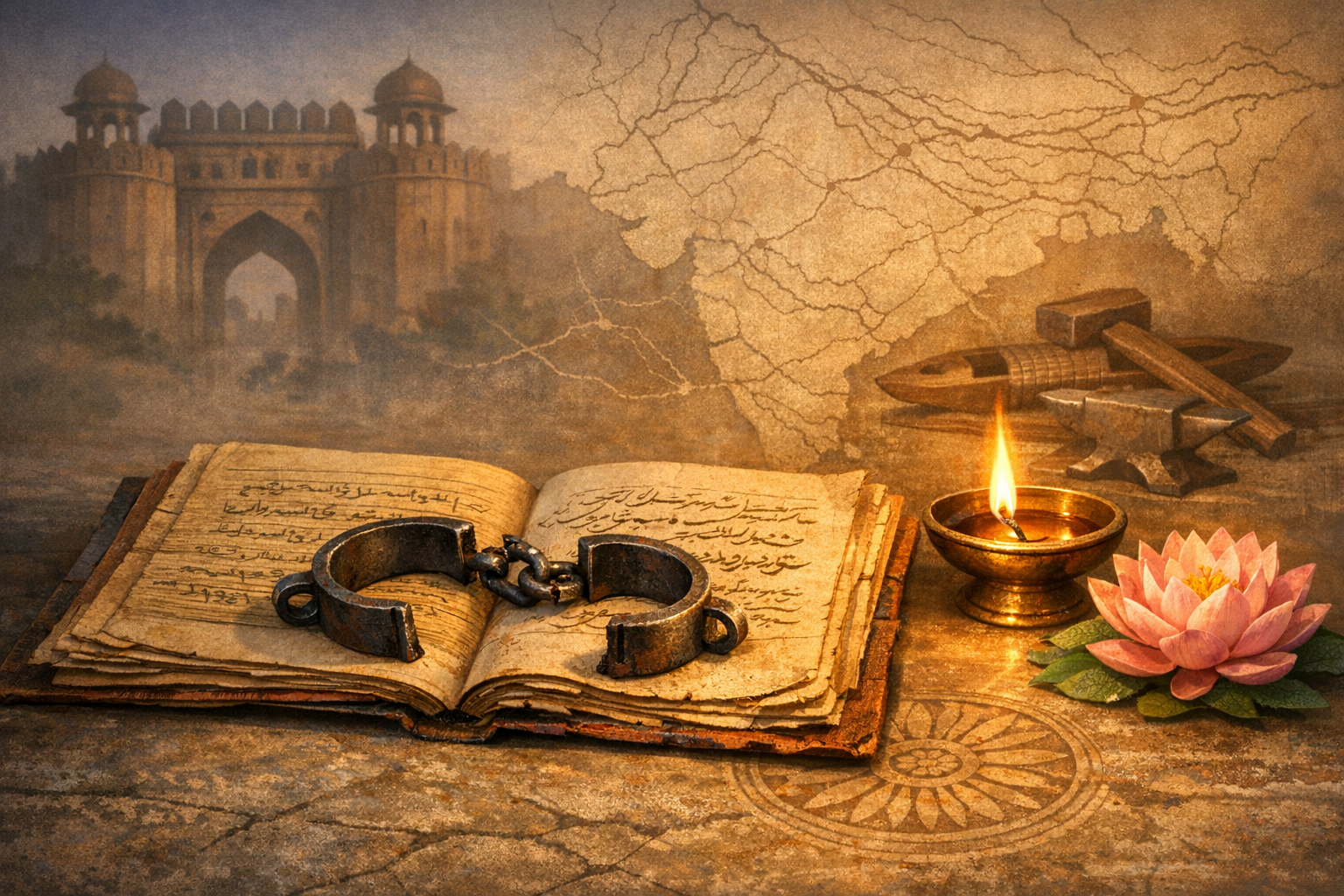
Across the world, discussions of slavery often focus on the transatlantic trade or the Arab trans-Saharan and Red Sea networks. Far less visible in popular memory is the complex history of enslavement in medieval India, especially under the Delhi Sultanate and successor polities. This oversight impoverishes public understanding of South Asian history and obscures how institutions of slavery operated, how communities suffered and resisted, and how the region’s social fabric was reshaped over centuries.
Public memory in South Asia has not fully confronted these pasts. In a country with a Hindu majority, museums and exhibitions dedicated to documenting medieval-era violence, captivity, and cultural resistance remain sparse. Apart from the Chhatrapati Shivaji Maharaj Museum created by François Gautier, there are few sustained, research-driven spaces that narrate this experience at scale. Strengthening such historical literacy is not about fueling division; it is about building an inclusive civic memory that acknowledges harm, honors resilience, and informs future solidarity across dharmic communities—Hindu, Buddhist, Jain, and Sikh.
Within public discourse, there is also a tendency toward quietism—an impulse, at times religiously couched, to look away from uncomfortable social and historical questions. Ram Swarup cautioned against such escapism and urged a grounded, responsible Dharma that takes both inner and outer life seriously. He observed: “Hindus fought Muslim invaders and locally established Muslim dynasties but neglected to study the religious and ideological motives of the invaders. Hindu learning or whatever remained of its earlier glory, followed the old grooves and its texts and speculations remained unmindful of the new phenomenon in their midst. For example, even as late as the fourteenth century, when Malik Kafur was attacking areas in the far South, in the vicinity of the seat of Sri Ramanujacharya, the scholarly dissertations of disciples of the great teacher show no awareness of the fact.” This critique remains relevant as a call to rigorous, evidence-based engagement with history.
This analysis employs a cautious, academic approach to scale and causality. Figures for deaths and captives over eight centuries vary widely and are frequently contested. While K. S. Lal’s The Muslim Slave System in Medieval India assembles a substantive body of evidence for large-scale enslavement, other historians (including Richard Eaton, Peter Jackson, Sunil Kumar, and Satish Chandra) urge more conservative demographic inferences and emphasize regional variation, source bias, and episodic intensities. What is not in dispute is the institutionalization of slavery in state-building, warfare, and elite households, as attested by multiple Persian chronicles and administrative texts.
Under various sultanates, the legal and social architecture of slavery drew upon Islamic jurisprudence as interpreted by court elites. Enslavement typically arose from warfare, punitive expeditions, debt, and purchase. Captives entered differentiated roles: military slaves (mamluks or ghulams) formed elite corps; household slaves and concubines served domestic and courtly functions; and khwājasarā (eunuchs) protected harems and often exercised significant administrative authority. Slaves could be inherited, gifted, or manumitted, and their status intersected with regulations on marriage, sale, and endowment, embedding the institution into fiscal, legal, and kinship systems.
The Delhi Sultanate’s early history underscores a stark paradox: men enslaved in youth could ascend to sovereign power. Qutb al-Din Aibak, Shams al-Din Iltutmish, and Ghiyas al-Din Balban—often referenced as the Mamluk or “Slave Kings”—were once purchased as military slaves but rose through merit, patronage, and martial prowess to rule. Their courts expanded the bandagān (slave-retainer) networks, intertwining loyalty, kinship, and state formation. Chronicles such as Minhaj-i Siraj’s Tabaqat-i Nasiri and Ziya’ al-Din Barani’s Tarikh-i Firoz Shahi record the centrality of these slave hierarchies to court politics.
Market regulation provides another window into the system’s institutional depth. During Alauddin Khalji’s reign, the state famously imposed price controls on essential commodities and on items vital to the military economy, including horses—and, as Barani notes, slaves were also subject to such oversight. Price fixing did not humanize bondage; rather, it integrated enslaved labor into a broader regime of provisioning, taxation, and wartime mobilization, ensuring sustained flows of manpower and goods to the karkhanas (royal workshops) and to large-scale architectural projects.
State karkhanas employed vast numbers of laborers, including enslaved men and women, to produce textiles, armaments, courtly luxuries, and construction materials. Monumental building—from fortified cities like Siri to palatial complexes—drew on coerced labor and revenue systems that extracted surplus from agrarian society. The symbolic grandeur of these works should not obscure the coercion and dispossession many subjects endured.
The role of eunuch slaves (khwājasarā) illustrates both the human cost and administrative reach of the institution. Eunuchs guarded harems, managed palace access, and handled sensitive communications; some became powerful intermediaries in succession politics and patronage networks. Sources suggest that forced castration created a steady supply of eunuchs, often recruited at young ages. While numbers are difficult to verify, the social trauma involved—dislocation, bodily harm, and lifelong servitude—was profound.
Regional dynamics mattered. Campaigns in Bengal, the Deccan, and the Tamil country produced large numbers of captives, redistributed across the subcontinent and, at times, exported to Central Asian markets. References to revenue payments involving human tribute in certain frontier contexts appear in some sources and in Lal’s synthesis, though such claims remain debated and require careful, region-specific corroboration. Similarly, accounts of Malik Kafur’s southern expeditions—occurring within living memory of the intellectual centers associated with Sri Ramanujacharya—speak to the disjunction between scholastic pursuits and the violent, rapidly changing political order that pressed upon them.
Communities developed resilient strategies to survive. Chronicles and later ethnographic patterns suggest that some villages fled to forests, hills, and marshlands, trading material prosperity for relative safety from raids, enslavement, and coercive taxation. Over generations, these migrations shaped settlement patterns, caste and jāti boundaries, and the social ecologies of frontier zones. Such adaptations demonstrate not passivity but a pragmatic ethic of preservation that is visible in many dharmic communities’ oral histories.
These medieval histories also reverberate in more recent traumas—most notably the mass violence of the Partition of India and the atrocities of 1971 in what became Bangladesh. For many Hindu and Sikh families, as well as for allied dharmic communities, intergenerational memory blends medieval devastation, colonial disruptions, and twentieth-century upheavals into a single arc of loss and endurance. Acknowledging this continuity is essential, yet it must be paired with a clear ethical stance: historical accountability should never license contemporary prejudice. The purpose of remembrance is empathy, not enmity.
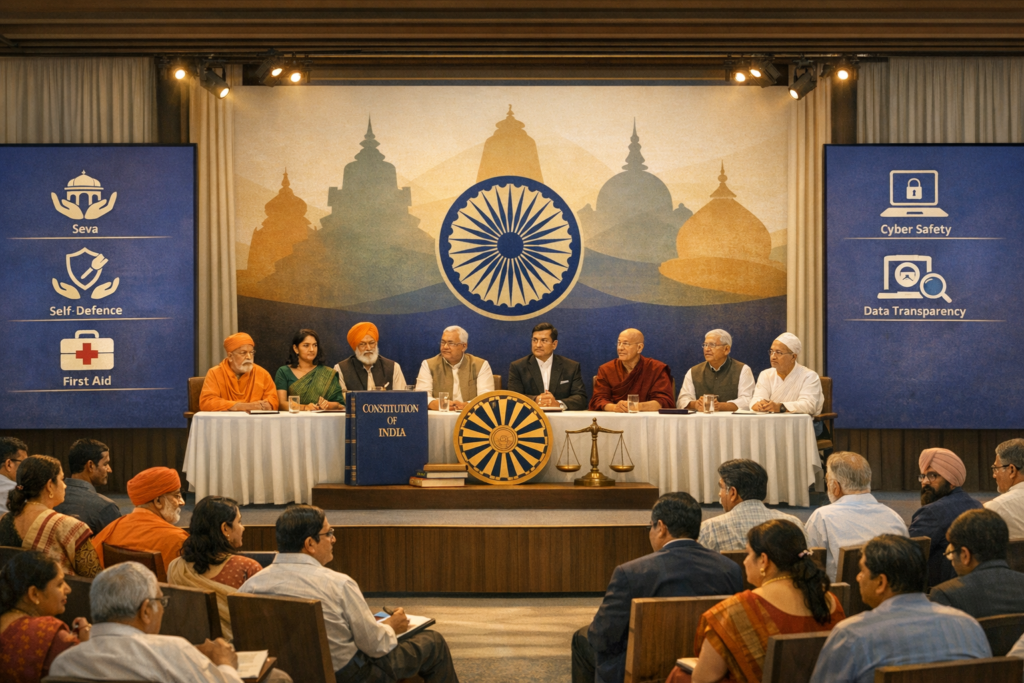
Present-day commentators—legal scholars, historians, and public intellectuals—are contributing to a more forthright conversation about this past. Constructive engagement means moving beyond polemic and cultivating a civic pedagogy that is meticulous with sources, transparent about uncertainty, and sensitive to the lived experiences of all affected communities. It also means resisting the lure of fatalism or spiritualized indifference and embracing a dharmic ethos that combines śaurya (courage) with karuṇā (compassion).
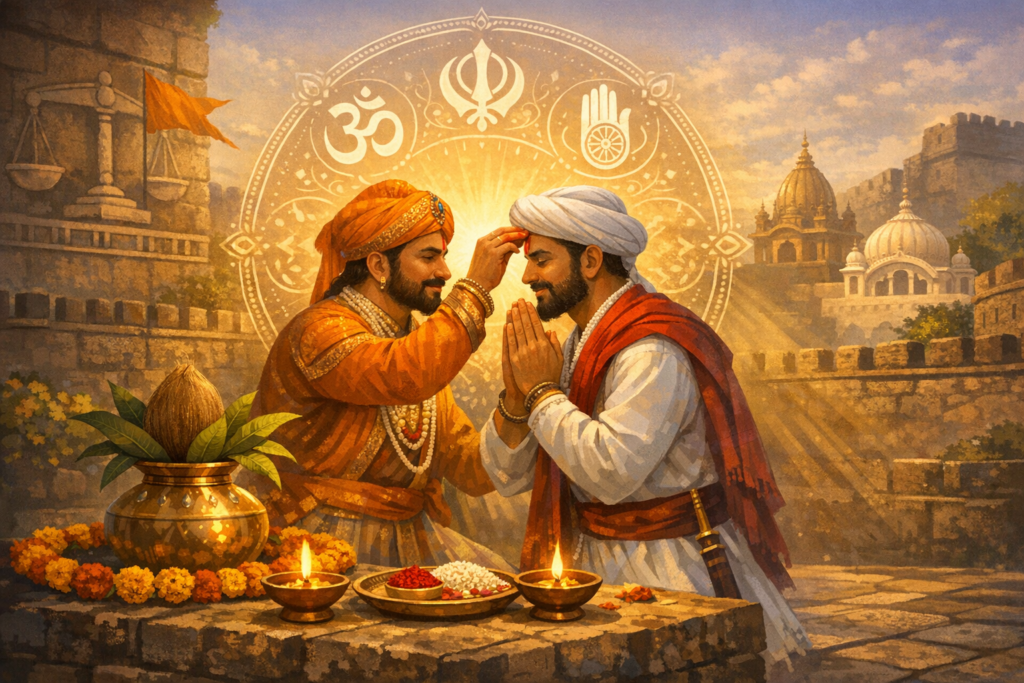
Advancing that ethos entails concrete steps: developing academically curated exhibitions; integrating balanced modules on slavery in medieval India into school curricula; digitizing Persian, Sanskrit, and regional-language sources; and supporting translations that enable wider access to primary materials. Done well, such work can unify Hindu, Buddhist, Jain, and Sikh perspectives around a shared commitment to truth-telling, mutual care, and the healing of historical wounds.
Readers who wish to explore documentary evidence and historiographical debate will find value in K. S. Lal’s The Muslim Slave System in Medieval India alongside works by Richard Eaton, Peter Jackson, Sunil Kumar, Satish Chandra, and André Wink, as well as chronicles by Ziya’ al-Din Barani, Minhaj-i Siraj, Ibn Battuta, and Shams-i Siraj ‘Afif. Engaging these sources together clarifies what is well-attested, what is inferential, and where further archival work is needed.
For reference: Muslim Slave System in Medieval India – K. S. Lal (PDF): https://www.hinduhumanrights.info/wp-content/uploads/2026/06/Muslim-Slave-System-in-Medieval-India-K.-S.-Lal.pdf
Note on scope and ethics: This discussion analyzes historical institutions and policies of specific medieval states. It does not assign collective guilt to present-day communities. The aim is scholarly clarity, dharmic solidarity, and a commitment to accurate public history.
Inspired by this post on Hindu Human Rights Blog.







Leave a Reply
You must be logged in to post a comment.