
Arjuna occupies a central place in the Mahabharata as one of the most technically gifted warriors in the epic tradition of Sanatana Dharma. He is trained by Dronacharya, strengthened by discipline, armed with the Gandiva bow, and repeatedly tested by circumstances that demand courage, restraint, and moral clarity. Yet the Mahabharata does not present him as victorious merely because he is skilled. It presents him as worthy only after his strength is purified by humility, tapas, divine grace, and obedience to dharma.
The episode in which Mahadev Shiva appears before Arjuna as a Kirata, or mountain hunter, is among the most profound moments in the Mahabharata’s spiritual psychology. It is not simply a story about a warrior receiving a celestial weapon. It is a carefully structured lesson on ego, surrender, divine testing, and the inner qualification required before power can be entrusted to a human being. Before Arjuna could help the Pandavas prevail in the Kurukshetra War, something within him had to be broken: not his courage, not his skill, and not his sense of duty, but the subtle pride that can accompany excellence.
In the narrative setting, the Pandavas are in exile after the disastrous dice game that strips them of kingdom, honour, and security. The coming conflict with the Kauravas is already visible, even if the war has not yet begun. Yudhishthira understands that ordinary strength will not be enough against warriors such as Bhishma, Drona, Karna, Kripa, Ashwatthama, and the vast armies aligned with Duryodhana. Arjuna is therefore directed toward intense spiritual preparation so that he may obtain divine weapons capable of balancing the military power of the opposing side.
This detail is important because the Mahabharata treats warfare, when unavoidable, as a matter of dharma rather than mere aggression. The Pandavas do not seek weapons for conquest or vanity. They seek them in the shadow of injustice, after every legitimate claim has been denied. Arjuna’s quest for celestial weapons is therefore tied to kshatra dharma: the disciplined obligation to protect order, resist adharma, and use force only under rightful conditions. The epic repeatedly insists that power without moral discipline becomes destructive, while power under dharma becomes protective.
Arjuna’s austerities are traditionally located in the Himalayan region, often associated with Indrakila. There he performs severe tapas to propitiate the divine powers. Tapas in this context is not a symbolic decoration. It is a technical discipline of self-conquest. It includes bodily endurance, mental steadiness, control of the senses, concentration, and the willingness to submit personal ambition to a higher purpose. In Sanatana Dharma, such tapas generates spiritual eligibility. It refines the seeker so that the divine gift does not become a burden or a danger.
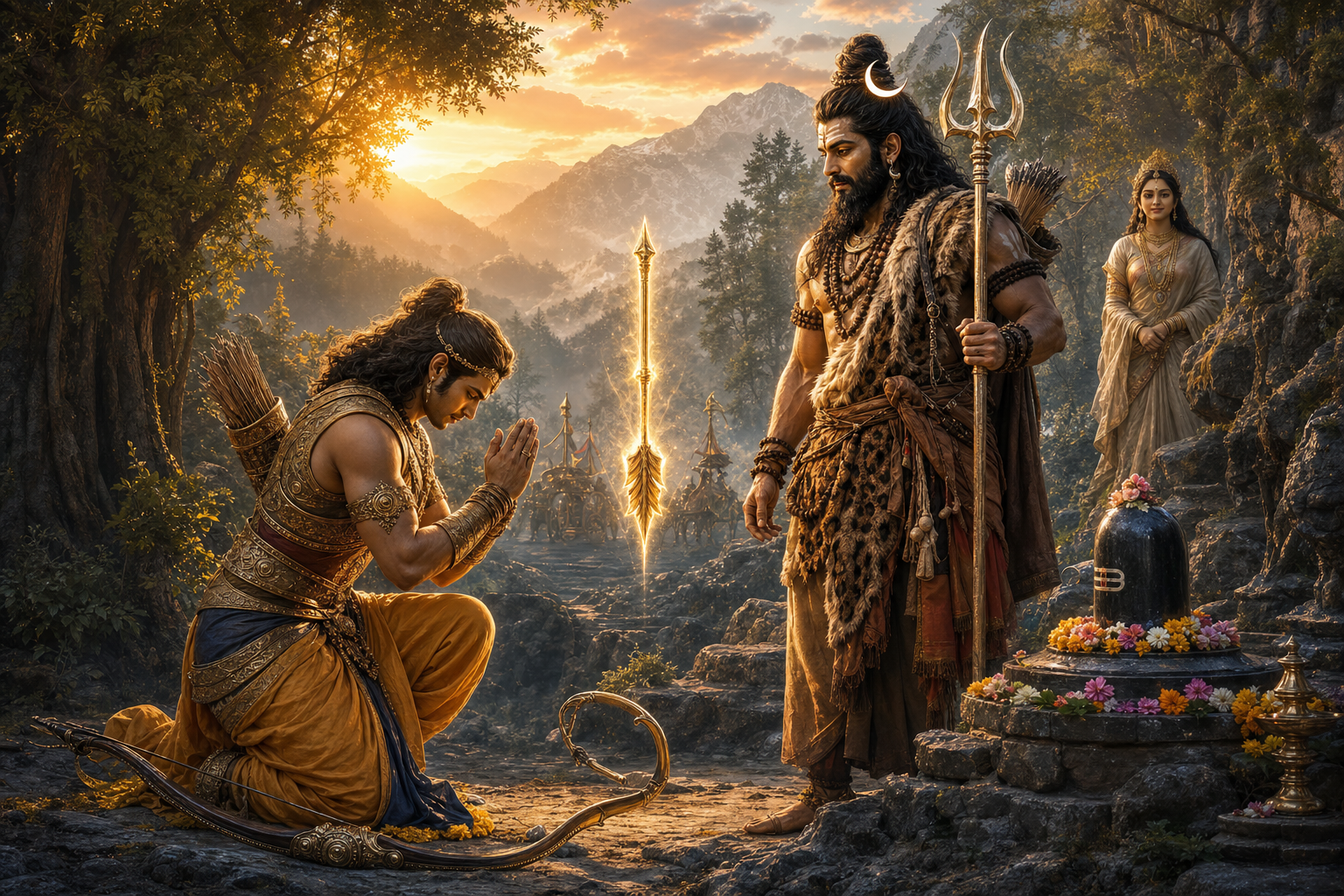
The test comes when a wild boar rushes toward Arjuna. In several traditional tellings, the boar is associated with the demon Muka, who has come to disrupt Arjuna’s austerity. Arjuna immediately takes aim and releases an arrow. At the same moment, a Kirata hunter also shoots the boar. Both arrows strike the animal, and both claim the kill. What appears at first to be a dispute over hunting rights becomes a spiritual examination of Arjuna’s inner state.
The Kirata is no ordinary hunter. He is Mahadev Shiva in disguise, accompanied in many tellings by Devi Parvati. The disguise is theologically significant. Shiva does not appear first in royal splendour, cosmic radiance, or temple iconography. He appears in a form outside courtly expectation: wild, direct, self-possessed, and beyond social vanity. This is consistent with Shiva’s larger place in Hindu thought. He is both ascetic and lord, both destroyer and benefactor, both the one beyond form and the one who enters every form to test, guide, and liberate.
Arjuna’s first response is not surrender. He argues. He asserts his claim. He sees a hunter challenging him and responds as a warrior whose competence has been questioned. This reaction is understandable, and that is precisely why the episode is psychologically powerful. Arjuna is not portrayed as arrogant in a shallow sense. He is a disciplined and noble warrior. Yet even noble excellence can carry a hidden attachment to status, recognition, and mastery. The test exposes that subtle attachment.
The confrontation escalates into combat. Arjuna uses his formidable archery, but the Kirata remains unaffected. The Gandiva, which terrifies ordinary warriors, cannot overwhelm him. Arjuna’s arrows are neutralized. His weapons fail. His strength is exhausted. He eventually moves from ranged combat to physical struggle, but even there the mysterious hunter proves superior. The greatest archer of his age is defeated by someone he has not yet recognized as divine.
This defeat is the core of the episode. Shiva does not defeat Arjuna to humiliate him in a crude sense. He defeats him to reveal the limit of human ability when it stands alone. Skill, discipline, lineage, training, and courage are necessary, but the Mahabharata insists that they are incomplete without humility before the cosmic order. Arjuna must learn that the warrior who will stand at Kurukshetra cannot rely only on personal brilliance. He must become an instrument of dharma.
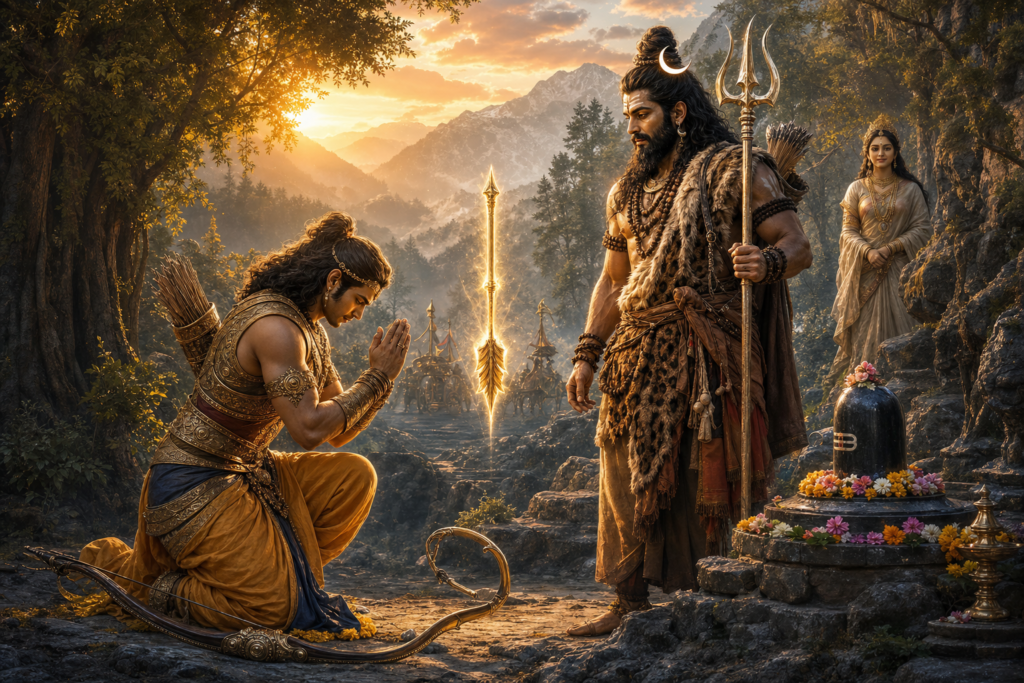
After being overcome, Arjuna turns inward. In many devotional retellings, he fashions a linga and worships Shiva with flowers. When the flowers offered to the linga are seen upon the Kirata, the truth becomes clear. The hunter is Mahadev himself. Arjuna recognizes his error, bows, and surrenders. This moment is not merely a change of information; it is a change of consciousness. The opponent is revealed as the deity. The conflict is revealed as grace. Defeat is revealed as instruction.
Shiva, pleased with Arjuna’s courage, devotion, and eventual humility, grants him the Pashupatastra. This weapon is one of the most powerful astras in the Hindu epic imagination. It is associated with Shiva’s supreme destructive capacity and is not to be used casually. The Mahabharata’s treatment of divine weapons is technical and ethical: an astra is not merely a missile, but a force invoked through mantra, discipline, and spiritual authority. Its use requires eligibility, self-control, and knowledge of consequences.
The Pashupatastra therefore represents more than military advantage. It symbolizes entrusted power. Shiva does not give it to Arjuna before the test. He gives it after Arjuna has been defeated, corrected, and transformed. The sequence matters. First comes tapas. Then comes confrontation. Then comes failure. Then comes recognition. Then comes surrender. Only then comes the weapon. In this structure, the Mahabharata teaches that the highest power is given not to the most aggressive seeker, but to the seeker who can be trusted after ego has been disciplined.
This is why the phrase “Shiva broke Arjuna” should be understood carefully. Mahadev did not break Arjuna’s spirit. He broke the illusion of self-sufficiency. He did not weaken Arjuna. He strengthened him by removing the inner obstacle that could have corrupted his strength. The warrior who rises after surrender is greater than the warrior who fought before defeat, because he now understands that power is sacred only when subordinated to dharma.
The episode also clarifies an important relationship between Shaiva and Vaishnava dimensions within the Mahabharata. Arjuna is guided throughout the epic by Sri Krishna, who serves as friend, charioteer, strategist, and divine teacher. Yet Arjuna also receives the Pashupatastra through the grace of Shiva. The epic does not treat these traditions as hostile. It presents them as mutually illuminating expressions of the same dharmic universe. Krishna guides Arjuna toward wisdom and action; Shiva tests and empowers him through tapas and surrender. Together, these dimensions deepen the unity of Hindu spiritual tradition.
This unity is essential for understanding the Mahabharata as scripture, literature, and civilizational memory. The epic contains many forms of devotion, many modes of worship, many philosophical accents, and many paths of spiritual growth. Its world is not narrow. It accommodates Vedic ritual, tapas, bhakti, yoga, dana, rajadharma, moksha-dharma, and the ethical burden of action. In that sense, the story of Arjuna and Shiva is not sectarian. It is a dharmic teaching about the relationship between human effort and divine grace.
Arjuna’s transformation also anticipates the Bhagavad Gita. On the battlefield of Kurukshetra, he again breaks down, but in a different way. Before Shiva, he must learn humility in the face of divine power. Before Krishna, he must learn clarity in the face of moral confusion. In both episodes, Arjuna is not mocked for vulnerability. His crisis becomes the doorway to revelation. The Mahabharata repeatedly uses Arjuna’s inner struggles to show that genuine heroism includes the capacity to question, fall, learn, and rise under guidance.
The Kurukshetra War is therefore not won only by arrows, formations, and battlefield tactics. It is won through preparation that begins long before the conches are blown. Arjuna’s victory depends on Dronacharya’s training, Krishna’s guidance, Shiva’s grace, Indra’s support, the moral endurance of the Pandavas, and the accumulated strength of dharma. The war is military on the surface, but metaphysical beneath it. The external conflict mirrors the internal struggle between arrogance and surrender, attachment and duty, adharma and righteousness.
From a technical perspective, the episode also reveals the ancient Indian understanding of weaponry as inseparable from consciousness. Modern readers often think of weapons as external tools: stronger metal, better range, greater destructive force. The Mahabharata’s astras operate differently. They require mantra, initiation, restraint, and the ability to withdraw or control the invoked force. This is why the moral character of the warrior matters as much as the weapon itself. A divine weapon in undisciplined hands would be a catastrophe.
Arjuna’s eligibility for the Pashupatastra rests on several qualities working together. He has technical skill, because without skill he cannot function as a warrior. He has tapas, because without austerity he cannot refine himself. He has courage, because he does not flee from the Kirata even when overpowered. He has devotion, because he turns toward Shiva in worship. Most importantly, he becomes capable of humility, because he recognizes the divine where he first saw only a rival. This combination makes him fit for sacred power.
The story also carries a subtle warning for every age. Talent can become intoxicating. Knowledge can harden into intellectual pride. Spiritual practice can become another form of self-importance. Public success can create the illusion that one is beyond correction. Arjuna’s encounter with Shiva challenges these tendencies. It teaches that the higher one rises, the more necessary humility becomes. In dharmic thought, humility is not weakness; it is alignment with reality.
This lesson applies beyond the battlefield. A teacher, scholar, administrator, artist, parent, activist, monk, entrepreneur, or community leader may all face versions of Arjuna’s test. One may possess skill and still require purification of intent. One may be right in a cause and still need freedom from ego. One may work for justice and still need inner discipline. The Mahabharata remains relevant because it does not separate outer responsibility from inner maturity.
There is also an emotional depth in this episode that makes it memorable. Arjuna’s defeat is not the defeat of a villain. It is the defeat of a sincere seeker who has not yet completed his preparation. This makes the story relatable. Many serious people experience moments when their strongest abilities fail them. The failure may come through criticism, loss, confusion, exhaustion, or an unexpected challenge. The dharmic reading of such moments is not despair. It asks whether the difficulty is revealing a hidden attachment that must be transformed.
In this sense, Shiva appears not only as destroyer but as healer. He destroys what obstructs spiritual growth. He breaks the false center so that the true center can emerge. The Kirata form is especially fitting because it strips away polished assumptions. Arjuna cannot rely on courtly identity, fame, or reputation. He must confront reality directly. Only when he sees the divine in the unexpected form does the conflict resolve into blessing.
The Pashupatastra also raises the question of restraint. The greatest power is not always displayed. In dharmic ethics, the possession of force does not imply its indiscriminate use. The epic tradition repeatedly honours warriors who know when not to use destructive capacity. This restraint is a sign of mastery. Arjuna’s reception of the Pashupatastra therefore strengthens him not only because he gains a weapon, but because he gains a deeper awareness of the responsibility that accompanies power.
Kurukshetra can then be understood as the visible outcome of many invisible preparations. The Pandavas win not because every event is easy for them, but because their suffering gradually becomes discipline. Exile becomes preparation. Humiliation becomes endurance. Instruction becomes clarity. Divine tests become empowerment. Arjuna’s encounter with Shiva is one of the decisive moments in this transformation. It turns a gifted warrior into a spiritually authorized warrior.
The phrase “I am Arjuna” can therefore be read as a powerful inner reflection. It does not mean claiming Arjuna’s greatness in a literal sense. It means recognizing the human condition reflected in him: talent mixed with doubt, courage mixed with pride, devotion mixed with struggle, and destiny mixed with testing. Every seeker who walks the path of dharma may eventually meet a form of Shiva that challenges identity, defeats ego, and demands surrender before blessing can arrive.
For Hindu tradition, this story reinforces the deep bond between action and surrender. Arjuna does not abandon effort and wait passively for divine help. He performs tapas, fights with full strength, and stands firm. Yet effort alone does not complete the journey. The decisive shift occurs when effort matures into humility. This balance is central to the Mahabharata: act with discipline, but do not mistake oneself for the ultimate source of power.
The broader dharmic traditions of Hinduism, Buddhism, Jainism, and Sikhism all preserve, in their own ways, the value of self-discipline, humility, restraint, and ethical action. While their doctrines and practices differ, they share a concern for the transformation of the human being. The Arjuna-Shiva episode speaks especially from within the Hindu epic world, but its ethical insight resonates widely: unrefined power must be disciplined, and the conquest of the self is higher than the conquest of an opponent.
That is why Shiva’s defeat of Arjuna is not a setback in the story of the Pandavas. It is a necessary precondition for their eventual victory. The Pandavas needed Arjuna’s arrows, but Arjuna needed Shiva’s correction. The war required martial excellence, but dharma required purified intent. Mahadev’s test ensured that the warrior who would stand beside Krishna at Kurukshetra had already learned that the greatest strength arises when human skill bows before divine order.
The enduring lesson is clear. Before the outer battle can be won, the inner battle must be faced. Before Arjuna can challenge the might of the Kauravas, he must confront the pride hidden inside his own excellence. Before he can receive the Pashupatastra, he must recognize Shiva in the form of the one who defeats him. In that recognition lies the secret of dharmic victory: power becomes righteous only when ego yields to truth.
Inspired by this post on Hindu Blog.






Leave a Reply
You must be logged in to post a comment.