
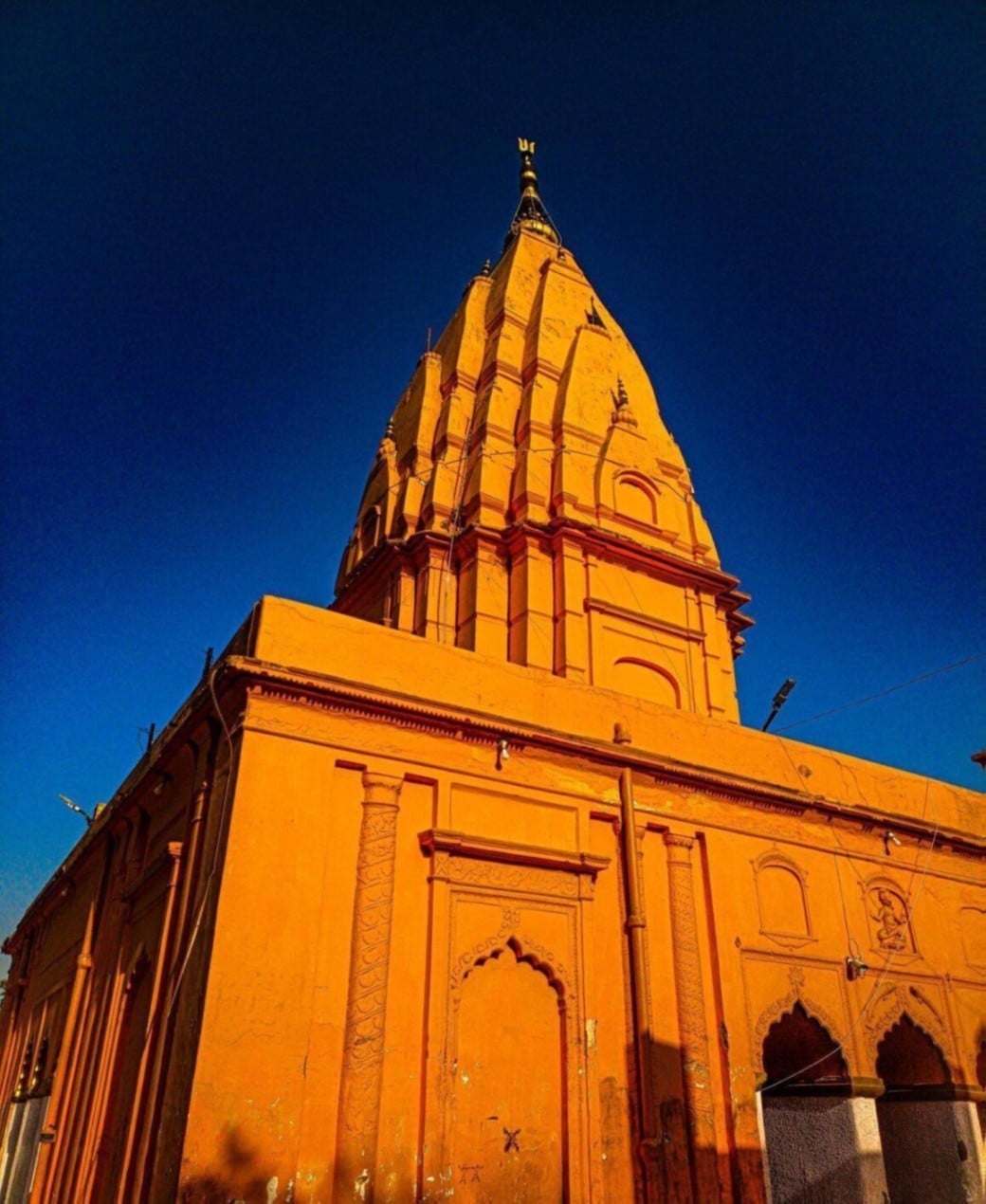
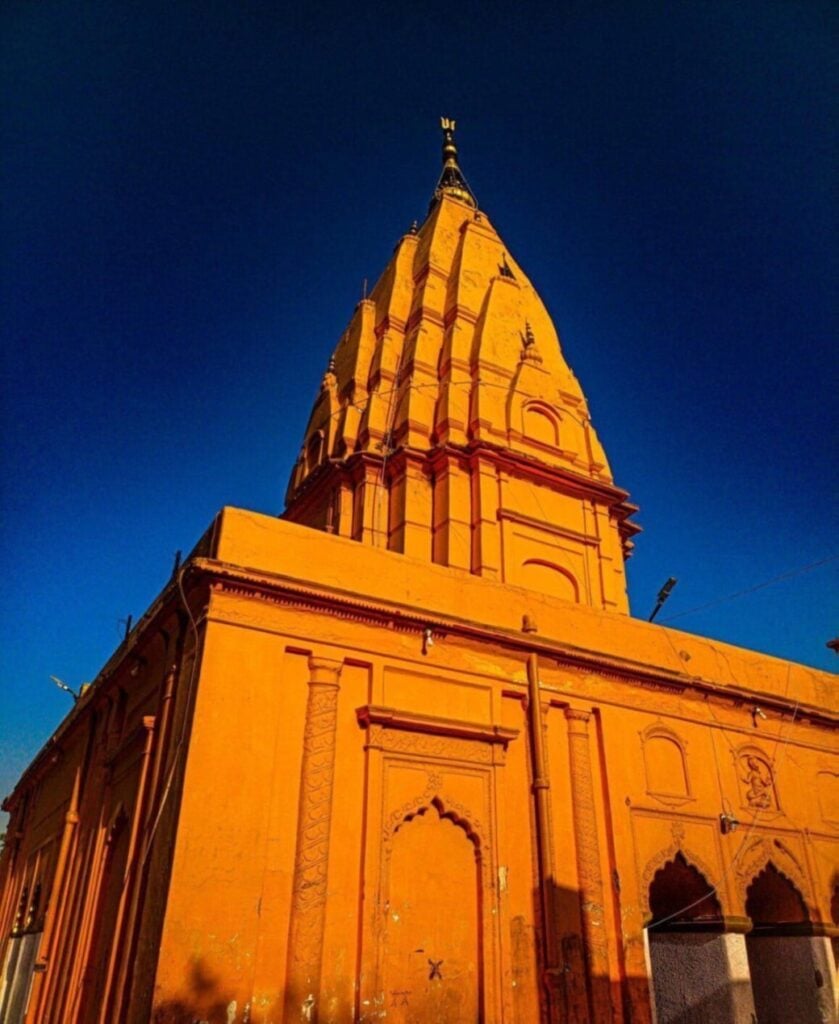
Prithvinath Temple in the Khargupur region of Gonda, Uttar Pradesh, is most widely known for its immense Shivling, a sacred Lingam traditionally associated with Bhīma, the second eldest Pandava, during the period of exile in the Dvapara Yuga. For many pilgrims, this association gives the temple its devotional gravity; for many visitors, the sheer scale of the Lingam makes the first impression unforgettable. Yet the temple’s deeper significance may not lie only in its celebrated central object of worship. Around its walls, almost quietly, stand a small number of weathered sculptures that point toward a more layered civilisational history.
The temple’s atmosphere carries the stillness expected of a long-standing Shaiva shrine: worship, memory, local tradition, and the unbroken rhythm of pilgrimage. Its fame rests on religious devotion, but its material remains suggest that Prithvinath may also be an important site for the study of temple history, iconography, regional art, and heritage preservation. The neglected idols placed along or within the outer walls appear to belong to older artistic phases, possibly medieval and perhaps even earlier. Their presence demands careful attention because such objects are not decorative remnants; they are historical evidence in stone.
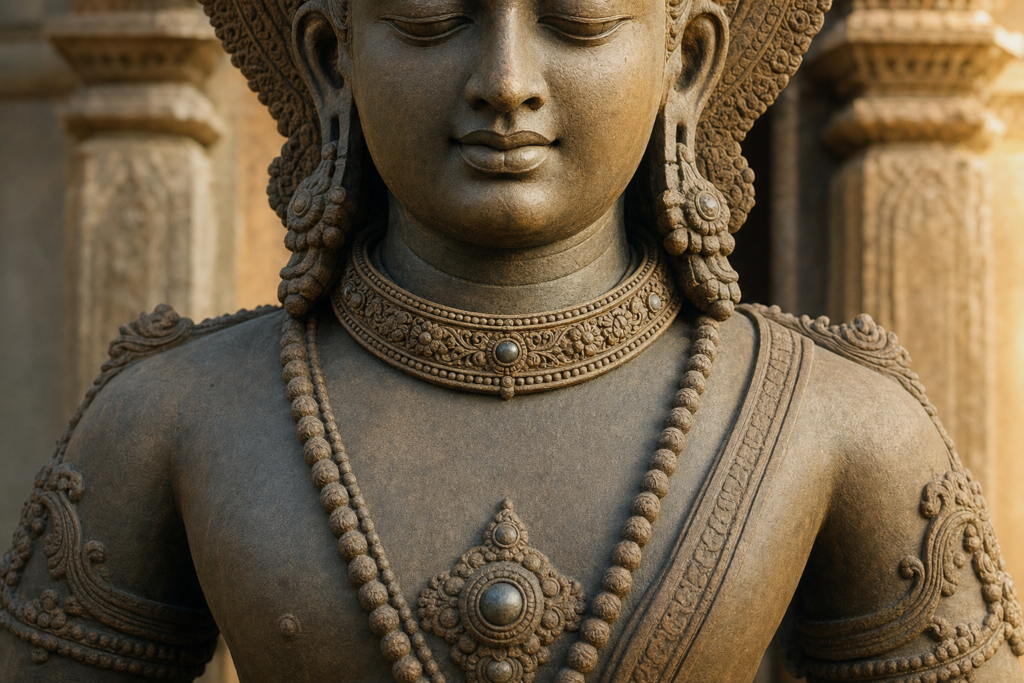
A close visual encounter with the temple reveals a striking contrast. The main Shivling commands immediate reverence, while the sculptural fragments on the periphery seem vulnerable, exposed, and almost secondary in the current devotional arrangement. Approximately seven or eight idols are visible near the outer structure. Many show signs of erosion from wind, rain, touch, and ritual substances. Chandan, flowers, rice-mixed water, and milk offerings, though offered with devotion, can accelerate surface deterioration when applied repeatedly to fragile stone. This creates a difficult but important question: how can living worship and heritage conservation coexist without diminishing either?
The answer requires sensitivity. Devotees do not approach these objects with harmful intent; they approach them through inherited habits of reverence. Yet archaeological and art-historical objects require a different mode of care. Once the carvings lose their surface detail, the historical information carried by posture, ornament, facial form, attendant figures, and iconographic markers may be permanently lost. Preservation, therefore, is not opposed to bhakti. It is a disciplined extension of reverence, especially when the object may hold clues to Hindu, Buddhist, Jain, or wider Dharmic artistic networks.
Local accounts suggest that these idols were unearthed from the same area where the temple structure developed around the ancient Linga. After discovery, they were treated as temple property and placed where visitors could see them. This pattern is common across many Indian sacred landscapes: when older sculptures emerge during construction, renovation, or excavation, they are often absorbed into living worship spaces rather than transferred to museums or examined through formal archaeological procedures. Such continuity preserves a sacred relationship, but it can also leave historically significant objects without technical documentation, controlled display, or conservation-grade protection.
The temple authorities appear to have recognized the importance of these sculptures and installed boards requesting devotees not to place offerings on them. That step is meaningful, but it remains insufficient unless supported by public education, protective barriers, documentation, and expert assessment. A sign can discourage direct contact, but it cannot replace a conservation plan. Sacred heritage sites require practical systems: proper plinths, non-invasive lighting, rain protection, cataloguing, condition reports, and periodic inspection by trained specialists.
The sculptures themselves invite serious study. Their style has been compared with features associated with the Mathura school of art, a major Indian artistic tradition known for robust human forms, broad chests, expressive faces, light drapery, and iconography connected with Buddhist, Hindu, and Jain themes. Such comparisons must remain provisional until professional examination is conducted, but they are not without value. Visual resemblance can provide a starting point for inquiry, especially when a site lies within a broader historical region linked to religious movement, pilgrimage, political change, and trade routes.
The possible Mathura connection is especially significant because Mathura was not merely an art centre; it was a religious and commercial node. Its sculptural language influenced large parts of northern India. If the Prithvinath fragments show stylistic parallels with Mathura traditions, the site may have participated in a larger network of artistic exchange. This possibility would align with the historical importance of routes connecting North-West India, the Gangetic plains, Ayodhya, and eastern regions such as Magadha. Temples on such routes often functioned not only as places of worship but also as social, economic, and cultural institutions.
Ancient temples were frequently located near settlement clusters, political centres, pilgrimage paths, agrarian zones, or trade corridors. Their architecture and ritual life depended on patronage, circulation, and community support. A major shrine required artisans, priests, donors, transport, food supply, and periodic gatherings. Therefore, when a large or historically layered temple appears in a region such as Gonda, it is reasonable to examine whether older commercial or religious networks sustained it. The presence of Ashokan and Gupta-period inscriptions in the wider region further strengthens the need for systematic historical mapping, though it does not by itself date the temple sculptures.
The proximity of Gonda to Ayodhya also matters. Ayodhya has been central to the sacred geography of the Ramayana tradition and to the wider memory of northern India. Scholarly discussions often place early layers of the Valmiki Ramayana between roughly the 3rd and 5th centuries BCE, though textual dating remains complex and debated. What is less debatable is Ayodhya’s long-standing cultural importance. Sites around Ayodhya and Gonda should therefore be studied not in isolation but as part of a wider religious landscape shaped by Shaiva, Vaishnava, Buddhist, Jain, and regional devotional currents.
One of the most compelling possibilities at Prithvinath is that the visible remains may represent more than one shrine or ritual phase. A Shaiva centre could have existed alongside Vaishnava imagery, Buddhist imagery, or subsidiary sacred spaces. Such plurality is not unusual in Dharmic landscapes. Indian sacred sites often developed through accumulation rather than replacement: a Linga, a Vishnu image, a Devi fragment, a Yakshini figure, a Buddha panel, a guardian sculpture, and local folk memories may all survive in close physical proximity. Rather than reading this as contradiction, it may reflect civilisational continuity through layered devotion.
Among the sculptural fragments, one image has been interpreted as possibly connected with Pashupati or a Shaiva form because of the meditative posture and the presence of surrounding animals. If this identification is correct, it may relate to a broader Shaiva iconographic vocabulary in which Shiva is understood as lord of beings, ascetic, yogi, and cosmic presence. However, such identifications require caution. Damaged sculptures can mislead the eye, and later ritual coverings may obscure important details. Still, even a tentative Shaiva reading strengthens the possibility that Prithvinath was not merely a shrine with a large Lingam but a more complex sacred complex.
Another fragment appears to show a standing figure interpreted as Vishnu. The suggestion is supported by the possibility of attendant forms, including a trunk-bearing figure that may represent Ganesh and another figure that may represent Lakshmi. If the central form is indeed Vishnu, the sculpture may indicate Vaishnava presence within or near the site. This would not be surprising in a region shaped by the devotional geography of Rama, Vishnu, Shiva, and Devi worship. Such coexistence illustrates the integrative nature of Hindu temple culture, where sectarian identities often interacted within shared sacred landscapes.
A separate broken piece may have belonged to a pillar, doorway, or larger architectural panel. Its damaged condition makes definitive identification difficult. It may represent a guardian, attendant, devotee, or fragment of a larger deity panel. This uncertainty is precisely why professional archaeological survey is necessary. Context is everything in iconography. A sculpture found in situ, associated with foundation layers, floor levels, architectural fragments, or inscriptions, can be dated and interpreted far more responsibly than a detached fragment placed against a modern wall.
One eroded figure has been described as resembling a Yakshini, a nature-associated feminine presence widely represented in early Indian art. If the identification is plausible, the figure may preserve traces of fertility, abundance, auspiciousness, and sacred ecology. Yakshini imagery often bridges folk, regional, Buddhist, Jain, and Hindu artistic worlds. Such a possibility is especially important for a blog committed to unity among Dharmic traditions, because it shows how shared visual languages travelled across communities without requiring rigid boundaries. The same artistic grammar could serve multiple sacred visions.
The most debated and perhaps most significant fragment is a seated figure interpreted as a possible Buddha image. The identification is based on a Padmasana-like posture, attendant seated figures on both sides, elephants above, and a smaller upper element that may represent a personified Bodhi tree, though it is partly obscured by chandan. If this interpretation is correct, the sculpture could point to Buddhist presence in or near the Prithvinath area. Even if later study revises the identification, the possibility alone demonstrates why unprotected ritual application can become a serious heritage problem: the very details needed for identification are being covered or worn away.
The presence of possible Shaiva, Vaishnava, and Buddhist imagery at one site should be approached with intellectual care rather than sensationalism. It may indicate multiple shrines, reuse of older fragments, relocation from nearby ruins, or a temple complex that grew over several centuries. It may also reflect a sacred geography where different Dharmic traditions shared routes, patrons, artisans, and symbolic forms. Indian history contains conflict, patronage shifts, and religious debate, but it also contains deep patterns of coexistence, shared aesthetics, and mutual influence. Prithvinath may preserve one such layered history in stone.
This is why the site deserves documentation before further deterioration occurs. A responsible research programme would begin with high-resolution photography, 3D scanning, measurements, stone analysis, iconographic description, and mapping of each fragment’s current location. Local oral histories should be recorded, including accounts from priests, elders, residents, and artisans. Archival records, revenue documents, older photographs, and district gazetteers should be examined. The objective should not be to force a predetermined conclusion but to build a disciplined evidence base for Prithvinath Temple’s historical development.
Archaeological work must also respect the living nature of the temple. Prithvinath is not an abandoned ruin; it is an active sacred site. Conservation measures should therefore be designed in consultation with temple authorities and devotees. Protective enclosures, interpretive panels, and controlled offering zones can allow worship to continue while preventing damage to vulnerable sculptures. In many cases, devotees respond positively when the reason for preservation is explained clearly: the same object that receives reverence today must remain legible for future generations.
The larger lesson extends beyond one temple in Gonda. Across India, countless sculptures, inscriptions, hero stones, temple fragments, and sacred objects remain outside formal museum systems. Some are worshipped, some are neglected, and some are reused in walls, fields, wells, or village shrines. These objects often preserve histories absent from textbooks: local dynasties, trade routes, artisan guilds, goddess cults, Buddhist and Jain movements, Shaiva and Vaishnava expansions, and regional devotional practices. Heritage preservation in Bharat must therefore move beyond only famous monuments and include smaller sites where civilisational memory survives in fragile form.
Prithvinath Temple offers a powerful example of how sacred geography can hide historical evidence in plain sight. The large Shivling rightly receives devotion, but the surrounding sculptures invite another form of reverence: patient study. They ask visitors to slow down, look closely, and recognize that the past is not always buried underground. Sometimes it stands beside the wall, weathered by rain and ritual, waiting for a society to notice it before it disappears.
A balanced approach would honour the temple’s Shaiva sanctity, acknowledge the possible Vaishnava and Buddhist layers, and situate all of them within the wider family of Dharmic traditions. Such an approach strengthens unity rather than division. It recognizes that Hinduism, Buddhism, Jainism, and Sikhism have each contributed to the civilisational fabric of Bharat in distinct yet interconnected ways. The sculptural remains of Prithvinath, if studied carefully, may become not only evidence of a temple’s past but also a reminder that India’s sacred heritage is shared, layered, and worthy of collective protection.
The immediate need is clear: local authorities, heritage professionals, temple management, and the community should collaborate to protect these idols from further erosion. The Archaeological Department should survey the site and surrounding area, not to remove the temple from devotees but to help preserve its material memory. A living temple can remain alive while also becoming better documented, better protected, and better understood. Prithvinath’s buried past should not remain a footnote behind its famous Shivling; it should become part of a serious conversation on temple history, archaeological responsibility, and cultural preservation in Uttar Pradesh.
Inspired by this post on Hindu Post.







Leave a Reply
You must be logged in to post a comment.