
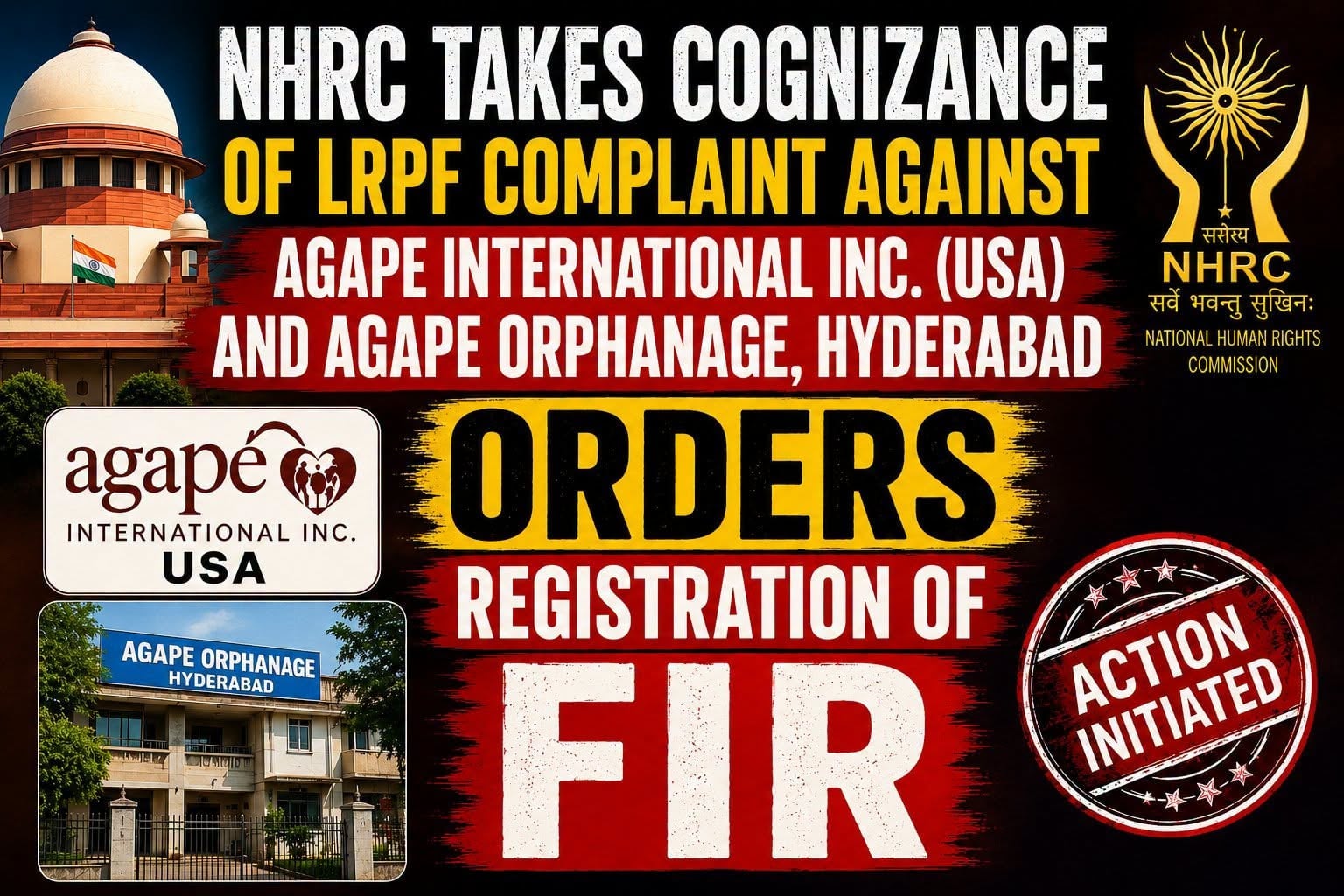
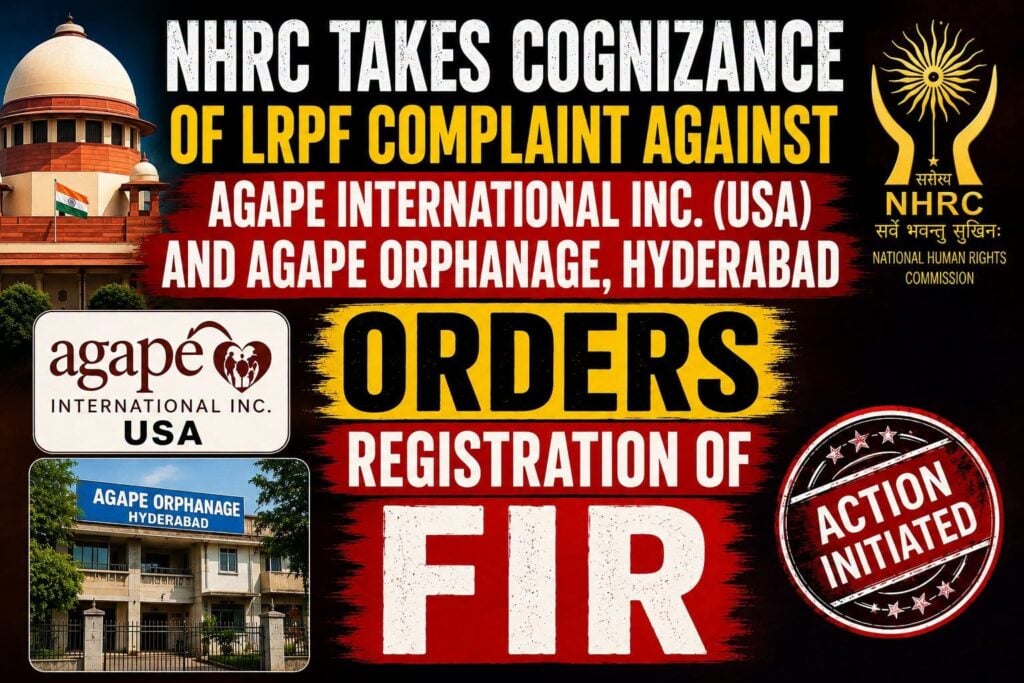
The National Human Rights Commission’s intervention in the complaint concerning Agape Orphanage in Hyderabad has brought a highly sensitive child-rights issue into formal scrutiny. The complaint, filed by Hyderabad-based activist A.S. Santhosh, alleges that HIV-affected orphan children associated with the institution were publicly identified through photographs, names, personal histories and medical details on websites and fundraising platforms. In a notice dated 30 June 2026, issued under Section 12 of the Protection of Human Rights Act, the NHRC stated that the allegations, if established, would prima facie involve violations of human rights and called for an Action Taken Report within two weeks.
The matter is significant because it sits at the intersection of child protection, medical confidentiality, institutional accountability and foreign-funded welfare operations. In any civilised society, the protection of vulnerable children is not merely an administrative obligation; it is a moral test of governance. Children affected by illness, abandonment or institutional dependency cannot be treated as instruments for publicity, sympathy or donor mobilisation. Their dignity is independent of their circumstances, and their privacy is especially important when disclosure may expose them to stigma, discrimination or lifelong social harm.
According to the NHRC communication issued from its Law Division in New Delhi, the complaint dated 15 June 2026 was placed before the Commission on 30 June 2026 and taken cognisance of by a Bench presided over by NHRC Member Priyank Kanoongo. The notice was addressed to the Joint Secretary of the Ministry of Home Affairs’ FCRA Wing, the Chief Secretary of Telangana and the Director General of Police, Telangana. This distribution of responsibility indicates that the Commission has treated the issue not as a single institutional grievance, but as a multi-layered inquiry involving human rights, police action and foreign contribution compliance.
The Commission directed the Telangana Chief Secretary and the Director General of Police to have the allegations inquired into and to initiate the lodging of an FIR. Separately, it asked the Joint Secretary of the FCRA Wing to examine possible violations of the Foreign Contribution (Regulation) Act. The NHRC also reminded the authorities that, under the Protection of Human Rights Act, 1993, it possesses inquiry powers, including powers similar to those of a civil court under Section 13. This legal framing gives the notice procedural weight and places a clear obligation on the concerned authorities to respond with concrete action rather than general assurances.
The central allegation in the complaint is that Agape International Inc., described as a United States-based charity, and its associated Agape Orphanage in Hyderabad publicly disclosed the identities, photographs, HIV status and personal stories of HIV-affected orphan children. The petitioner argues that such disclosure violated the children’s privacy, dignity and confidentiality, while also exposing them to the risk of stigma and exploitation. In cases involving children, especially those affected by HIV or AIDS, the harm caused by public exposure is not abstract. It can follow a child into school, community life, future employment, marriage prospects and social relationships.
The complaint reportedly includes screenshots and extracts from sponsorship pages that list children’s names, ages, gender and personal histories. It also refers to material identifying at least one child as “living with HIV.” The petitioner contends that these materials converted the children’s medical and personal circumstances into narratives for overseas fundraising. The concern is not whether social service institutions may raise funds for welfare work; legitimate child-care work often requires public support. The concern is whether fundraising was allegedly done by exposing children whose legal and ethical protection required the highest degree of confidentiality.
The legal issue is therefore much more than a question of taste, sensitivity or public relations. Bharat’s HIV and AIDS (Prevention and Control) Act, 2017 contains a specific confidentiality framework, including Section 11, which restricts disclosure of HIV-related information except in legally recognised circumstances. The law also recognises the special position of children affected by HIV or AIDS. When medical status is revealed in a public forum without proper safeguards, the injury is not limited to embarrassment; it may become a legally cognisable invasion of dignity, equality and personal security.
The complaint also revives earlier allegations concerning the treatment of children at Agape. It cites 2017 media reports that HIV-affected orphan children housed at the institution were allegedly forced to clean underground septic drains. The complaint presents this allegation as evidence of a possible safeguarding failure. If such allegations are examined, the relevant inquiry would need to distinguish between verified facts, institutional records, media claims and official responses. However, the presence of such past allegations strengthens the argument that oversight authorities must examine whether child-protection norms were consistently enforced.
A further issue raised in the complaint concerns registration and regulatory compliance under the Juvenile Justice framework. The petitioner claims that the institution was reportedly functioning without mandatory registration at the time of the earlier controversy, but later obtained permissions and recognition. On that basis, the complaint asks whether state authorities conducted proper due diligence, background verification, safety assessment and monitoring before granting or renewing approvals. This is an important governance question because child-care institutions cannot be treated like ordinary private facilities. They hold custody over minors who are often unable to complain, leave or defend themselves.
The Juvenile Justice framework is built on the principle that children in need of care and protection must be placed in regulated environments subject to inspection, documentation, rehabilitation planning and child welfare oversight. Registration is not a technical formality; it is a gatekeeping mechanism intended to prevent vulnerable children from being placed in unsafe, unverified or opaque institutions. Where allegations involve HIV-affected children, the obligation becomes even more serious because the children may face multiple layers of vulnerability: orphanhood, illness, poverty, stigma and institutional dependence.
The complaint also refers to Ms. Lynne Marie Voggu, identified in the petition as Executive Director of Agape International Inc. and as an executive member of the Hyderabad-based Agape society. It claims that criminal proceedings are pending against her in a POCSO-linked sessions case and argues that her continued involvement in child welfare activities raises concerns about institutional oversight and the safety of vulnerable minors. It is essential to state clearly that these remain allegations in the complaint and are not findings of guilt. The presumption of innocence remains a core principle of justice, even as child-safety authorities have a duty to assess risk and suitability with seriousness.
The POCSO context, if accurately reflected in the complaint, makes the safeguarding dimension more sensitive. Child welfare systems are expected to apply precautionary standards when adults associated with institutions are facing serious allegations involving children. Such standards do not replace the criminal trial, nor do they declare guilt in advance. They exist because children in institutional care depend on regulatory authorities, child welfare committees, police and administrators to create protective environments before harm occurs, not merely to respond after damage is done.
The financial trail described in the complaint attempts to connect Agape International Inc. with the Bharatiya recipient organisation, Agape Society, registered in Telangana. The petition identifies Agape International Inc. as a United States charity with EIN 20-0452537. It reproduces Form 990 material showing that, for the 2024 tax year, Agape International Inc. reported gross receipts of 397,018 dollars, total revenue of 389,727 dollars and total expenses of 422,480 dollars, resulting in a deficit of 32,753 dollars. The same filing is said to show 243,472 dollars in grants and similar amounts paid, 157,441 dollars in salaries and compensation, and year-end net assets of 927,342 dollars.
The longer revenue pattern cited in the filing is also notable. Contributions and grants were listed at 1,045,952 dollars in 2020, 3,837,128 dollars in 2021, 574,167 dollars in 2022, 493,263 dollars in 2023 and 362,406 dollars in 2024, giving a five-year total of 6,312,916 dollars. Schedule A reportedly states a 2024 public support percentage of 47.81 percent, above the 33.33 percent threshold used for publicly supported charity status in that filing. These figures do not by themselves prove wrongdoing, but they explain why the complaint asks regulators to examine the flow, use and compliance status of foreign-linked funds.
The complaint further asserts that Agape’s FCRA registration or licence had reportedly been cancelled by the Ministry of Home Affairs. Publicly available MHA material indicates that cancellation of FCRA registration bars an association from receiving and using foreign contribution. Related government material also shows that such action is generally connected to violations of the Act or rules after due process. The NHRC’s decision to involve the FCRA Wing is therefore procedurally important, because child welfare concerns and foreign funding concerns may overlap where donor narratives, institutional permissions and regulatory records are linked.
Foreign-funded welfare work in Bharat is not inherently suspect; many lawful organisations perform valuable service in education, health and relief. However, foreign contribution in the child-care sector demands transparency, lawful registration, audited use of funds and respect for domestic child-protection norms. The concern raised by the complaint is that vulnerable children may have been used as the emotional face of fundraising while their confidentiality and dignity were allegedly compromised. A society rooted in dharmic values of compassion, seva and protection of the vulnerable must be especially alert when charity becomes entangled with publicity, influence or inadequate oversight.
Santhosh has sought a broad set of actions from the authorities. These include an independent inquiry into Agape Orphanage and Agape International Inc., registration of an FIR, immediate removal of children’s photographs and HIV-related details from websites, investigation into possible violations of child-rights and HIV confidentiality law, and action against responsible officials and office-bearers. The complaint also asks for an independent child-safety audit and for the Home Ministry to examine the continuation of OCI status granted to Lynne Marie Voggu, including possible deportation proceedings after due inquiry.
At this stage, the NHRC has not ruled on the truth of the allegations. That distinction is crucial. The Commission’s notice is not a conviction, nor is it a final finding against the institution or individuals named in the complaint. What it does is convert the allegations into a live human-rights inquiry and require the Telangana administration and the Union Home Ministry to explain what action has been taken. In rights-sensitive matters, this procedural escalation matters because silence, delay or fragmented jurisdiction can often become a shield for institutional neglect.
The case also raises a larger policy question: how should Bharat regulate child-care institutions that combine charitable work, foreign donor networks, religious or ideological influence and custody over vulnerable minors? The answer cannot be selective outrage or communal generalisation. It must be a uniform child-first standard applied across institutions, irrespective of religious identity, donor profile or social reputation. Hindu, Buddhist, Jain and Sikh traditions all preserve deep ethical commitments to compassion, non-harm, restraint and protection of the helpless. A governance system informed by these values would place the dignity of the child above institutional prestige or fundraising convenience.
The alleged public disclosure of HIV status is especially troubling because stigma around HIV remains a social reality. Even where legal protections exist, children and families may continue to face exclusion, whispered judgment and social isolation. A child whose medical status is placed on the internet may lose control over that information permanently. Digital exposure is not temporary; screenshots, archives and copied fundraising content can continue circulating long after an institution removes the original page. For this reason, confidentiality law must be understood not as bureaucratic paperwork, but as a shield against lifelong harm.
The complaint’s emphasis on photographs, names and personal stories also speaks to a broader problem in the charitable sector. Poverty, illness and abandonment are often packaged into emotionally persuasive stories for donors. While storytelling can help mobilise support, ethical fundraising must never reduce children to objects of pity. The better model is anonymised, consent-conscious and rights-compliant communication that explains needs without exposing identity. Children in care are not case studies for public display; they are persons with privacy, memory, self-respect and futures still being formed.
For Telangana authorities, the immediate task is to establish facts. This requires examining registration records, inspection reports, child welfare committee files, police records, FCRA documentation, website archives, donor communications and the current status of all children connected to the institution. It also requires ensuring that children are not re-traumatised during inquiry. Interviews, medical verification and case-history reviews must be conducted with sensitivity, confidentiality and professional safeguards. A child-protection investigation that exposes children again in the name of inquiry would defeat the very purpose of intervention.
For the Union Home Ministry’s FCRA Wing, the question is narrower but still important: whether any foreign contribution was received, used, represented or channelled in violation of law, especially if an FCRA licence was cancelled or otherwise restricted. If the complaint’s claims about fundraising platforms and foreign-linked sponsorship pages are accurate, regulators may need to examine whether donor-facing representations matched domestic compliance records. The public interest lies not in obstructing lawful charity, but in ensuring that foreign funds do not bypass Indian legal protections for children.
The NHRC’s intervention also underlines the importance of accountability within state institutions. If an orphanage or child-care facility had earlier faced serious allegations, authorities responsible for later permissions would need to show what verification was undertaken. Approval mechanisms must not become rubber stamps. Child welfare governance depends on inspections that are real, documentation that is accurate, staff background checks that are meaningful and complaint systems that children can safely access. Without these safeguards, even well-intended institutions can become spaces of unchecked power.
The broader lesson is that compassion without accountability can become dangerous. Institutions serving vulnerable children may use the language of service, charity or rescue, but such language cannot substitute for legal compliance. The best protection for genuine welfare work is transparency: lawful registration, audited accounts, trained staff, confidential records, child-sensitive communication, independent monitoring and swift response to complaints. Where these safeguards are absent, the risk is not merely reputational; it can become a direct threat to children who have already endured hardship.
The Agape Orphanage complaint, therefore, should be seen as more than a dispute involving one institution. It is a case study in the governance of vulnerable childhood in Bharat. It asks whether the state can protect children whose suffering makes them attractive to donor networks. It asks whether medical confidentiality will be honoured even when publicity is financially useful. It asks whether regulators can coordinate across police, child welfare and foreign funding authorities. Most importantly, it asks whether the dignity of a child will remain non-negotiable when institutional interests are at stake.
Until the inquiry is completed, all allegations must be treated as claims requiring verification. Yet the seriousness of the issues justifies urgent and transparent action. If the allegations are found to be false, the record should be corrected with the same clarity. If they are found to be true, the response must include legal accountability, protection for affected children, removal of unlawful disclosures and a wider review of institutional oversight. Human rights are not protected by sympathy alone; they are protected when law, ethics and administration converge in defence of those least able to defend themselves.
Inspired by this post on Hindu Post.







Leave a Reply
You must be logged in to post a comment.