
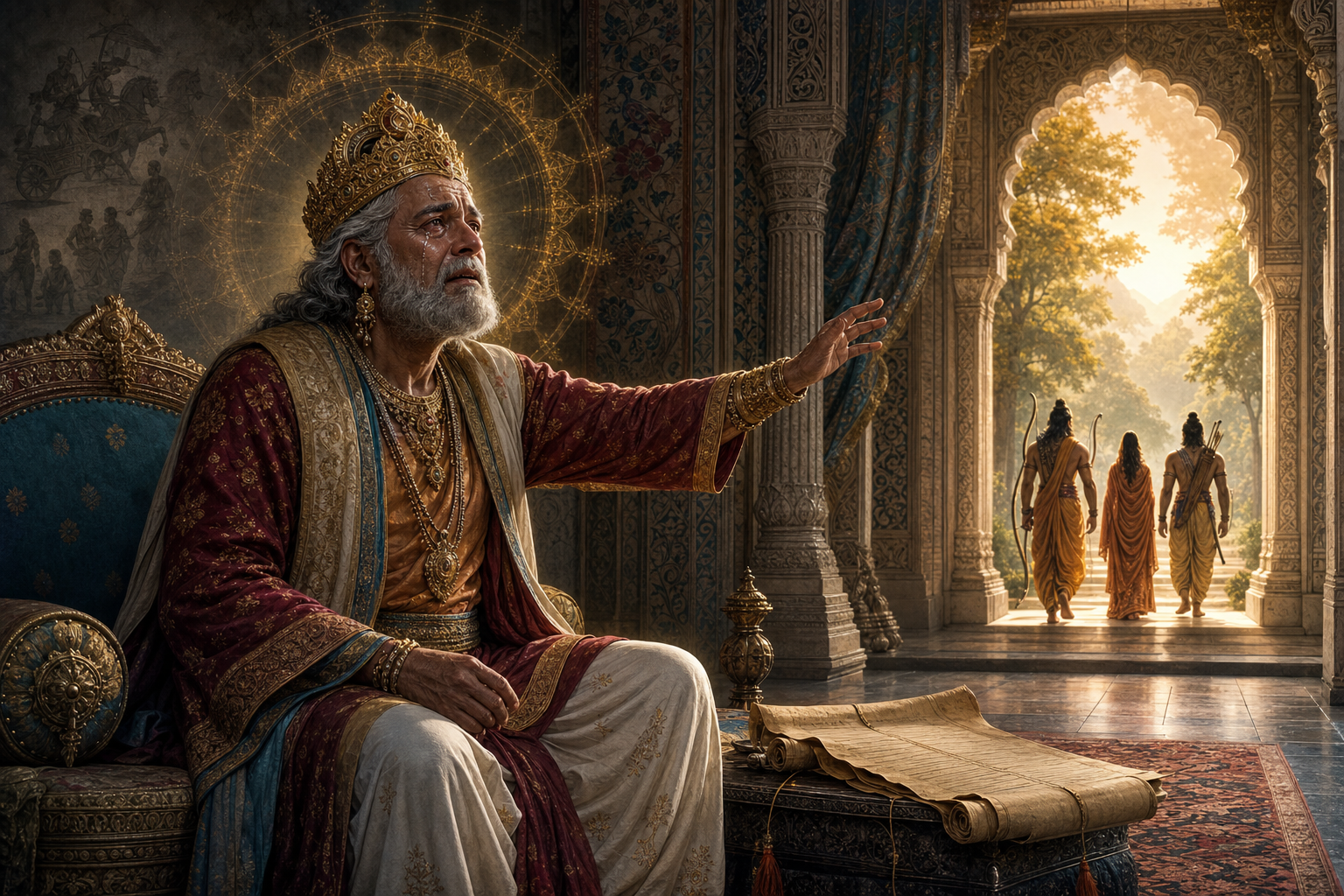
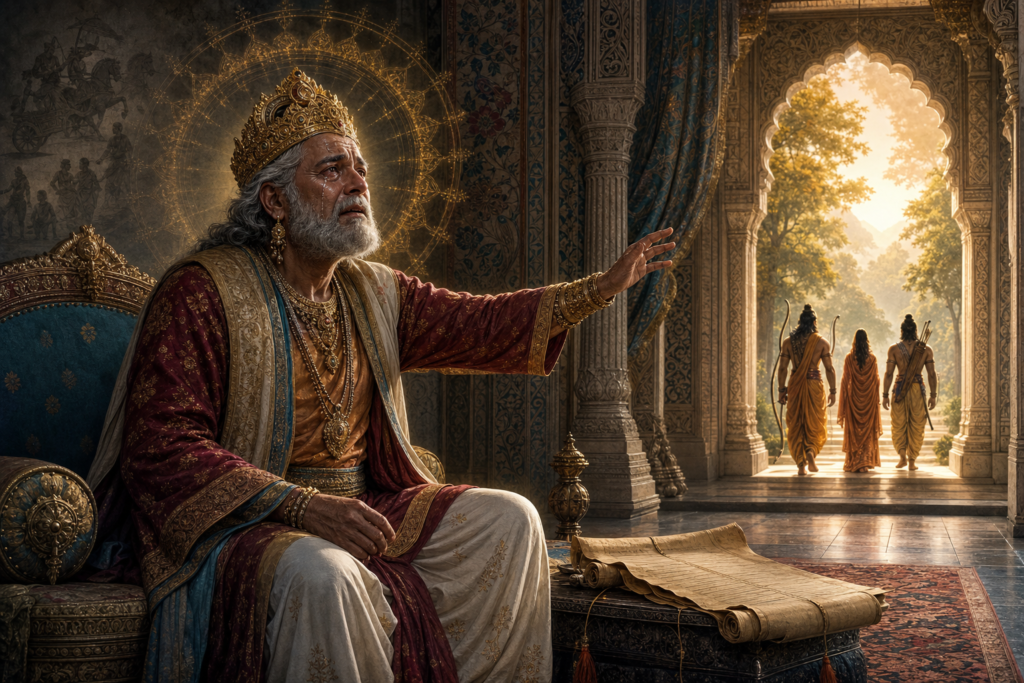
The Kashmiri Ramayana preserves one of the most emotionally intense reflections on the exile of Sri Rama: the image of King Dasharatha weeping until grief itself darkens his sight. This episode is not merely a dramatic embellishment. It is a theological and ethical meditation on attachment, kingship, parental love, and the precise moral logic of karma.
Within the broader Ramayana tradition, Rama’s departure from Ayodhya is often remembered as the moment when dharma becomes painfully visible. A prince who deserves coronation accepts exile without resentment. A kingdom that expects celebration is thrown into mourning. A father who once commanded armies becomes helpless before a promise he cannot revoke. The Kashmiri telling intensifies this moral crisis by giving Dasharatha’s grief a bodily consequence: tears that blind him.
The force of the episode lies in its refusal to treat sorrow as a private emotion alone. In the Ramayana, grief is never isolated from duty, memory, and moral consequence. Dasharatha’s tears arise from love for Rama, but they also expose the fragility of human attachment when it collides with vows, political obligations, and past actions. The king’s blindness becomes a profound symbol: when attachment overwhelms discernment, even a ruler with worldly authority loses inner vision.
The Kashmiri Ramayana belongs to the rich regional life of Rama Katha, the many retellings through which communities across Bharat have received, interpreted, and internalized the epic. These traditions do not merely repeat a fixed narrative. They illuminate different ethical accents within the same sacred story. In Kashmir’s literary and spiritual environment, where Sanskrit learning, Shaiva philosophical reflection, and devotional imagination deeply shaped cultural expression, the story of Dasharatha’s collapse becomes a meditation on consciousness, suffering, and karmic inevitability.
Dasharatha is not portrayed as a weak king. He is a ruler of Ayodhya, a guardian of royal order, and a father whose affection for Rama is both tender and immense. Yet the Ramayana repeatedly demonstrates that greatness does not exempt anyone from the consequences of action. Kings, sages, warriors, and ordinary people alike move within the field of karma. The moral law does not bend for status, lineage, or power.
The immediate cause of Dasharatha’s anguish is Kaikeyi’s demand that Rama be sent into exile and Bharata be installed as heir. Bound by boons he had once granted her, Dasharatha cannot withdraw his word without violating the royal commitment that sustains his authority. The tragedy is therefore not a simple conflict between good and evil. It is a collision among truth, promise, affection, and consequence.
Rama’s response gives the episode its ethical center. He does not argue that the demand is unjust, although the emotional injustice is evident. He does not humiliate Kaikeyi, accuse Dasharatha, or manipulate public sympathy. Instead, he accepts exile as the path required by dharma. In this acceptance, the Ramayana presents a demanding vision of moral life: righteousness is not measured only when circumstances are favorable, but especially when obedience to truth wounds the heart.
Dasharatha’s grief, by contrast, reveals the human cost of dharma when one is not inwardly prepared for its demands. He knows the binding power of his promise, yet he cannot bear its consequence. His sorrow is not shallow sentiment. It is the agony of a father who must watch the most beloved son depart because of a word once given, a courtly obligation once accepted, and a destiny now unfolding beyond his control.
The Kashmiri emphasis on tears that blind Dasharatha deepens the psychology of the scene. Physical blindness here is more than a medical condition or poetic exaggeration. It expresses the breakdown of perception under the pressure of unbearable attachment. The king cannot see Rama because he cannot accept a world in which Rama is absent. His eyes, overwhelmed by tears, become the organs through which attachment reveals its own limitation.
This detail also invites comparison with a wider Indic understanding of sight. In Hindu philosophy and spiritual literature, seeing is not merely sensory. It is linked to knowledge, discernment, and inner clarity. True vision requires more than open eyes; it requires steadiness of mind and alignment with dharma. Dasharatha’s blindness therefore becomes a moral and spiritual image: the mind clouded by attachment cannot perceive the full pattern of reality.
The episode becomes still more layered when read alongside the earlier story of Shravana Kumara. In many Ramayana traditions, Dasharatha accidentally kills the devoted son of blind parents while hunting, mistaking the sound of water for an animal. The grieving parents curse him that he too will die in sorrow caused by separation from his son. The later agony over Rama’s exile is thus not random suffering. It is the ripening of karma.
This karmic background is crucial. The Ramayana does not present karma as crude punishment or fatalistic despair. Karma is moral continuity. Actions carry consequences, even when performed in ignorance. Dasharatha did not intend to kill Shravana Kumara, yet the harm was real. The pain of bereaved parents entered the moral fabric of his life and returned as a parallel suffering: the unbearable separation of father and son.
The Kashmiri image of blindness intensifies this karmic symmetry. Dasharatha had once caused devastating grief to blind parents. Later, his own grief is associated with loss of sight. This is not merely narrative irony. It is a theological statement about the precision with which the epic imagination understands moral causality. The suffering one causes, even unknowingly, cannot be dismissed as finished simply because the act is past.
At the same time, the Ramayana does not invite contempt for Dasharatha. His grief is presented with compassion. He is not a villain, nor is he reduced to his past error. He is a tragic figure whose love is real, whose anguish is real, and whose karmic burden is real. This balance is one of the epic’s great strengths: it allows moral accountability without stripping human beings of dignity.
Such an approach is deeply relevant to dharmic traditions more broadly. Hinduism, Buddhism, Jainism, and Sikhism each, in distinct ways, ask human beings to examine action, intention, attachment, and consequence. The language and metaphysical frameworks differ, but the ethical seriousness is shared. The story of Dasharatha speaks across these traditions because it asks a universal question: how should one live when love, duty, and the results of past action converge?
In Hindu thought, karma is inseparable from dharma. Dharma gives action its proper orientation; karma records the moral force of action. Dasharatha’s tragedy emerges because royal dharma requires truthfulness, familial love pulls him toward Rama, and past karma shadows the present. The result is not a simple lesson but a layered moral crisis that demands reflection rather than quick judgment.
Rama’s exile also reveals the distinction between attachment and love. Love, in its highest form, seeks the good and remains aligned with dharma. Attachment clings, fears loss, and experiences separation as annihilation. Dasharatha loves Rama deeply, but his love is entangled with dependence. Rama, by contrast, loves his father without becoming bound by emotional collapse. He honors Dasharatha, comforts those around him, and still walks toward the forest.
This contrast is not meant to make Rama emotionally distant. On the contrary, Rama’s restraint gives emotional life its proper measure. He feels, but he is not ruled by feeling. He suffers, but suffering does not make him abandon truth. This is why he is remembered as Maryada Purushottama, the supreme exemplar of disciplined righteousness. His greatness lies not in the absence of pain, but in the ordering of pain under dharma.
Dasharatha’s grief remains powerful because it is recognizable. Families, communities, and societies repeatedly face moments when love cannot prevent separation, when a promise made earlier becomes costly, or when consequences arrive long after their causes have been forgotten. The Ramayana gives such experiences sacred depth. It teaches that grief should be honored, but also understood. Sorrow becomes spiritually meaningful when it leads to humility, responsibility, and clearer vision.
The image of a king weeping himself blind also critiques political power. Dasharatha governs a great kingdom, yet he cannot govern the consequences of his own word. He possesses authority, but not freedom from karma. This is a recurring principle in Indian epic literature: rulership without self-mastery is incomplete. Rajadharma requires not only military strength and administrative skill, but also truthfulness, restraint, and awareness of the unseen effects of action.
Ayodhya’s sorrow further shows that the moral life of a ruler affects the whole community. Rama’s exile is not confined to the palace. The citizens grieve, the royal household is shaken, and the emotional atmosphere of the city changes. In epic thought, leadership is never merely personal. The inner disorder of the palace becomes the public sorrow of the kingdom.
The Kashmiri Ramayana’s regional voice adds another layer to this reflection. Kashmir has historically been a region of profound Sanskrit scholarship, philosophical inquiry, temple culture, and poetic refinement. A Kashmiri rendering of the Ramayana naturally attends to subtle emotional and metaphysical textures. Dasharatha’s blinding tears fit this refined sensibility: a visible event becomes a window into invisible causality.
Regional Ramayana traditions should therefore not be treated as secondary or decorative. They are interpretive treasures. The Valmiki Ramayana provides the foundational structure of the narrative, while later and regional tellings reveal how communities have contemplated its meanings over centuries. Kashmiri, Tamil, Awadhi, Bengali, Assamese, Odia, Thai, Lao, and many other Ramayana traditions demonstrate the extraordinary cultural range of Rama Katha.
This plurality strengthens rather than weakens the sacred narrative. Dharmic civilization has long allowed truth to be contemplated through many voices, languages, and aesthetic forms. The unity of the Ramayana tradition lies not in mechanical uniformity, but in shared reverence for dharma, Rama, Sita, Lakshmana, Hanuman, and the moral universe they inhabit. The Kashmiri episode of Dasharatha’s tears is one luminous thread in this wider fabric.
The role of Sita should not be overlooked in this moment. Though the focus often falls on Rama and Dasharatha, Sita’s decision to accompany Rama into exile gives the episode another dimension of dharma. She refuses comfort detached from companionship and duty. Her presence transforms exile from solitary punishment into a shared vow. The emotional burden of Ayodhya is therefore carried not only by the father and son, but also by the wife who chooses hardship with clarity.
Lakshmana’s response adds still another layer. His devotion is active, protective, and intense. Where Dasharatha collapses under separation, Lakshmana channels love into service. This contrast helps the reader distinguish different forms of emotional energy. Grief may immobilize; devotion may mobilize. The Ramayana does not reject emotion. It disciplines emotion so that it becomes seva, courage, and moral action.
Kaikeyi’s role also demands careful interpretation. She is often remembered as the immediate cause of Rama’s exile, but the epic’s moral structure is more complex than blaming a single person. Her demands arise from insecurity, persuasion, ambition, and distorted judgment. Yet even her action becomes part of a larger unfolding through which Rama’s dharma, Bharata’s renunciation, Sita’s steadfastness, Lakshmana’s service, and Hanuman’s devotion are revealed.
This does not excuse wrongdoing. Rather, it shows how dharmic literature can hold two truths at once: harmful actions remain morally accountable, and divine order may still bring wisdom out of suffering. The exile is painful, but it becomes the path through which the world encounters Rama’s character in its fullest brilliance. Dasharatha’s grief is therefore not the end of the story; it is the dark threshold through which dharma enters a wider field.
The symbolism of tears deserves special attention. Tears can purify, but they can also obscure. They reveal tenderness, but they may also signal helpless attachment. In Dasharatha’s case, tears do both. They disclose his genuine love for Rama, while also showing that love without inner steadiness can become unbearable. The Kashmiri Ramayana uses this image with remarkable economy: the eye that should see becomes flooded by emotion.
In contemporary life, this image remains ethically useful. People often speak of being blinded by grief, anger, fear, or desire. The epic gives that phrase a sacred narrative form. Dasharatha’s blindness warns that emotional intensity, however understandable, can narrow perception. The path of dharma requires compassion for grief, but also practices that restore discernment: reflection, self-control, humility, prayer, and truthful remembrance.
The episode also challenges modern readings that reduce the Ramayana to political conflict or mythic adventure. Its true power lies in moral psychology. It studies how human beings respond when their deepest attachments are threatened. It studies how vows bind the future. It studies how past actions return not as abstract doctrine, but as intimate suffering. It studies how the righteous continue to act when the heart is breaking.
Dasharatha’s death after Rama’s departure is therefore not merely a plot event. It is the completion of a karmic arc. The king who once caused a father and mother to lose their son now loses the presence of his own son. The grief that leaves him blind also leads him toward the end of his life. The epic does not present this with cruelty. It presents it with solemnity, as a reminder that every action enters a moral universe larger than immediate intention.
Bharata’s later response completes the ethical frame. He refuses to benefit from Rama’s exile, rejects the throne as personal possession, and rules only as Rama’s representative. This is one of the great restorations of dharma in the epic. Where Dasharatha is broken by attachment and Kaikeyi is clouded by ambition, Bharata demonstrates renunciation within power. His conduct prevents Ayodhya’s sorrow from becoming moral collapse.
Thus, the Kashmiri Ramayana’s account of Dasharatha’s blinding grief should be read not as isolated tragedy, but as part of a wider ethical architecture. Rama reveals obedience to dharma. Sita reveals shared commitment. Lakshmana reveals service. Bharata reveals renunciation. Dasharatha reveals the sorrow of attachment and the weight of karma. Together, they form a complete study of human response to crisis.
The enduring value of this episode lies in its capacity to educate emotion. It does not ask readers to become indifferent. It asks them to love with awareness, to grieve without losing discernment, to honor promises before making them, and to understand that actions carry consequences beyond the moment of choice. Such teaching is both spiritual and practical.
For students of Hindu scriptures, Indian literature, and dharmic philosophy, the episode offers a compact but profound lesson in karma. Karma is not a distant theory reserved for metaphysical debate. It is present in speech, in vows, in parental responsibility, in political decision, in hunting, in grief, and in memory. The Ramayana makes karma visible through relationships because relationships are where moral life is most intensely tested.
The Kashmiri tradition’s contribution is to make that visibility sharper. Dasharatha does not merely mourn; he loses sight. The outer eye fails when the inner world is overwhelmed. Yet the reader is invited to see more clearly through his blindness. The tragedy becomes instruction. The king’s tears become a mirror. The exile of Rama becomes not only an event in Ayodhya, but a permanent meditation on dharma, attachment, grief, and the solemn weight of karma.
Inspired by this post on Hindu Blog.





Leave a Reply
You must be logged in to post a comment.