
Leadership is often taught through frameworks: decision matrices, communication models, performance metrics, stakeholder maps, and team-building exercises. These tools have value, but they usually address leadership as an external skill set. Indian classical arts approach the same territory differently. They train decision-making, adaptability, execution, communication, discipline, attention, humility, and teamwork through repeated embodied practice.
This distinction is important. In many formal leadership programs, a participant may understand a concept intellectually before being asked to apply it later. In classical dance, music, martial arts, yoga, and other Indic traditions of practice, the learning is immediate. The body forgets a movement, the rhythm slips, the expression becomes excessive, the ensemble falls out of alignment, or the performer loses connection with the audience. Correction is not theoretical; it is lived in real time.
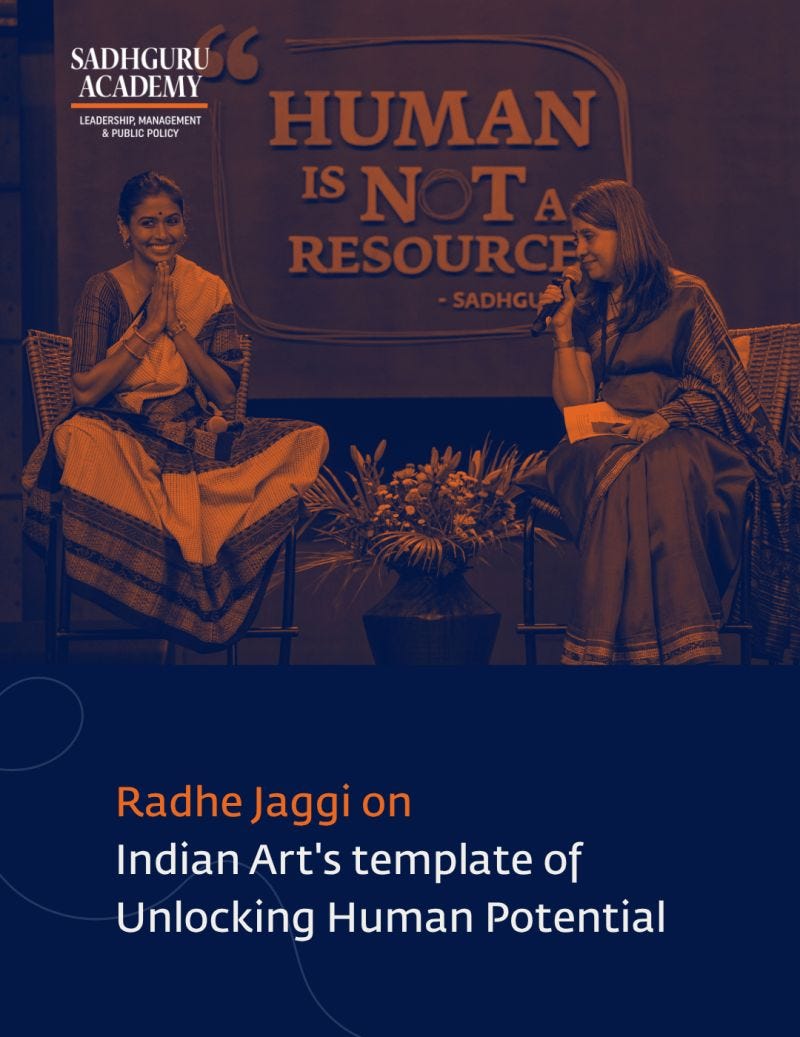
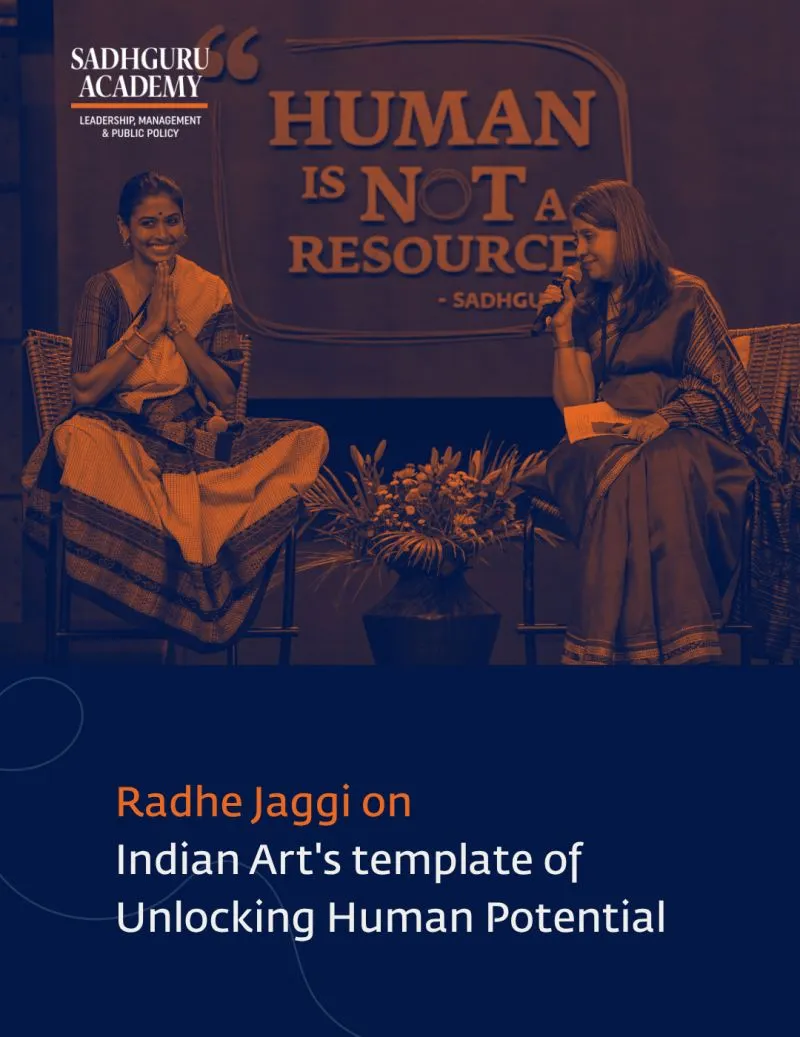
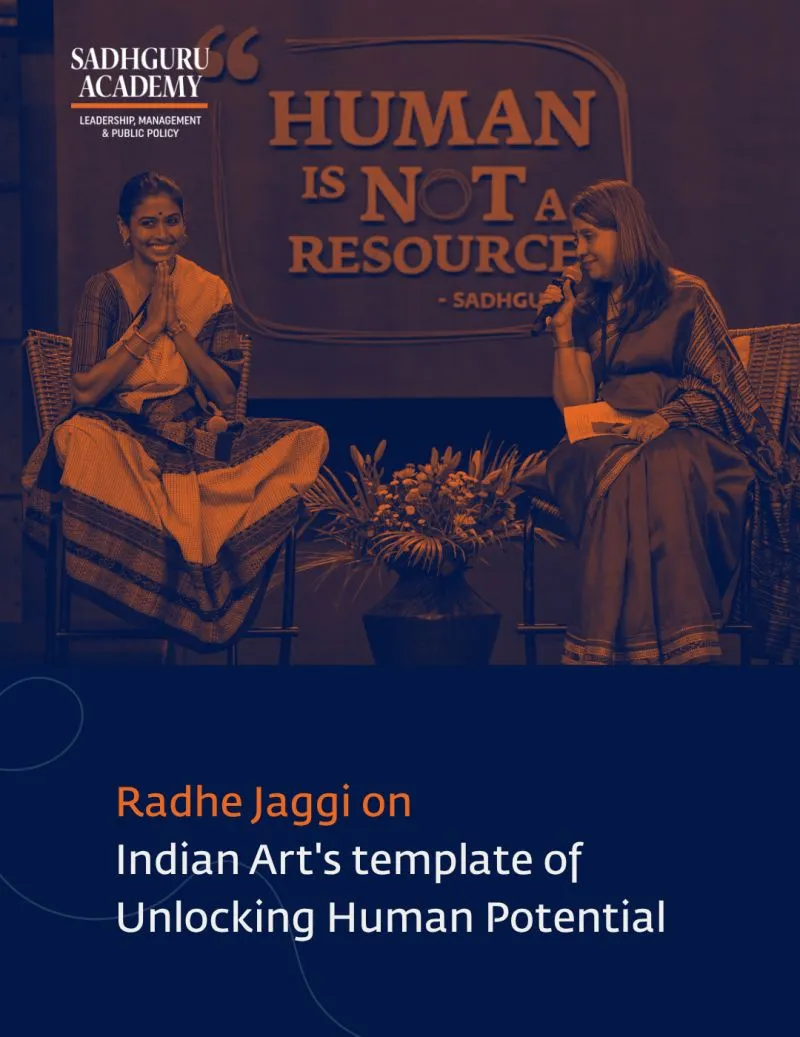
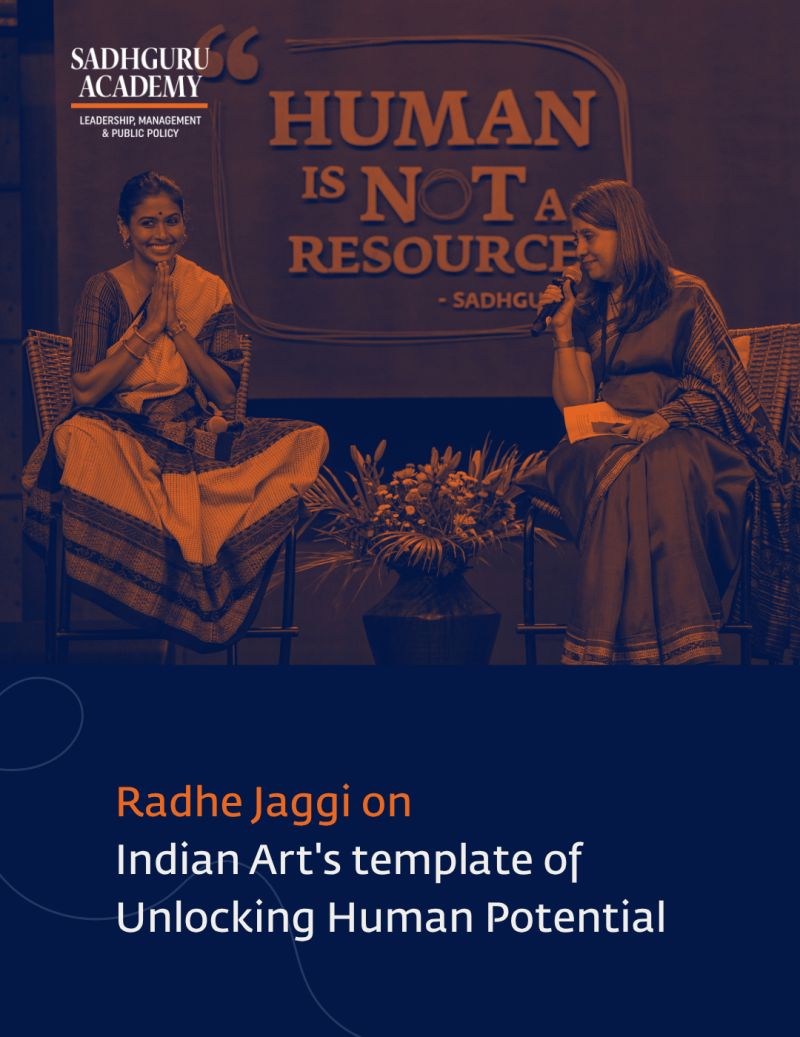
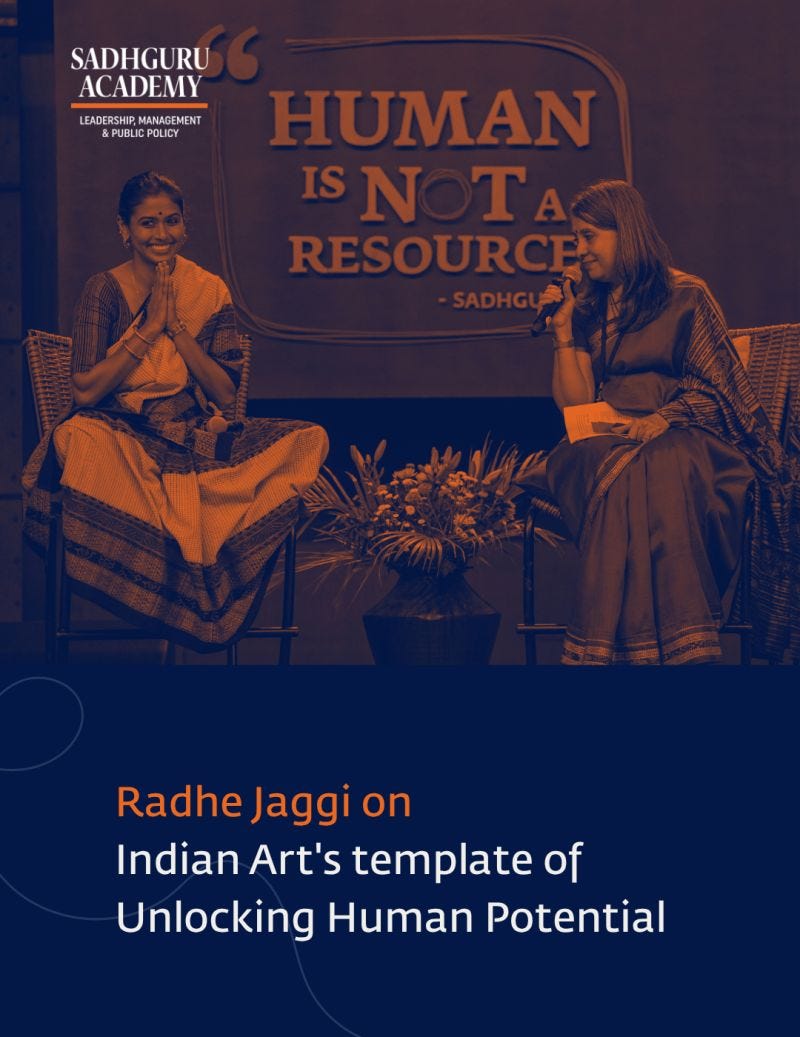
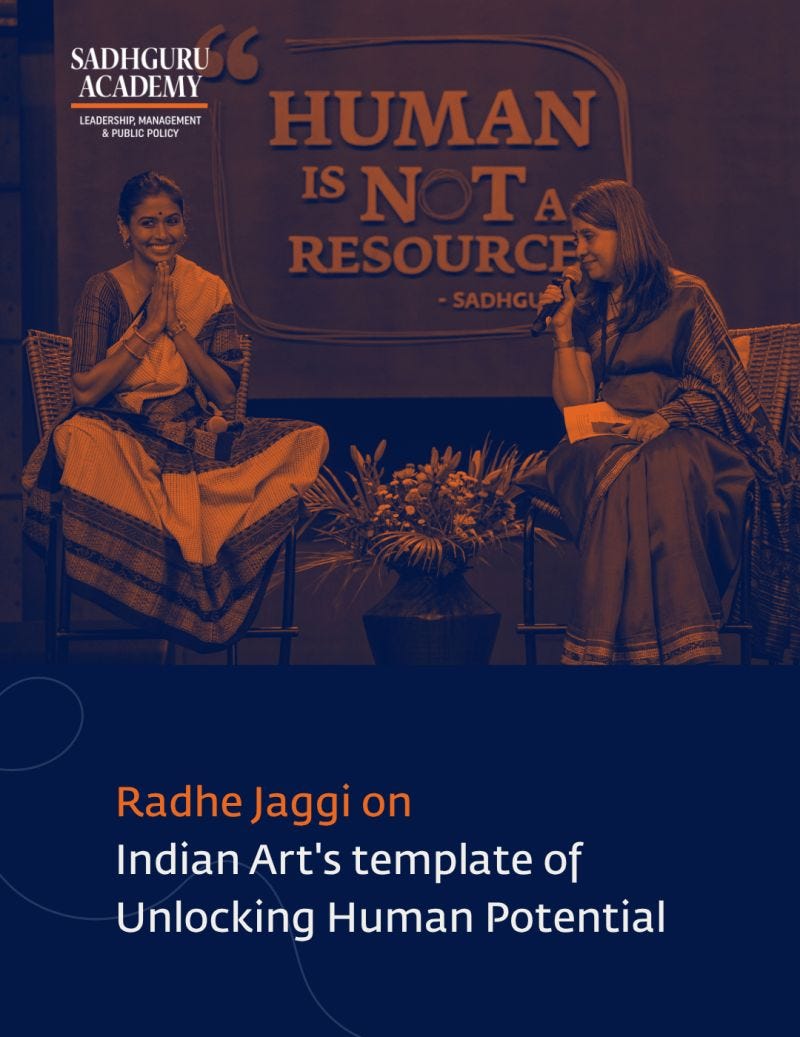
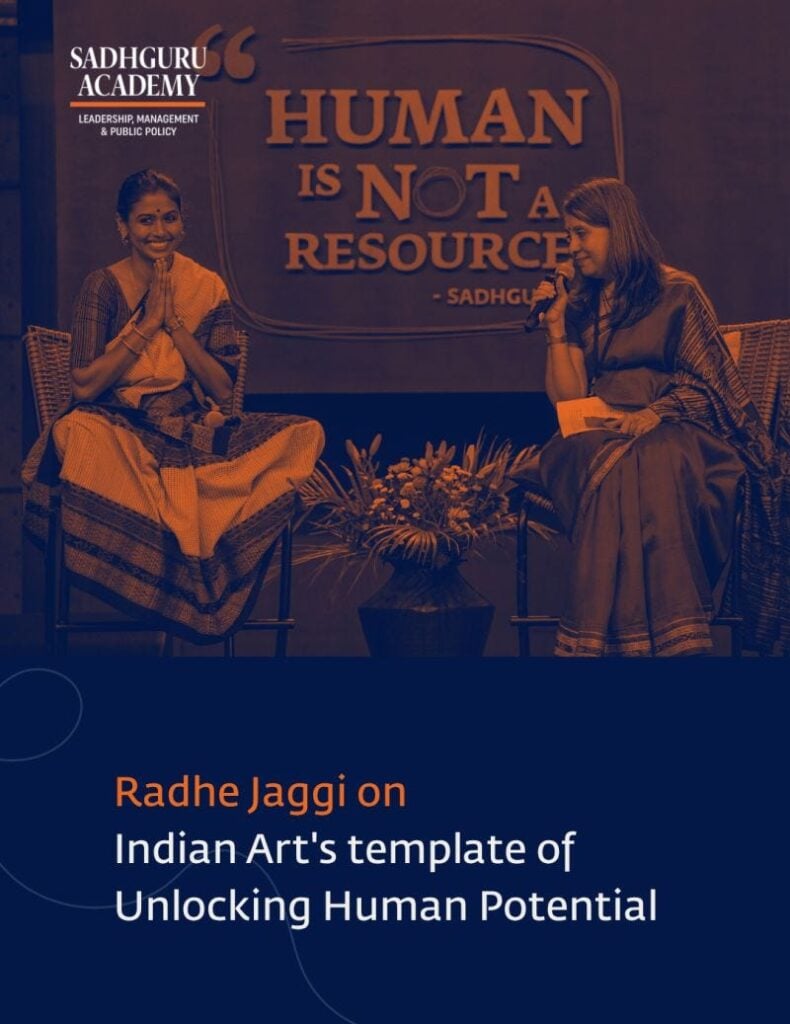
A conversation at Sadhguru Academy’s Human is Not a Resource program, where Radhe Jaggi reflected on decades of classical dance training, offers a useful lens through which to examine this relationship between Indian classical dance and leadership. Her observations show that the arts do not merely produce performers. Under rigorous conditions, they cultivate the inner architecture required for responsible leadership: attentiveness, receptivity to feedback, emotional regulation, clarity of intent, and the capacity to carry others through a shared experience.
Classical arts as leadership training
Classical arts are sometimes treated as cultural ornamentation, as though they belong only to festivals, ceremonies, or aesthetic appreciation. This is a serious underestimation. Indian classical dance traditions such as Bharatanatyam, Kuchipudi, Kathak, Odissi, Mohiniyattam, Kathakali, Manipuri, and Sattriya carry sophisticated systems of movement, rhythm, memory, emotion, symbolism, storytelling, ethics, and disciplined apprenticeship. Their pedagogy is demanding because the art form requires alignment between mind, body, breath, emotion, imagination, and audience awareness.
Leadership requires the same integration. A leader may have a strong strategy, but if communication is unclear, the organization does not move. A leader may have technical competence, but if emotional balance is absent, teams become unstable. A leader may have vision, but if that vision is not translated into shared experience, it remains private ambition. Classical arts train precisely this movement from inner intent to outer impact.
In dharmic traditions, learning is rarely reduced to information transfer. The guru-shishya tradition, sadhana, abhyasa, seva, tapas, and self-discipline all point toward transformation through practice. The purpose is not merely to know, but to become capable. This is why classical arts remain relevant to education, leadership development, and cultural heritage. They preserve not only forms of beauty, but also tested methods for shaping attention, conduct, and responsibility.
1. The ability to drop what is not working
One of the most valuable leadership capacities is the ability to abandon what is failing without collapsing into defensiveness. Leaders often become attached to plans because those plans carry their effort, authority, reputation, or emotional investment. The more public the commitment, the harder it becomes to change direction. Yet organizations suffer when leaders protect an idea longer than the evidence justifies.
Classical arts make this form of detachment unavoidable. A dancer cannot preserve a flawed movement because it feels personally meaningful. A musician cannot defend a broken rhythm because it was sincerely attempted. A performer cannot insist that an expression worked if the audience did not receive it. Artistic practice repeatedly teaches that sincerity is not a substitute for precision.
Radhe Jaggi described this quality with practical clarity: “The minute you realize that something is not working, it’s very easy to implement whatever corrections you want to implement because that’s what you have been doing your whole life.” This statement reveals a deep pedagogical principle. Repeated correction changes the nervous system’s relationship with feedback. Criticism becomes less threatening because revision becomes normal.
In many professional environments, feedback is treated as a performance review event. In rigorous artistic environments, feedback is continuous. The student is corrected in posture, timing, expression, breath, stance, weight transfer, hand placement, gaze, and emotional tone. Over time, the ego has less room to dominate the process because the work itself demands accountability.
Radhe noted that there is always someone who dances better, creates more powerfully, or carries stronger stage presence. This awareness can produce insecurity in an immature mind, but under disciplined training it produces humility. The practitioner learns to look at excellence without resentment and to recognize that improvement is not humiliation. It is the natural condition of serious learning.
A leadership culture built on this principle would look very different from one built on image management. Instead of asking, “Who is to blame?” it would ask, “What is not working?” Instead of protecting a strategy because senior leadership approved it, the organization would examine whether the strategy is still serving the intended outcome. This is not weakness. It is mature decision-making.
Radhe’s recollection of a blunt performance review from her father captures the psychological strength required. Before a major tour, he reportedly said, “Can I be honest with you? This simply won’t fly.” Her response was not denial, but inquiry: “I know it was very bad, but tell me what’s not working.” This is the leadership mind at work. It receives reality, absorbs the discomfort, and turns toward correction.
For managers, founders, teachers, public servants, and community leaders, this lesson is urgent. Adaptability is not simply the ability to change when circumstances change. It is the ability to recognize failure early, separate self-worth from the flawed plan, and move toward a better possibility without drama. Classical arts train this through the daily discipline of refinement.
2. Rasa and the duty to carry others
The concept of Rasa offers one of the most profound bridges between Indian classical arts and leadership. In common usage, Rasa is often translated as emotion, flavor, essence, or aesthetic experience. In the performance traditions shaped by the Nāṭyaśāstra and later interpretive traditions, Rasa is not merely what the performer feels. It is what is evoked, communicated, and experienced by the audience.
This distinction matters. A performer may be emotionally intense, technically accomplished, and visually impressive, yet still fail to create Rasa. The purpose is not self-display. The purpose is transmission. The audience must be carried into the intended experience. Radhe described it directly: “You are trying to create an emotion and the audience is trying to experience that same emotion.”
She further explained that admiration alone is insufficient. If the audience merely watches the dancer and thinks the dancer is beautiful, talented, or expressive, the deeper artistic purpose has not been fulfilled. “You also have to be with me step on step and your emotions have to rise and fall along with me.” This is a demanding definition of communication. It does not measure success by the sender’s effort, but by the receiver’s participation.
Leadership operates by the same law. A founder may possess a powerful vision, but if employees do not understand it, partners do not align with it, and customers do not experience it, the vision remains incomplete. A teacher may love knowledge, but if students are not awakened into curiosity, the love has not been transmitted. A healthcare institution may declare compassion, but if patients experience indifference, the bhava has not reached them.
Every meaningful institution begins with a bhava, an originating intent or felt orientation. In dharmic language, bhava carries a quality of inner disposition. In organizational language, it may be called mission, purpose, ethos, or culture. The term may differ, but the central problem is the same: how does an inner commitment become a shared lived reality?
Indian classical dance offers a disciplined answer. The performer must remain connected to the story, the technique, the rhythm, the fellow performers, and the audience simultaneously. This requires emotional intelligence, but also emotional restraint. The performer cannot be swallowed by personal feeling. Feeling must be shaped into communication.
Radhe shared a striking example from rehearsal. A performer portraying Sita became so overwhelmed by emotion that she began crying on stage. Many observers found it moving. Yet another artist responded with a sharper standard: “You are failing your audience by being overwhelmed with your own story in your head.” This statement belongs not only to the arts, but to ethics, governance, education, and leadership.
A leader may feel pressure, pride, disappointment, fear, devotion, anger, or exhaustion. These emotions are human and often unavoidable. But leadership cannot be reduced to the leader’s inner drama. The duty remains to carry others responsibly. When the leader becomes absorbed in personal emotion, the team loses orientation. When the leader transforms emotion into clarity, the group can move.
Radhe’s phrase, “Your business is to take these hundred people, three hundred people, ten thousand people along with you on that journey,” expresses the essence of leadership as stewardship. The audience, the team, the institution, and the wider community are not accessories to the leader’s self-expression. They are the field of responsibility.
This is also where Indian classical arts can contribute to modern debates about emotional intelligence. Emotional intelligence is not merely the ability to identify feelings. It is the capacity to regulate, refine, and direct them toward constructive relation. Rasa requires empathy, but also craft. Bhava requires authenticity, but also discipline. Leadership requires both.
3. The freedom that comes from inhabiting many perspectives
Classical dance repeatedly asks the performer to inhabit different characters, emotional states, moral situations, and relational positions. A dancer may portray devotion, longing, courage, grief, playfulness, surrender, wonder, anger, or compassion. Within a single performance, the artist may move across roles, temperaments, and inner landscapes that are far from ordinary personality.
This has direct leadership significance. Many leaders become trapped by their own habitual identity. They communicate in one register, respond to conflict in one style, and interpret others through limited assumptions. Classical arts challenge this rigidity. They demonstrate that the human being is more plastic, more nuanced, and more capable of transformation than the fixed personality imagines.
Radhe expressed this freedom powerfully: “When you know that you can change absolutely everything about yourself if you want to, because you have done it many, many times, it’s extremely freeing.” The statement is not about superficial reinvention. It points to a trained ability to enter new states consciously rather than be imprisoned by old reactions.
For leadership, this capacity supports perspective-taking. A leader must understand the engineer, the artist, the investor, the customer, the patient, the student, the volunteer, and the critic without collapsing into any one view. In civilizational terms, this flexibility has deep resonance with dharmic traditions, where plurality is often handled through disciplined forms rather than through chaos. Difference is not denied; it is given structure, rhythm, and relational intelligence.
Such training can also support unity among Hinduism, Buddhism, Jainism, and Sikhism. These traditions differ in theology, practice, philosophy, and historical development, yet they share a civilizational respect for disciplined practice, inner refinement, ethical conduct, and the transformation of the human being. Classical arts can serve as a cultural meeting ground where devotion, mindfulness, non-violence, service, wisdom, and self-mastery are encountered through embodied learning.
4. Master the subject inside, outside, upside down
Effortless execution is usually the visible surface of invisible preparation. In Indian classical dance, the audience may see grace, expression, and continuity. Beneath that surface lie years of training in choreography, tala, laya, sahitya, abhinaya, posture, stamina, memorization, musicality, and stage awareness. What appears spontaneous is often the fruit of disciplined repetition.
Radhe described this preparation without compromise: “You have to know your subject inside, outside, upside down, backwards, forwards.” In leadership terms, this is domain mastery. It is not enough to hold a title or speak confidently. Authority becomes reliable only when grounded in deep understanding.
In performance, deep preparation allows recovery. If a sequence is forgotten, if an entry is missed, if another performer makes an error, or if the music shifts unexpectedly, the trained artist can return to structure. The dancer who knows only surface choreography may panic. The dancer who understands the grammar of the work can adapt without destroying the whole.
This principle applies exactly to leadership. Leaders who know only slogans cannot respond well to disruption. Leaders who understand the underlying structure of their field can diagnose problems, adjust execution, and communicate with precision. In business, this means understanding the product, customer, financial model, operational constraints, team capacity, and cultural dynamics. In education, it means understanding the learner, the subject, the method, and the purpose of knowledge. In public life, it means understanding institutions, history, law, community realities, and consequences.
Depth also improves communication. Radhe observed, “You have to know it so well that you can make it relevant to anybody who comes and sits in front of you.” This is a highly developed leadership skill. Superficial knowledge communicates in one fixed way. Deep knowledge can translate itself for different audiences.
A technical expert may need one explanation. A new employee may need another. A community elder, a child, an investor, a patient, or a policymaker may each require a different entry point. The leader who truly understands can adjust language without diluting truth. This is not manipulation; it is responsible pedagogy.
Indian knowledge traditions have long understood this principle. The same insight may be conveyed through sutra, story, debate, ritual, music, silence, meditation, or direct instruction depending on the readiness of the listener. Classical arts preserve this educational flexibility because they communicate through multiple channels at once: word, sound, gesture, rhythm, costume, space, and emotional tone.
5. Learn what one is genuinely terrible at
Another significant lesson from Radhe’s reflections concerns the beginner’s state. She encouraged participants to observe what happens when they attempt something at which they are genuinely poor: “Everybody must learn something that you’re terrible at, absolutely terrible at.” This advice is deceptively simple. It challenges the adult preference for competence, reputation, and control.
Many professionals spend years working inside their strengths. This produces efficiency, but it can also produce rigidity. A person who is always competent may forget how learning feels. A leader who has forgotten the vulnerability of learning may become impatient with beginners, dismissive of slow progress, or blind to the emotional cost of change.
When a person starts at zero, the mechanics of learning become visible. Resistance appears. Embarrassment appears. Comparison appears. Frustration appears. But so do curiosity, adaptation, and small improvements. Radhe explained, “If you start absolutely at zero, it’s very easy to observe how quickly you’re capable of learning something if you put your mind to it.” This is self-awareness through practice.
For leadership development, this is invaluable. A leader who periodically enters beginnerhood becomes less arrogant and more observant. Such a leader better understands training, change management, skill development, and human hesitation. The experience of not knowing becomes a source of empathy rather than shame.
Classical music, dance, martial arts, Sanskrit learning, yoga practice, or any disciplined art can create this experience. The specific form matters less than the seriousness of engagement. Casual exposure may entertain, but rigorous beginnerhood transforms. It reveals the mind’s reactions and trains patience, concentration, and respect for process.
6. Listening with the whole body
Radhe’s statement about listening is especially important: “You have to learn how to listen not just with your ears, but with your whole body.” In ordinary speech, listening is treated as an auditory act. In performance, listening is total. The dancer listens to rhythm through the feet, space through peripheral awareness, fellow performers through timing, and the audience through subtle shifts in energy and attention.
This kind of listening is close to presence. It is not passive. It is alert, embodied, and responsive. Leaders often fail not because they lack information, but because they do not perceive what is happening until it becomes too obvious to ignore. Teams communicate through tone, hesitation, silence, fatigue, enthusiasm, confusion, and alignment. A leader trained only in verbal reporting may miss these signals.
Classical arts refine perception. A slight delay in rhythm matters. A misplaced glance changes meaning. A hand gesture without inner connection looks empty. A strong movement without breath looks forced. These disciplines train the practitioner to notice subtlety, and subtlety is essential to leadership. Culture breaks down first in small signals before it appears in large failures.
Listening with the whole body also has ethical implications. It asks the leader to be present, not merely perform attention. It asks the teacher to notice whether a student has truly understood. It asks the institution to sense whether its declared values are actually being experienced. It asks the community to move beyond slogans and into lived responsibility.
7. Discipline without harshness, excellence without ego
There is a common misunderstanding that discipline and sensitivity are opposites. Classical arts demonstrate that they can be mutually reinforcing. A dancer must be disciplined enough to repeat, correct, and refine. At the same time, the dancer must be sensitive enough to express nuance, receive feedback, and remain connected to the audience.
Leadership requires the same balance. Discipline without sensitivity becomes authoritarian. Sensitivity without discipline becomes ineffective. The classical arts train both because the art collapses if either is absent. Technical perfection without inner bhava is lifeless. Emotional intensity without structure is disorderly. The mature performer integrates both.
This integration has relevance for modern organizations. Many workplaces oscillate between excessive rigidity and excessive informality. Classical training suggests a third possibility: high standards held within a culture of sincere learning. In such a culture, correction is not cruelty, excellence is not vanity, and humility is not weakness.
The same principle can support dharmic community life. Hindu, Buddhist, Jain, and Sikh traditions all possess disciplines of practice, whether through meditation, seva, vrata, svadhyaya, kirtan, ethical restraint, or contemplative inquiry. These practices are not merely private spiritual preferences. They form human beings who can contribute with steadiness, restraint, compassion, and courage.
8. From performance to responsibility
The deepest leadership lesson in classical arts may be that performance is not self-display. It is responsibility. The performer prepares not to be admired, but to serve the work, the tradition, the audience, and the moment. This orientation changes the meaning of excellence. Excellence becomes a form of service.
When leadership is understood similarly, it becomes less about personal charisma and more about carrying a collective journey. The leader must understand the bhava of the enterprise, communicate it through action, adapt when necessary, and ensure that others can participate meaningfully. This is why Rasa is such a powerful leadership metaphor. The leader has not succeeded merely because the leader feels inspired. The organization must experience the intent.
This is especially relevant in cultural and educational work. It is not enough to speak about Indian culture, Hindu philosophy, Yoga, Nāṭyaśāstra, or spiritual wisdom as inherited treasures. They must be made intelligible, relevant, and alive for present generations. That requires scholarship, but also pedagogy. It requires devotion, but also clarity. It requires reverence for tradition, but also the ability to communicate across modern contexts.
Leadership as a lived experience
The conversation at Sadhguru Academy is significant because the lessons were not presented as leadership theories. They emerged from rehearsals, errors, correction, performance, discipline, music, movement, and artistic rigor. This is precisely why they matter. The most durable forms of learning are often those that pass through the body, the emotions, the intellect, and the will together.
Classical arts train the whole person. They demand memory, attention, humility, resilience, aesthetic sensitivity, cultural literacy, physical discipline, emotional control, and the ability to respond to changing circumstances. These are not secondary leadership traits. They are central to any serious act of guidance, institution-building, teaching, or service.
Modern leadership education can learn from this. It can move beyond lectures alone and incorporate embodied learning, artistic discipline, silence, rhythm, observation, teamwork, and reflective practice. Such methods do not replace analytical training; they deepen it. They help transform leadership from a vocabulary into a way of being.
Indian classical arts may therefore be among the most effective leadership schools because they do not permit easy separation between knowledge and conduct. They ask the practitioner to listen fully, correct quickly, prepare deeply, communicate responsibly, and carry others through a shared experience. In that sense, leadership is not merely learned in the boardroom. It is learned in the rehearsal hall, on the stage, in the discipline of daily practice, and in the quiet willingness to be corrected until the work becomes worthy of those it seeks to serve.
Inspired by this post on RightViews.








Leave a Reply
You must be logged in to post a comment.