
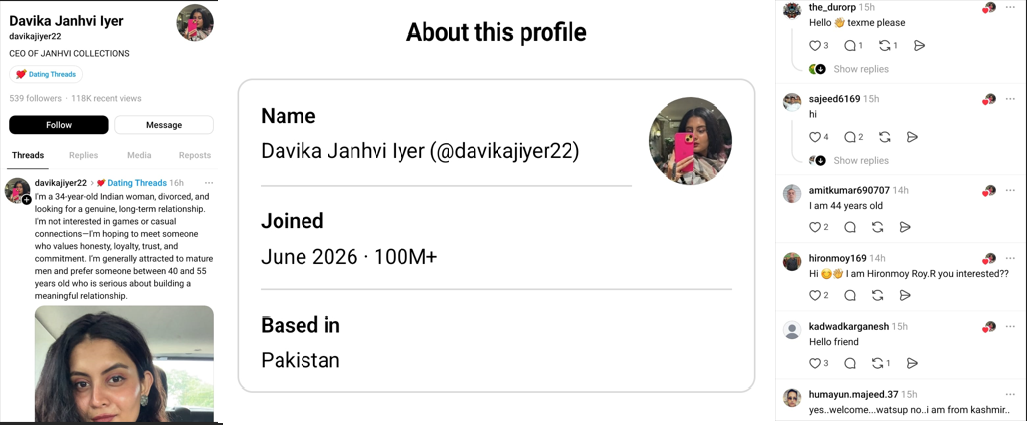
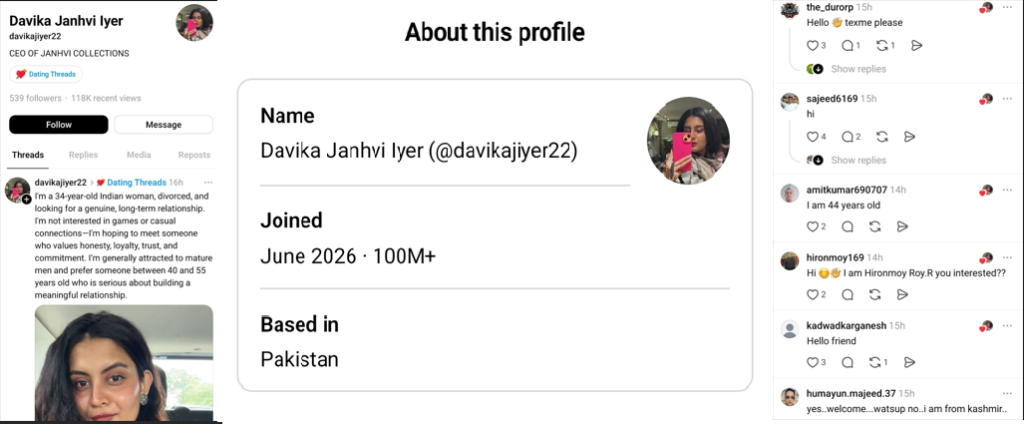
The reported “Davika Jahnvi Iyer” episode is not merely a story about one suspicious social media profile. It is a case study in how the honey trap has moved from the restricted world of espionage, diplomacy, and military counterintelligence into the everyday digital lives of ordinary Bharatiya citizens. According to the source report, more than 200 Indian men publicly expressed readiness for “a serious relationship” with a stranger online, despite having no verified knowledge of her identity, background, intentions, or even whether the photographs attached to the profile were genuine. That single fact deserves careful attention because it reveals a larger social and security vulnerability: emotional trust can now be manufactured, scaled, and exploited through ordinary platforms used for friendship, romance, networking, and cultural expression.
A traditional honey trap depended on proximity, patience, and access. A hostile intelligence operative or criminal intermediary had to identify a target, learn the target’s weaknesses, build contact, and gradually convert intimacy into leverage. Digital platforms have altered that process. Today, a false persona can be created quickly, decorated with convincing photographs, supplied with a plausible biography, and circulated across public networks. The attacker no longer needs to begin with a high-ranking officer, diplomat, scientist, or bureaucrat. The attacker can begin with hundreds of ordinary people and let the responses reveal who is lonely, impulsive, ambitious, vulnerable, careless with information, or eager for validation.
This is the democratization of the honey trap. The term does not mean that every online relationship is dangerous or that every stranger is malicious. It means that the techniques once associated with specialized espionage have become cheap, repeatable, and accessible. Social engineering has become industrial. A profile can attract attention, test emotional availability, gather biographical details, map social circles, and identify useful targets long before any direct request for money, documents, photographs, political opinions, or confidential information is made. In that sense, the public response to a fake or unverified persona may itself become intelligence.
The national security dimension is obvious, but the social dimension is equally serious. Bharat’s internal security is not protected only at borders, bases, laboratories, ministries, and police stations. It is also protected inside homes, phones, family conversations, workplace chats, alumni groups, religious communities, and local networks of trust. Ordinary citizens may not imagine themselves as targets because they do not hold classified files. Yet they may know someone who does. They may work in logistics, telecom, software, civil aviation, ports, banking, local administration, education, media, or infrastructure. They may have relatives in the armed forces or government service. They may participate in public debates that shape community morale. In modern information warfare, such people can be useful even when they are not powerful.
Honey trapping is best understood as a form of social engineering. Its core method is not romance; its core method is manipulation. Romance, flattery, sympathy, ideology, grievance, career opportunity, spiritual curiosity, and shared cultural identity can all be used as entry points. The attacker studies what the target wants to believe. If the target seeks admiration, the persona offers admiration. If the target seeks companionship, the persona offers intimacy. If the target seeks recognition as a protector of dharma, nation, community, or tradition, the persona may mirror that language. The danger lies not in affection itself, but in affection being simulated for extraction.
The “Davika Jahnvi Iyer” framing is therefore important because it shows how identity markers can be weaponized. A name, photograph, linguistic style, claimed regional background, religious vocabulary, or patriotic tone can make a stranger appear familiar. Familiarity reduces suspicion. In a civilizational society where names, customs, festivals, and community references carry emotional meaning, this familiarity can be especially powerful. The response should not be cynicism toward cultural identity; it should be disciplined verification. Sanatana Dharma, Sikh, Buddhist, and Jain traditions all place high value on self-mastery, discernment, restraint, truthfulness, and responsibility. Those values are directly relevant to digital conduct.
The technical structure of such operations often begins with open-source intelligence. Public posts reveal age, location, profession, political interests, religious affiliations, family details, travel patterns, emotional states, and peer networks. A person who posts photographs from a workplace, comments about family members in uniform, shares frustrations about employment, or publicly displays loneliness may not intend to disclose sensitive information. Yet a patient observer can assemble a profile. The attacker does not need one dramatic secret. Small details, collected over time, can produce a precise map of a person’s habits and vulnerabilities.
The next layer is engagement. A suspicious account may begin with likes, comments, compliments, shared interests, or appeals to cultural affinity. It may avoid asking for anything at first. The goal is to normalize contact. Once trust develops, the conversation may move to private messages, encrypted apps, video calls, or disappearing-message platforms. The target may then be encouraged to share personal photographs, frustrations, workplace details, travel plans, political opinions, financial information, or information about friends and relatives. At that point, the interaction may still feel voluntary, even affectionate. The coercion often begins only after the target has disclosed something that can be used for blackmail, embarrassment, financial pressure, or recruitment.
Artificial intelligence and synthetic media intensify the risk. Fake profile pictures, altered videos, voice imitation, automated translation, and chatbot-assisted conversation can make deception more persuasive and scalable. An attacker can maintain multiple personas, respond in different emotional tones, imitate regional speech patterns, and adapt quickly to the target’s reactions. This does not mean every attractive profile is artificial. It means that visual charm and fluent conversation are no longer reliable proof of identity. In the digital environment, trust must be earned through consistent verification rather than granted through emotional impact.
The most troubling part of the reported episode is the public willingness of many men to commit emotionally to an unknown profile. Such behavior reflects a broader crisis of digital judgment. Social media rewards instant reaction, public performance, and emotional display. A person who would be cautious in a physical setting may become reckless online because the screen creates distance from consequences. Publicly declaring romantic intent toward an unverified stranger is not merely a private embarrassment. It signals susceptibility. It tells observers that the person may respond to flattery, fantasy, and attention without basic verification.
This vulnerability should be discussed without humiliation. Shame rarely produces better security habits. Many people fall for social engineering because the manipulation targets normal human needs: affection, respect, companionship, recognition, and belonging. A healthy society does not mock loneliness; it builds stronger families, communities, friendships, and institutions where people are less desperate for validation from unknown accounts. At the same time, compassion cannot become naivety. Emotional need does not remove personal responsibility. Digital restraint is now part of civic discipline.
From an internal security perspective, the ordinary citizen is now part of the attack surface. This phrase may sound technical, but its meaning is simple. Every public profile, device, chat group, cloud account, and social connection can become a path through which hostile actors gather information or apply pressure. The security of Bharat therefore depends not only on intelligence agencies and police forces, but also on everyday habits: what citizens share, whom they trust, how they verify, and whether they report suspicious approaches before harm occurs.
Several warning signs deserve attention. A new account with limited history but intense emotional interest should be treated cautiously. A person who rapidly shifts conversation from public comments to private channels may be testing boundaries. Requests for secrecy, late-night intimacy, personal photographs, financial help, workplace information, or details about relatives in sensitive professions are serious red flags. So are inconsistent biographies, reluctance to verify identity through ordinary means, pressure to delete chats, and attempts to create emotional dependency. A genuine relationship can withstand reasonable verification; a manipulative operation usually resists it.
Verification should be practical rather than theatrical. Reverse-image search can sometimes reveal stolen photographs, though it is not foolproof. A long-standing social presence, mutual real-world contacts, consistent identity across platforms, and willingness to interact in normal, accountable ways are more meaningful than a polished profile. Citizens should avoid sharing sensitive personal media with strangers, especially material that can be used for blackmail. They should separate professional and personal accounts, limit public visibility of family and workplace information, use strong authentication, and avoid storing compromising material in easily accessible cloud folders or chat histories.
The workplace dimension is especially important. Employees in technology, telecom, banking, logistics, ports, aviation, healthcare, research, education, media, and government-linked services may underestimate the value of routine information. Shift patterns, procurement details, internal disputes, office photographs, vendor relationships, and travel schedules can all become useful fragments. A hostile actor may not ask directly for classified material. Instead, the actor may collect harmless-looking details that later help craft phishing attacks, impersonation attempts, recruitment approaches, or targeted disinformation.
Families also need a more mature vocabulary for online safety. Young people should not be taught that all interaction is dangerous, but they should be taught that intimacy without verification is risky. Parents and elders should avoid moral panic and instead discuss specific behaviors: oversharing, secret chats, sudden emotional dependency, financial requests, unknown video calls, and public romantic declarations toward strangers. Community organizations, temples, gurdwaras, Jain sanghs, Buddhist institutions, student groups, and cultural forums can all help normalize digital caution as a form of self-respect and social responsibility.
There is also a gendered aspect that must be handled carefully. Men are often targeted through admiration, romance, and ego, while women may be targeted through emotional intimacy, coercion, threats, or reputational pressure. Both men and women can be victims, and both can be used as fronts by criminal or hostile networks. Reducing the issue to crude stereotypes weakens analysis. The central problem is not gender; it is exploitability. Any person who can be emotionally isolated, flattered, frightened, or compromised can become a target.
Public discourse should also avoid turning every suspicious online interaction into communal suspicion. The objective of dharmic unity requires clarity without indiscriminate hostility. Bharat’s security challenges are real, and hostile networks may exploit religious, ideological, regional, or national identities. Yet the response must remain disciplined, evidence-based, and lawful. The purpose of discussing honey traps is to strengthen society, not to create paranoia between communities or weaken the ethical foundations of dharma. Truth, restraint, and vigilance must operate together.
The legal and institutional response should include public awareness, cybercrime reporting, platform accountability, and better digital literacy. Social media companies should improve detection of coordinated fake personas, stolen images, impersonation, and suspicious mass-engagement patterns. Law enforcement agencies need accessible reporting pathways so citizens can report suspicious approaches before blackmail or financial loss occurs. Schools, colleges, and workplaces should treat social engineering as a core safety topic rather than a niche cybersecurity concern.
At the personal level, the most effective defense is a combination of dignity and delay. Dignity prevents a person from seeking validation from every flattering stranger. Delay prevents impulsive disclosure. Before responding to an intense online approach, a person can pause and ask basic questions: Is this identity verified? Why is the interest so sudden? What information has already been shared? Is secrecy being requested? Would this conversation look reasonable if reviewed by a trusted friend or family member? These questions are simple, but they interrupt manipulation.
The “Davika Jahnvi Iyer” incident should therefore be read as a warning about the age of scalable intimacy. Digital platforms have made it possible for strangers to simulate closeness before trust has been earned. That simulation can be used for romance scams, extortion, propaganda, recruitment, reputational damage, or intelligence gathering. Ordinary Bharatiya citizens are increasingly targeted because ordinary citizens are connected, expressive, searchable, and often unaware of their own informational value.
Bharat’s civilizational traditions have long emphasized viveka, self-restraint, truthful conduct, and alertness to illusion. Those principles are not abstract spiritual ideas alone; they are practical tools for modern life. In the age of AI-assisted deception and social media manipulation, digital viveka becomes a national necessity. The lesson is not to withdraw from society or distrust every human bond. The lesson is to build relationships through verified trust, protect personal dignity, and recognize that internal security begins with the discipline of ordinary citizens.
Inspired by this post on Hindu Post.









Leave a Reply
You must be logged in to post a comment.