
In popular devotion, Śakti is often encountered through her formidable images—Durga triumphant over the buffalo-demon, Kali standing fearless amid the battlefield, and Chamunda dissolving entrenched evil. These raudra (fierce) forms rightly command awe. Yet a fuller understanding of the Hindu Goddess requires seeing the ground of these displays: an all-pervading, maternal compassion. This is why the Mother is venerated as Karunamayi—she who is suffused with karuṇā, an active, ever-flowing grace that heals, nourishes, and liberates.
Philologically, Karunamayi unites karuṇā (compassion, mercy, empathic responsiveness) with the feminine -mayī suffix, indicating embodiment and plenitude. The name signals not a transient emotion but an ontological quality: compassion as the Mother’s very nature. This semantic field encompasses allied Sanskrit terms such as dayā (tender regard), anukampā (resonant sympathy), and kṛpā (grace), each attested across Śruti, Smṛti, and Purāṇic literature and central to bhakti.
Across the dharmic family—Hinduism, Buddhism, Jainism, and Sikhism—compassion shapes ethics, metaphysics, and spiritual practice. Buddhism cultivates karuṇā as a Brahmavihāra, Jainism roots ahiṁsā in anukampā for all jīvas, and Sikh teachings uphold dayā as foundational to righteous conduct. In Sanatana Dharma, this compassionate principle is personified in the Mother Goddess, whose motherhood encircles the world (Vasudhaiva Kutumbakam) and whose concern extends to every being, visible and invisible.
Vedic and early Upaniṣadic seeds of this vision are evident. The Devi Sukta (Ṛg Veda 10.125) presents the Goddess as the immanent and transcendent force sustaining beings, granting welfare, and guiding understanding. Later, the Devi Upaniṣad expounds her as the substratum of the guṇas and the power behind knowledge, protection, and prosperity—motifs inseparable from compassionate governance of the cosmos. The Mahābhārata’s exhortations on dayā, alongside ahiṁsā, further elevate compassion as a measure of dharma.
Shakta scripture crystallizes this ethic. In the Devi Mahatmyam (Durga Saptashati), cosmic interventions—slaying of Mahiṣa, Śumbha-Niśumbha, and other embodiments of adharma—are framed not as retribution but as restorative acts. Traditional exegesis reads these narratives as “surgical compassion,” where the Mother dissolves tamas and rajas that veil buddhi, reestablishing balance for the welfare of all. Even when corrective, the impetus remains karunā toward a universe in disequilibrium.
Liturgical litanies amplify this persona. In numerous sahasranāmas and regional stotras, the Goddess is praised as Dayāmayī, Kṛpāmayī, and Karunamayi. Whether invoked as Tripura Sundarī, Annapūrṇā, Rājarājeśvarī, Kamākṣī, or Mīnākṣī, the devī’s compassionate glance (karuṇā-kaṭākṣa) is sought as the boon that calms fear, nourishes life, and reveals knowledge. Devotees understand these epithets not as poetic ornaments but as theological commitments embedded in daily worship.
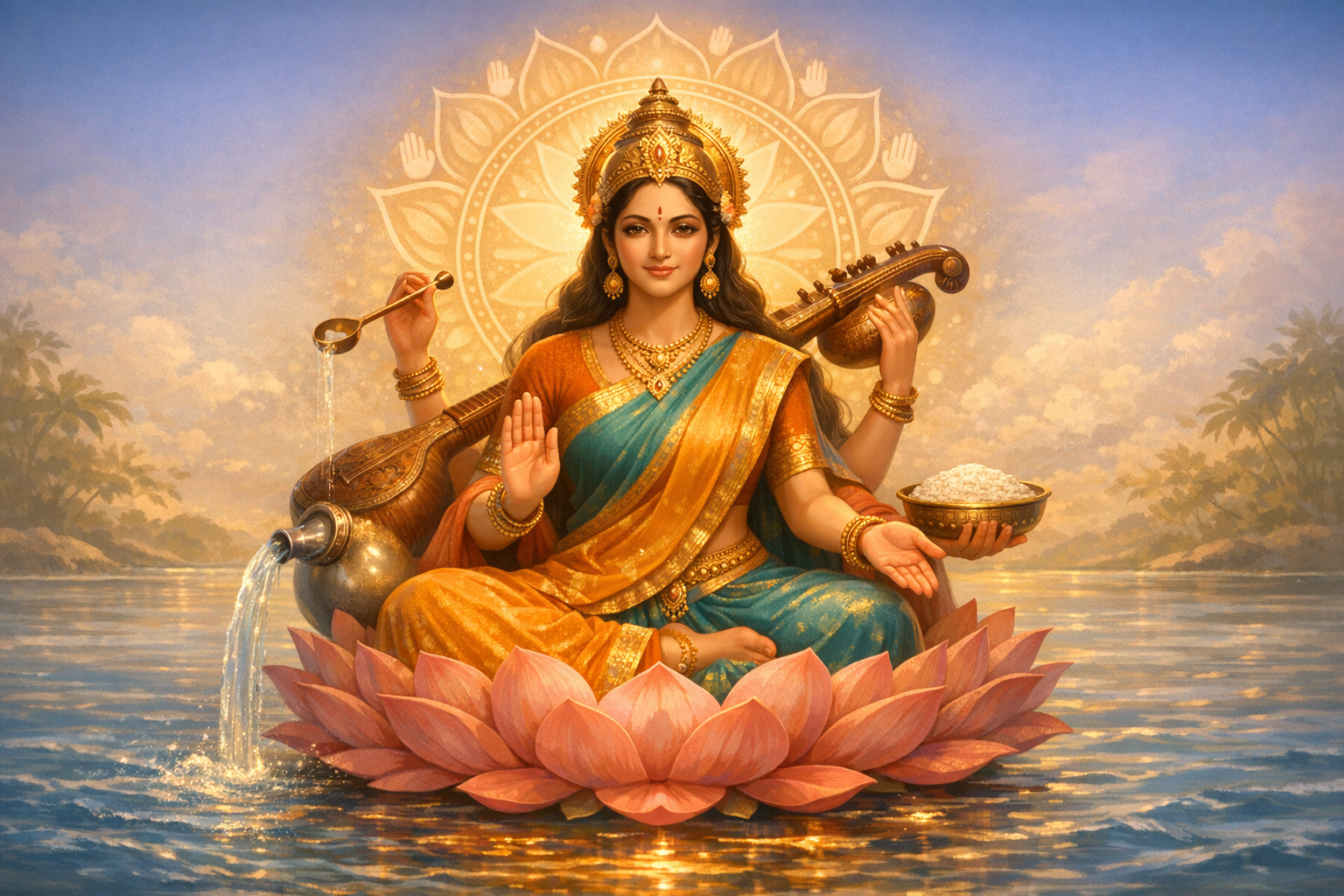
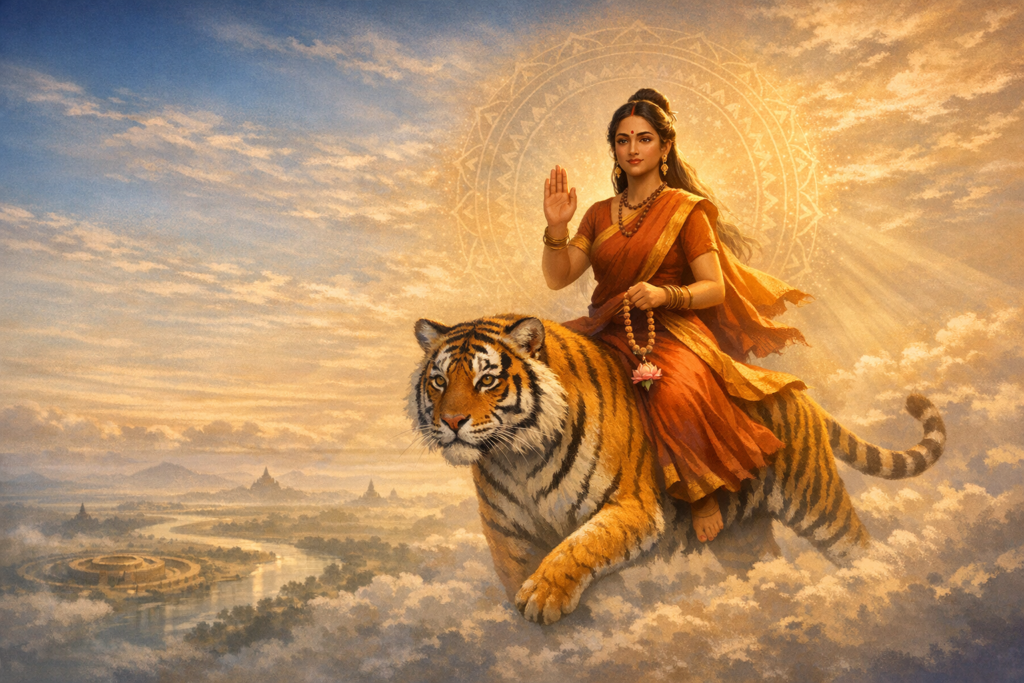
Iconography reinforces this reading. In both saumya (benign) and ugra (fierce) mūrti-s, the right hand often displays abhaya (dispelling fear) and the left, varada (boon-bestowing)—a visual grammar of compassionate assurance and generous support. Lotuses, granaries, and flowing vessels signal fertility and sustenance (Lakṣmī and Annapūrṇā), while the vīṇā (Sarasvatī) marks the bestowal of viveka and vidyā—forms of karuṇā that nourish mind and soul.
The Annapūrṇā tradition of Kāśī makes this maternal ethic vivid. When the world experienced scarcity, the Goddess manifested as Annapūrṇā, ladle in hand, to feed beings and restore dignity to nourishment itself. In hagiographic memory, even Śiva received alms from Her—teaching that knowledge (jñāna) and sustenance (anna) are both sacred, and that compassion ennobles every exchange that preserves life.
Philosophically, Karunamayi aligns with the doctrine of anugraha (grace), the fifth act in the pañcakṛtya of Śiva-Śakti: sṛṣṭi (emanation), sthiti (maintenance), saṁhāra (withdrawal), tirobhāva (veiling), and anugraha (unveiling/compassionate release). In nondual Śākta and Kashmir Śaiva thought, compassion is not adjunct but intrinsic to Consciousness-Power; as spanda (vibrant awareness) recognizes itself in beings, it spontaneously moves as dayā, guiding the jīva from bondage toward freedom.
Rasa theory supplies a psychological corollary. Vātsalya rasa—the tender, protective love of a mother—pervades Śākta bhakti. Addressing the Goddess as “Mā” is not mere sentiment; it is a soteriological method that softens ego defenses, cultivates trust, and enables surrender (śaraṇāgati). In this inner ecology, karuṇā becomes the atmosphere in which discernment grows and tapas becomes sustainable.
Understanding the fierce forms through this lens resolves apparent paradoxes. Ugra is the mode of deterrence and decisive surgery; saumya is the mode of nurturing and instruction. Both serve dharma and are propelled by compassion for the many—especially the vulnerable who suffer most when adharma proliferates. Thus, the battlefield is not a repudiation of karuṇā but a drastic instrument in its service.
In practice, devotion to Karunamayi infuses sādhanā with ethical clarity. During Navaratri, devotees undertake vratas and recite stotras that praise the Mother’s mercy—Durga, Lakṣmī, and Sarasvatī in their complementary streams. Śrīvidyā traditions contemplate the Mahā-Śrī mantra (Aim Hrim Srim) to internalize wisdom, creative force, and plenitude as compassionate currents. Household and temple pūjā alike foreground bhūta-dayā (care toward beings) as an essential yama-niyama.
The ethical horizon of Karunamayi extends well beyond ritual. Ahiṁsā, seva, and hospitality become natural expressions of devotion. Compassion informs speech, livelihood, and civic responsibility; it checks harshness in polemic and cultivates civility in disagreement. In this way, the Mother’s grace translates into social harmony, echoing the dharmic axiom that inner refinement must ripple outward into community welfare.
Parallels across the dharmic traditions illuminate a shared moral grammar. Buddhism’s Avalokiteśvara and Tārā embody liberative compassion; Jainism’s devotion to ahiṁsā is nourished by anukampā for every life-form; Sikh history remembers Bhai Kanhaiya serving water to wounded on both sides of battle, seeing the Divine in all. Such convergences reveal that compassion is not sectarian sentiment but the connective tissue of South Asian spiritual wisdom.
Ecologically, devotion to the Mother invites reverence for Pṛthvī (Mother Earth) and the more-than-human commons—rivers, forests, and creatures. Karunamayi becomes a compass for sustainable choices, aligning personal consumption with care for future generations. Traditional idioms—gau-sevā, sacred groves, and festival practices that honor seasonal cycles—are reframed as living expressions of dayā in a time of environmental strain.
Regional Goddess traditions also encode compassion at their core. Kamākṣī of Kāñcīpuram is invoked for her benevolent glance; Mīnākṣī of Madurai is celebrated for protective sovereignty tempered by care; Tripura Sundarī’s sweetness conveys beauty as a healing power; Annapūrṇā in Kāśī nourishes body and soul. While aesthetics and ritual vary, the underlying appeal to karuṇā is unmistakable.
For contemporary seekers, recognizing the Mother as Karunamayi reshapes spiritual maturity. It refines motivation (saṅkalpa), softens the hard edges of identity, and opens a path where devotion and responsibility are inseparable. Cultivating compassion is not passivity; it is disciplined strength guided by clarity—ever ready to protect, but oriented toward healing.
Practical contemplations flow from this vision. Meditate on the Goddess’s abhaya and varada mudrās, visualizing fear dissolving and wisdom arising. Offer anna-dāna or volunteer for local seva as a daily sāttvic act. In speech and online discourse, uphold maryādā that reflects bhakti. Small, consistent gestures align the mind with the Mother’s compassionate current and steadily transform character.
Ultimately, to call the Goddess Karunamayi is to affirm that compassion structures reality at every scale—from the cosmic to the intimate. The same power that creates, sustains, and dissolves also unveils and redeems. Seen thus, the battlefield of the myths becomes a metaphor for the inner conquest of cruelty, callousness, and ignorance; the Mother’s victory is the restoration of right-seeing and right-relating.
When devotees, scholars, and communities foreground Karunamayi, a common language arises across Hinduism, Buddhism, Jainism, and Sikhism. This shared commitment to karuṇā strengthens unity without erasing the richness of diverse forms and practices. In honoring the Mother as the Ocean of Compassion, dharmic traditions together advance a civilization of care—anchored in wisdom, radiant in courage, and gentle in everyday life.
Inspired by this post on Hindu Blog.




Leave a Reply
You must be logged in to post a comment.