
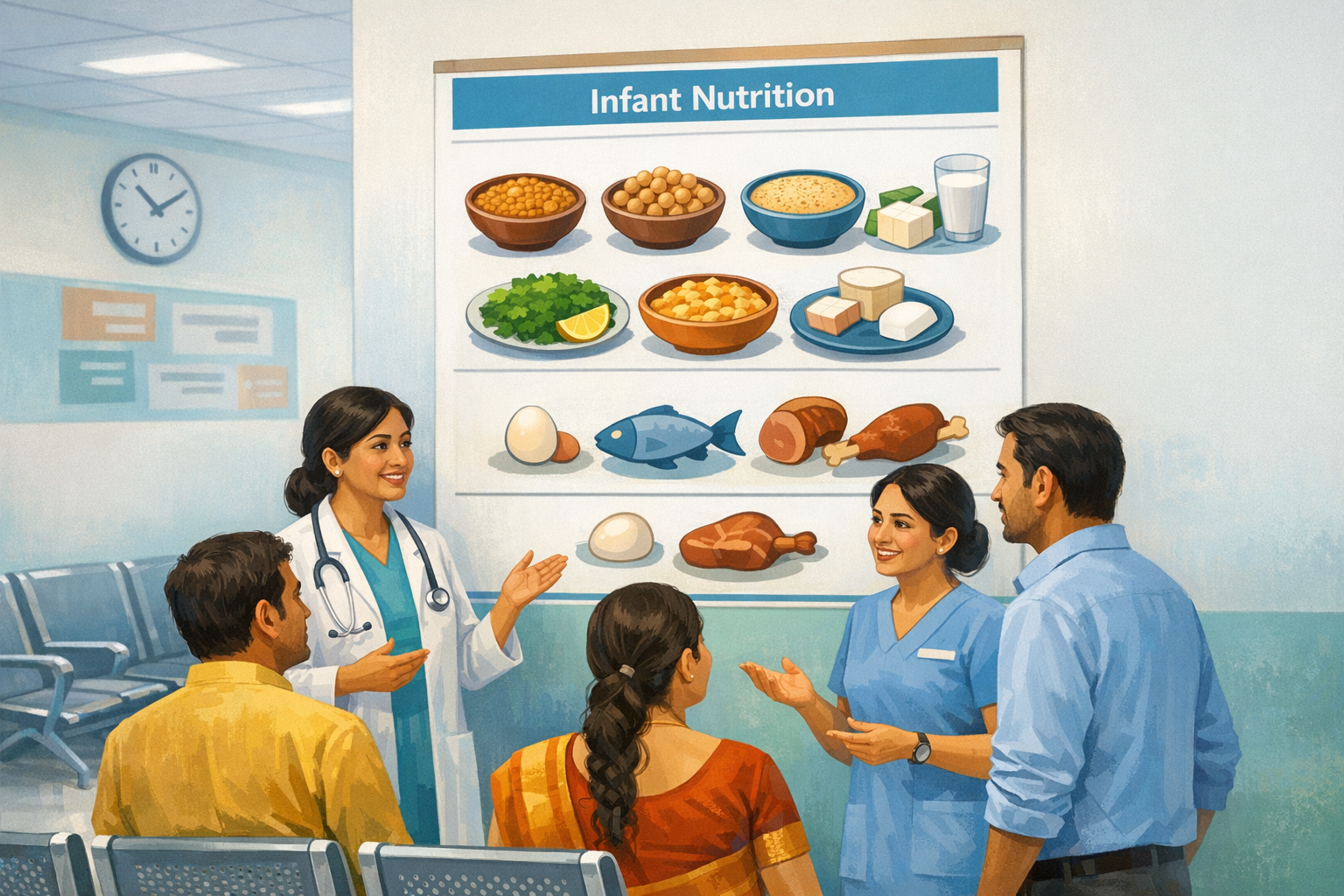
Reports from Navi Mumbai indicate that a poster displayed inside a municipal hospital in Vashi advised parents to include beef in infants’ diets. The Vishwa Hindu Parishad (VHP) publicly called for legal action against those responsible, asserting that the recommendation hurt Hindu religious sentiments. The episode has triggered a broader conversation about how public hospitals in India communicate nutrition advice across a society defined by diverse dietary practices and deep Dharmic sensitivities.
At its core, the controversy highlights a structural challenge in public health communication: the need to pair scientific accuracy with cultural sensitivity. In a nation where Hinduism, Buddhism, Jainism, and Sikhism provide shared ethical touchstones—ahimsa, satya, and respect for life—specific food prescriptions on government signage can inadvertently alienate patients and erode trust, even when intended to address legitimate nutrition needs.
From a clinical perspective, global and national standards converge on several noncontroversial pillars. The World Health Organization and the Indian Academy of Pediatrics recommend exclusive breastfeeding for the first six months, followed by timely, adequate, and safe complementary feeding while continuing breastfeeding up to two years and beyond. Complementary foods should be rich in iron, zinc, and other micronutrients, because children aged 6–23 months face elevated risks of anemia and growth faltering. India’s most recent National Family Health Survey (NFHS‑5, 2019–21) reported a high prevalence of anemia in children (6–59 months), underscoring the urgency of effective, acceptable nutrition messaging.
Iron is central to this discussion. Heme iron from meat, poultry, and fish is more readily absorbed, while non‑heme iron from legumes, grains, nuts, and vegetables benefits from concurrent vitamin C to enhance bioavailability. Evidence‑based guidance therefore often names animal‑source foods as one option, but responsible public messaging in India must present them only as part of a broader, culturally adaptable menu that also foregrounds vegetarian pathways.
Clinically sound and culturally respectful signage can, for example, recommend iron‑rich options in plural terms: mashed and well‑cooked lentils, beans, and chickpeas; ground and thoroughly cooked cereals and millets (ragi, bajra) with oil or ghee for energy density; finely chopped and well‑cooked green leafy vegetables paired with vitamin C–rich fruits; fortified cereals where available; dairy and paneer after six months as tolerated; and, for families that consume animal‑source foods, properly cooked eggs, fish, and meat. Such wording keeps scientific integrity intact while honoring household choices grounded in Dharmic traditions.
Beef carries distinctive religious and cultural sensitivities in India. For many in the Hindu community and for large segments among Buddhists and Jains, reverence for the cow is a matter of faith and identity; many Sikh families also avoid beef by preference. Against this backdrop, a government hospital’s explicit endorsement of beef—rather than neutrally referencing “animal‑source foods where culturally appropriate”—predictably provokes hurt and undermines the ideal of patient‑centered, inclusive care.
Constitutional values reinforce the same imperative. Article 25 safeguards freedom of conscience and the right to profess and practice religion, while public institutions bear a corresponding responsibility to avoid avoidable offense in routine communication. The National Health Policy emphasizes patient‑centricity and community trust; both are weakened when clinical signage appears prescriptive in ways that disregard deeply held beliefs.
In law and ethics, intent and impact both matter. Indian penal provisions addressing deliberate and malicious acts that outrage religious feelings exist to deter provocation, yet healthcare environments also warrant space to correct inadvertent errors without criminalizing good‑faith public health efforts. A transparent administrative review—identifying how the poster was created, approved, and displayed—serves public accountability while keeping de‑escalation and harmony at the forefront. This analysis does not ascribe intent or apportion blame; it focuses on systemic improvements that protect both science and social cohesion.
Practical safeguards are straightforward: establish a communications review committee in every district hospital, including pediatricians, dietitians, nursing leadership, and community representatives from Hindu, Buddhist, Jain, and Sikh organizations; mandate pre‑display vetting for all patient‑facing materials; and require template language that offers multi‑option dietary pathways. Such structures turn an isolated controversy into a durable governance upgrade.
Effective design techniques help. Replace single‑item prescriptions with category language; add “if your family eats meat/eggs” qualifiers for animal‑source foods; specify vegetarian combinations that improve iron absorption (for example, dal with lemon, millet upma with vegetables); use clear icons and plain‑language translations; and include a nonjudgmental note inviting parents to ask clinicians about culturally suitable choices. In a crowded outpatient department, clarity delivered with respect is more likely to change behavior than prescriptive messaging.
Technical nuance can be conveyed without controversy. It is appropriate to note that iron, zinc, vitamin B12, and high‑quality protein are important after six months; that textures must be age‑appropriate and foods hygienically prepared; and that feeding frequency and energy density increase as the child grows. None of this requires naming a specific meat that a large share of the local community considers unacceptable.
Trust is the currency of public health. When messaging respects religious harmony and cultural sensitivity, parents are more likely to seek timely care, complete immunizations, and adopt recommended feeding practices. Conversely, a perception of disregard for Hindu sentiments—or for the values of any Dharmic community—risks generalized mistrust that can spill over into vaccine hesitancy, delayed care, and poorer outcomes.
A constructive path forward in Navi Mumbai would include promptly reviewing the poster, issuing a corrective advisory with inclusive language, and engaging concerned community bodies—including the Vishwa Hindu Parishad (VHP) and other civil‑society groups—in a dialogue focused on shared goals: healthier children, respectful care, and social cohesion. Such engagement affirms that India’s healthcare system can be both scientifically rigorous and culturally thoughtful.
The broader lesson is civilizational rather than merely administrative. Dharmic traditions, while diverse, converge on compassion, self‑restraint, and dignity for all beings. Public institutions honor that inheritance when they offer parents choices, not edicts; when they treat differences as design parameters, not obstacles; and when they protect the moral ecology that allows science to work with, not against, culture.
In sum, the “beef for infants” poster controversy at Vashi Municipal Hospital is less an argument about nutrition science than a reminder about how science should be communicated in India. With inclusive templates, transparent reviews, and genuine community partnership, hospitals can meet rigorous clinical standards while strengthening unity across Hindu, Buddhist, Jain, and Sikh communities. That balance—evidence‑based and empathetic—is the surest path to healthier children and a more harmonious public sphere.
Inspired by this post on Hindu Jagruti Samiti.










Leave a Reply
You must be logged in to post a comment.