
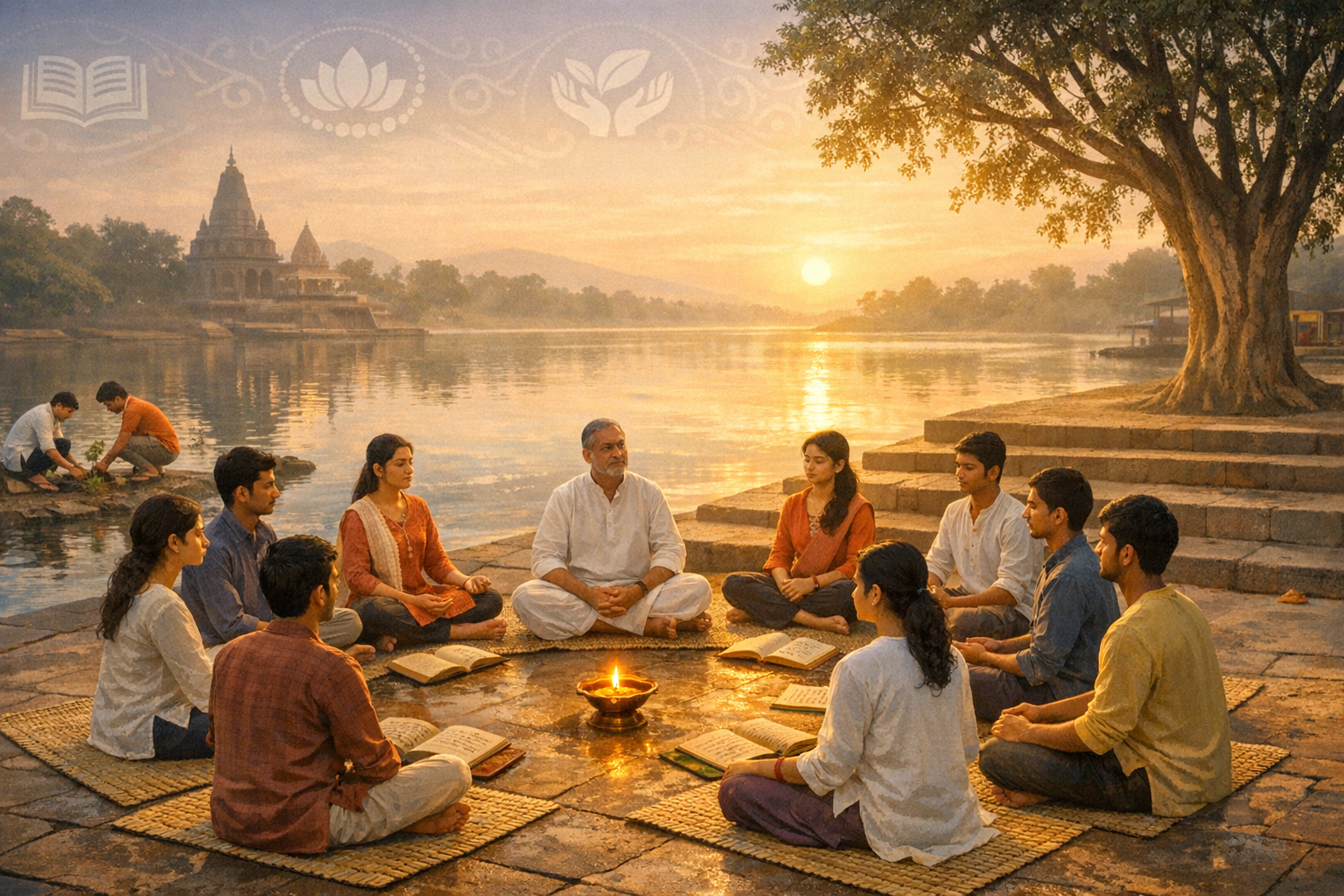
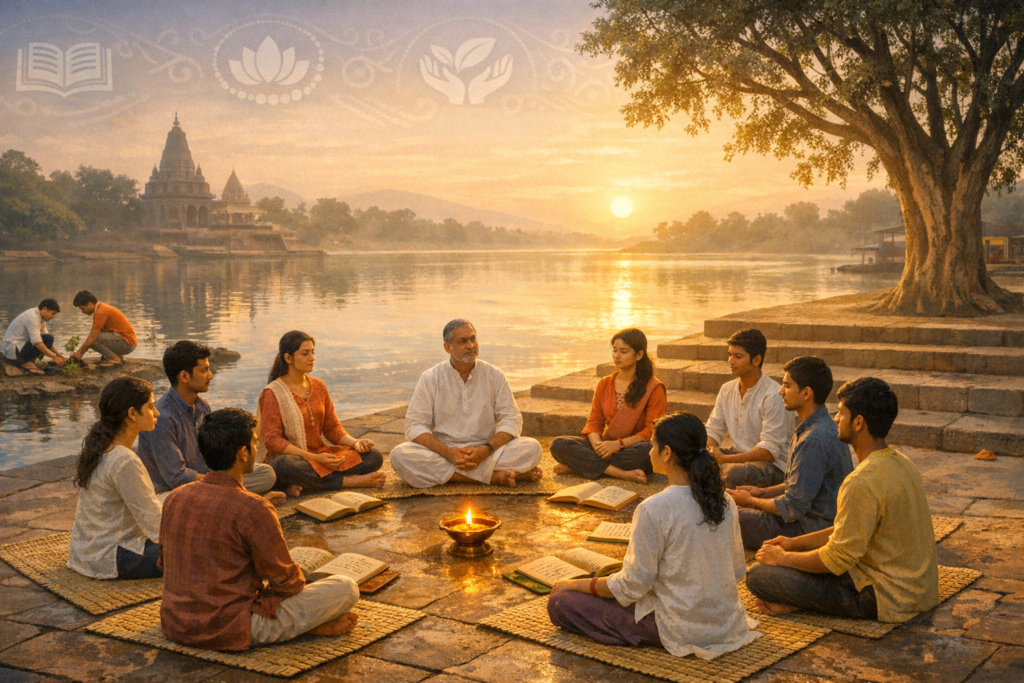
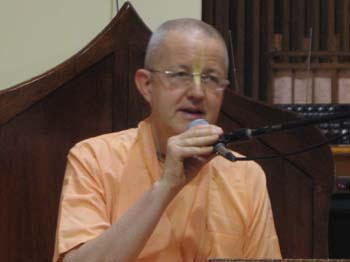
At Narasimhawadi in Maharashtra, a Hindu Dharma Sanskar Shibir conducted by the Hindu Janajagruti Samiti (HJS) concluded with a focused call to cultural renewal. Speaking at the camp, Shri. Sadashiv Dhavaleguruji emphasised the urgent need to revive Sanskar, Sanskrit, and Sanatan Hindu culture, while urging youth to strengthen themselves spiritually and culturally to meet contemporary challenges with clarity, character, and compassion.
Narasimhawadi—revered as a tirtha set amid the sacred landscape of southern Maharashtra—provided an apt setting for a civilisational conversation on dharma and character-building. The choice of place underlined an old Indic insight: learning deepens when it is anchored to living traditions, pilgrimage sites, and shared memory. In such settings, dharmic knowledge naturally connects with daily conduct, intergenerational transmission, and community belonging.
The program’s core message aligned three interdependent pillars. First, Sanskar (Samskara) as the cultivation of ethical dispositions and life-affirming habits. Second, Sanskrit as a civilisational knowledge medium and a unifying scholarly language that has preserved diverse dharmic ideas. Third, Sanatan Hindu culture as a living continuum grounded in dharma, service, and pluralism. Together, these pillars offer a coherent path for Youth Empowerment and Cultural Revival.
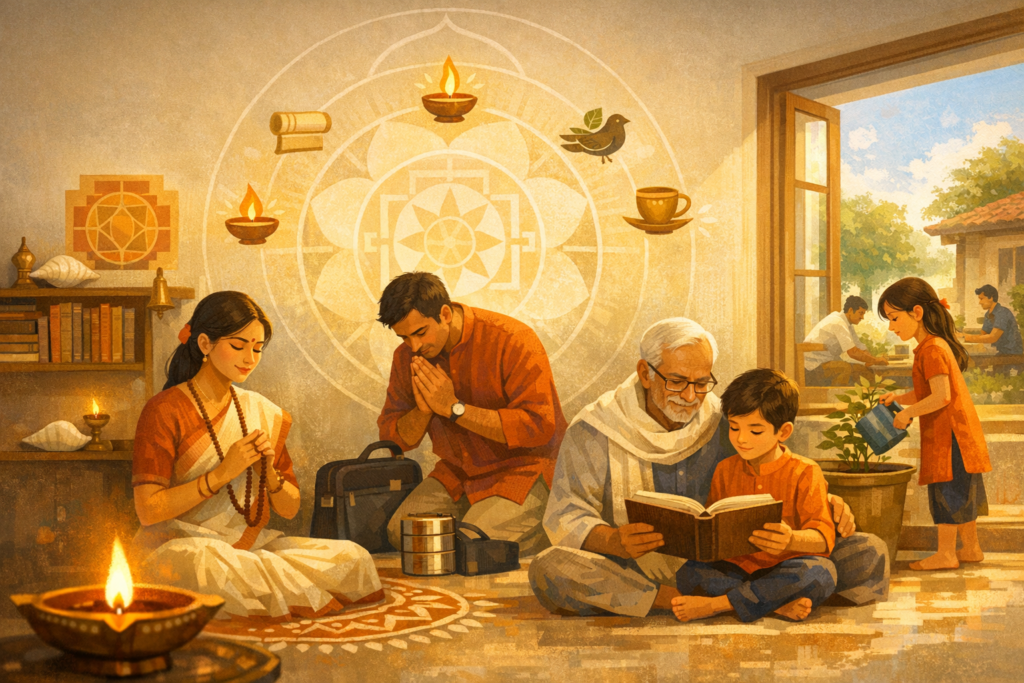
In the wider Indic framework, Sanskar signifies both formative rites and sustained cultivation of virtues. While Hindu texts detail shodasha samskaras that guide life stages, cognate ideas appear across dharmic traditions. In Buddhism, disciplined mental formations and ethical training refine intention and action; in Jainism, anuvratas and day-to-day austerities embed non-violence and self-restraint; in Sikh tradition, simran and seva shape steadfastness and social responsibility. The shared emphasis is clear: character is formed through repeated, value-congruent practice supported by community and counsel.
Sanskrit’s relevance extends beyond heritage into methodology. Paninian grammar, with its precision and rule-governed structure, has informed modern linguistics and computational thinking. As a bridge-language among Hindu, Buddhist, and Jain scholastic traditions—and a reference point for Sikh exegesis of older Indic concepts—Sanskrit strengthens textual literacy, comparative understanding, and philosophical clarity. Importantly, renewed Sanskrit learning need not displace mother tongues; rather, it can coexist with regional languages and English to widen access to knowledge and scholarship.
Sanatan Hindu culture, referenced in the address as Sanatan Hindu culture, is best understood as a resilient, adaptive way of life rooted in dharma, truthfulness, compassion, and duty. Its civilisational breadth naturally accommodates multiple schools of thought, practices, and paths, mirroring the plural spirit found across dharmic communities. This pluralism fosters interreligious respect and cooperation while strengthening ethical groundings for civic life.
For youth navigating digital overload, rapid social change, and identity diffusion, the camp’s message translates into practical capacities: steadier attention, emotional resilience, moral clarity, and community participation. Research-aligned practices—such as mindful breathing for stress regulation, memorisation and chanting for working-memory gains, and service activities for purpose and belonging—offer a pragmatic pathway from ideals to measurable outcomes.
A succinct model that emerged from the camp’s emphasis can be described as four integrals: adhyayan (study), sadhana (embodied practice), seva (service), and sangha (community). Study clarifies principles; practice stabilises mind and conduct; service grounds values in action; community sustains motivation and accountability. This integrative blueprint resonates with the Hindu way of life and is equally compatible with Buddhist, Jain, and Sikh paths that balance knowledge, discipline, compassion, and collective uplift.
Program design can be further strengthened through a modular approach: foundational modules on dharma and ethics; language and liturgy modules introducing Sanskrit phonetics and basic texts; wellness modules combining asana, pranayama, and contemplative silence; and civic modules on environmental stewardship, cultural heritage care, and volunteerism. Each module can be scaffolded from introductory to advanced levels to serve diverse age groups and learning trajectories.
Evaluation should be integral, not ornamental. Baseline and post-program knowledge checks, short attention and memory tasks, resilience self-assessments, and simple metrics for seva (e.g., volunteer hours, peer mentoring) offer concrete indicators of progress. Qualitative reflections—journals or small-group dialogues—capture shifts in perspective, empathy, and life goals that numbers alone may miss.
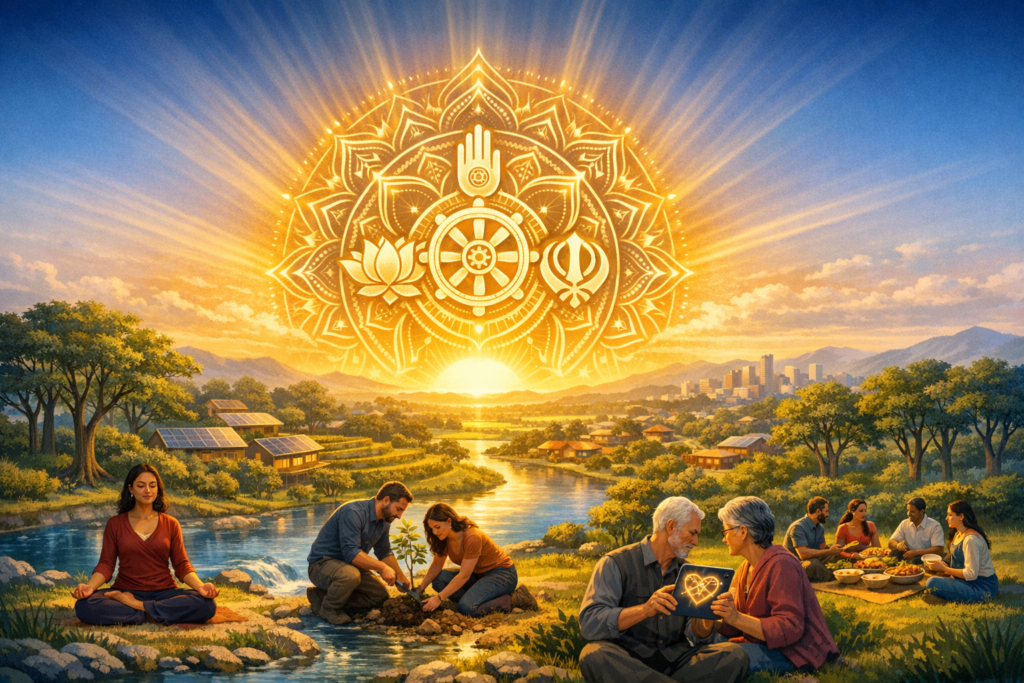
Inclusivity is essential to the dharmic ethos. Activities that foreground common civilisational values—ahimsa, satya, dana, seva—allow participants from Hindu, Buddhist, Jain, and Sikh families to learn together while maintaining fidelity to their respective practices. Dialogues that compare key concepts across traditions can deepen mutual respect and illuminate the shared Indic commitment to truth-seeking and compassionate action.
As a place-based learning environment, Narasimhawadi highlights how tirtha pedagogy adds depth. Pilgrimage sites bundle narrative memory, ritual discipline, and community service opportunities in one living classroom. Linking cultural learning with environmental care—riverbank cleanliness, heritage maintenance, and responsible pilgrimage—translates dharma into stewardship, making culture tangibly relevant to contemporary civic life.
Participants in such shibir settings commonly report more settled attention, renewed interest in family traditions, and a stronger sense of purpose. Many describe how learning to recite a simple shloka with accurate meter and pronunciation builds confidence, or how a weekly seva commitment reshapes weekend routines from consumption to contribution. These concrete, relatable shifts are the lived expression of Sanskar.
Practical next steps for communities include building small, recurring study-practice circles; adopting a four-language orientation (mother tongue, Sanskrit basics, English for research access, and a regional or national link language as needed); curating starter text-packs spanning the Bhagavad-Gita, Dhammapada, Tattvartha Sutra extracts, and selections from Sikh teachings on seva and simran; and setting up peer-mentoring chains that keep learning social and sustainable.
The success of the Hindu Dharma Sanskar Shibir at Narasimhawadi demonstrates how focused, values-centered camps can connect youth with deep civilisational roots while equipping them for modern realities. By aligning Sanskar, Sanskrit, and Sanatan Hindu culture with practical skill-building and cross-dharmic unity, such initiatives strengthen families, communities, and the wider social fabric.
In essence, the message delivered by Shri. Sadashiv Dhavaleguruji—revive Sanskar, re-engage Sanskrit, and live the Sanatan ethos—offers a timely, actionable framework. When pursued with intellectual rigor, daily discipline, and service-mindedness, it becomes a shared roadmap for dharmic traditions to flourish together in harmony.
Inspired by this post on Hindu Jagruti Samiti.




Leave a Reply
You must be logged in to post a comment.