
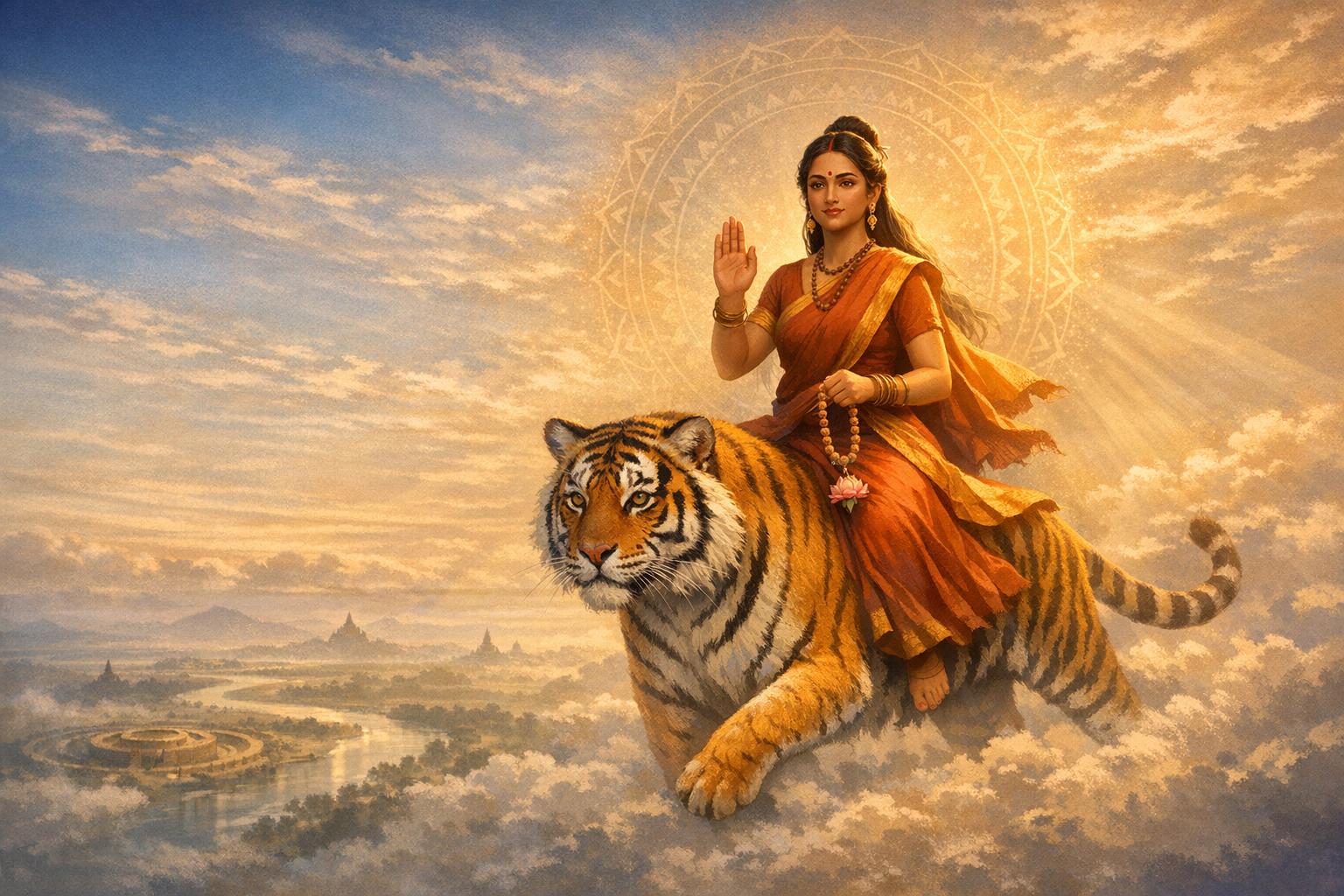
Dombi Yogini stands at the luminous crossroads of Tantrism, where spiritual realization and social critique converge. Portrayed in medieval Indian hagiographies as an outcaste woman who rode a tiger through the sky, she is remembered not merely as a figure of wonder but as a catalyst who challenged caste hierarchies and revealed the immediacy of Mahamudra—a direct insight into the nature of mind. Her narrative continues to resonate because it braids together non-dual wisdom, gendered agency, and ethical courage in the face of social exclusion.
The term “Dombi” refers to communities historically positioned at the margins of the caste order in medieval India. Within the stratified structures that conferred ritual purity to some and invisibility to others, the presence of a “Dombi Yogini” as bearer of liberating insight is both spiritually radical and socially subversive. This conjunction is not accidental; Tantric literature often frames wisdom as emerging from precisely those spaces that rigid orthodoxy refuses to see.
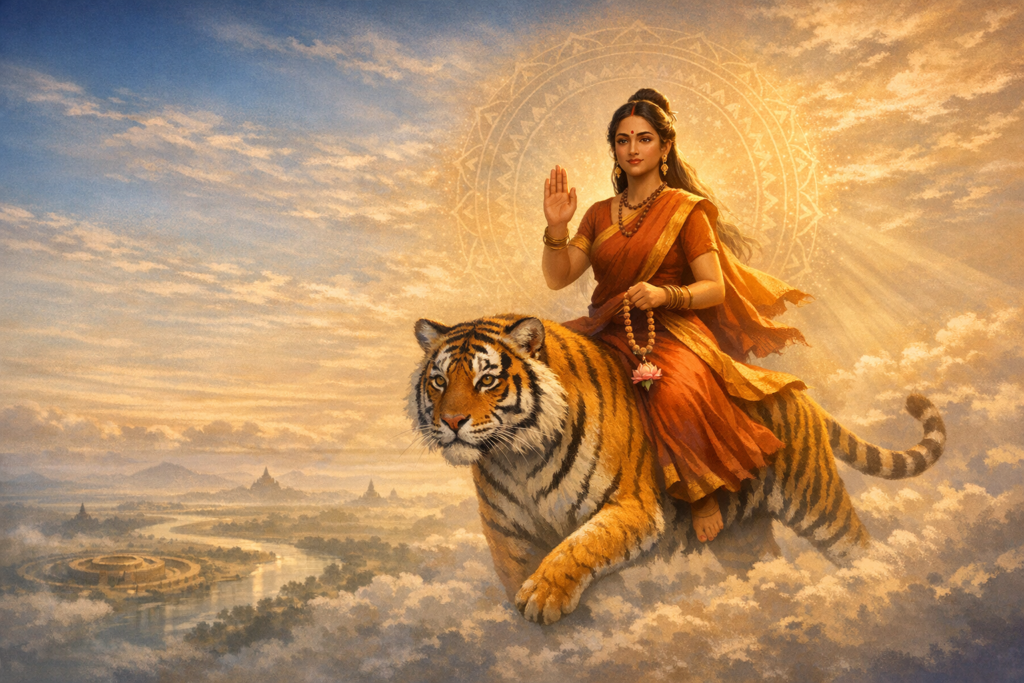
The vivid image of a woman riding a tiger across the sky functions as more than spectacle. In Tantric iconography, the tiger symbolizes formidable energy, untamed passion, and the fear that binds the mind; to ride it is to harness and transform these very forces. The sky, for its part, signifies the boundless expanse of awareness, the dharmadhatu that is unconfined and indivisible. Together, tiger and sky articulate a Mahamudra view: fear, desire, and social identity are not to be destroyed but recognized as expressions of luminous, empty awareness.
Multiple narrative streams orbit this figure. In Buddhist Vajrayana accounts, related motifs appear around masters like Dombipa (often styled Dombi Heruka), whose yogic realization is signified by riding a tigress; in parallel, stories of Saraha and the arrowsmith woman foreground the insight of an outcaste consort who shatters scholastic pride. In Shakta and Yogini traditions within Hinduism, yoginis likewise embody autonomous spiritual power that defies social boundaries. The continuities across these strands illuminate a shared Dharmic concern: realization is not the privilege of birth, caste, or institutional office.
Mahamudra—literally the “Great Seal”—names a comprehensive contemplative science developed by Indian mahasiddhas and elaborated in later Tibetan transmissions. Technically, it describes the direct recognition of mind’s nature as luminous emptiness, free from conceptual elaboration. Rather than seeking liberation elsewhere, Mahamudra points to what is already present: awareness that is clear, open, and compassionate by its very texture.
Classical presentations describe four yogas or stages: one-pointedness, simplicity (or freedom from elaboration), one taste, and non-meditation. One-pointedness stabilizes attention; simplicity relaxes conceptual construction; one taste recognizes that all appearances share the same nature; non-meditation releases effortful contrivance altogether. Across these phases, practice integrates shamatha and vipashyana, posture and gaze, mindfulness and insight, until the practitioner’s conduct becomes spontaneously compassionate.
Within Tantric hermeneutics, Dombi Yogini’s figure can be read as prajna—wisdom—while her consort or counterpart may represent upaya—skillful means. In many Mahamudra and Mahayoga texts, realization flowers where prajna and upaya are indivisible. The outcaste woman as teacher, consort, or yogini upends the authority of caste and gender by revealing that the Great Seal seals everything: high and low, pure and impure, sacred and profane.
This transgressive sacrality is not an escape from ethics; it is ethics grounded in reality. Mahamudra’s conduct—carried by bodhicitta—insists that insight must express itself as non-harm and care for all beings. The rhetoric of overturning convention thus serves an ethical telos: to dissolve the delusions that justify social violence, including caste-based discrimination, while cultivating a fearless compassion.
Symbolically, the tiger links Dombi Yogini’s tale with the broader Indian iconographic field. In Shakta traditions, Devi as Durga rides a tiger or lion, indicating mastery over primordial energies. In Yogini cults and the 64 Yogini temples of central and eastern India, feminine power appears as autonomous, mobile, and ungovernable by courtly or priestly norms. The skyward flight, in turn, enacts the Mahamudra axiom that mind is originally open—like the sky—unhindered by concepts of self and other, clean and unclean, center and margin.
Historically, these narratives emerge from the mahasiddha milieu that spanned regions of present-day Bihar, Bengal, and beyond between roughly the eighth and twelfth centuries. The world of itinerant adepts, craft communities, and courtly patrons generated a literature of doha (songs of realization) and life-stories that prized direct experience over scholastic credential. Dombi Yogini’s presence within or alongside this archive aligns with the period’s broader preference for experiential proof.
The caste critique embedded here is subtle but decisive. By revealing liberating knowledge through an outcaste woman, the stories declare that spiritual capacity is not hereditary. The inversion of purity norms—so often policed through food, touch, and marriage—exposes their contingency. What endures, according to Mahamudra and allied yogic currents, is sahaja: the uncontrived, spontaneous clarity that neither depends on nor is marred by social labels.
Resonances across Dharmic traditions amplify this message. Advaita Vedanta’s articulation of non-dual reality (akhand) converges with the Mahamudra view of luminous emptiness, even as their languages differ. Jain anekantavada, by insisting on many-sided truth, deflates absolutist claims about ritual status. Sikh teachings of Ik Onkar and the centrality of equality and service similarly reject hierarchies of birth. Read together, these currents affirm a unity in spiritual diversity that Dombi Yogini so powerfully symbolizes.
Yet traditions also warn against confusing symbolic transgression with license. The antinomian gestures in Tantric sources occur within disciplines of mantra, vow, and meditation that stabilize attention and refine motivation. Without the guardrails of compassion, humility, and guidance, outer imitation of transgressive forms becomes self-seeking rather than liberating. Mahamudra’s litmus test remains conduct: is suffering reduced, and is kindness growing?
Gender is not incidental to this philosophy. The dakini in Buddhist Tantrism and the yogini in Hindu Shakta practice signify the irreducible dynamism of wisdom and the autonomy of feminine spiritual authority. Names such as Lakshminkara and the sisters Mekhala and Kanakhala in Vajrayana lore, along with the yoginis of the 64 Yogini temples, demonstrate an unbroken memory of women as teachers, adepts, and guardians of esoteric knowledge.
Linguistically and socially, the term “Dom/Domba/Dombi” indicates communities engaged in diverse occupations and subject to stigma in premodern sources. Hagiographies that elevate a Dombi Yogini do so with awareness of this stigma, turning it inside out. In doing so, they teach a practical hermeneutic: to test social claims against the experiential truth of awareness and the ethical truth of compassion.
From a technical perspective, Mahamudra methods train the nervous system to recognize clarity in the midst of sensation. Stabilizing shamatha might use breath or body as anchor; vipashyana inquires into the arising and vanishing of thoughts, emotions, and perceptions. As conceptual fixation loosens, appearances self-liberate—like writing on water—without repression or indulgence. This is the inner meaning of riding the tiger: kleshas become the very momentum of awakening.
The image of flight helps refine the view. Sky-like mind is not blankness but vivid openness; it is empty of fixed essence and yet luminous with knowing. When insight matures, conduct simplifies. Social relations are no longer scripted by purity codes but guided by empathy, discernment, and responsibility.
Modern readers may find in Dombi Yogini a template for integrating spiritual realization with social healing. Meditation clarifies perception; ethical commitment orients that clarity toward the alleviation of suffering; and cultural memory supplies images—like the tiger and the sky—that recalibrate courage. The narrative thus functions as contemplative pedagogy and civic imagination at once.
In comparative perspective, the unifying strands across Hinduism, Buddhism, Jainism, and Sikhism are unmistakable: a wariness of rigid hierarchy, a reverence for direct experience, and a conviction that truth must flower as compassion. Differences in metaphysics and method remain, but these differences enhance rather than fracture a shared civilizational commitment to dignity. Dombi Yogini’s story invites honoring that unity while learning from each tradition’s distinctive genius.
Scholarly caution adds depth without dampening inspiration. Variants of the tale circulate with differing attributions; some center a male siddha named Dombipa, others emphasize an outcaste female adept or consort. What persists across versions is the doctrinal core: the Great Seal is universal, and social boundaries have no ultimate claim on awareness.
Read in this light, the Dombi Yogini who rides a tiger through the sky is neither spectacle nor scandal. She is method and meaning: energy harnessed rather than suppressed, openness realized rather than imagined. Her flight is the mind’s own freedom; her challenge is the end of caste-based conceit; her legacy is a Mahamudra that binds wisdom to compassion and insight to responsibility.
The story endures because it speaks to perennial human struggles—with fear, with exclusion, and with the tendency to clutch at identity as salvation. It answers with a practice that is both intimate and public: intimate in the recognition of awareness as luminous emptiness, public in the demand that such recognition abolish the pretext for harm. In that double fidelity lies the power of Dombi Yogini’s Mahamudra for today.
Inspired by this post on Hindu Blog.







Leave a Reply
You must be logged in to post a comment.