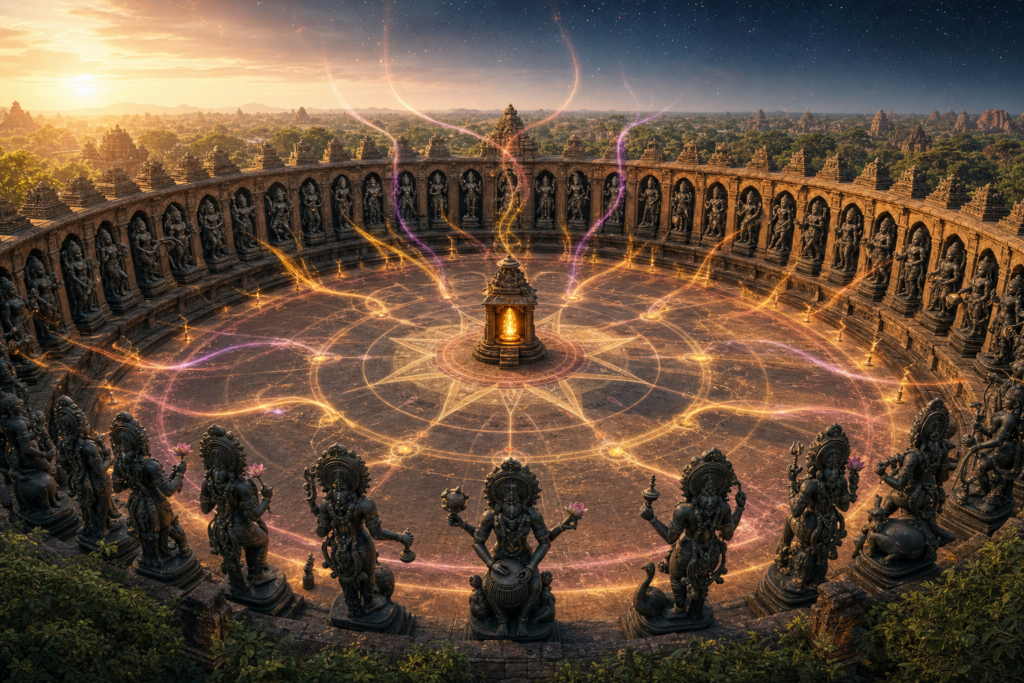
Angaraka, also revered as Mangala and identified with the planet Mars, embodies the vivid red force of courage, discipline, and righteous action in Vedic cosmology. Angaraka Loka, the subtle abode of this graha, is portrayed in the Puranas as a realm that reflects the planet’s fiery vitality and its ethical impetus in human life. In temple traditions, Mangala is closely associated with Lord Muruga (Subrahmanya/Skanda), whose valor and guardianship over dharma mirror the martial symbolism of the Red Planet.
Across Puranic narratives, genealogies vary while maintaining a coherent spiritual arc. Some sources describe Mangala as the son of Lord Varaha and Ma Bhudevi, highlighting a sacred bond between Earth and the celestial warrior. Other traditions honor him as Bhaumaborn of Bhudevi herselfunderscoring a lineage rooted in Earth’s resilience and vitality. These strands converge to portray Mangala as a protector who channels strength toward dharmic purpose.
Symbolically, the red hue of Mars signifies energy, resolve, and constructive assertivenessqualities that, when aligned with dharma, advance justice and communal well-being. Within this lens, Angaraka’s influence is not mere aggression; it is disciplined courage, the Kshatra principle directed toward protection, stewardship, and ethical responsibility. The association with Lord Muruga reinforces this ideal through the image of a divine commander who acts with clarity and compassion.
In the language of Vedic cosmology, a loka marks both a subtle sphere and a way of understanding reality. Angaraka Loka thus offers a contemplative framework through which the Navagrahadeities representing cosmic rhythmsshape human experience. Ancient astronomers, observing the striking redness and wandering course of Mars, integrated empirical insight with sacred meaning. This synthesis allowed astronomy and spirituality to enrich each other rather than compete, an approach that remains instructive today.
Ritual observances reflect these ideas in lived practice. Many households honor Mangala on Tuesdays through simple offerings, red-hued flowers, or recitation of Mangala stotras to cultivate discipline, fortitude, and clarity in decision-making. Temple worship and Navagraha shanti rites likewise emphasize channeling Mars’s intensity toward healing, protection, and purposeful actionespecially in times of conflict, delay, or indecision.
Devotees frequently recount a deepened sense of resolve and ethical focus when aligning weekly routines with Angaraka’s day. Astrological guidance often frames Mangala’s influence as a call to transform raw energy into service, perseverance, and fair-minded leadership. In this way, the symbolism of the Red Planet becomes a practical compass for navigating relationships, responsibilities, and societal duties.
Dharmic traditionsHinduism, Buddhism, Jainism, and Sikhismshare a reverence for cosmic order and moral discipline, offering a unifying horizon for contemplating Angaraka’s meaning. While emphases differ across texts and practices, there is a common appreciation for channeling inner force toward non-harm, truthfulness, and service to the community. Understanding Angaraka Loka through this inclusive lens fosters unity in diversity, honoring varied paths without erasing their distinct insights.
Contemporary interest in Marsfrom naked-eye astronomy to interplanetary explorationgives fresh relevance to these ancient reflections. Observing the Red Planet can inspire both scientific curiosity and ethical introspection: the former expanding knowledge, the latter guiding how that knowledge is used. In this spirit, Angaraka Loka invites a balanced engagement with powerfirm yet compassionate, bold yet discerning.
The multiple Puranic threads regarding Mangala’s origin and character illustrate a nuanced tradition that values both diversity of telling and integrity of meaning. Seen together, they present Angaraka as a guardian of purposeful strength, an emblem of disciplined courage, and a reminder that true victory in life is measured by alignment with dharma and the welfare of all.
Inspired by this post on Hindu Pad.