
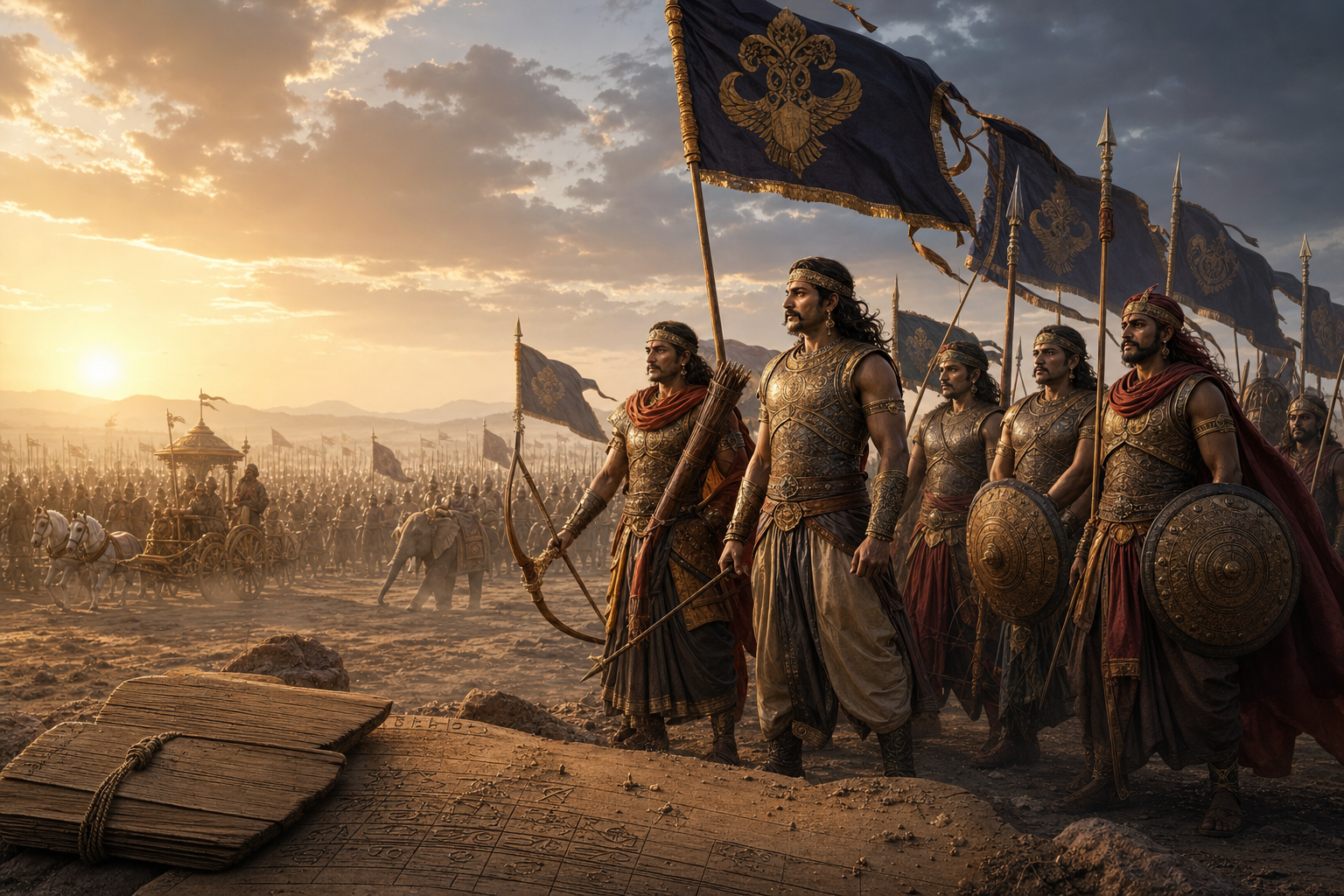
The Abhishahas in the Mahabharata occupy a small but significant place in the vast military landscape of the Kurukshetra War. They are not among the most elaborately narrated figures of the epic, yet their appearance in the Kaurava host reveals how the Mahabharata preserves memory not only of celebrated heroes such as Bhishma, Drona, Karna, Arjuna, Bhima, and Duryodhana, but also of lesser-known warrior groups who formed the living strength of ancient armies.
The name Abhishaha appears in connection with the forces aligned with the sons of Dhritarashtra. The available textual references are brief, and that brevity is important. It reminds readers that the Mahabharata is not merely a heroic biography of a few central characters; it is also a layered record of clans, kingdoms, martial communities, alliances, loyalties, and regional identities that came together on the field of Kurukshetra. The Abhishahas therefore deserve attention precisely because they represent the many warriors whose names survive only in fragments, yet whose presence helped shape the epic scale of the war.
In the epic tradition, the Abhishahas are described as part of the Kaurava side rather than as an independent narrative line. Their association with the sons of Dhritarashtra suggests political and military proximity to the Kuru court. While the Mahabharata does not provide a detailed genealogy for them, their placement among the Kaurava forces indicates that they were recognized as a martial group of some standing. In ancient Indian epic literature, such mentions are rarely accidental. A clan named in a battle roll, formation, or deployment scene is being placed within a larger map of power.
The term itself invites careful interpretation. In Sanskritic usage, names associated with warrior groups often carry meanings connected with strength, conquest, resistance, or battlefield quality. The Abhishahas may be understood in relation to the idea of those who attack, overcome, or press forward in conflict, though any exact etymological certainty must be approached with caution. The academic value lies not in forcing a modern reconstruction, but in recognizing that the name belongs to the martial vocabulary of the epic world.
Their role becomes clearer when viewed within the organization of the Kaurava army. The Kaurava host was not a simple family militia. It was a large confederated force consisting of Kuru loyalists, allied kings, regional chiefs, professional warriors, chariot fighters, elephant divisions, cavalry units, infantry formations, and clan-based contingents. The Abhishahas appear to belong to this wider network of military support that Duryodhana gathered through kinship, diplomacy, obligation, gratitude, rivalry, and political calculation.
The Mahabharata repeatedly shows that warfare in ancient India was structured by more than personal bravery. It required alliances, supply, formation discipline, command hierarchy, ritual legitimacy, and the moral language of Kshatra Dharma. The Abhishahas, though only briefly preserved in the narrative, help illuminate this larger world. Their presence points to a battlefield where identity was collective as well as individual, and where warrior communities fought under banners that linked them to kings, teachers, patrons, and ancestral obligations.
The Abhishahas are especially important because they highlight the difference between fame and function in epic warfare. Famous warriors dominate the dramatic imagination, but armies are sustained by disciplined groups whose stories are not always individually narrated. The Mahabharata often names such groups in passing, creating a panoramic military record. These brief references preserve the texture of an age in which many clans stood at the crossroads of Dharma, loyalty, ambition, and fate.
Within the Kaurava alignment, the Abhishahas would have fought under a command structure shaped first by Bhishma, then by Drona, then by Karna, and finally by Shalya. This succession of commanders is one of the most technically significant aspects of the Kurukshetra War. It shows that the Kaurava army had to continually reorganize after the fall of major leaders. Any warrior clan within that host had to adapt to changing strategies, formations, morale, and battlefield expectations.
Military formations in the Mahabharata, such as vyuhas, are not merely decorative descriptions. They indicate a sophisticated imagination of battlefield geometry. Chariots, elephants, horses, and foot soldiers were placed according to tactical purpose. Lesser-known martial groups like the Abhishahas would likely have been assigned according to their combat strengths, regional fighting style, and reliability under pressure. Whether stationed near royal divisions, supporting a flank, or integrated into a larger formation, their function would have been part of an organized war machine.
Their association with the sons of Dhritarashtra also raises the issue of loyalty. In the Mahabharata, loyalty is never simple. Many warriors on the Kaurava side are not portrayed as inherently devoid of virtue. Bhishma fights for the throne of Hastinapura because of his vow. Drona fights because of obligation and royal service. Karna fights because of friendship, gratitude, and personal honor. In this atmosphere, the Abhishahas can be read as part of a wider moral complexity: warriors bound to a political order even when that order is shadowed by adharma.
This is one of the enduring lessons of the Mahabharata. The epic does not reduce history to a simple division between noble individuals on one side and ignoble individuals on the other. It studies the tragic consequences of choices, attachments, vows, pride, insult, silence, and ambition. The Abhishahas, as Kaurava-aligned warriors, become part of that tragic field. Their fate belongs to the same moral universe in which great skill can be misdirected when political loyalty is separated from Dharma.
From a historical and literary perspective, the Abhishahas also point toward the epic’s memory of clan-based warfare. Ancient Indian polities were often organized through lineage, territory, ritual authority, and military obligation. A named clan in the Mahabharata may preserve a remembered social unit, even if later tradition no longer retains its full history. Such references are valuable because they suggest that the epic absorbed layers of older traditions, local memories, and martial identities into its grand narrative structure.
It is also necessary to distinguish between textual certainty and interpretive possibility. The Mahabharata provides limited direct information about the Abhishahas. A responsible reading must therefore avoid inventing unsupported biographies, kings, territories, or dramatic episodes for them. Their importance lies in what can be reasonably inferred: they were a warrior group, they were connected with the Kaurava host, and their mention contributes to the epic’s portrayal of a vast interregional conflict.
The absence of extensive detail should not be treated as insignificance. In epic studies, silence can be meaningful. A briefly named group may indicate a once-recognized clan whose memory survived in the textual tradition but whose independent stories were lost, absorbed, or never expanded in the main narrative. The Abhishahas therefore stand among the many shadowed participants of Kurukshetra: remembered enough to be named, but not enough to be individually developed.
This makes them valuable for readers interested in Mahabharata history, Indian epics, and the social imagination of ancient India. Their presence encourages a broader reading of the war. Kurukshetra was not only a duel between Pandavas and Kauravas. It was a civilizational crisis that drew in kingdoms, teachers, clans, families, friends, students, rulers, and ordinary soldiers. The grief of the war is intensified when one realizes how many lives were consumed by a conflict that began with unresolved injustice and hardened into total destruction.
The Abhishahas also help modern readers reflect on the emotional experience of epic memory. Anyone who has read the Mahabharata carefully notices that the text often moves from intimate dialogue to sweeping battlefield lists. These lists can appear dry at first, but they carry a solemn weight. Each name represents people with homes, teachers, vows, ancestors, and hopes. The Abhishahas are part of that human depth. Their brief mention becomes a reminder that war is never abstract to those who must stand in its dust.
In the Dharmic imagination, the Mahabharata is not preserved merely to glorify battle. It is preserved to teach discernment. The epic studies the cost of anger, greed, humiliation, envy, and failed counsel. It also honors courage, discipline, sacrifice, truthfulness, self-command, and devotion to duty. The Abhishahas belong to the martial setting through which these teachings are dramatized. Their story, though fragmentary, becomes part of the wider inquiry into how strength should be governed by wisdom.
This point is essential for a unified understanding of Dharmic traditions. Hindu, Buddhist, Jain, and Sikh traditions each engage in different ways with questions of duty, restraint, courage, compassion, and the ethical use of power. The Mahabharata’s portrayal of war can be read alongside these broader Dharmic concerns. Valor without self-knowledge becomes dangerous; loyalty without moral reflection becomes tragic; power without Dharma becomes destructive. The Abhishahas, as warriors within a morally troubled alliance, offer a small but meaningful lens into that shared ethical concern.
The Kaurava side itself should be studied with nuance. Duryodhana’s choices drive much of the disaster, yet many who fought for him did so for reasons rooted in obligation, gratitude, political order, or inherited allegiance. This does not erase the moral failures of the Kaurava cause, but it prevents a simplistic reading of every participant. The Abhishahas can therefore be understood as part of a tragic confederacy: brave enough to be remembered, yet bound to a side whose leadership repeatedly rejected wise counsel.
For technical study, the Abhishahas are best approached through three dimensions. The first is textual: where and how they are named in the Mahabharata. The second is military: what their presence suggests about the composition of the Kaurava army. The third is ethical: how their alignment fits into the epic’s wider meditation on Dharma and adharma. These dimensions allow a balanced reading that respects the source without exaggerating the evidence.
Textually, their importance comes from being included in the epic’s battlefield memory. Militarily, they represent the clan-based and confederate nature of ancient warfare. Ethically, they stand as an example of how individuals and groups can be drawn into great conflicts by bonds that are honorable in one sense but dangerous when placed in the service of a flawed cause. This layered reading is more faithful to the Mahabharata than either romantic glorification or dismissive neglect.
The Abhishahas also deepen the study of Kshatra Dharma. The warrior’s duty in the epic is not merely to fight. It is to protect order, uphold justice, honor rightful authority, and restrain destructive impulses. When the political order itself becomes compromised, the warrior faces a profound dilemma. The Mahabharata explores this dilemma again and again, from Arjuna’s despair on the battlefield to Bhishma’s painful loyalty to the throne. The Abhishahas belong to this same moral landscape, even though the text does not give them individual speeches.
Their remembrance also broadens the category of Mahabharata characters. Not every character in the epic is an individually developed personality. Some are collective characters: clans, armies, assemblies, councils, and peoples. These collective presences matter because they shape the epic’s sense of scale. The Abhishahas are one such collective presence. They help the reader understand that Kurukshetra was not only a battlefield of heroes, but also a battlefield of communities.
In modern study, such groups are especially useful for reconstructing the epic’s social world. They invite questions about regional affiliations, warrior identities, political loyalty, and the transmission of oral memory. Even when firm answers are unavailable, the questions themselves are productive. They lead readers away from a narrow retelling and toward a more comprehensive understanding of the Mahabharata as literature, history, philosophy, and civilizational memory.
The Abhishahas should therefore be remembered not because they dominate the narrative, but because they reveal how carefully the Mahabharata preserves the breadth of a world in crisis. Their name is a small window into the Kaurava host, the machinery of ancient Indian warfare, and the tragic consequences of collective alignment. Through them, the epic quietly teaches that every participant in history carries moral weight, even when only a fragment of that participant’s story survives.
Ultimately, the Abhishahas stand as forgotten warriors of Kurukshetra whose significance lies in disciplined attention. They remind readers that the Mahabharata is not exhausted by its most famous scenes. Its depth also lives in passing names, martial lists, clan references, and the understated memory of those who fought beneath greater banners. To study them is to honor the epic’s complexity and to recognize that Dharma must be examined not only in the decisions of kings, but also in the loyalties of communities that follow them into history.
Inspired by this post on Hindu Blog.




Leave a Reply
You must be logged in to post a comment.