
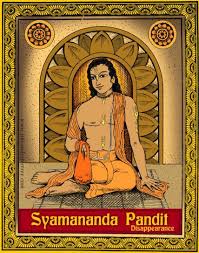
Sri Syamananda Prabhu, also remembered as Shyamananda Pandit, occupies a luminous place in the history of Gaudiya Vaishnava spirituality. His life is studied not only as a devotional biography, but also as a significant chapter in the transmission of Sri Caitanya Mahaprabhu’s teachings after the Lord’s disappearance from the world. Along with Srinivasa Acarya and Sri Narottama dasa Thakura, he is traditionally honored as one of the great carriers of the Gaudiya sampradaya into eastern India, where scriptural learning, kirtana, guru-seva, and intimate devotion to Sri Sri Radha-Krsna were preserved and expanded.
The observance of Sri Syamananda Prabhu’s disappearance is therefore more than a memorial date. It invites a careful reflection on the nature of discipleship, the preservation of sacred knowledge, and the emotional depth of bhakti. In the language of devotional tradition, disappearance does not signify an end in an ordinary historical sense. It marks the saint’s withdrawal from visible earthly activity while his teachings, example, and spiritual presence continue to guide the community.
Sri Syamananda made his appearance in Utkala, in the village of Dharenda Bahadurpur. His father was Sri Krsna Mandal and his mother was Sri Durika. The family is described as belonging to the line of sad-gopas, a community associated with agrarian life, devotional culture, and service. The tradition also records that Sri Krsna Mandal and Sri Durika had endured the loss of several children before this son was born. This background gives the birth of Syamananda a tone of tenderness and gravity, for his life was understood by devotees as a divine answer after deep sorrow.
From childhood, the boy showed an unusual absorption in Gaura-Nityananda. His father, himself a serious devotee, recognized that such spiritual inclination required proper guidance through mantra-diksa and the discipline of a recognized guru-parampara. The boy then expressed his inner conviction with clarity: “Sri Hrdaya Caitanya is my guru. He is at Ambika Kalna. His guru is Sri Gauri dasa Pandita. The two brothers, Sri Gaura-Nityananda, are eternally present in his house. If you give your permission, I will proceed to there to become his disciple.”
This statement is central to understanding Syamananda’s life. It shows that his devotion was not sentimental individualism, but devotion seeking form through lineage, discipline, and surrender. In dharmic traditions, especially within Vaishnava practice, the guru is not merely a teacher of doctrine. The guru is a living channel of memory, realization, and sacred responsibility. The boy’s request for permission also reflects the older Indian ideal that spiritual aspiration harmonizes with family respect rather than rejecting it harshly.
When he reached Ambika Kalna, Sri Hrdaya Caitanya received him with affection and gave him the name Krsna das. The guru is said to have remarked, “From now your name is Krsna das. Since early this morning I was feeling that someone would come today.” Such details, preserved in devotional memory, are important because they express the Gaudiya understanding that guru and disciple are joined by divine arrangement rather than by social convenience alone.
Sri Hrdaya Caitanya soon recognized both the intelligence and devotion of his new disciple. He instructed him to proceed to Vrindavana and study the literature of the Gosvamis under Srila Jiva Gosvami. This instruction placed Krsna das at the intellectual and theological center of the Gaudiya Vaishnava world. Vrindavana was not only a place of pilgrimage; it was the sacred laboratory of Gaudiya theology, where the teachings of Sri Caitanya were being systematized through Sanskrit works, devotional practice, temple worship, and sacred geography.
Srila Jiva Gosvami received Duhkhi Krsna dasa with great satisfaction. Under his care, Krsna das studied the writings of the Gosvamis and also served his teacher carefully. This pairing of scholarship and service is a technical hallmark of the Gaudiya tradition. Knowledge was never treated as a purely intellectual ornament. It was meant to refine humility, deepen remembrance of Sri Krsna, and prepare the disciple to carry sacred literature responsibly into the world.
During this period, Srinivasa Acarya and Narottama dasa Thakura also came to study under Sri Jiva. Their association formed one of the most consequential devotional networks in early modern Vaishnava history. The three were different personalities, yet each became essential to the continuation of Mahaprabhu’s mission. For devotees, their friendship demonstrates that dharma often advances through shared service rather than solitary achievement.
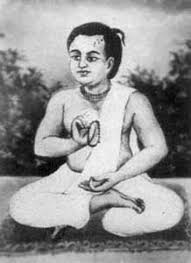
Krsna das eventually requested a special service from Srila Jiva Gosvami. Sri Jiva instructed him to sweep the forest grove of Sevakunja every day. Externally, this service appeared simple. Theologically, however, it was profound. Sweeping a sacred grove in Vrindavana is an act of humility, purification, and readiness. It expresses the aspiration that the heart itself may become clean enough to receive divine presence.
The account of the ankle bracelet of Srimati Radharani is the most celebrated episode in Syamananda’s life. While sweeping the kunja, Krsna das discovered a beautiful ankle bracelet lying in the dust. He touched it to his head and tied it in the corner of his cloth, resolving to return it only to its rightful owner. The gesture is small, but its meaning is vast: sacred things are not possessed; they are protected with reverence until they can be restored to their proper place.
The next morning, the gopis noticed that Srimati Radharani’s left ankle bracelet was missing. Radharani explained, “Last night, when I was dancing in the kunja, it must have fallen off. Please look for it and bring it back to me, whoever finds it.” In devotional literature, such narratives are not read as ordinary events alone. They reveal the intimacy of Vrindavana, where even a lost ornament becomes the cause of divine grace.
When Visakha devi came searching, she saw Krsna das sweeping the grove and asked, “Have you found an ankle bracelet here?” He was struck by her beauty and presence, then humbly answered that he had found it. Their exchange is preserved with a dramatic simplicity. Visakha identified herself as a cowherd girl and said that the ornament belonged to a new bride in their house. Krsna das, however, declined to hand it over indirectly. He wished to return it personally to the one who had lost it.
This insistence should not be misunderstood as stubbornness. In the devotional reading, it reveals spiritual integrity. Krsna das had no desire to exploit the ornament, no desire to claim a mystical experience, and no desire for recognition. He simply wanted the object to reach its rightful owner. Such care for truth, even in a delicate situation, becomes the doorway to revelation.
Visakha devi then returned with Srimati Radha Thakurani, who stood in the shade near a large tree. Visakha called out, “Bhakta, the person who lost her ankle bracelet has come to receive it.” She further told him, “O best of the devotees! Our Sakhi wants to give you a benediction to express her gratitude.” The narrative then moves from ordinary perception into divine trance, a mode of experience deeply respected in bhakti literature.
Duhkhi Krsna dasa saw the sacred waters of Radha kunda before him. After offering obeisances, he immersed himself in those waters and attained a transcendentally beautiful feminine form. Emerging from the kunda, he offered prayers before Visakha devi. Visakha then led this new “forest sakhi” to Srimati Radha Thakurani, where the devotee fell at Her lotus feet.
Srimati Radharani decorated his forehead with tilaka, using the ankle bracelet and the kumkum from Her lotus feet. She declared, “This tilak will remain on your forehead. From today you will be known as Syamananda. Now you can go.” When the trance ended, Duhkhi Krsna dasa found himself again in his male body, alone in the grove, yet the tilaka placed by Srimati Radharani remained visible on his forehead.
Theologically, this episode explains both his name and the distinctive spiritual identity associated with his lineage. The name Syamananda means one who gives joy to Syama, or one who receives joy in relation to the dark-hued Lord and His divine consort. The tilaka became a sign of grace, not merely a sectarian mark. It indicated that service performed with humility can become the foundation for the highest form of devotional revelation.
Sri Syamananda, Srinivasa, and Sri Narottama then continued their studies and worship in Vrindavana. They lived simply, begging a little food and dedicating the main portion of their time to Sri Krsna’s service. Their lives demonstrate an ideal often difficult for modern readers to grasp: rigorous learning, spiritual friendship, physical simplicity, and emotional devotion were not separate pursuits. They formed one integrated discipline.
The Gosvamis eventually convened and decided that these three should be sent to Gaudadesa to preach Mahaprabhu’s teachings as presented in the Gosvami literature. Srila Jiva Gosvami called them together and informed them of this decision. They accepted the order with bowed heads. This moment is historically important because it marks the organized movement of Gaudiya Vaishnava scripture from Vrindavana into Bengal, Odisha, and neighboring regions.
On an auspicious day, Srila Jiva Gosvami sent them with a large, carefully decorated container filled with sacred manuscripts. These texts represented the theological achievement of the Vrindavana Gosvamis. They carried works that articulated sambandha, abhidheya, and prayojana: the nature of divine relationship, the practice of devotion, and the ultimate goal of prema-bhakti. In practical terms, the mission depended on the preservation and circulation of books.
The journey was interrupted when the manuscripts were stolen by the dacoit king Sri Hambhir in Bishnupur. The event is remembered as one of the most dramatic episodes in the spread of Gaudiya Vaishnavism. Srinivasa Acarya remained behind to recover the books, while Narottama continued toward Kheturi and Syamananda proceeded to Ambika Kalna. The division of their paths shows the strategic nature of their mission: one recovered the texts, one continued preaching, and one returned to the guru’s shelter before taking up further service.
When Syamananda reached Ambika Kalna, he offered obeisances to Sri Hrdaya Caitanya Prabhu. His guru embraced him and inquired about the well-being of the Gosvamis in Vrindavana. On hearing that the books had been stolen in Bishnupur, Hrdaya Caitanya became deeply concerned. This concern reflects the centrality of scripture in the Gaudiya tradition. A saint may carry realization in the heart, but sacred books preserve that realization for communities and generations.
Syamananda then remained in the service of his guru for some time. This stage of his life is quiet but significant. After receiving extraordinary grace in Vrindavana and after being entrusted with a major preaching mission, he still returned to serve the lotus feet of his guru. Such conduct reveals the ethical discipline of the guru-shishya tradition: spiritual experience does not free the disciple from humility; it deepens it.
At that time, many of Lord Caitanya’s early devotees in Orissa had departed from the world, and the preaching of Mahaprabhu’s teachings had weakened. Hrdaya Caitanya Prabhu recognized this as a serious concern and instructed Syamananda Prabhu to go there and revive the mission. Odisha, with its deep Jagannath culture and rich devotional landscape, became a major field for Syamananda’s work.
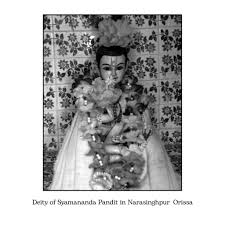
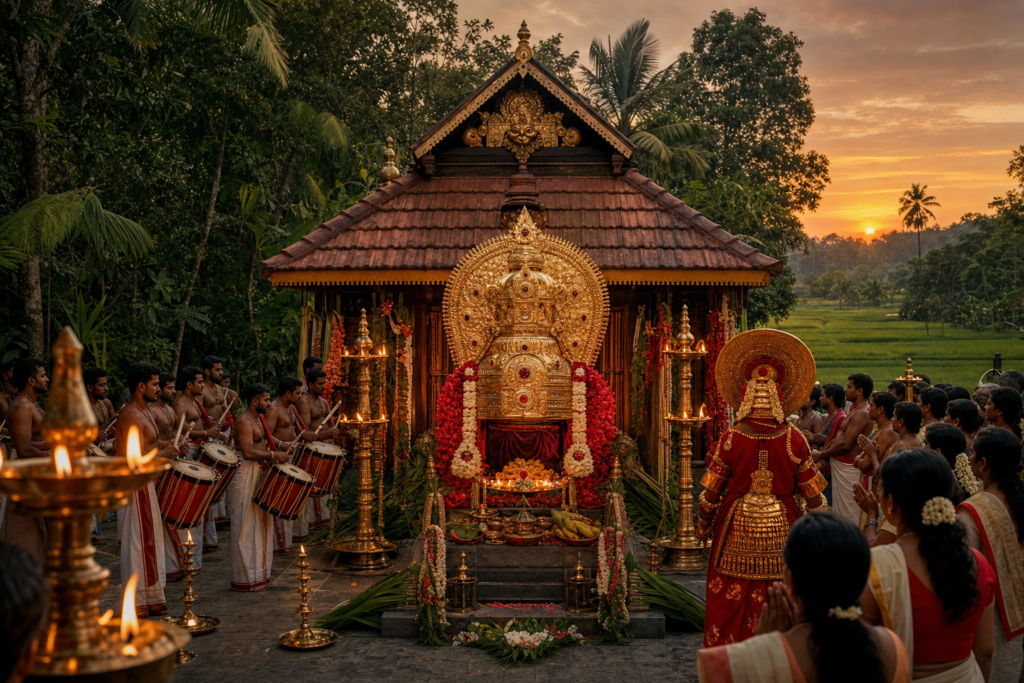
Syamananda returned to Gopi-ballabhpur, where he observed a great festival for several days. He later came to the house of Uddanda Raya Bhui at Nrsimhapur, where he held another important festival. Festivals in the Vaishnava tradition are not merely ceremonial gatherings. They are vehicles for teaching, singing, feeding, remembering, and reorganizing community life around dharma. Through such gatherings, theology becomes embodied in shared practice.
On the first day of the dark fortnight in the month of Asar, Sri Syamananda Prabhu left this world. His disappearance is observed with reverence by devotees who remember his service, his humility, his scholarship, his guru-bhakti, and his extraordinary connection with Srimati Radharani. The date carries emotional weight because it turns attention toward the continuity of spiritual responsibility after the visible departure of a saint.
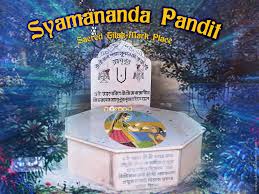
Syamananda Prabhu’s puspa samadhi and the place where he found Srimati Radharani’s ankle bracelet are remembered in Vrndavana, just across the street from the temple of Sri Sri Radha-Syamsundara. Sri Sri Radha-Syamsundara are his worshipful Deities. For pilgrims, these locations are not simply historical markers. They are sacred coordinates in the devotional map of Vrindavan, where memory, theology, and lived practice meet.
The enduring power of Syamananda’s life lies in the union of inner mystical experience and outer service. He was not remembered only because of the vision in Sevakunja, nor only because of his role in preaching. His greatness emerges from the way these dimensions supported one another. The same devotee who received Radha’s tilaka also swept the grove, studied under Jiva Gosvami, obeyed his guru, traveled with scriptures, and worked to revive spiritual life in Odisha.
For contemporary readers across dharmic traditions, Syamananda’s life offers a broader lesson. Spiritual communities survive when memory is preserved, when teachers are honored, when texts are protected, and when service is performed without arrogance. Hindu, Buddhist, Jain, and Sikh traditions each preserve distinctive paths, yet they also share respect for discipline, compassion, humility, sacred learning, and the transformative presence of realized teachers. Syamananda’s example can therefore be appreciated as part of a wider dharmic conversation about devotion and self-transcendence.
His disappearance day is best understood not as a conclusion, but as an invitation to renewed practice. The devotee sweeping Sevakunja becomes a model for anyone seeking to cleanse the inner field of distraction, pride, and forgetfulness. The recovered anklet becomes a symbol of spiritual honesty. The tilaka of Srimati Radharani becomes a sign that grace descends where service is sincere. The journey of the scriptures becomes a reminder that sacred knowledge must be carried carefully through time.
In that sense, Sri Syamananda Prabhu’s legacy remains alive wherever bhakti is practiced with humility, wherever guru-seva is honored, wherever Vrindavan is remembered with reverence, and wherever communities gather to preserve the teachings of Sri Caitanya Mahaprabhu. His life continues to teach that the deepest spiritual revelations often come not through display, argument, or status, but through quiet service performed with a clean heart.
Inspired by this post on Dandavats.






Leave a Reply
You must be logged in to post a comment.