
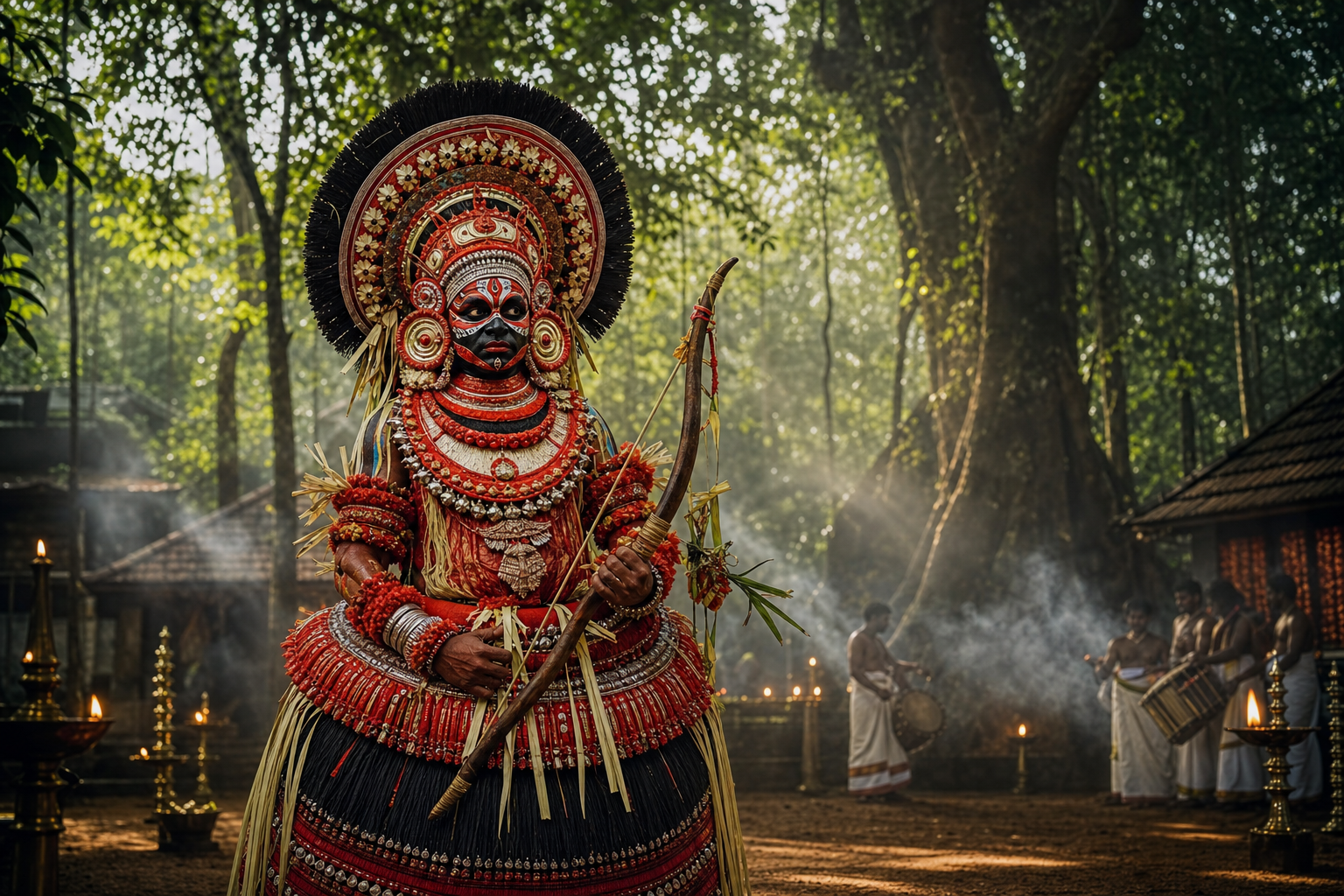
Karumakan occupies a distinctive place in the sacred landscape of North Kerala, where Hindu worship, regional memory, forest symbolism, and ritual performance meet in the living tradition of Theyyam. Revered in many local contexts as a manifestation connected with Kiratha Shiva, Karumakan is not merely remembered as a deity in mythic language; he is encountered through embodied ritual, ancestral continuity, community devotion, and the charged atmosphere of the kavu, the sacred grove.
The name Karumakan is often understood as meaning “the dark son” or “the black one.” In a shallow reading, darkness may suggest absence, fear, or marginality. In Hindu symbolism, however, darkness can signify depth, fertility, mystery, cosmic fullness, and the ungraspable nature of divine power. The dark form absorbs easy definition. It resists reduction. It points toward a divinity who belongs to the forest, the night, the soil, the hunt, the unseen world, and the protective energies that guard a community from visible and invisible dangers.
Karumakan is especially meaningful when studied within the broader Shaiva imagination of Kiratha Shiva. The Kirata form of Shiva is associated with the hunter, the forest-dweller, the testing of human pride, and the revelation of divine grace beyond conventional appearances. In Sanskritic memory, the celebrated Kiratarjunamurti theme presents Shiva appearing as a hunter before Arjuna, challenging him and ultimately blessing him with the Pashupatastra. In regional devotional practice, the same theological idea becomes more immediate: Shiva is not confined to polished temple iconography, but may appear in fierce, dark, rustic, and intimate forms among the people.
This is why Karumakan cannot be understood only as a “local god” in a narrow sense. He belongs to the layered religious world of Kerala, where folk worship and classical Hindu theology are not opposing systems but interacting modes of sacred experience. Theyyam itself demonstrates this principle with unusual clarity. A Theyyam shrine may preserve local myths, clan memories, heroic narratives, goddess traditions, serpent worship, ancestor reverence, and Shaiva or Shakta theology within a single ritual environment. Karumakan stands within this wide and inclusive field of Hindu tradition.
Theyyam, also known in related contexts as Kaliyattam, is one of North Kerala’s most powerful ritual performance traditions. It is practiced especially in the Malabar region, including Kannur, Kasaragod, and nearby cultural zones. The performer does not simply act out a myth for spectators. Through preparation, costume, rhythm, invocation, possession, and ritual transformation, the performer becomes the living presence of the deity for the duration of the rite. The community approaches, receives blessings, presents grievances, asks questions, and experiences the deity as present, audible, visible, and responsive.
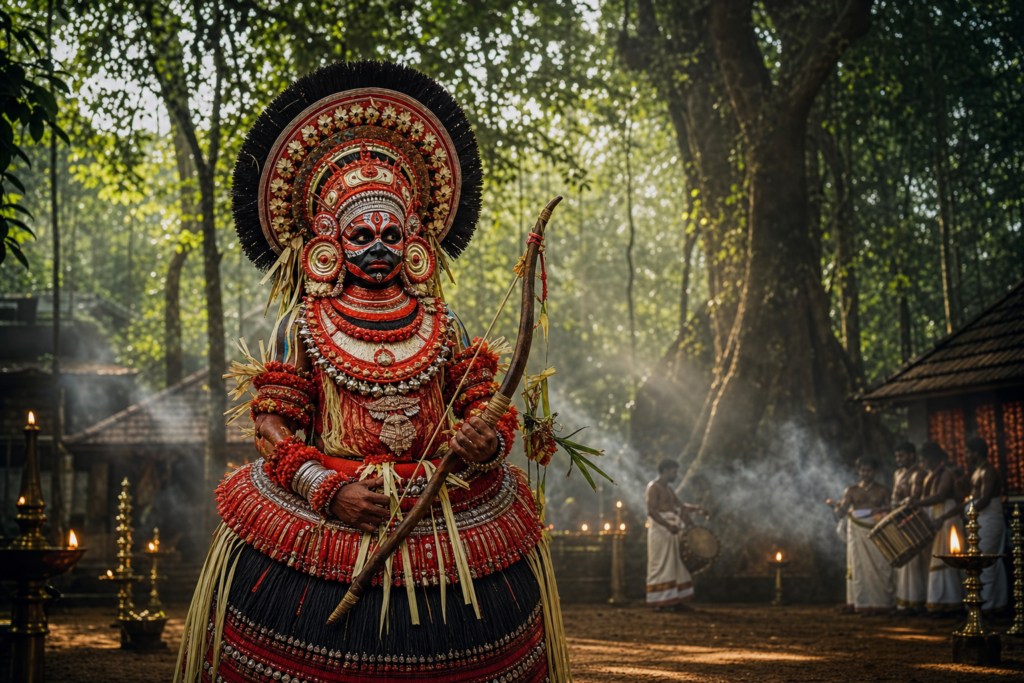
In the case of Karumakan, the Theyyam context gives the deity a striking ritual body. The dark divine hunter becomes visible through color, movement, weapon symbolism, facial expression, drum rhythm, and the sacred tension between fear and protection. The performance does not treat divinity as distant. It brings the deity into the courtyard, into the grove, into the shared space of ordinary people. This immediacy is one of the reasons Karumakan remains spiritually compelling in North Kerala’s religious culture.
Karumakan’s connection with darkness deserves careful attention. In Hindu thought, dark forms of the divine are often deeply auspicious. Krishna’s name is linked with darkness; Kali’s blackness suggests time, dissolution, and the power beyond form; Shiva himself is associated with ash, cremation grounds, mountain caves, night, and the transcendence of social boundaries. Karumakan’s dark identity therefore should not be read as negative. It is better understood as a sign of hidden potency, protective intensity, and the sacredness of what lies beyond ordinary visibility.
The forest dimension is equally important. The Kiratha Shiva motif places the divine in the wilderness, not merely in royal courts or urban temples. The hunter moves through terrain that is unpredictable, alive, and morally testing. In Kerala’s sacred geography, groves and wooded shrines preserve a similar religious memory. The kavu is not just a location; it is a ritual ecology. Trees, serpents, ancestors, guardians, goddesses, and fierce deities are held together in a network of reverence. Karumakan’s presence in such an environment reflects an older understanding that nature is not inert matter but sacred habitat.
This ecological dimension gives Karumakan worship contemporary relevance. Long before modern environmental language became common, sacred groves helped communities preserve biodiversity, regulate behavior, and maintain reverence for land. The religious logic was not abstract conservation policy. It was relational: the grove had a presence, a guardian, a memory, and a consequence. To violate sacred space was not merely to damage property; it was to disturb a moral and spiritual order. Karumakan, as a dark hunter and protector, belongs naturally to this world of sacred boundaries.
At the ritual level, Theyyam also reveals an important social dimension. Many Theyyam performers come from communities historically placed outside elite ritual hierarchies, yet during the performance they become the deity before whom all devotees may bow. This reversal is not a modern invention but a long-standing feature of the tradition. It shows how Hindu practice in Kerala has often carried multiple layers of social meaning: hierarchy and transcendence, community memory and divine equality, inherited roles and moments of sacred inversion. Karumakan’s Theyyam form participates in this complex ritual grammar.
The power of Karumakan worship lies partly in this accessibility. A devotee approaching the Theyyam does not encounter a distant theological concept. The deity speaks in the language of the people, appears in a familiar landscape, responds to local anxieties, and carries the authority of a sacred presence recognized by generations. There is an emotional intimacy in this mode of worship. It allows ordinary struggles, family concerns, illness, fear, livelihood, justice, and gratitude to enter the sacred conversation.
Karumakan’s identity as a hunter should also be understood symbolically rather than crudely. The divine hunter is not merely one who pursues animals. In Shaiva interpretation, the hunter can represent the one who tracks ego, illusion, fear, and disorder. Shiva as Kirata tests Arjuna’s pride before granting him power. Similarly, the dark hunter of North Kerala may be seen as a guardian who detects what is hidden, pursues what threatens the community, and restores balance where ordinary social mechanisms fail.
This symbolic reading is consistent with the broader Hindu understanding of divine fierceness. Fierce deities are not worshipped because devotees celebrate violence. They are revered because life requires protection, boundary, courage, and the removal of harmful forces. Bhadrakali, Veerabhadra, Narasimha, Bhairava, and many regional guardian deities express this same theological truth in different forms. Karumakan belongs to this protective family of sacred powers, while retaining the local specificity of North Kerala’s ritual imagination.
In Theyyam, the body of the performer becomes a theological text. Costume, paint, headdress, ornaments, weapons, and dance are not decorative additions; they are ritual signs. Color marks divine mood. Movement establishes energy. Drumming alters the space. Fire, lamp, and offering transform ordinary time into sacred time. When Karumakan appears, the community reads the deity through these embodied signs. This is a form of knowledge transmitted not only through books, but through sight, sound, repetition, and participation.
Such traditions challenge narrow definitions of scripture and theology. Hindu Dharma has always preserved knowledge through many channels: Veda, Agama, Purana, Itihasa, temple ritual, oral narrative, pilgrimage, festival, dance, mantra, family practice, and local shrine traditions. Theyyam belongs to this wider knowledge ecology. It is not outside Hinduism; it is one of the ways Hindu civilization has allowed regional communities to experience the divine without erasing local language, memory, and landscape.
Karumakan also demonstrates the unity of the folk and the philosophical. The deity may be approached through local myth and ritual fear, yet the symbolism opens into major Shaiva themes: the hidden form of Shiva, the testing of ego, the sacredness of wilderness, the power of the marginal, the transformation of the human body into a vessel of divine presence, and the ultimate nearness of the divine to ordinary life. This layered quality is one of the hallmarks of Hindu religious culture.
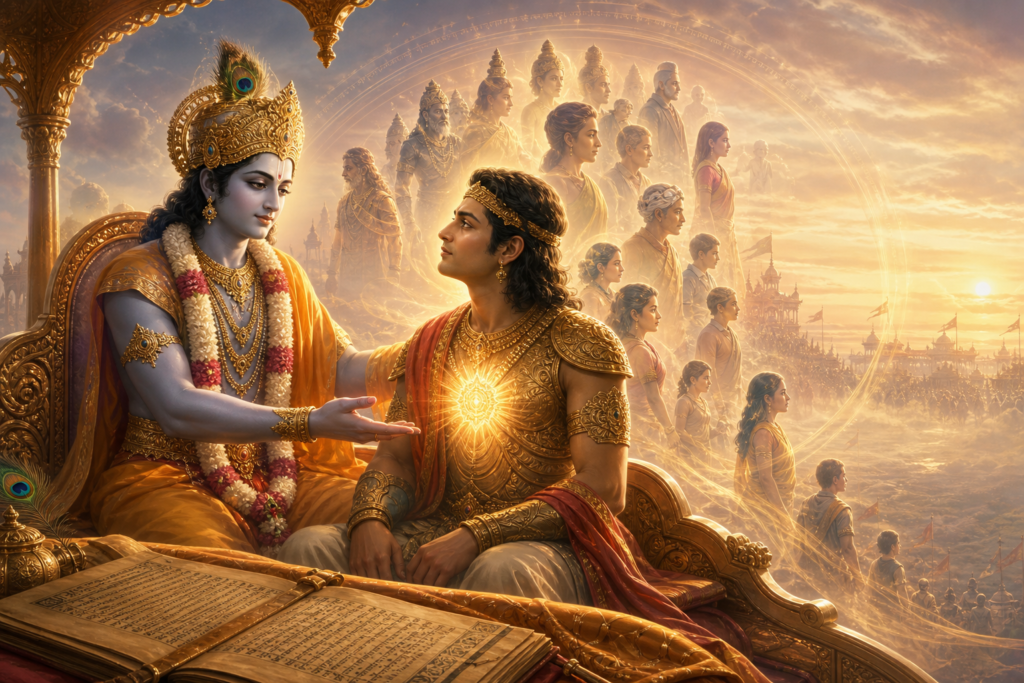
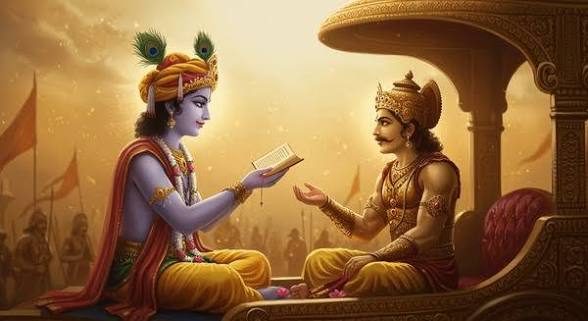
The Kiratarjunamurti connection is especially valuable for understanding Karumakan in a pan-Indian frame. In the Mahabharata tradition, Arjuna performs tapas to obtain divine weapons. Shiva appears in the form of a Kirata hunter and engages him in combat. Only after Arjuna’s pride is broken does the hunter reveal himself as Shiva. The episode teaches that divine grace may arrive in unexpected form, that spiritual strength requires humility, and that the forest is a legitimate site of revelation. Karumakan’s regional form resonates with all these themes.
North Kerala’s sacred traditions often preserve this kind of theological compression. A village deity may hold within itself memories of Shiva, ancestral heroes, local ecology, clan protection, and moral order. The shrine may appear modest when compared with large stone temples, but its ritual authority can be immense. Devotees do not measure sacred power only by architectural scale. The living continuity of worship, the intensity of vow and blessing, and the presence felt during ritual are equally central.
Karumakan’s worship also reflects the importance of oral tradition. In many Theyyam contexts, the story of a deity is carried through songs, invocations, ritual specialists, family memory, and shrine practice. These narratives may vary across localities, and such variation should not be treated as weakness. In Hindu traditions, plurality often indicates vitality. A deity may be remembered differently in different villages while still belonging to a shared sacred universe. Karumakan’s identity is therefore best approached with respect for local transmission rather than excessive standardization.
This point matters because modern readers often expect a single, fixed biography for every deity. Regional Hindu traditions do not always function in that manner. Their truth is not merely documentary but ritual, relational, and inherited. A deity’s meaning is held in the way people worship, the vows they keep, the festivals they observe, the songs they preserve, and the ethical boundaries they honor. Karumakan’s significance is therefore found not only in etymology or mythology, but in the continuing devotion of communities that experience him as guardian and divine presence.
The visual language of Karumakan Theyyam is also essential to its impact. Theyyam aesthetics are deliberately intense. The face is transformed. The body becomes larger than ordinary human scale. The ornaments and colors create a threshold between the human and the divine. The deity’s arrival may evoke awe, fear, tenderness, and trust at the same time. This emotional range is not accidental. Hindu ritual often recognizes that the sacred is not always gentle in appearance, even when its purpose is protective and compassionate.
For many devotees, such a ritual encounter can feel more immediate than philosophical explanation. A child watching from the edge of the courtyard may first experience Karumakan as sound, fire, color, and intensity. An elder may see in the same moment the protection of ancestors and the memory of vows fulfilled. A family may approach with anxiety and leave with a sense of being heard. These human dimensions do not reduce the deity to psychology; rather, they show how ritual gives form to devotion, fear, gratitude, and belonging.
Karumakan also helps illuminate the relationship between Shiva and regional guardian traditions. Shiva is both the great yogi of the Himalaya and the lord who appears in cremation grounds, forests, village boundaries, and fierce local forms. His presence is not limited to one social location. The Kirata form emphasizes this fluidity. Shiva may appear as hunter, ascetic, householder, dancer, teacher, destroyer, and compassionate lord. Karumakan can be understood as a North Kerala expression of this vast Shaiva adaptability.
In this sense, Karumakan is part of a larger Hindu pattern in which local deities and pan-Indian deities are mutually illuminating. The local form gives texture, emotion, and place to theology. The pan-Indian form gives philosophical depth and broader recognition to local worship. Neither needs to erase the other. Their relationship is one of resonance. Karumakan is meaningful precisely because he is both rooted and expansive: rooted in North Kerala’s Theyyam tradition, expansive in his connection to Shiva, forest symbolism, and sacred protection.
The role of the community is central to this continuity. Theyyam is not sustained by performers alone. It requires shrine custodians, ritual families, musicians, devotees, patrons, oral specialists, and the wider public that recognizes the sanctity of the event. Karumakan’s presence is therefore communal as well as divine. Each annual performance renews a relationship between deity, land, family, and society. The ritual is not simply remembered; it is re-enacted and made present.
The ethical dimension of Karumakan worship should not be overlooked. Guardian deities often function as protectors of social truth. They are approached in matters of justice, illness, oath, fear, and unresolved conflict. The deity’s fierce presence reminds devotees that moral life has consequences. In a world where formal institutions may feel distant, ritual spaces often preserve a powerful sense of accountability. Karumakan’s authority is therefore not merely supernatural; it is also moral and communal.
At the same time, a careful academic reading should avoid romantic exaggeration. Theyyam traditions are historically layered and socially complex. They carry beauty, devotion, hierarchy, transformation, and memory together. Karumakan should not be flattened into a simple symbol of “tribal,” “folk,” or “classical” religion. Such labels are often too rigid. The better approach is to recognize the deity as part of a dynamic Hindu religious system in which regional practice, Shaiva theology, ritual embodiment, and social history interact.
This approach also supports unity among Dharmic traditions. Hinduism, Buddhism, Jainism, and Sikhism all preserve, in different ways, reverence for disciplined practice, ethical life, sacred memory, and the possibility of transformation. Karumakan’s tradition is specifically Hindu and Shaiva in its ritual grammar, yet its deeper themes of humility, protection, ecological reverence, and community responsibility can be appreciated across Dharmic sensibilities. Respectful study of such traditions strengthens cultural understanding rather than sectarian division.
Karumakan’s dark form can also be read as a challenge to modern discomfort with the fierce and mysterious. Contemporary religious presentation often prefers softness, simplicity, and easily marketable imagery. Theyyam refuses such reduction. It preserves the fact that the sacred can be overwhelming, difficult, and transformative. The divine does not always arrive in forms designed for comfort. Sometimes it appears as the dark hunter, demanding attention, humility, and reverence.
The connection between Karumakan and sacred performance further shows how Hindu traditions transmit theology through the arts. Dance, music, costume, oral poetry, and ritual space are not secondary to doctrine. They are vehicles of doctrine. The drummer, the singer, the performer, the lamp-bearer, and the devotee together create a field in which theology becomes experience. This is one reason Theyyam remains so powerful: it does not merely explain the divine; it stages the encounter.
From a historical perspective, North Kerala’s coastal and inland cultures have long been shaped by movement, trade, martial traditions, agrarian life, temple networks, and local clan structures. Sacred traditions in the region naturally absorbed these social realities. Deities such as Karumakan became protectors not in an abstract theological vacuum, but in the lived worlds of households, fields, groves, boundaries, and seasonal festivals. The divine hunter belongs to a society that knew the forest, the uncertainty of livelihood, and the need for guardianship.
The term “Karumakan” itself invites layered interpretation. “Karu” can evoke blackness or darkness in Dravidian linguistic contexts, while “makan” means son. The name therefore carries intimacy as well as power. The deity is dark, but also son-like; fierce, but also close to the community. This combination helps explain the emotional charge of the tradition. Karumakan is not a remote cosmic abstraction. He is a sacred presence with a local name, a recognizable ritual form, and a relationship with devotees.
Such naming is important in Hindu practice. Names are not merely labels; they are modes of approach. A devotee who says Shiva, Mahadeva, Rudra, Bhairava, Dakshinamurthy, Nataraja, or Kirata invokes different aspects of the same vast sacred reality. Karumakan functions similarly in the regional sphere. The name opens a path into a particular experience of divine power: dark, forested, protective, embodied, and immediate.
Karumakan’s relevance today depends on preserving both devotion and knowledge. Ritual continuity without understanding can become fragile, while academic study without reverence can become lifeless. A balanced approach requires documentation, local consultation, respect for performers, sensitivity to shrine customs, and careful interpretation of symbols. The tradition deserves neither exoticization nor dismissal. It deserves serious attention as a living expression of Hindu cultural heritage.
For younger generations, Karumakan Theyyam offers a way to reconnect with a form of Hinduism that is local, artistic, ecological, and deeply embodied. It shows that Sanatana Dharma is not only found in printed texts or large temples, though those are invaluable. It also lives in the night-long vigil, the drumbeat in the shrine courtyard, the sacred grove protected by memory, and the moment when a human performer becomes a vessel of divine presence before the community.
There is also a methodological lesson here for the study of Hindu deities. Regional forms should be studied through multiple lenses: language, ritual, oral narrative, iconography, ecology, social history, and theology. Karumakan becomes more intelligible when these lenses are brought together. The deity’s darkness is symbolic, his hunter form is Shaiva, his ritual body is Theyyam, his landscape is North Kerala, and his continuing meaning is sustained by community devotion.
Karumakan’s tradition ultimately affirms a central Hindu insight: the divine is not limited by a single form, location, language, or social category. Shiva can appear as the ascetic of Kailasa, the cosmic dancer, the silent guru, the linga of temple worship, the fierce Bhairava, or the Kirata hunter of the forest. In North Kerala’s Theyyam tradition, this same sacred reality is encountered as Karumakan, the dark divine hunter whose presence protects, tests, blesses, and binds the community to its ancestral sacred world.
To study Karumakan is therefore to study more than one deity. It is to study how Hindu Dharma holds together locality and universality, fear and compassion, forest and shrine, performance and theology, memory and renewal. Karumakan remains a powerful reminder that the sacred often survives most vividly where land, people, and ritual still speak to one another. In that living conversation, the dark son of North Kerala continues to shine with a depth that cannot be reduced to ordinary light.
Inspired by this post on Hindu Blog.

Leave a Reply
You must be logged in to post a comment.