
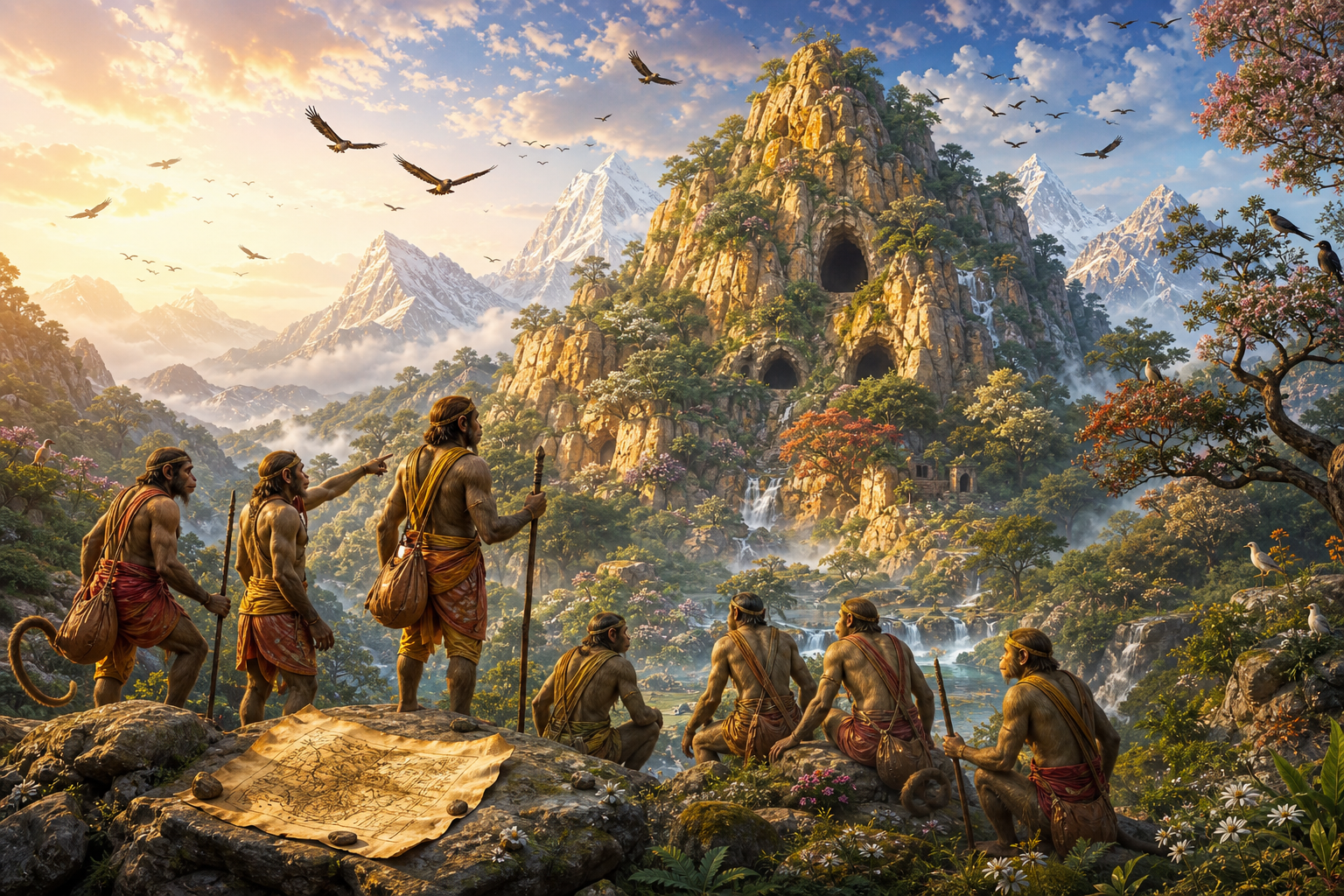
Devasakha occupies a brief but meaningful place in the Valmiki Ramayana, appearing in the Kishkindha Kanda during Sugriva’s systematic dispatch of search parties to locate Sita after her abduction by Ravana. Though the mountain does not receive an extended episode like Chitrakoot, Rishyamuka, Mahendra, or Lanka, its mention is significant because it belongs to the epic’s vast sacred geography: a world of forests, caves, rivers, plateaus, ascetic hermitages, celestial beings, difficult passes, and regions that test both physical endurance and moral purpose.
In the northern search route, Sugriva instructs the vanara leader Shatavali and his companions to explore the lands crowned by the Himalaya. The command is not casual reconnaissance. It is an organized, disciplined mission undertaken to repay Rama’s friendship and to serve dharma by finding Janaki. Devasakha appears in this itinerary after Mount Sudarshana and before the searchers move beyond it toward a vast empty tract and then toward Kailasha. This placement makes Devasakha part of a sequence in which geography becomes increasingly remote, luminous, and sacred.
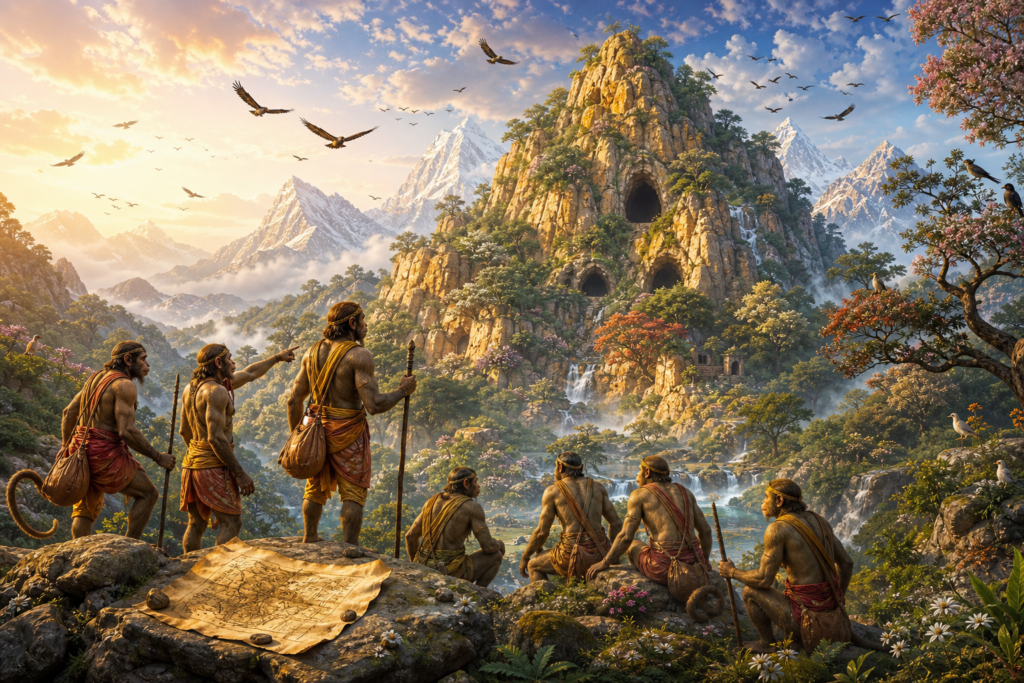
The name Devasakha may be understood in a devotional and literary sense as “friend of the gods” or “companion of the devas,” although the Ramayana’s narrative emphasis is less on etymology and more on the mountain’s qualities. It is described as a refuge of birds, filled with many varieties of winged creatures, covered with trees of diverse fragrance, and marked by golden rocks, springs, and caves. These details are not ornamental excess. They identify the mountain as a living ecological and spiritual zone where beauty, danger, abundance, and mystery coexist.
Devasakha’s immediate narrative function is practical: Sugriva tells the searchers to examine its caves, rocks, and hidden places for Ravana and Sita. This instruction reflects the tactical logic of the Kishkindha Kanda. Sita’s concealment could not be assumed to lie in a royal city alone. Ravana’s path and powers made forests, mountain caverns, remote peaks, and inaccessible regions possible hiding places. The vanaras therefore had to search like scouts, geographers, trackers, and servants of dharma, not merely like warriors awaiting battle.
This is where Devasakha becomes more than a scenic mountain. In the Ramayana, landscape often reveals the inner condition of the characters who move through it. Rama’s grief in the forest, Sugriva’s fear on Rishyamuka, Hanuman’s leap from Mahendra, and the vanaras’ desperation before the ocean all show that terrain in the epic is never neutral. Devasakha stands within this same literary method. It is a terrain of uncertainty, requiring careful search, courage, attention, and loyalty to a promise.
The northern expedition also reveals Sugriva’s knowledge of the world. His instructions name peoples, regions, mountains, forests, hermitages, and celestial spaces with striking confidence. The itinerary moves through human territories such as the Kurus, Madrakas, Kambojas, Yavanas, Shakas, and other groups, then into Himalayan and trans-Himalayan zones associated with devas, gandharvas, rishis, siddhas, and regions beyond ordinary travel. Devasakha is part of this widening map from political geography to sacred cosmography.
A technical reading of this passage shows how the Ramayana organizes space through layered categories. There are inhabited regions, tribal and frontier lands, aromatic forests, snow-covered mountains, ascetic hermitages, golden peaks, bird-filled refuges, deserts without visible life, divine residences, and cosmic boundaries. Devasakha belongs to the category of the fertile and animate mountain: a place of trees, fragrance, birds, caves, and flowing water. It is not barren like the empty tract that follows it, nor fully celestial like Kailasha. It stands at a threshold.
The mention of birds is especially important. The Ramayana repeatedly associates winged beings with perception, movement, and witness. Jatayu witnesses Sita’s abduction and sacrifices his life resisting Ravana. Sampati, though wingless and aged, becomes the crucial informant who reveals Sita’s location in Lanka. Hanuman himself, though a vanara, performs a bird-like crossing of the ocean, moving through the sky as the decisive messenger of Rama. Devasakha as a refuge of birds subtly participates in this broader symbolic world of aerial knowledge and far-reaching vision.
The forests and fragrant trees of Devasakha also deserve close attention. In ancient Indian literature, fragrance often signals both sensual richness and sacred presence. Fragrant woods such as devadaru, sandalwood, lotus-bearing waters, and flowering groves mark places where nature is not inert matter but a field of rasa, memory, and divine order. The diverse fragrances on Devasakha suggest biodiversity, but also poetic refinement. The mountain is imagined as a complete environment, one that engages sight, smell, sound, and movement.
The golden rocks, springs, and caves create another layer of meaning. Gold in the Ramayana can signify beauty and radiance, but it can also warn readers about illusion, desire, and hidden danger. The golden deer in the Aranya Kanda leads to Sita’s separation from Rama, while golden Lanka displays Ravana’s wealth without dharmic restraint. Devasakha’s golden stones, however, are not presented as deception. They belong to a sacred mountain landscape where brilliance is integrated with natural order. The searchers are asked to examine it carefully, not to covet it.
The caves of Devasakha connect the mountain to one of the Ramayana’s recurring motifs: the hidden interior. Caves can be places of danger, refuge, austerity, deception, or revelation. Vali’s conflict with Mayavi begins with pursuit into a cave, leading to misunderstanding and the rupture between Vali and Sugriva. Later, the southern search party enters the mysterious Rikshabila cavern and encounters Swayamprabha. In this context, Devasakha’s caves represent the unknown spaces that must be investigated when dharma has been disturbed.
Sugriva’s instruction to search Devasakha also reflects the ethics of gratitude. He explicitly frames the mission as a repayment of Rama’s help. Rama restored Sugriva to kingship by defeating Vali; Sugriva now must act with discipline to restore Sita to Rama. This moral reciprocity is central to the Kishkindha Kanda. Devasakha is therefore linked to the transformation of Sugriva’s kingship from personal recovery to public responsibility. A ruler’s gratitude must become organized action.
For readers of Hindu scriptures, this episode offers a practical insight: devotion is not only emotion, and friendship is not only affection. Both must mature into duty. The vanaras do not merely praise Rama; they travel across harsh and unknown regions to serve his cause. In that sense, the search of Devasakha becomes a model for disciplined seeking. One searches not because success is guaranteed at each stop, but because the cause is righteous and the promise must be honored.
Devasakha also helps modern readers appreciate the geographic imagination of the Valmiki Ramayana. The epic is not confined to palace drama or battlefield heroism. It ranges across forests, mountain chains, sea routes, hermit settlements, frontier peoples, divine realms, and cultural zones of ancient Bharatavarsha and beyond. This breadth is one reason the Ramayana became a civilizational text across Hindu, Buddhist, Jain, Sikh-adjacent, and wider Asian cultural worlds. Its landscapes invite different communities to remember dharma through place, journey, discipline, and ethical choice.
At the same time, Devasakha should not be treated as a site that can be identified with certainty on a modern map. The Ramayana’s geography contains recognizable regions, poetic expansions, sacred cosmology, and symbolic landscapes. The northern itinerary passes through the Himalaya toward Kailasha, Uttara Kuru, and cosmic regions where ordinary geography gives way to mythic space. A careful academic approach therefore avoids unsupported claims while recognizing that sacred geography operates through memory, meaning, and tradition as much as through cartographic precision.
This careful approach strengthens rather than weakens reverence for the text. When Devasakha is read as part of Sugriva’s northern search, its value lies in what the passage reveals: the discipline of the search, the sanctity of mountains, the ecological richness of the epic world, the role of birds and caves in Ramayana symbolism, and the movement from political duty to cosmic order. The mountain’s importance is literary, theological, ecological, and ethical.
The ecological dimension is particularly relevant today. Devasakha is described through living signs: winged creatures, trees of many fragrances, springs, rocks, and caves. Such imagery reflects a worldview in which mountains are not dead geological masses but habitats, guardians, and sacred presences. This outlook resonates deeply with dharmic traditions, where rivers, trees, mountains, animals, and human beings exist in a network of responsibility. The Ramayana’s mountain landscapes quietly teach ecological humility without needing modern terminology.
There is also a contemplative lesson in the order of the northern route. Devasakha appears before the searchers cross into emptiness and then behold Kailasha. Symbolically, the seeker first passes through abundance, sound, fragrance, life, and hidden caves; then through barrenness; then toward a luminous sacred height. This pattern resembles many inner journeys. Human beings often search first through the dense forest of experience, then through periods of silence and uncertainty, before glimpsing clarity. The Ramayana’s geography can therefore be read as both outer travel and inner discipline.
In relation to Rama and Sita, Devasakha reminds readers that the rescue mission is built from many unseen efforts. Hanuman’s leap to Lanka receives justly celebrated attention, but the epic also honors the larger network of service that made that moment possible. Search parties were sent east, south, west, and north. Routes were mapped. Mountains were named. Caves were to be examined. Leaders were assigned. Hope was preserved through structure. Devasakha belongs to this less dramatic but essential architecture of collective action.
This point is valuable for any dharmic reading of the Ramayana. Great achievements in the epic are rarely isolated acts. Rama depends on Lakshmana, Sita’s strength, Hanuman’s devotion, Sugriva’s alliance, Jambavan’s wisdom, Vibhishana’s counsel, and the labor of countless vanaras. Devasakha, though a place rather than a character, is part of that network because it marks the thoroughness of the search. It shows that the path of dharma includes attention to places that may appear minor but cannot be neglected.
The mountain also deepens the emotional texture of the search for Sita. The vanaras moving through Devasakha are not sightseeing. They are searching for a woman torn from her home, separated from her husband, and held by a ruler who has violated the moral order. Every cave and spring must be examined because Sita’s suffering cannot be abstracted. This gives the passage its emotional seriousness. The beauty of Devasakha does not erase grief; it becomes the setting within which compassion takes disciplined form.
In academic terms, Devasakha may be understood as a micro-example of the Ramayana’s integration of narrative progression, environmental description, and ethical instruction. The passage advances the plot by widening the search. It builds the world by naming a distinctive mountain. It instructs the audience by showing gratitude, service, precision, courage, and responsibility. Its brevity is not a weakness; it is part of the epic’s technique, where even a short geographical reference can carry cultural and symbolic density.
For contemporary readers, Devasakha offers a way to approach the Ramayana with both reverence and intellectual care. It encourages attention to the smaller place-names of the epic, not only the famous episodes. It invites reflection on sacred geography without forcing premature historical certainty. It highlights the unity of dharma, ecology, friendship, and service. Above all, it shows that the search for Sita is not merely a military operation but a moral pilgrimage across the visible and invisible worlds of the Ramayana.
Devasakha therefore stands as a powerful but understated mountain in the Ramayana: a refuge of birds, a forested and fragrant height, a place of caves and golden rocks, and a waypoint in Sugriva’s northern command. Its memory preserves the epic’s larger message that dharma must be pursued with patience, breadth, and sincerity. Every mountain, every forest, every hidden cave, and every living creature may become part of the sacred effort to restore truth, protect dignity, and reunite what adharma has torn apart.
Inspired by this post on Hindu Blog.








Leave a Reply
You must be logged in to post a comment.