
Śrīmad-Bhāgavatam 4.22.17-31 presents one of the most concentrated teachings on spiritual civilization, disciplined perception, and the inner work required for liberation. In this section, the sages known as the Kumāras instruct King Pṛthu, a ruler already known for responsibility and devotion, on the deeper meaning of human life. The discussion is not merely theological. It is a carefully structured spiritual psychology in which consciousness, attachment, humility, service, and knowledge are examined as practical forces shaping human destiny.
The class associated with Nanda Devi Dasi at Krishna House Gainesville brings attention to a core feature of the Bhāgavata tradition: spiritual knowledge is not meant to remain abstract. The teaching must be heard, reflected upon, and gradually embodied. Śrīmad-Bhāgavatam repeatedly presents this method through dialogue. A sincere seeker asks; a realized teacher responds; the listener becomes transformed not by information alone, but by a change in orientation toward life, duty, and the Supreme.
King Pṛthu approaches the Kumāras with reverence, and that reverence is significant. In Vedic culture, humility before wisdom is not a social ornament but an epistemological discipline. It acknowledges that the senses are limited, the mind is conditioned, and ego can distort even intelligent inquiry. By receiving instruction from saintly persons, Pṛthu demonstrates that leadership in dharma depends on teachability. A ruler may command armies and administer wealth, yet spiritual authority begins with the willingness to listen.
The verses emphasize that liberation from material bondage requires more than moral respectability or ritual correctness. The heart must be cleansed of deep attachment to temporary identities. The Bhāgavata describes the living being as distinct from the body, yet entangled through identification with bodily designations, possessions, relationships, and ambitions. This does not reject worldly responsibility; rather, it asks that responsibility be purified by devotion, self-knowledge, and detachment from egoistic control.
A major theme in Śrīmad-Bhāgavatam 4.22.17-31 is association. Human consciousness is porous. It is shaped by the company one keeps, the speech one hears, the desires one normalizes, and the ideals one admires. Association with sādhus, devotees, and disciplined spiritual practitioners is therefore treated as a transformative environment. It helps redirect the mind from restless consumption toward Krishna consciousness, service, and remembrance of the Supreme Lord.
This teaching remains technically precise from the standpoint of bhakti psychology. Desire is not destroyed by repression alone. It is purified by higher attachment. The Bhāgavata does not propose a merely negative spirituality in which life becomes empty, colorless, or emotionally dry. It teaches that the heart naturally seeks love, meaning, beauty, and relationship. When these impulses are centered on the Supreme Person, they become sources of liberation rather than bondage.
The Kumāras explain that devotion is nourished through hearing about the Lord. This is why śravaṇam, attentive hearing, occupies such a central place in the bhakti tradition. Hearing sacred narration is not passive consumption. It trains memory, softens the heart, challenges false identity, and gradually reveals the difference between temporary excitement and enduring spiritual satisfaction. The class format itself reflects this principle: scripture is spoken, heard, contemplated, and applied within community.
The verses also clarify the relationship between knowledge and devotion. In many philosophical systems, knowledge is treated as the highest independent means of liberation. The Bhāgavata honors knowledge but situates it within devotion. Knowledge without devotion can become pride; devotion without philosophical grounding can become sentimentality. The synthesis offered here is profound: the mind becomes purified by devotion, and purified consciousness allows knowledge of the self and the Supreme to become steady.
This balance is especially important for dharmic traditions more broadly. Hinduism, Buddhism, Jainism, and Sikhism all recognize, in distinct ways, that untrained desire binds the human being to suffering, confusion, or karmic consequence. The Bhāgavata’s contribution is its explicitly theistic and relational focus: liberation matures through loving service to Bhagavān. Yet the ethical emphasis on self-restraint, compassion, discipline, humility, and liberation from ego resonates across the wider dharmic landscape.
In practical terms, the instruction to avoid degrading attachment is not a call to contempt for the world. It is a call to see the world accurately. Relationships become sacred when they are aligned with dharma. Wealth becomes meaningful when used in service. Speech becomes purifying when it carries truth and remembrance. Leadership becomes noble when it protects spiritual culture. The same external life can either bind or liberate depending on consciousness.
The example of King Pṛthu is therefore essential. He is not a renunciant who abandons society; he is a king. His spiritual seriousness shows that liberation is not reserved only for those outside public life, family life, or professional duty. The Bhāgavata consistently teaches that the decisive question is not merely where one stands socially, but how consciousness is directed. A person in governance, family, scholarship, business, or service can cultivate devotion when action is offered without possessive ego.
The Kumāras also point toward the danger of bodily identification. Modern life often intensifies this illusion through constant comparison, performance, and anxiety over status. The body is treated as the whole self, and the mind becomes absorbed in validation, fear, and acquisition. The Bhāgavata intervenes with a radically different anthropology: the living being is ātmā, eternal, conscious, and meant for loving relationship with the Supreme. Forgetfulness of this identity is the root of bondage.
This teaching has emotional force because it names a common human experience. Even after achieving external success, people often feel inwardly incomplete. The Bhāgavata explains that this incompleteness is not accidental. The finite cannot satisfy the infinite hunger of the soul. Temporary objects can provide utility, comfort, or responsibility, but they cannot replace spiritual connection. Devotion therefore becomes not an escape from reality but a return to the deepest reality of the self.
The passage also presents detachment as intelligent freedom. Detachment does not mean coldness, negligence, or lack of affection. It means freedom from the illusion that temporary arrangements can be possessed absolutely. When detachment is joined with bhakti, affection becomes cleaner and service becomes steadier. One can care deeply without demanding that the world obey the ego’s script. This is a mature form of spiritual resilience.
Within the Bhagavata Purana, such detachment is inseparable from remembrance of Krishna. The senses and mind require engagement. If they are not engaged in spiritual practice, they drift toward habitual patterns. Chanting, hearing, study, worship, prasadam, seva, and association provide a disciplined structure through which the whole person is reoriented. The Bhāgavata is therefore not only a sacred text but also a manual of consciousness formation.
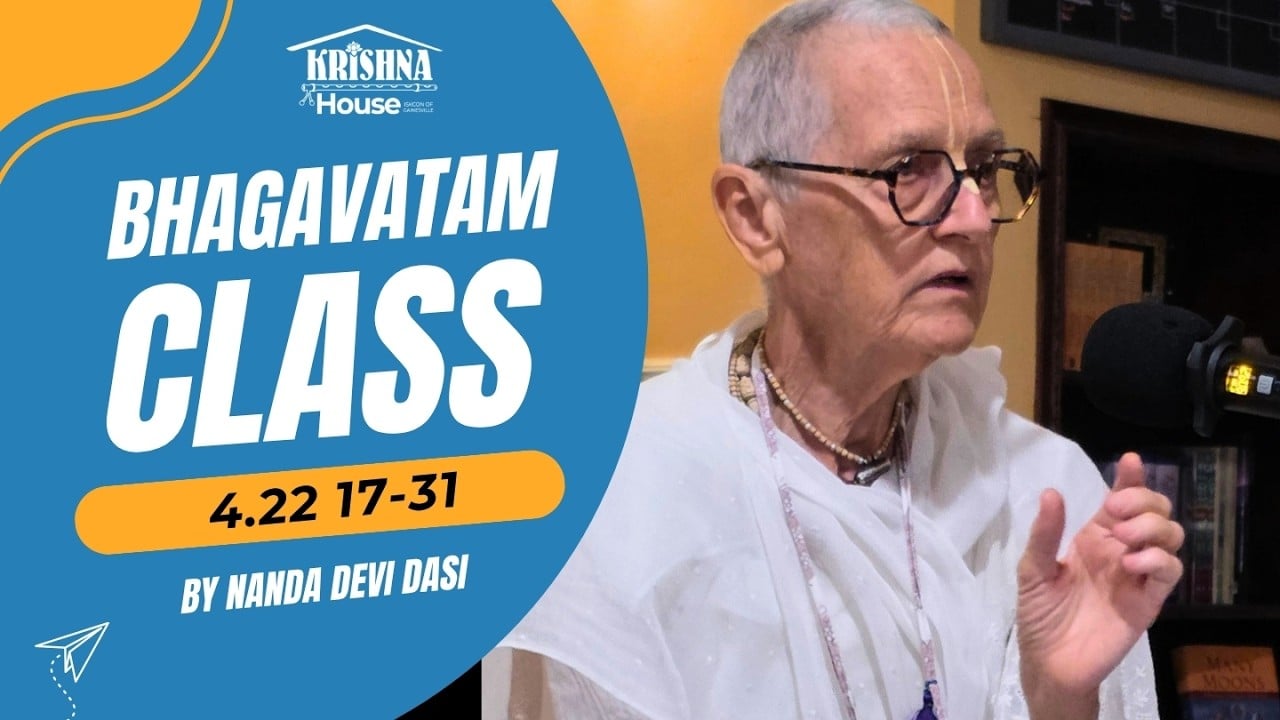
The class title, Bhagavatam Class 4.22 17-31 | Nanda Devi Dasi, points to a living tradition of scriptural study rather than a merely historical artifact. Krishna House Gainesville functions within the broader Hare Krishna and ISKCON ecosystem, where Śrīmad-Bhāgavatam classes are part of daily devotional education. Such classes preserve the oral and communal dimension of Vedic knowledge, allowing scripture to become a shared discipline rather than a private abstraction.
A technical reading of these verses also shows the Bhāgavata’s layered model of spiritual development. First, there is contact with saintly association. Then comes hearing. Hearing awakens faith and reflection. Reflection encourages disciplined practice. Practice purifies desire. Purified desire stabilizes knowledge. Knowledge supports detachment. Detachment allows devotion to deepen without obstruction. This sequence is not mechanical, but it describes the organic growth of spiritual life.
The instruction is also socially relevant. A civilization shaped by spiritual hearing values elders, teachers, sacred texts, and moral restraint. A civilization shaped only by appetite becomes restless and fragmented. The Bhāgavata’s concern is therefore not only personal salvation but cultural health. When leaders like Pṛthu receive wisdom from sages, the text presents a model of governance guided by dharma, humility, and accountability before higher truth.
This is why the passage matters for contemporary readers. Many people inherit religious language but not always a clear method for transforming consciousness. Śrīmad-Bhāgavatam 4.22.17-31 offers that method with clarity: seek the association of the wise, hear sacred teachings attentively, reduce ego-centered attachment, cultivate devotion, and understand the self beyond the body. These are not vague ideals. They are repeatable disciplines.
The emotional depth of the teaching lies in its confidence that transformation is possible. The conditioned mind may be turbulent, but it is not beyond purification. The heart may be attached, but it can learn higher love. A person may be burdened by habit, but sacred association can redirect life. The Bhāgavata does not flatter human weakness, yet it never treats the soul as hopeless. Its realism is joined with profound spiritual hope.
The unity of dharmic traditions can be strengthened by reading such passages with generosity and philosophical care. The Bhāgavata speaks from a Vaiṣṇava devotional standpoint, yet its concerns are widely recognizable: the need for self-mastery, the danger of ego, the value of compassion, the importance of disciplined hearing, and the possibility of liberation. These shared concerns can encourage respectful dialogue among Hindu, Buddhist, Jain, and Sikh communities without erasing their real differences.
In conclusion, Bhagavatam 4.22.17-31 offers a powerful study in spiritual maturity. King Pṛthu’s humility, the Kumāras’ instruction, and the Bhāgavata’s emphasis on devotional hearing together form a complete path for inner refinement. The passage teaches that liberation is not achieved by social status, intellectual pride, or external performance. It unfolds through purified association, sincere inquiry, disciplined practice, and loving devotion to the Supreme. For readers seeking Vedic wisdom, Krishna consciousness, and a practical philosophy of spiritual growth, these verses remain exceptionally relevant.
Inspired by this post on Dandavats.









Leave a Reply
You must be logged in to post a comment.