
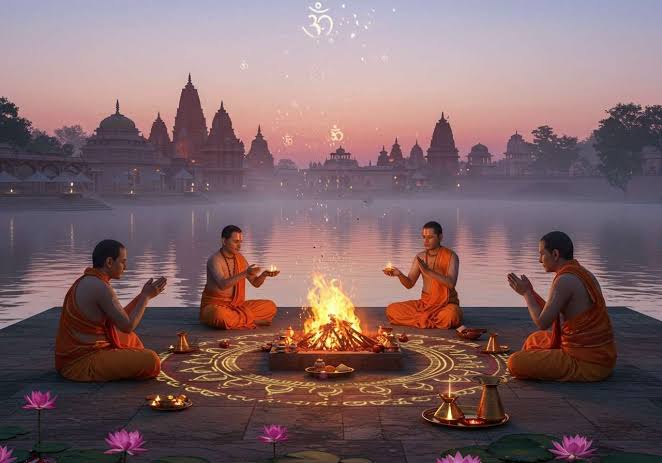
Civilisations are not preserved by monuments alone. Temples, inscriptions, sculptures, manuscripts, and sacred geography provide visible evidence of continuity, but the deeper life of a civilisation survives through habits, values, memory, and disciplined transmission. Hindu civilisation has endured through periods of political change, migration, social disruption, colonial pressure, and rapid modernisation because its cultural identity has never depended only on a single institution or a central authority. It has lived most powerfully in the home, the temple, the festival ground, the pilgrimage path, the oral tradition, and the everyday acts through which families embody Dharma.
Hindu rituals, therefore, cannot be understood merely as isolated religious ceremonies. They are expressions of Hindu philosophy, Hindu values, spiritual practice, social ethics, and cultural memory. They translate metaphysical ideas into lived experience. A lamp is lit, a mantra is recited, a child bows to elders, food is offered before eating, a festival story is retold, and a family gathers before a home mandir. Each of these actions may appear simple, yet together they create a civilisational grammar through which identity is formed across generations.
In the present age of globalisation, mass migration, digital distraction, and changing family structures, these practices have acquired renewed importance. For many Hindu families in Bharat and across the Indian diaspora, ritual is not only a link to the past; it is also a method of orientation in a fast-moving world. It gives children a language of belonging, adults a structure of responsibility, and communities a shared rhythm of celebration, mourning, learning, and renewal. The continuity of Sanatan Dharma is visible precisely in this ability to make ancient traditions meaningful in contemporary life.
Rituals as living carriers of Hindu civilisation
One of the most striking features of Hindu civilisation is its capacity to preserve continuity without relying on a single ecclesiastical hierarchy. Hindu traditions are diverse, regionally rich, philosophically plural, and liturgically varied. Shaiva, Vaishnava, Shakta, Smarta, folk, tribal, temple-centred, household-centred, and guru-parampara-based traditions all participate in a larger civilisational framework. This diversity does not weaken Hindu identity; rather, it reflects the depth of a tradition that has long recognised multiple valid approaches to the sacred.
Ritual practices function as the practical medium through which this diversity remains connected. Daily puja, vrata, yajna, japa, pilgrimage, samskaras, temple worship, bhajans, kirtan, scriptural recitation, and festival observances transmit values that are not always taught through formal instruction. They communicate reverence, gratitude, restraint, discipline, hospitality, ecological awareness, family responsibility, and the pursuit of spiritual knowledge. In this sense, ritual is not separate from philosophy; it is philosophy made visible and repeatable.
Every chant, offering, mudra, circumambulation, and act of reverence carries a layered meaning. A ritual may honour a deity, mark a cosmic cycle, purify intention, sanctify food, invoke blessings, remember ancestors, or strengthen community. It also places the individual within a larger order of time. A family performing a traditional puja is not merely repeating an inherited act. It is participating in a chain of memory that links the present generation to parents, grandparents, teachers, sages, scriptures, and sacred landscapes.
Family traditions as the micro-habits of Dharma
Cultural identity is rarely formed by abstract instruction alone. It is shaped more deeply by repeated experiences in the household. Children learn what a family honours by watching what the family does consistently. In many Hindu homes, the day may begin with lighting a diya, offering water to Surya, chanting a mantra, bowing before a deity, touching the feet of elders, or placing food before the Divine before eating. These gestures form what may be called the micro-habits of Dharma.
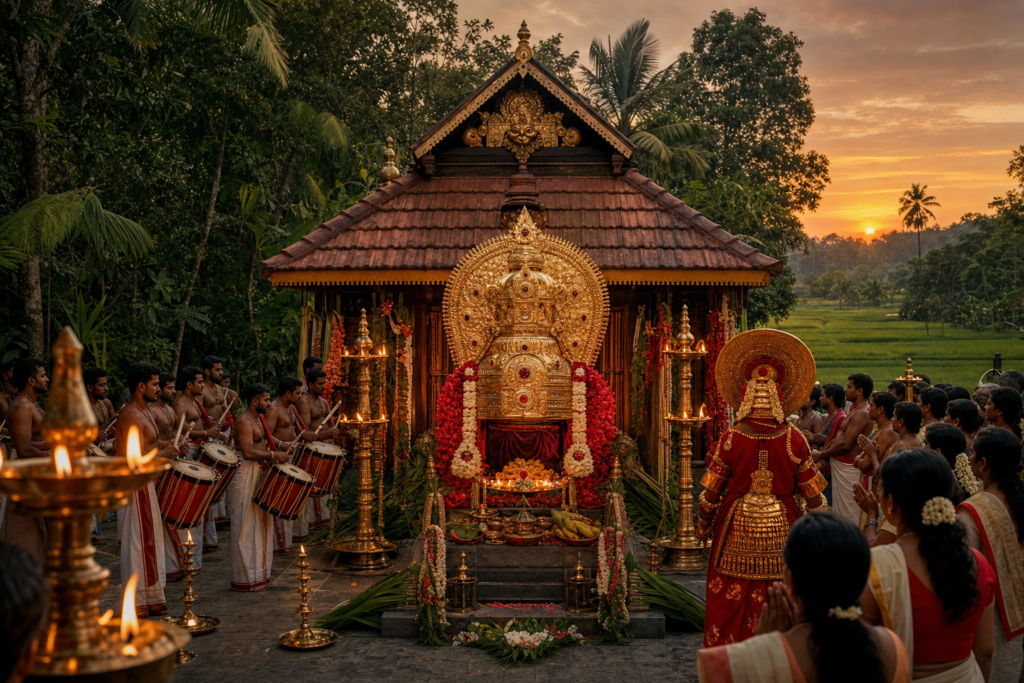
Daily puja creates a dedicated space and time for stillness. In a world that rewards speed, constant stimulation, and outward achievement, puja teaches the value of inward attention. The act of standing before a murti, image, flame, or sacred symbol allows the mind to pause and reorient itself. For children, the fragrance of incense, the sound of bells, the rhythm of mantras, and the sight of elders praying become emotional memories associated with peace, reverence, and belonging.
Touching elders’ feet, often called Charan Sparsh, is another practice with deep cultural and ethical meaning. It is not merely a gesture of social hierarchy. At its best, it symbolises humility, gratitude, and recognition of experience. It teaches that knowledge is transmitted through relationship and that elders are not disposable once modern life becomes more efficient. In families where the practice is explained with sensitivity rather than imposed mechanically, it can strengthen intergenerational respect and emotional continuity.
Lighting the diya carries a similarly powerful symbolism. The flame represents knowledge, clarity, auspiciousness, and the removal of darkness. When a lamp is lit at dawn, dusk, or during worship, the household is reminded that inner refinement is central to Hindu spiritual life. This symbolic act also connects domestic space to cosmic order. The home is not only a private residence; it becomes a place where Dharma is remembered and renewed.
Scripture reading, bhajans, kirtan, and storytelling further deepen this domestic culture. The Ramayana, Mahabharata, Bhagavad Gita, Puranas, Upanishadic teachings, regional saint literature, and local temple legends enter family life not only as texts but as living narratives. Through them, children encounter ideals such as courage, devotion, restraint, truthfulness, loyalty, compassion, sacrifice, and self-mastery. The home becomes an informal school of Hindu culture, where learning takes place through sound, memory, affection, and repetition.
These household practices help embed Hindu values without turning culture into a burden. Gratitude, bhakti, discipline, respect for knowledge, reverence for parents and teachers, and awareness of the sacred are absorbed gradually. When performed with sincerity and explanation, these acts become emotionally meaningful rather than merely procedural. They create continuity because they are small enough to be repeated and deep enough to shape character.
Festivals and the expansion of community memory
If daily puja forms the quiet centre of the household, Hindu festivals expand that centre into the wider community. Diwali, Navratri, Janmashtami, Raksha Bandhan, Makar Sankranti, Holi, Ram Navami, Ganesh Chaturthi, Durga Puja, Onam, Pongal, Vishu, Gudi Padwa, Chaitra Navratri, and countless regional observances give collective form to cultural memory. They unite families, neighbourhoods, temples, artists, priests, musicians, cooks, storytellers, and volunteers in shared celebration.
Festivals are among the most effective vehicles of cultural continuity because they make abstract philosophy emotionally accessible. A child may not immediately understand complex metaphysical discussions about Dharma, cosmic order, or the triumph of sattva over tamas. Yet the same child can intuitively understand the meaning of light overcoming darkness while placing a clay diya during Diwali. The symbolism becomes visible, tactile, and memorable.
Similarly, Navratri teaches reverence for Devi Shakti through fasting, music, dance, discipline, and community worship. Janmashtami brings the life of Sri Krishna into the home through stories, songs, decorations, and midnight worship. Raksha Bandhan affirms bonds of protection and responsibility. Makar Sankranti links spiritual observance to solar transition, harvest cycles, charity, and gratitude to nature. These festivals do not merely entertain; they educate through joy.
Festivals also preserve regional diversity within a larger Hindu framework. The same sacred season may be expressed differently in Tamil Nadu, Bengal, Maharashtra, Gujarat, Odisha, Assam, Karnataka, Kerala, Nepal, or among diaspora communities in North America, Europe, Africa, Southeast Asia, and the Caribbean. Local foods, languages, songs, temple customs, dress, and family traditions become part of the celebration. This regional plurality helps Hindu culture remain rooted rather than homogenised.
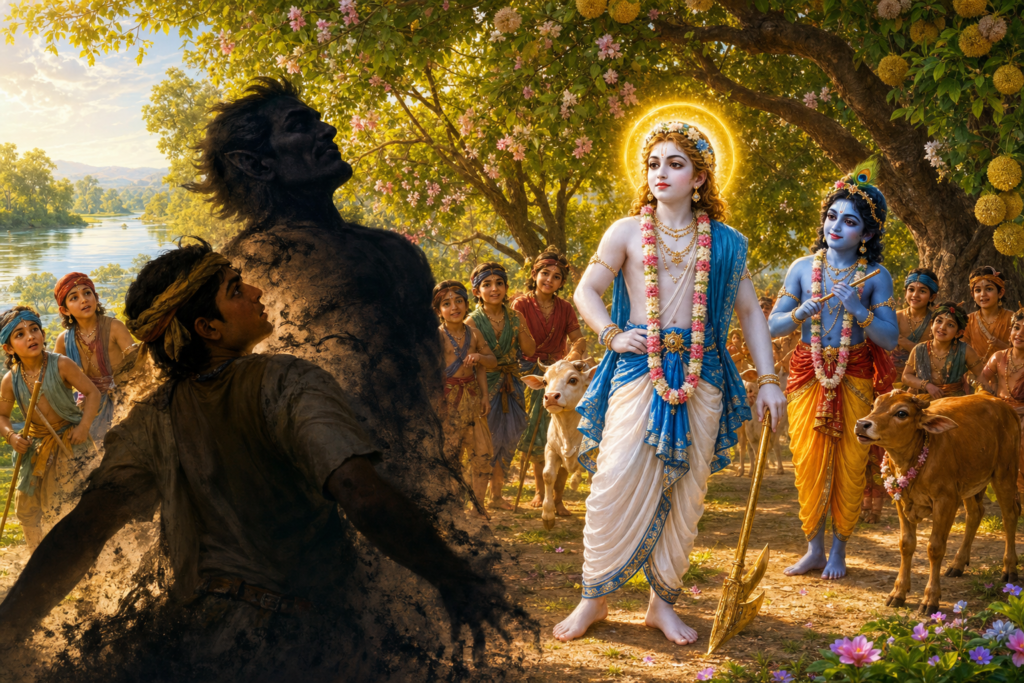
Another important function of festivals is the transmission of historical and sacred narratives. Stories of Rama, Krishna, Durga, Shiva, Lakshmi, Saraswati, Ganesha, Subrahmanya, Prahlada, Savitri, the Pandavas, saints, gurus, and local deities are retold in a social setting. Such storytelling creates continuity between scriptural imagination and communal identity. It also allows elders to become active transmitters of memory rather than passive observers of cultural change.
Samskaras and the sanctification of the human life cycle
Hindu tradition recognises that human life is not a random sequence of biological events. It is a journey marked by responsibility, learning, relationship, duty, and spiritual possibility. The samskaras, often described as rites of passage, sanctify major transitions from birth to death. Classical traditions identify sixteen principal samskaras, though their form, number, and performance vary across regions, communities, and sampradayas.
The Naming Ceremony, or Namakarana, welcomes the newborn into family, lineage, and community. It affirms that a child is not merely an isolated individual but part of an inherited moral and cultural world. Annaprashana, the first feeding of solid food, celebrates nourishment, health, and the child’s entry into a wider relationship with food, family, and nature. These early samskaras create a sense that life itself is sacred from its beginning.
Upanayana, traditionally associated with initiation into education and spiritual discipline, marks the beginning of formal learning and responsibility in several Hindu communities. Its deeper meaning lies in the movement from childhood toward disciplined study, self-control, and reverence for the Guru. Even where the exact ritual form differs today, the underlying principle remains important: education is not merely vocational training but a sacred undertaking connected to character and self-knowledge.
Vivaha, or marriage, is not only a social contract but a sacred commitment. It joins families, establishes the responsibilities of Grihastha life, and places household life within the framework of Dharma. The householder stage has long been recognised as central to the support of society, since it sustains family, hospitality, charity, ritual continuity, and community institutions. Hindu marriage customs, when understood in their ethical depth, point toward partnership, duty, mutual respect, and shared spiritual growth.
Antyeshti, the funeral rite, completes the visible life journey by returning the physical body to the elements and honouring the continuing journey of the atman according to Hindu understanding. It provides structure to grief and helps the community support the bereaved. In moments of loss, ritual language offers a way to hold sorrow, memory, duty, and hope together. The family is reminded that death is not treated as mere disappearance, but as part of a larger metaphysical order.
The ethical foundation of this life-cycle vision is reflected in the Taittiriya Upanishad (1.11.1):
मातृदेवो भव – Let your mother be a god to you, पितृदेवो भव – Let your father be a god to you, आचार्यदेवो भव – Let your teacher be a god to you, and अतिथिदेवो भव – Let your guest be a god to you.
This passage captures the moral architecture of Hindu family and social life. Mother, father, teacher, and guest are treated as sacred presences because Dharma is learned through relationship. Samskaras reinforce this insight. They remind the individual that life is woven into family, community, ancestors, teachers, sacred knowledge, and cosmic order.
Language, scriptures, and sacred knowledge
The preservation of Hindu scriptures, Sanskrit learning, regional languages, oral traditions, and sacred knowledge is one of the great achievements of Indian civilisation. This preservation did not occur only through libraries and formal schools. It was also sustained through ritual, recitation, memorisation, temple performance, family storytelling, pilgrimage, music, dance, and the Guru-Shishya Parampara.
Ritual exposes participants to Sanskrit mantras, vernacular devotional poetry, regional liturgies, and inherited forms of pronunciation. Even when a child does not immediately understand every word, the soundscape of worship creates familiarity. Over time, curiosity often follows exposure. A mantra heard daily may later become an object of study. A festival story heard in childhood may later lead to the Ramayana, Mahabharata, Bhagavad Gita, or Puranas. A bhajan sung at home may lead to an interest in saints, philosophy, or regional literature.
This pattern demonstrates an important pedagogical principle: cultural literacy often begins with participation before analysis. Modern education tends to privilege explanation first and experience later. Hindu ritual traditions frequently reverse that order. A person first participates, observes, hears, repeats, and remembers. Understanding deepens gradually through questions, study, and guidance. This layered method has helped sacred knowledge remain alive even during periods when formal institutions were disrupted.
Regional languages also receive protection through ritual life. Tamil hymns, Marathi abhangas, Bengali kirtan, Kannada vachanas, Telugu devotional compositions, Odia Jagannath traditions, Assamese Vaishnava music, Malayalam temple arts, Sanskrit stotras, and many other forms continue to circulate because they are tied to worship and celebration. Thus, Hindu rituals help preserve not only religious identity but linguistic heritage, artistic practice, and regional memory.
The Indian diaspora and cultural continuity abroad
For the Indian diaspora, Hindu rituals often become a lifeline of identity. Families living thousands of miles from Bharat may face the pressures of assimilation, limited access to extended family, unfamiliar social norms, and dominant cultural narratives that do not always understand Dharmic traditions. In such settings, a home mandir, a weekly puja, a temple visit, a language class, a festival gathering, or a community bhajan can become a powerful source of rootedness.
Immigrant families frequently carry culture through portable practices. A small altar in an apartment, a packet of kumkum, a brass diya, a copy of the Bhagavad Gita, a framed image of a deity, a grandmother’s festival recipe, or a recorded chant can transform a foreign environment into a spiritual home. These objects and actions are not nostalgic decorations alone. They help children understand that their identity has depth and continuity beyond immediate social surroundings.
Community temples abroad play a particularly important role. They function as places of worship, cultural education, language preservation, youth engagement, charity, intergenerational bonding, and public representation. In multicultural societies, they help Hindu children grow with confidence rather than confusion. Such children can participate fully in their country of residence while remaining emotionally and spiritually connected to ancestral heritage.
The diaspora experience also shows that cultural preservation need not create isolation. Properly understood, Sanatan Dharma encourages inner rootedness along with respect for diverse paths. Hindu rituals can strengthen identity while supporting social harmony, interfaith understanding, and unity among Dharmic traditions, including Hinduism, Buddhism, Jainism, and Sikhism. Shared values such as ahimsa, seva, self-discipline, reverence for knowledge, meditation, compassion, and liberation-oriented life provide a broader Dharmic foundation for cultural confidence.
Technology as a support, not a substitute
The digital age has created unprecedented opportunities for preserving and sharing Hindu heritage. Families can access digital scriptures, translations, online satsangs, virtual classes, live darshan from temples, recordings of Vedic chanting, pronunciation guides, calendars, and educational resources from almost anywhere in the world. For diaspora communities and younger generations, such tools can reduce distance from sacred knowledge and make learning more accessible.
However, technology must be understood as a supporting instrument rather than a replacement for embodied practice. Watching a live darshan can inspire devotion, but it cannot fully replace the discipline of personal sadhana. Reading a digital text can encourage study, but it does not replace the formative experience of learning with humility from teachers, elders, and community. Listening to a mantra recording can aid pronunciation, but the transformative value of japa arises through regular practice, attention, and intention.
The most balanced approach is to use technology for education, access, and preservation while keeping the centre of ritual life in lived participation. A family may learn the meaning of a mantra online and then chant it together at home. A child may watch a temple festival livestream and later visit a local temple with greater interest. A diaspora community may use digital calendars to coordinate observances while still gathering physically for festivals. Technology becomes valuable when it strengthens practice rather than displacing it.
Why the younger generation matters
The future of Hindu culture depends significantly on how younger generations encounter tradition. If rituals are presented only as obligations without explanation, many young people may experience them as inherited pressure. If they are explained with clarity, warmth, and intellectual honesty, the same rituals can become sources of identity, psychological stability, ethical orientation, and spiritual strength.
Modern youth often ask direct questions: Why is a diya lit? Why are mantras repeated? Why is food offered before eating? Why are elders honoured? Why do festivals follow lunar and solar calendars? Why do families fast? Why do temples use bells, flowers, incense, water, and fire? These questions should not be treated as disrespect. In many cases, they show seriousness. A tradition confident in its depth can respond with patience and substance.
Explaining Hindu rituals through philosophy, psychology, ecology, ethics, aesthetics, and social function can make them more meaningful. Puja can be discussed as devotion, mindfulness, gratitude, and symbolic ordering of life. Fasting can be explored in terms of restraint, discipline, health, and sacred time. Festivals can be explained as cultural memory, seasonal awareness, and communal bonding. Respect for elders can be connected to gratitude, continuity, and humility. Such explanations help young people see tradition as a living inheritance rather than a frozen command.
Parents, grandparents, teachers, temple communities, and cultural organisations all have a role in this process. The most effective transmission combines participation with meaning. Children should be invited to help arrange flowers, light lamps under guidance, prepare prasadam, learn simple chants, hear stories, ask questions, visit temples, serve the community, and understand the ethical purpose behind ritual. When involvement is active, cultural identity becomes personal rather than distant.
Ritual, unity, and the wider Dharmic vision
Hindu rituals preserve cultural identity most effectively when they are grounded in Dharma rather than narrow social pride. Their purpose is not merely to mark difference from others, but to cultivate a refined way of living. They teach reverence for the sacred, awareness of duty, gratitude toward ancestors, respect for teachers, honour for parents, care for guests, discipline of the senses, compassion toward beings, and recognition of the interconnected nature of life.
This wider Dharmic vision naturally supports unity among Hindu, Buddhist, Jain, and Sikh traditions while respecting their distinct histories and practices. These traditions differ in theology, philosophy, ritual structure, and institutional development, yet they share civilisational concerns such as self-cultivation, ethical action, liberation from ignorance, reverence for teachers, compassion, restraint, and disciplined practice. A mature understanding of Hindu rituals can therefore strengthen Hindu identity without weakening broader Dharmic solidarity.
In contemporary public life, this is especially important. Cultural continuity should not become rigidity, and modernity should not become deracination. The challenge is to preserve what is meaningful, explain what is misunderstood, adapt what is contextual, and practise what is essential. Hindu rituals have survived precisely because they are capable of both continuity and renewal. They hold memory, but they also invite reflection.
Conclusion: continuity through meaningful practice
Hindu rituals are far more than mechanical actions or decorative ceremonies. They are carriers of Hindu heritage, protectors of family values, transmitters of spiritual knowledge, and living bridges between generations. They preserve language, scripture, sacred memory, regional diversity, community cohesion, and personal identity. They give form to gratitude, devotion, discipline, reverence, and belonging.
The enduring strength of Sanatan Dharma lies in this ability to bring the cosmic into the domestic, the philosophical into the practical, and the ancient into the present. A diya lit in a home, a mantra taught to a child, a festival celebrated with meaning, a samskara performed with understanding, or a story retold by an elder may seem modest in isolation. Together, these acts keep a civilisation alive.
When Hindu rituals are practised with sincerity, explained with clarity, and transmitted with affection, they do not burden the younger generation. They offer roots, resilience, and a framework for living with dignity in a changing world. Through such meaningful practice, Hindu culture, Vedic traditions, and the wider Dharmic heritage can remain vibrant, unbroken, and deeply relevant for generations to come.
Inspired by this post on Hindu Post.


Leave a Reply
You must be logged in to post a comment.