
Grihastha Dharma in the Bhagavad Gita presents household life not as a lesser spiritual path, but as one of the most demanding and transformative arenas of Dharma. Within Bharatiya life philosophy, Dharma is not confined to ritual performance or sectarian identity. It is the sustaining order that guides conduct, responsibility, moral discernment, family life, social cooperation, and the pursuit of spiritual growth. The Gita’s teaching becomes especially powerful because it does not ask the sincere seeker to reject the world mechanically. It asks the seeker to act rightly within the world, purify intention, discipline desire, and convert ordinary duties into sacred responsibility.
The householder’s life, or Grihastha Dharma, is therefore central to understanding Indian Philosophy and Hindu Dharma. The family is the earliest institution of education, discipline, affection, restraint, service, and character formation. Long before a person studies scripture formally, moral life is absorbed in the home through speech, habits, food, relationships, generosity, respect for elders, care for children, and the daily handling of conflict. The home becomes the first gurukula of conduct, and the householder becomes both practitioner and teacher through example.
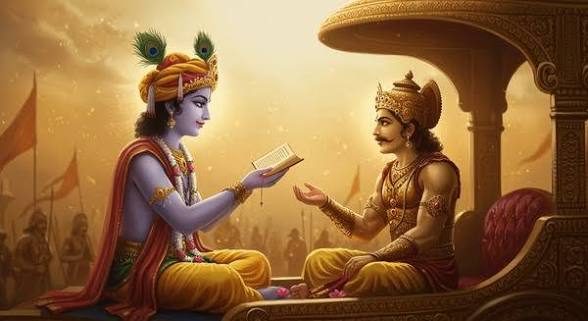
The Shrimad Bhagavad Gita emerged from the crisis of Arjuna on the battlefield of Kurukshetra, yet its relevance extends beyond that historical and epic setting. Lord Krishna’s dialogue with Arjuna is concerned with action, knowledge, devotion, self-control, duty, fear, grief, courage, and liberation. These themes are not limited to kings and warriors. They are equally present in the lives of parents, spouses, students, workers, community leaders, and citizens who must make ethical decisions while facing pressure, attachment, uncertainty, and responsibility.
Ancient Indian life philosophy described four ashramas: Brahmacharya, or student life; Grihastha, or householder life; Vanaprastha, or gradual withdrawal; and Sannyasa, or renunciation. Grihastha Ashrama was often viewed as the supporting pillar of the others because householders sustained social, educational, economic, ritual, and charitable life. The student needed support, the forest-dweller needed social order behind him, and the renunciate depended on the generosity of society. Thus the ancient saying remains significant:
“Grihasthashramah Sarvashramamoolam.”
Meaning: The householder stage is the foundation of all other stages of life.
This statement does not glorify materialism. It recognizes responsibility. A true householder is not merely a consumer or income-earner. The householder preserves lineage, protects dependents, honours guests, supports learning, gives charity, contributes to social welfare, and participates in the moral stability of the community. In this sense, Grihastha Dharma is not private domesticity alone; it is a disciplined form of lokasangraha, the holding together of society through righteous action.
The Gita’s most famous teaching on Karma Yoga gives the philosophical foundation for such a life:
“Karmanye vadhikaraste ma phaleshu kadachana.
Ma karma-phala-hetur bhur ma te sango’stvakarmani.”
(Chapter 2, Verse 47)
Meaning: You have the right to perform your duty, but you are not entitled to the fruits of your actions. Do not let the results of your actions be your motive, and do not become attached to inaction.
For family life, this verse is not abstract philosophy. It directly addresses the emotional weight of everyday duties. Parents work for children without guaranteed results. Spouses care for one another without always receiving equal recognition. A person may serve ageing parents, educate the young, earn honestly, manage household stress, and support society while facing uncertainty. Karma Yoga teaches that such action becomes spiritually meaningful when it is performed with sincerity, clarity, discipline, and freedom from selfish obsession with reward.
This does not mean indifference to results. The Gita does not teach carelessness. It teaches freedom from egoistic dependence on results. The householder must plan, work, provide, save, teach, protect, and correct. Yet the inner attitude must remain anchored in Dharma rather than anxiety, greed, vanity, or possessiveness. When household duty is performed in this spirit, work becomes worship, care becomes seva, and ordinary life becomes a field of sadhana.
One of the most relatable insights of the Gita is that renunciation is primarily internal. It is often assumed that spiritual growth demands the abandonment of family and social life. Lord Krishna challenges that simplified view. The person who performs necessary duties without selfish attachment is closer to Yoga than the person who outwardly withdraws but remains inwardly bound by desire, anger, pride, or expectation. Grihastha Dharma therefore asks for a mature balance: deep love without possessiveness, commitment without domination, sacrifice without resentment, and prosperity without greed.
This principle is especially relevant to the relationships between husband and wife, parents and children, siblings, elders, and the wider family network. A Dharmic household is not created by sentiment alone. It requires restraint in speech, respect in disagreement, shared responsibility, financial ethics, care for the vulnerable, and the willingness to place duty above temporary moods. Love becomes stable when it is guided by moral responsibility. Affection becomes purifying when it expands beyond ego and serves the well-being of others.
The Bhagavad Gita also gives a profound social psychology of example. Lord Krishna says:
“Yad yad acharati shreshthas tat tad evetaro janah.
Sa yat pramanam kurute lokas tad anuvartate.”
(Chapter 3, Verse 21)
Meaning: Whatever a great person does, others follow. Whatever standard they set, the world follows.
This verse has direct importance for parenting and social leadership. Children do not learn character only through instruction. They learn it through observation. If elders speak truthfully, keep promises, control anger, honour food, serve guests, respect knowledge, and show compassion to those in need, children absorb these values as lived reality. If elders preach morality but practice selfishness, harshness, dishonesty, or contempt, the contradiction itself becomes the lesson. The Gita thus makes the family a moral institution with civilizational consequences.
Grihastha Dharma also includes charity, cooperation, and social responsibility. A householder who thinks only of private comfort has not understood the Dharmic purpose of wealth. Wealth earned through honest effort carries an ethical obligation. It must sustain the family, but it must also support education, guests, the needy, religious and cultural institutions, and the broader welfare of society. In this context, Lord Krishna describes sattvic charity:
“Datavyam iti yad danam diyate’nu pakarine.
Deshe kale cha patre cha tad danam sattvikam smritam.”
(Chapter 17, Verse 20)
Meaning: That charity which is given without expecting anything in return, at the proper place, time, and to a deserving person, is considered to be sattvic (pure) charity.
This teaching remains deeply practical. Charity is not merely the act of giving away money. It is the purification of ownership. It teaches the householder that resources are not absolute possessions of the ego. They are instruments of Dharma. Supporting the poor, helping students, caring for elders, protecting animals, serving pilgrims, contributing to community kitchens, preserving temples and knowledge traditions, and assisting in times of distress are all ways in which household prosperity is transformed into social harmony.
The ancient ideal of “Atithi Devo Bhava” reflects this same spirit. Hospitality trains the household to look beyond self-enclosure. A guest, a traveller, a student, a monk, a relative in distress, or a stranger in need becomes an opportunity to practice generosity. Such customs are not merely social etiquette. They reflect a sacred anthropology in which every person is treated as worthy of dignity and care.
The Gita’s concept of Yajna gives Grihastha Dharma an even wider meaning. Yajna does not refer only to formal offerings into sacred fire. In the Gita, it also points to reciprocal, disciplined, and self-offering action performed for a higher purpose. The teacher who shares knowledge, the farmer who produces food, the artisan who works honestly, the parent who raises children with values, and the citizen who contributes to social order all participate in a yajnic vision of life when their actions serve more than selfish gain.
Lord Krishna says:
“Saha-yajnah prajah srishtva purovacha prajapatih.
Anena prasavishyadhvam esha vo’stv ishta-kama-dhuk.”
(Chapter 3, Verse 10)
Meaning: At the beginning of creation, the Creator created humanity along with the spirit of sacrifice and cooperation and instructed them to prosper through it.
This verse is central to a Dharmic understanding of society. Human beings are not isolated individuals pursuing private satisfaction in competition with one another. Life is sustained through interdependence. Food, education, protection, culture, worship, law, family, and community all depend on cooperation. Grihastha Dharma trains the individual to recognize this interdependence and to repay it through disciplined contribution.
Swami Vivekananda’s statement, “We want that education by which character is formed,” aligns closely with this vision. Education in the Dharmic sense is incomplete if it produces skill without character, information without wisdom, ambition without service, or success without self-control. The first institution of such education is the household. The child who sees responsibility, patience, kindness, truthfulness, reverence, and courage at home receives a form of education that no formal curriculum can fully replace.
The Gita also diagnoses the forces that destroy household peace. Desire, anger, and greed are not treated as minor weaknesses. They are described as gates to self-destruction:
“Trividham narakasyedam dvaram nashanam atmanah.
Kamah krodhas tatha lobhah.”
(Chapter 16, Verse 21)
Meaning: There are three gates leading to self-destruction—desire, anger, and greed.
This teaching is psychologically precise. Many household conflicts arise when desire becomes entitlement, when anger becomes habitual speech, and when greed becomes the measure of success. The Gita does not deny human emotion, but it insists that emotion must be disciplined by wisdom. Self-control, patience, forgiveness, humility, and truthful communication are not optional virtues. They are necessary conditions for family stability and social well-being.
Marriage, in this framework, is not merely a contract or a social arrangement. It is a sacred partnership of shared Dharma. The relationship between husband and wife becomes spiritually meaningful when both support each other’s moral and inner growth. Mutual respect, emotional restraint, fidelity, cooperation, financial responsibility, and shared service give marriage a higher purpose. A successful household is not one without difficulty; it is one in which difficulty is handled through Dharma rather than ego.
Raising children is another central aspect of Grihastha Dharma. The purpose of education is not merely career preparation. It is the development of viveka, character, compassion, discipline, and reverence for truth. A child’s first experience of Dharma is not a philosophical definition. It is the atmosphere of the home. The way food is respected, elders are addressed, promises are kept, guests are welcomed, disagreements are handled, and prayers are offered becomes the child’s first understanding of civilization.
Mahatma Gandhi’s reverence for the Gita illustrates how deeply its teachings shaped modern moral life. He said:
“When doubts haunt me, when disappointments stare me in the face, and I see not one ray of hope on the horizon, I turn to the Bhagavad Gita and find a verse to comfort me.”
The ideals of truth, service, self-discipline, and selfless action in Gandhi’s public life drew strength from the Gita’s vision of duty without selfish attachment. This is important because Grihastha Dharma does not remain inside the walls of a home. A home shaped by Dharma produces persons capable of public responsibility, social courage, and compassionate action.
In the modern age, the relevance of Grihastha Dharma has increased rather than declined. Technological progress, urban mobility, professional competition, consumer culture, and digital distraction have changed the structure of family life. Many people experience loneliness despite constant communication, stress despite material comfort, and moral confusion despite abundant information. The Gita offers a corrective by reminding society that fulfillment cannot be built on consumption alone. It requires duty, restraint, service, relationship, and inner steadiness.
This teaching also supports unity among Dharmic traditions. Hinduism, Buddhism, Jainism, and Sikhism have distinct metaphysical frameworks and practices, yet they share a deep concern for self-discipline, compassion, truthful living, non-harm, service, generosity, and liberation from ego. The householder’s life is honoured in different ways across these traditions. The shared ethical emphasis is clear: family and society become healthier when desire is restrained, service is practiced, and spiritual life is integrated with daily conduct.
The Gita’s teaching on equality further expands the moral horizon of the household. Lord Krishna says:
“Vidya-vinaya-sampanne brahmane gavi hastini.
Shuni chaiva shvapake cha panditah sama-darshinah.”
(Chapter 5, Verse 18)
Meaning: The wise see with equal vision a learned and humble person, a cow, an elephant, a dog, and even a person considered socially low.
This sama-darshana, or equal vision, has immediate relevance for family and society. A Dharmic home cannot be built on contempt, arrogance, or narrow selfishness. It must cultivate dignity toward all beings. The child, elder, worker, guest, neighbour, animal, and stranger all come within the moral field of the householder. Such equality does not erase practical roles and responsibilities, but it purifies them by grounding them in respect.
Grihastha life, then, is not bondage in itself. Bondage arises from ignorance, attachment, ego, greed, and uncontrolled desire. Household life becomes liberating when it is guided by Dharma, Karma Yoga, self-control, charity, devotion, and concern for the welfare of others. It becomes a discipline through which a person learns patience, sacrifice, forgiveness, humility, courage, and love.
The enduring message of the Bhagavad Gita is that spirituality is not restricted to forests, monasteries, temples, or moments of formal worship. Spirituality must enter speech, livelihood, marriage, parenting, hospitality, charity, education, and social responsibility. A householder who lives with purity of intention, performs duties without selfish attachment, serves others, and sees all beings with respect participates in one of the highest expressions of Dharmic life.
Grihastha Dharma in the Gita therefore represents an eternal ideal of Bharatiya civilization. It teaches that the family is the first school of human values, the household is a field of spiritual practice, and society is strengthened when individuals live with duty, compassion, discipline, and selfless service. The highest life is not necessarily the life that escapes responsibility. It is the life that transforms responsibility into Dharma.
Inspired by this post on Hindu Post.








Leave a Reply
You must be logged in to post a comment.