

Spanda and the Living Universe of Hindu Thought
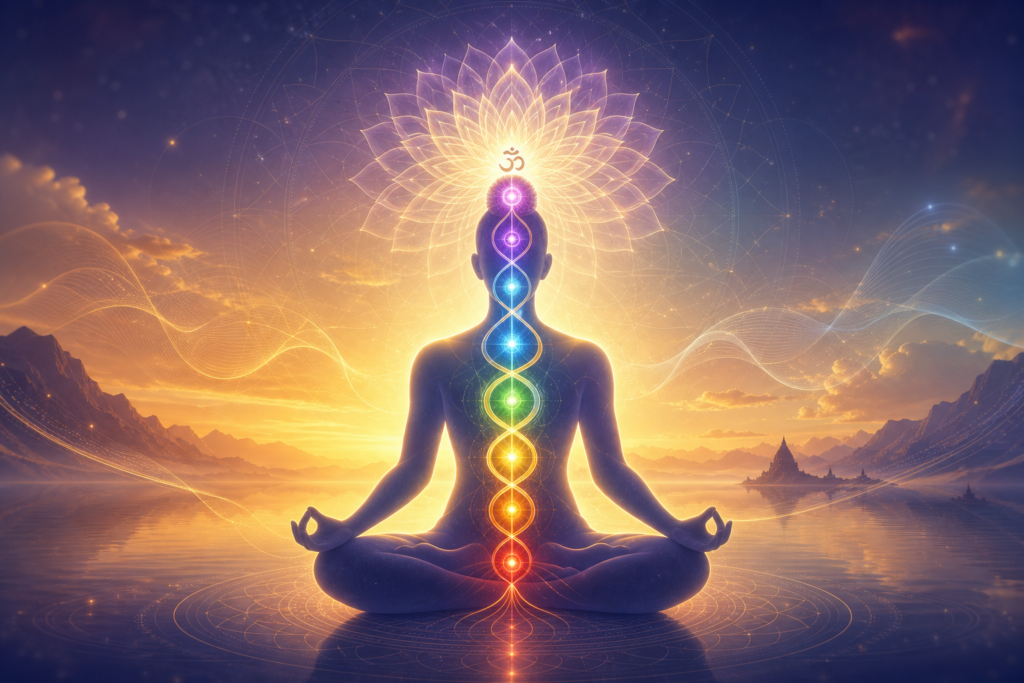
Spanda, one of the most profound ideas in Kashmir Shaivism, presents the universe not as a dead mechanism or a completed event, but as a living, conscious pulsation. In this view, creation is not merely something that occurred in a remote cosmic beginning. It is the continuous self-expression of Supreme Consciousness, unfolding here and now as awareness, movement, perception, thought, matter, breath, and spiritual awakening. The doctrine of Spanda therefore offers a technically rich and emotionally resonant understanding of existence: reality is alive because consciousness itself is alive.
The Sanskrit word spanda is often translated as vibration, pulsation, throb, tremor, or subtle movement. Yet none of these English words fully captures the metaphysical precision of the term. Spanda is not vibration in a merely physical sense, as though Kashmir Shaivism were reducing the universe to sound waves, particles, or mechanical oscillation. It refers instead to the innate dynamism of consciousness. It is the subtle stir by which awareness knows itself, manifests worlds, withdraws them, and remains unchanged in its essential nature.
Kashmir Shaivism, especially in its Trika and Pratyabhijna traditions, teaches that the ultimate reality is Śiva, not as a distant deity separate from the cosmos, but as boundless, self-luminous consciousness. This consciousness is not inert. It is inseparable from Śakti, its power of self-awareness, manifestation, concealment, and grace. Spanda is the living pulse of this Śiva-Śakti unity. It is the movement within stillness, the creative intensity within silence, and the first throb of awareness through which the universe becomes intelligible.
Creation as Continuous Unfolding
Many religious and philosophical traditions speak of creation as an origin story: a divine act, a cosmic explosion, or a metaphysical beginning. Kashmir Shaivism reframes the question. It does not deny origin, sequence, or manifestation, but it refuses to confine creation to the past. Creation is understood as a present-tense process. Every perception, every act of attention, every emergence of thought, every form in nature, and every movement of life participates in the same ongoing pulsation of consciousness.
This insight changes the emotional and philosophical texture of Hindu spirituality. The world is not merely a trap to be escaped, nor is it an illusion in the simplistic sense of being worthless or unreal. In Kashmir Shaivism, the universe is the expressive body of consciousness. It is real as manifestation, sacred as the play of Śakti, and meaningful as the field in which recognition of the Self becomes possible. The cosmos is not outside the divine; it is the divine appearing as multiplicity.
Spanda therefore avoids two common extremes. It does not reduce spirituality to world-denial, because the world is a living manifestation of awareness. It also does not reduce reality to materialism, because matter itself is understood as condensed consciousness, a contracted form of the same universal power. The doctrine preserves both transcendence and immanence: Śiva is beyond all forms, yet fully present as all forms.
The Textual Foundations of Spanda
The Spanda doctrine is closely associated with the Śiva Sūtras and the Spanda Kārikā, foundational texts of Kashmir Shaivism. Traditional accounts connect the revelation of the Śiva Sūtras with Vasugupta, while the Spanda Kārikā is often linked to Kallaṭa, his disciple, though scholarly discussions continue regarding authorship and textual history. Later masters such as Abhinavagupta and Kṣemarāja deepened the philosophical interpretation of these teachings and integrated them into the broader Shaiva vision of recognition, liberation, and embodied practice.
The technical importance of these texts lies in their attempt to describe the dynamic nature of consciousness without compromising its unity. If ultimate reality is one, how does multiplicity appear? If consciousness is complete, why does manifestation arise? If liberation is recognition of one’s true nature, what prevents that recognition? Spanda answers these questions by presenting consciousness as inherently free, self-reflective, and creative. The many do not arise from a lack in the One; they arise from the fullness of its freedom.
In this framework, bondage is not the creation of a second reality opposed to Śiva. It is a contraction of awareness. The individual self, or limited subject, experiences itself as separate because the universal power of consciousness freely assumes limitation. Liberation is not the manufacture of a new spiritual identity. It is the recognition that the same pulse appearing as limited experience is, in truth, the movement of universal consciousness.
Spanda Is Not Mere Physical Vibration
Modern readers sometimes interpret Spanda through the language of physics, energy, frequency, or vibration. Such comparisons can be suggestive, but they must be handled carefully. Kashmir Shaivism is not making a laboratory claim about measurable oscillations. It is making a metaphysical and experiential claim about consciousness. Spanda is subtler than physical vibration because it is the condition that allows physical vibration, sensory experience, mental movement, and conceptual understanding to appear at all.
A useful way to approach the distinction is to observe ordinary awareness. A thought appears, remains briefly, and dissolves. A sensation arises in the body. A sound is heard. A memory comes forward. Beneath these changes there is a continuity of knowing. That knowing is not passive emptiness. It has a capacity to reveal, respond, contract, expand, and recognize. Spanda names this living capacity of awareness, the subtle dynamism by which consciousness is never a blank void but a luminous power.
For this reason, the doctrine is highly practical. It does not ask a practitioner to believe in an abstract metaphysical system alone. It directs attention toward the immediate texture of experience. Between two thoughts, at the beginning of a breath, during a moment of wonder, in the instant before speech, or in the stillness after deep emotion, the pulse of awareness can be intuited. Kashmir Shaivism treats such moments not as accidents but as openings into the nature of reality.
Śiva, Śakti, and the Pulse of Awareness
The doctrine of Spanda cannot be separated from the relationship between Śiva and Śakti. Śiva represents pure consciousness, the luminous ground of being. Śakti represents the power of that consciousness to know, manifest, conceal, reveal, and liberate. These are not two independent principles. They are distinguishable for teaching purposes, yet inseparable in reality. Fire and its heat, the sun and its radiance, awareness and its self-knowing are traditional analogies that help express this unity.
Spanda is the sign of this inseparability. If Śiva were pure stillness without Śakti, manifestation could not occur. If Śakti were movement without Śiva, there would be no stable ground of awareness. Kashmir Shaivism holds both together. The supreme is still, yet dynamic; silent, yet expressive; formless, yet capable of appearing as every form. This is why the universe can be described as a living vibration without falling into either materialism or vague mysticism.
This vision also deepens the meaning of devotion. Worship of Lord Shiva is not only reverence for a deity located beyond the world. It is reverence for the conscious ground of one’s own existence. Devotion to Śakti is not only ritual homage to divine power. It is recognition of the sacred energy moving through thought, body, nature, speech, and community. The doctrine therefore joins metaphysics, yoga, meditation, mantra, ritual, and daily life into one integrated field of spiritual understanding.
Recognition Rather Than Escape
A central concern of Kashmir Shaivism is pratyabhijñā, recognition. Liberation occurs when the limited self recognizes its identity with universal consciousness. This recognition is not an egoic claim that the ordinary personality is supreme. Rather, it is the dissolution of the false assumption that awareness is confined to the body, mind, biography, or social identity. The individual comes to recognize that the deepest subject within experience is not separate from Śiva.
Spanda supports this recognition because it reveals continuity between the finite and the infinite. The same pulse that manifests galaxies also appears as the movement of attention. The same consciousness that shines as the cosmos also shines as the capacity to ask, doubt, love, grieve, meditate, and seek truth. This gives spiritual life a profound intimacy. The divine is not reached only by fleeing the human condition; it is recognized by penetrating the human condition with clarity.
Such a view can be emotionally powerful for modern seekers. Many experience life as fragmentation: work separated from worship, body separated from spirit, intellect separated from devotion, and personal struggle separated from metaphysical inquiry. Spanda offers a unifying lens. It suggests that every layer of experience, when rightly understood, can become a doorway into awareness. Even restlessness can become instructive when it is observed as movement within consciousness rather than as an enemy of spirituality.
The Human Body as a Field of Consciousness
Kashmir Shaivism gives significant importance to embodied experience. The body is not treated as a mere obstacle to liberation. It is a field where consciousness becomes tangible. Breath, sensation, mantra, posture, attention, and emotion can all become means of recognition when approached with disciplined awareness. This aligns the Spanda doctrine with broader yogic traditions that understand the human being as a layered reality, extending from gross embodiment to subtle energy and pure consciousness.
The experience of breath is especially relevant. Breathing naturally contains expansion and contraction, emergence and return, movement and stillness. While Spanda should not be reduced to breath, breath can serve as a contemplative symbol and practical entry point. In attentive breathing, the practitioner may notice that awareness is present before inhalation, during inhalation, during the pause, during exhalation, and after exhalation. The changing rhythm reveals an unchanging witness, yet that witness is not lifeless. It is vividly present.
Similarly, mantra practice can reveal the pulse of consciousness through sound. A mantra arises from silence, vibrates through speech or thought, and returns to silence. The practitioner who attends carefully may begin to recognize that sound and silence are not enemies. Silence is the womb of sound, and sound is silence in motion. This insight mirrors the Spanda vision of the universe as the expression of consciousness without separation from its source.
Spanda and the Experience of Time
The doctrine also reshapes the understanding of time. If creation is an ongoing pulsation, then the present moment is not a thin line between past and future. It is the living site of manifestation. Every moment contains emergence, maintenance, and dissolution. A perception arises, is sustained, and subsides. A relationship forms, changes, and transforms. A civilization grows, declines, and leaves impressions. These are not merely external events; they express the rhythm of manifestation itself.
This does not imply fatalism. On the contrary, Kashmir Shaivism emphasizes the freedom of consciousness. Human action, ethical responsibility, devotion, knowledge, and spiritual discipline matter because they participate in the unfolding of awareness. The present is powerful because it is where recognition can occur. The pulse of Spanda is not an excuse for passivity; it is a call to become more awake within action.
In daily life, this insight can change how ordinary experiences are interpreted. A moment of anger may reveal contracted energy. A moment of compassion may reveal expansion. A moment of beauty may suspend the usual boundaries of self. A moment of silence may disclose a depth that was present all along. Spanda encourages disciplined sensitivity to these transitions, not as sentimental moods, but as evidence that awareness is dynamic and recoverable even in the midst of complexity.
Relation to Other Dharmic Traditions
Although Spanda is a distinct doctrine of Kashmir Shaivism, its broader concerns resonate across Hinduism, Buddhism, Jainism, and Sikhism in ways that support unity among Dharmic traditions. These traditions do not teach identical metaphysics, and their differences should be respected rather than flattened. Yet they share a seriousness about consciousness, liberation, ethical discipline, inner transformation, and the limitations of ordinary ego-centered perception.
In Hindu traditions, Spanda finds kinship with teachings on Brahman, Ātman, Śakti, prāṇa, mantra, yoga, and the sacredness of the cosmos. In Buddhist traditions, especially contemplative lineages, one finds rigorous attention to momentariness, awareness, interdependence, and the transformation of suffering through insight. Jainism contributes a profound discipline of non-violence, karma theory, self-restraint, and purification of consciousness. Sikhism emphasizes remembrance of the Divine, ethical action, devotion, and the presence of the sacred in household life. These traditions differ in doctrine, but they converge in refusing to reduce human life to material consumption or social identity alone.
Spanda can therefore be presented not as a sectarian claim against other Dharmic paths, but as one luminous contribution within the larger family of Indian spiritual thought. Its language is Shaiva, its metaphysics is non-dual, and its methods are shaped by Kashmir Shaivism. Yet its invitation to perceive life as sacred, conscious, disciplined, and interconnected can enrich dialogue across Dharmic communities.
Why Spanda Matters in the Modern World
The modern world often trains the mind to perceive reality as fragmented. Knowledge is divided into specializations, work into tasks, identity into categories, and attention into restless digital impulses. In such a climate, the Spanda doctrine offers more than historical interest. It provides a sophisticated spiritual anthropology: the human being is not an isolated consumer of experiences, but a center of awareness capable of recognizing the universal pulse within particular life.
This has implications for mental clarity and inner balance. When thoughts are mistaken for the whole of the self, the mind becomes trapped in its own fluctuations. When thoughts are observed as movements within awareness, a new space opens. Spanda does not demand suppression of the mind. It invites recognition of the energy behind mental movement. This can support meditation, emotional maturity, and a more compassionate relationship with oneself and others.
The doctrine also has ecological implications. If the universe is a living expression of consciousness, nature cannot be viewed merely as raw material. Rivers, mountains, forests, animals, and the elements are not spiritually irrelevant objects. Hindu traditions have long preserved sacred geographies and ritual forms that cultivate reverence for the natural world. Spanda gives this reverence a metaphysical foundation: the world is worthy of care because it is not separate from the sacred field of manifestation.
Socially, Spanda can encourage humility. If the same consciousness pulses through diverse beings, then rigid egoism becomes philosophically weak and spiritually immature. Differences of practice, temperament, language, sect, and community need not be treated as threats. They can be understood as varied expressions of a deeper unity. This is especially important for preserving harmony within Sanatana Dharma and among wider Dharmic traditions, where unity does not require uniformity.
Spanda, Meditation, and Direct Experience
The study of Spanda becomes meaningful only when joined to practice. Intellectual understanding can clarify the doctrine, but recognition requires a transformation of attention. Meditation in this context is not merely relaxation. It is a disciplined return to the source of experience. The practitioner learns to observe the arising and subsiding of thoughts, the rhythm of breath, the movement of emotion, and the silent luminosity in which all of these appear.
One practical insight associated with this tradition is that the doorway to recognition may appear in subtle transitions. The instant between two thoughts, the pause between breaths, the moment of astonishment before naming an experience, or the quiet after mantra can reveal the background of awareness. These moments are often overlooked because ordinary attention rushes toward objects. Spanda practice refines attention so that the subject, the power of knowing itself, becomes evident.
This is why Kashmir Shaivism is sometimes described as both philosophical and experiential. It offers rigorous categories, but it also values direct realization. Its aim is not the accumulation of concepts about consciousness. Its aim is recognition of consciousness as one’s own deepest reality. The doctrine of Spanda serves this aim by showing that every movement of life can point back to the unmoving ground that makes movement possible.
The Sacredness of Ordinary Life
One of the most attractive features of Spanda is its ability to restore dignity to ordinary life. The sacred is not confined to temples, scriptures, rituals, or rare mystical states, though all of these remain important. The sacred is also present in perception, conversation, work, memory, grief, courage, study, family responsibility, and ethical action. When understood through Spanda, ordinary life becomes a field of possible recognition.
This does not mean that every impulse should be indulged or that all actions are spiritually equal. Kashmir Shaivism is not a license for carelessness. The recognition of consciousness must be accompanied by refinement, discipline, and responsibility. Anger, desire, fear, and attachment are not denied, but they must be understood and transformed. The pulse of awareness is present even in contracted states, yet liberation requires recognizing that contraction and returning to the fullness of consciousness.
Such a view can be deeply healing. Many spiritual seekers assume that their restlessness disqualifies them from inner life. Spanda suggests a more nuanced approach. Restlessness is not the final truth of the self; it is a movement appearing within awareness. The task is neither self-condemnation nor indulgence, but recognition. This gives the doctrine practical relevance for people navigating stress, uncertainty, and the search for meaning in contemporary life.
Philosophical Precision and Devotional Warmth
The enduring power of the Spanda doctrine lies in its union of philosophical precision and devotional warmth. It is intellectually demanding because it asks how unity and multiplicity, stillness and motion, transcendence and immanence can be understood without contradiction. It is spiritually moving because it answers that the universe is not abandoned by the divine. Every moment trembles with the presence of consciousness.
This insight helps explain why Kashmir Shaivism continues to attract scholars, practitioners, yogis, and contemplative readers. It speaks to the intellect without starving the heart. It honors scripture without dismissing direct experience. It values the body without reducing the self to biology. It affirms the world without forgetting liberation. In an age of spiritual confusion, such integration is rare and valuable.
Spanda finally teaches that awareness is not a static witness watching a meaningless world. Awareness is luminous, free, creative, and intimate. The universe is not merely filled with things; it is alive with the pulse of consciousness. To understand this doctrine is to see creation not as a closed chapter in cosmic history, but as the living rhythm of existence itself. In that recognition, the seeker discovers that the first throb of awareness was never only at the beginning of time. It is present now, quietly vibrating at the heart of every experience.
Inspired by this post on Hindu Blog.







Leave a Reply
You must be logged in to post a comment.