
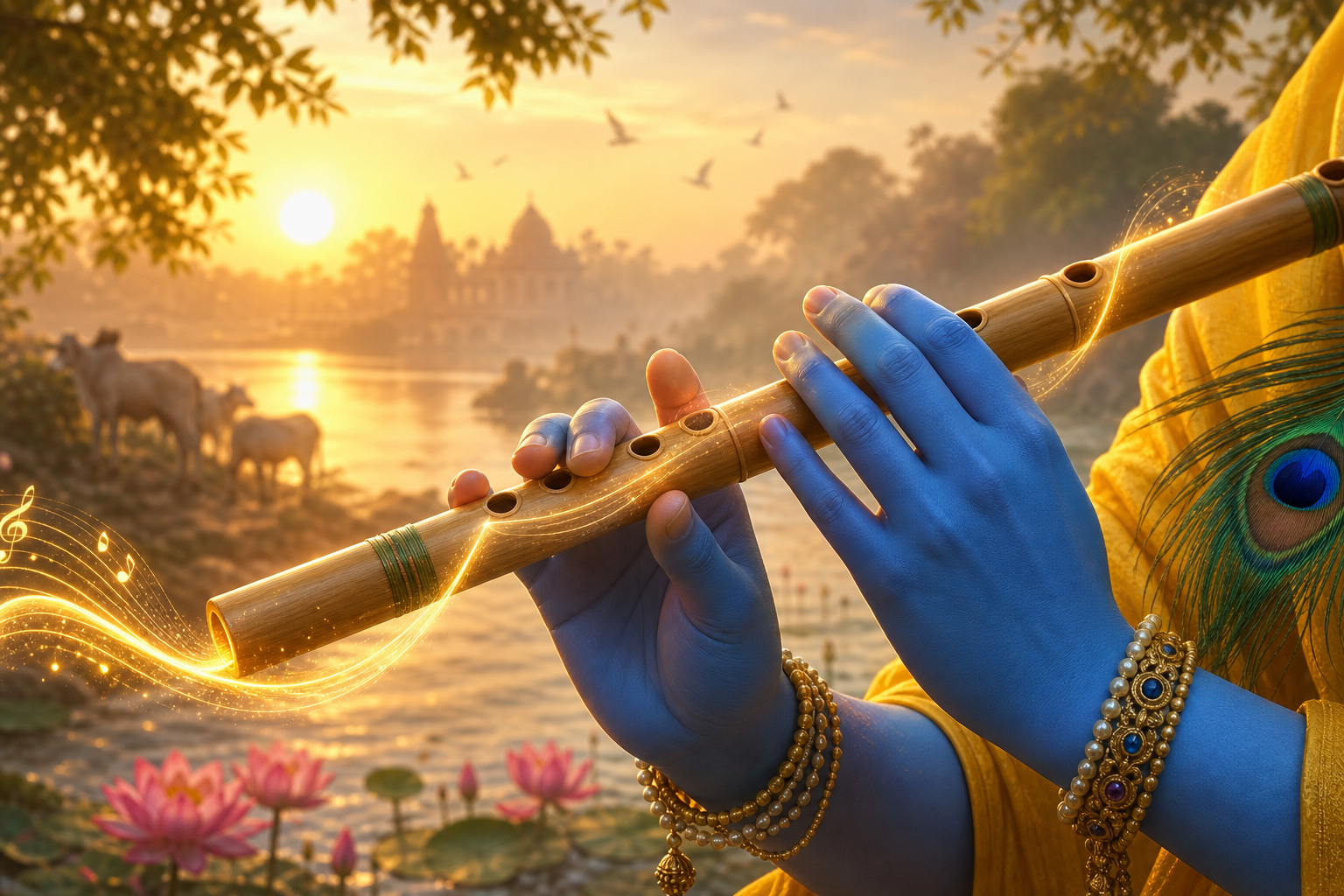
The image of Lord Krishna holding a bamboo flute remains one of the most tender and philosophically rich symbols in Hindu spirituality. It is not merely an artistic detail in devotional painting, temple sculpture, kirtan, or sacred storytelling. It represents the possibility that an ordinary life, when purified of ego and aligned with dharma, can become an instrument through which beauty, compassion, and divine wisdom flow into the world.
In the Krishna tradition, the flute is associated with the enchanting presence of Sri Krishna in Vrindavan, where the sound of the bansuri draws the hearts of the gopas, gopis, cows, birds, trees, and rivers toward the Divine. The symbol is powerful because the flute does not create music by itself. It becomes musical only when it is empty enough to receive breath, shaped enough to hold discipline, and surrendered enough to allow the musician’s intention to pass through it without resistance.
This symbolism offers a profound model for spiritual life. The human personality often seeks control, recognition, and certainty. Yet the flute teaches a different discipline: humility, receptivity, inner cleanliness, and alignment. A bamboo reed becomes a flute only after it is cut, dried, hollowed, pierced, and tuned. In the same way, a seeker becomes spiritually mature not by escaping life’s pressures, but by allowing experience, self-reflection, devotion, and ethical practice to refine the inner instrument.
Technically, a bamboo flute produces sound when breath is directed across an opening, setting the air column inside the hollow tube into vibration. The holes regulate pitch by changing the effective length of the vibrating air column. This physical fact becomes a precise spiritual metaphor. Breath may be compared to prana, grace, or divine movement; the hollow chamber to inner emptiness; the finger holes to disciplined openings created by sadhana; and the resulting melody to a life expressed through dharma, bhakti, and service.
To become like bamboo in the hands of Krishna is therefore not a call to passivity. It is a call to conscious surrender. In the Bhagavad Gita, surrender is not presented as helpless resignation, but as intelligent alignment with the Divine while continuing to act responsibly in the world. Krishna’s teaching to Arjuna integrates devotion, knowledge, disciplined action, and clarity of duty. The flute metaphor expresses the same principle in a softer devotional language: one acts, but without egoistic ownership over the music.
The bamboo flute also represents purity. Bamboo is simple, natural, and unadorned. Its greatness lies not in ornamentation but in readiness. A flute blocked by dust cannot sing clearly; a life blocked by pride, resentment, fear, or restless desire cannot easily transmit peace. This does not mean that spiritual seekers must become emotionless or detached from human tenderness. Rather, it suggests that emotions must be refined so that love becomes less possessive, service becomes less performative, and devotion becomes less dependent on external reward.
There is also an important psychological insight in this symbol. Many people carry the burden of needing to prove themselves, defend every opinion, and secure every outcome. The flute proposes another way of being: to become available to a larger intelligence. Such availability is not anti-intellectual. It requires discernment, self-observation, and moral steadiness. The ego is not destroyed through contempt for the self; it is educated until it no longer insists on occupying the center of every action.
In bhakti, the most refined offering is not merely a ritual object, a song, or a formal prayer, but the self made transparent. The devotee asks not only for blessings from Krishna but for the capacity to become useful to Krishna’s purpose. This is why the flute is such a moving symbol. It has no separate agenda, no claim over the melody, and no anxiety about applause. Its fulfillment lies in being held, breathed through, and transformed into music.
The same principle can be understood across dharmic traditions in a spirit of unity. Hindu bhakti speaks of surrender to Bhagavan; Buddhist practice emphasizes the loosening of ego-clinging and the cultivation of awakened awareness; Jain dharma honors aparigraha, restraint, and purification of the soul; Sikh teachings emphasize hukam, seva, humility, and remembrance of the Divine Name. Each tradition has its own theology, vocabulary, and practice, yet all recognize that spiritual growth requires reducing self-centeredness and increasing compassion, discipline, and truthfulness.
For this reason, the flute of Krishna should not be reduced to sentimental imagery. It can be read as a disciplined map of inner transformation. The cutting of bamboo may symbolize the removal of false identities. The hollowing may symbolize freedom from arrogance and possessiveness. The holes may symbolize wounds transformed into openings for wisdom. The tuning may symbolize the guidance of guru, scripture, community, and honest self-examination. The music may symbolize a life that brings harmony rather than disturbance into the world.
In daily life, becoming Krishna’s flute begins with small but concrete practices. Speech can become more truthful and less harmful. Work can become more service-oriented and less ego-driven. Relationships can become more patient and less transactional. Prayer can become less about demanding outcomes and more about refining intention. Meditation, japa, kirtan, svadhyaya, seva, and ethical restraint all help clear the inner passage through which grace may operate.
The metaphor is especially relevant in a noisy age. Modern life often rewards visibility, speed, reaction, and self-display. The flute teaches silence before sound. It reminds the seeker that meaningful expression comes from inner stillness, not from constant assertion. Before the melody appears, there must be emptiness; before the song becomes beautiful, there must be tuning; before life becomes service, there must be surrender.
Krishna’s flute also carries the theme of divine attraction. In devotional literature, the sound of the flute does not coerce; it calls. It awakens memory in the soul. It invites rather than threatens. This is a crucial distinction for spiritual culture. The highest form of dharma does not rely on force, contempt, or rivalry. It draws beings toward truth through beauty, compassion, wisdom, and lived example.
To live as a flute in Krishna’s hands is therefore to cultivate both inward surrender and outward responsibility. A person shaped by this ideal does not withdraw from the world in indifference. Such a person becomes more attentive to suffering, more careful with words, more disciplined in conduct, and more committed to harmony among communities. Devotion becomes visible as character.
The lesson of the bamboo flute is ultimately simple but demanding: emptiness must become sacred, discipline must become graceful, and surrender must become active love. When the human heart is cleared of needless hardness and offered to the Divine with sincerity, even an ordinary life can carry extraordinary music. In that sense, becoming bamboo in the hands of Krishna is not an escape from life; it is a way of allowing life itself to become a vehicle of divine beauty, dharma, and peace.
Inspired by this post on Hindu Blog.





Leave a Reply
You must be logged in to post a comment.