
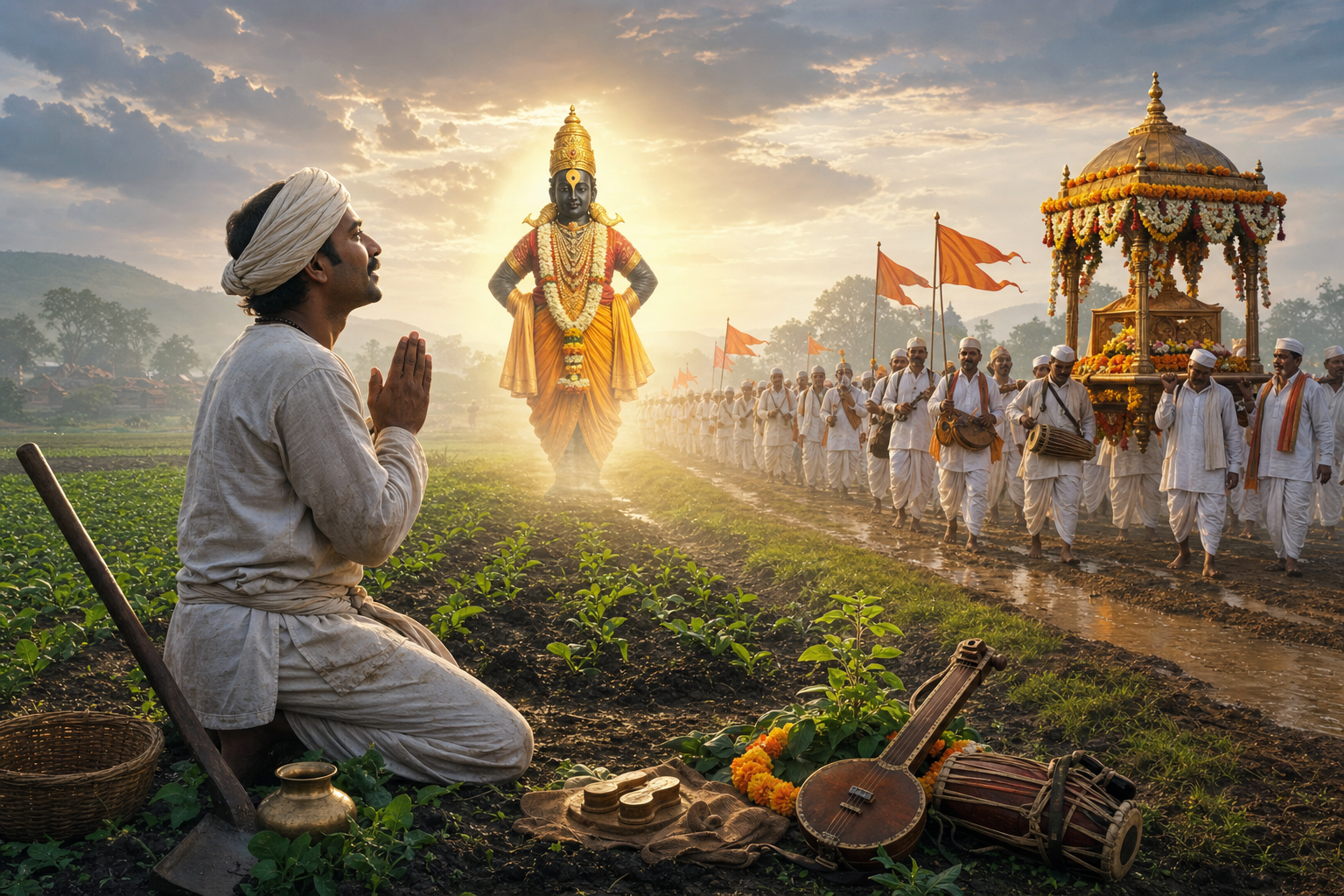
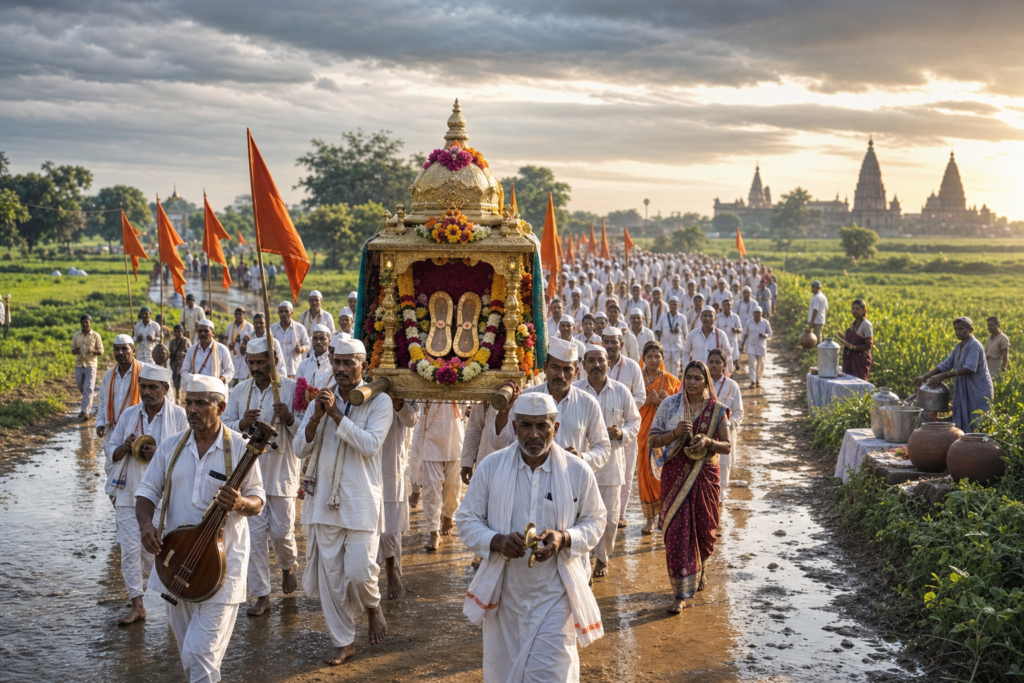
Sant Savata Mali Palkhi Sohala 2026 occupies a distinctive place within the wider Ashadhi Wari of Maharashtra. In most Wari traditions, the movement is directed toward Pandharpur, where devotees walk with the paduka or symbolic presence of revered saints to seek darshan of Lord Vithoba, also lovingly called Vitthal or Panduranga. The Sant Savata Mali tradition is remembered differently: it preserves the devotional memory that when the saint could not go to Pandharpur, Vitthal came to him. This reversal gives the Palkhi its emotional force and its theological depth.
In 2026, the Ashadhi Wari cycle falls in July, with Devshayani Ekadashi, also known as Ashadhi Ekadashi, observed on 25 July 2026 according to widely published Hindu calendar listings. The major Sant Tukaram Maharaj Palkhi is expected to leave Dehu on 7 July 2026, while the Sant Dnyaneshwar Maharaj Palkhi is expected to leave Alandi on 8 July 2026. The Sant Savata Mali Palkhi Sohala should be understood within this same sacred season, while devotees planning travel to Aran, Pandharpur, or nearby villages should verify the local 2026 schedule with temple authorities and district administration before finalizing arrangements.
Sant Savata Mali, remembered in Marathi tradition as संत सावता माळी, was a Varkari saint associated with Aran near Modnimb in present-day Solapur district of Maharashtra. He is placed by tradition in the thirteenth century and is remembered as a contemporary of major Bhakti figures such as Sant Namdev. His identity as a Mali, a gardener or cultivator community, is not incidental to his spiritual meaning. His life communicates a central Varkari insight: devotion is not confined to temple halls, monastic institutions, or scholarly status; it can flower in the field, in labor, in family life, and in the disciplined humility of ordinary work.
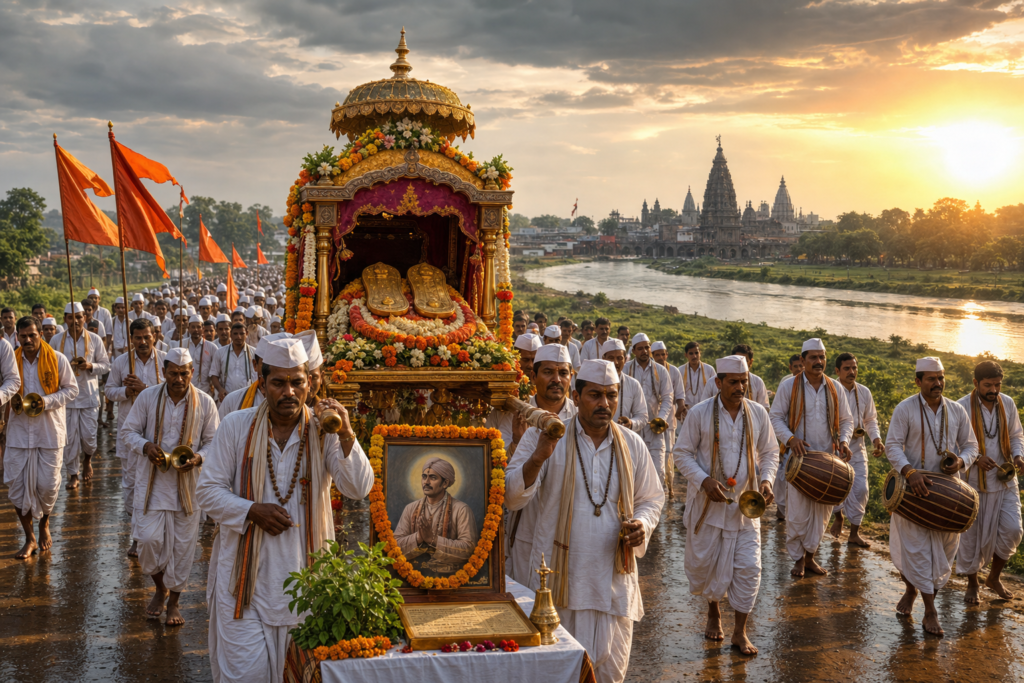
The usual structure of the Pandharpur Wari is outwardly simple but culturally immense. Warkaris walk in dindis, sing abhangas, carry tulsi malas, chant the names of Vitthal, and join processions that converge on Pandharpur before Ashadhi Ekadashi. The paduka of saints such as Sant Dnyaneshwar Maharaj and Sant Tukaram Maharaj are carried with ceremony, discipline, and collective care. The path itself becomes a moving institution of bhakti, social equality, service, endurance, music, memory, and shared cultural belonging.
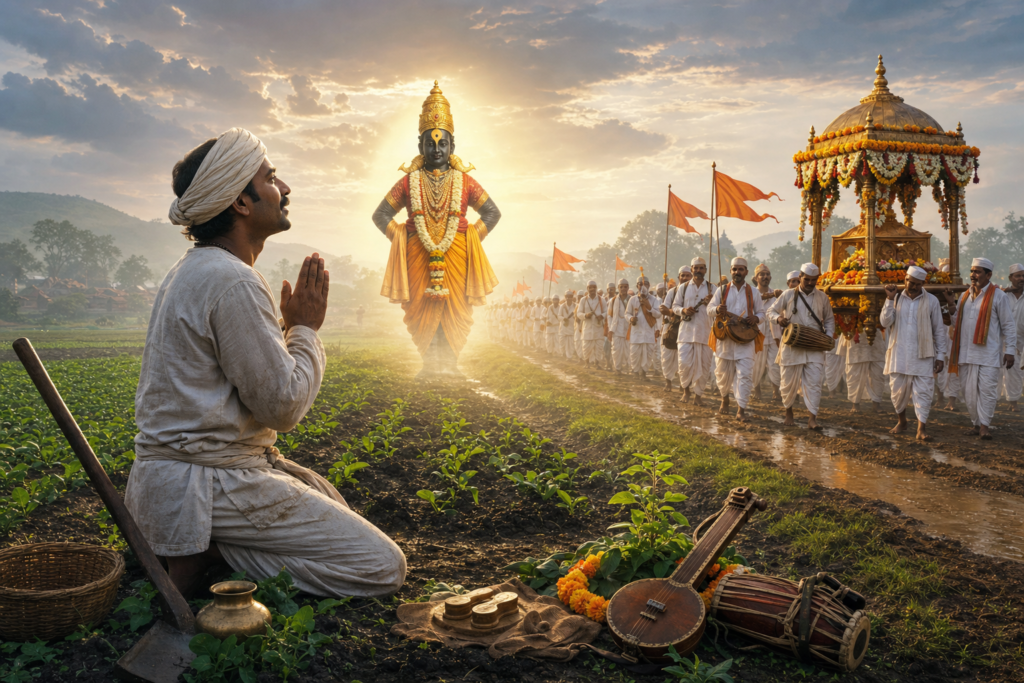
Against that familiar pattern, the Sant Savata Mali Palkhi appears remarkable. The core devotional memory says that Sant Savata Mali was so immersed in his farming and remembrance of Vithoba that he could not leave his field for Pandharpur. Rather than treating this as spiritual failure, the tradition interprets it as the perfection of inward devotion. Vitthal, moved by the saint’s sincerity, is believed to have come to him. In this telling, the saint does not abandon duty to search for God; God reveals that sincere duty, performed with bhakti, is already a path toward the divine.
This is the reason the Sant Savata Mali Palkhi is often described as a reverse movement within the Wari imagination. Its significance is not merely geographical. It expresses a profound theological claim: the divine is not distant from the devotee who is rooted in honest labor, humility, and remembrance. In the Varkari worldview, Vitthal is not an inaccessible deity locked behind ritual privilege; Vitthal is a compassionate presence who stands with the devotee, listens to the abhangas of the heart, and dignifies work as worship.
The Palkhi tradition also demonstrates why Maharashtra’s Bhakti movement remains so enduring. The saints of the Varkari sampradaya did not speak only to elites. They spoke to farmers, artisans, women, householders, laborers, and communities whose lives were shaped by seasonal work and social limitations. Sant Savata Mali’s memory gives sacred vocabulary to the worker whose hands are in soil, the family that cannot always travel, and the devotee who wonders whether daily responsibility can coexist with spiritual longing.
For many devotees, this is the emotional center of the Sant Savata Mali Palkhi Sohala. The story does not glorify escape from life; it sanctifies life when lived with remembrance. A field can become a shrine. A tool can become an offering. A day of labor can become a form of japa when the mind remains anchored in Vitthal. This insight has made Sant Savata Mali especially meaningful for communities connected to agriculture, rural life, and the ethics of selfless service.
The association of Sant Savata Mali with agriculture also expands the meaning of bhakti beyond emotion alone. Farming requires patience, discipline, uncertainty, and trust in cycles larger than the individual. Seeds are planted long before results are visible. Rain may come late. Labor may be unrecognized. Yet the cultivator continues. In a similar way, the Varkari path teaches perseverance in nama-smarana, humility in community, and steadiness in dharma. The Sant Savata Mali Palkhi therefore becomes a cultural commentary on work, ecology, faith, and moral resilience.
The Palkhi also carries an important social message. The Varkari tradition has long emphasized participation across caste and economic divisions, even while historical society did not always live up to the full implications of that ideal. Saints such as Sant Chokhamela, Sant Janabai, Sant Namdev, Sant Tukaram, Sant Dnyaneshwar, and Sant Savata Mali are remembered not as isolated figures but as voices within a broad devotional civilization. Their lives show that spiritual authority in bhakti is measured by devotion, compassion, and realization rather than by birth, wealth, or status.
This inclusive dimension is especially relevant for a blog committed to unity among dharmic traditions. The Sant Savata Mali Palkhi can be read as a Hindu devotional tradition, but its underlying values resonate widely across Hinduism, Buddhism, Jainism, and Sikhism: humility, service, remembrance, ethical labor, compassion, community, and reverence for realized beings. Dharmic traditions differ in theology and practice, yet they often converge on disciplined conduct, inner transformation, and the refusal to separate spirituality from daily life.
The Wari itself is a living example of collective discipline. Dindis move in organized formations. Food, rest, medical care, sanitation, music, and devotional programs require careful coordination. Local communities offer water, shelter, and seva to pilgrims. Administrative bodies manage crowd movement, traffic, public health, and security. The spiritual atmosphere may feel spontaneous to an observer, but its continuity depends on inherited systems of cooperation. The Sant Savata Mali Palkhi Sohala participates in this larger culture of disciplined devotion.
Ashadhi Ekadashi gives the entire season its liturgical focus. The day is associated with Lord Vishnu entering the period of cosmic rest known as Chaturmas. In Pandharpur, this Vaishnava observance takes on a deeply regional and emotional form through devotion to Vithoba and Rakhumai. Pilgrims bathe in the Chandrabhaga, sing abhangas, and seek darshan after days of walking. The Sant Savata Mali tradition enriches this spiritual geography by reminding devotees that while pilgrimage to Pandharpur is sacred, the grace of Vitthal is not limited by distance.
That reminder matters in modern life. Not every devotee can walk the Wari. Age, health, finances, employment, caregiving duties, and distance may prevent participation. The story of Sant Savata Mali offers a gentle correction to religious anxiety. It suggests that the sincerity of remembrance is not inferior to physical mobility. The one who walks to Pandharpur and the one who chants while fulfilling duty at home can both belong to the field of bhakti, provided the heart remains humble and truthful.
At the same time, the Palkhi should not be reduced to a metaphor alone. It is also a public cultural event rooted in place, memory, and community practice. Aran and the surrounding region preserve the saint’s association with lived geography. Devotees do not merely recall an abstract moral lesson; they gather in spaces where the story has been sung, inherited, and embodied for generations. This local continuity gives the Sant Savata Mali Palkhi its authenticity within Maharashtra’s religious culture.
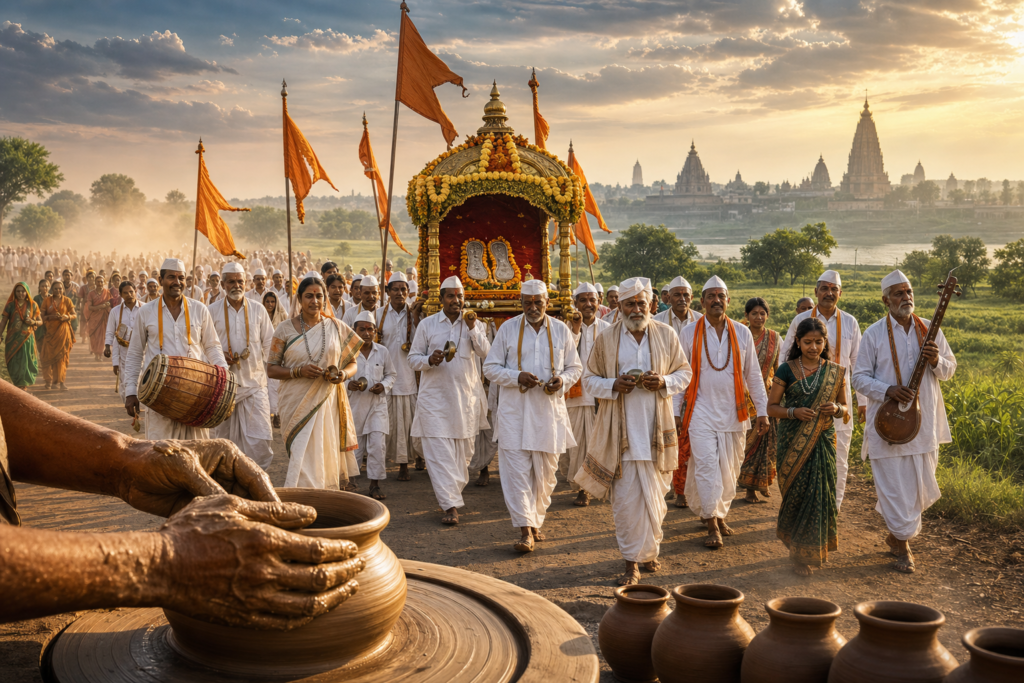
The term Palkhi itself deserves attention. In the Wari context, a palanquin is not simply a vehicle. It carries sacred presence, lineage memory, and communal devotion. The Palkhi makes the saint present among the people, and the people, by walking with it, enter a relationship with the saint’s teaching. In the case of Sant Savata Mali, that teaching centers on the dignity of labor, the nearness of Vitthal, and the possibility that devotion may ripen in the most ordinary settings.
Sant Savata Mali’s devotional poetry and memory belong to the larger tradition of abhangas, the Marathi devotional compositions that gave the Varkari movement its voice. Abhangas are not only poems; they are sung theology. They compress philosophy into phrases that ordinary people can carry while walking, working, cooking, farming, or resting. Through this musical culture, the Varkari tradition preserved spiritual knowledge outside formal scholastic boundaries while still sustaining a rigorous moral and philosophical worldview.
The 2026 Sant Savata Mali Palkhi Sohala will therefore be meaningful not only as a date on the religious calendar but as an opportunity to revisit the ethical grammar of the Wari. Devotees and observers can look beyond spectacle and ask what the tradition teaches: How is work made sacred? How does a community honor saints without turning devotion into social pride? How can pilgrimage strengthen humility rather than competition? How can inherited ritual remain alive for younger generations without losing its discipline?
These questions are not academic in a narrow sense. They arise naturally wherever living traditions meet modern pressures. Rural communities face migration, economic uncertainty, ecological stress, and changing family patterns. Urban devotees often experience distance from ancestral practices. Youth may know the names of saints but not the depth of their teachings. The Sant Savata Mali Palkhi offers a bridge between inherited memory and present responsibility because it presents devotion through work, not withdrawal from the world.
The environmental dimension of Sant Savata Mali’s memory is also worth noting. A saint associated with cultivation invites reflection on soil, water, food, and gratitude. Dharmic traditions have often treated the natural world not as inert material but as a field of relationship and responsibility. In this sense, honoring Sant Savata Mali can also mean honoring the farmer, the seed, the land, the rain, and the ethical obligation to live with restraint. The Palkhi’s bhakti becomes richer when connected to care for the earth that sustained the saint’s own life of devotion.
For visitors planning to participate in 2026, practical awareness is essential. Ashadhi Wari gatherings can involve large crowds, long walks, limited accommodation, changing traffic routes, monsoon weather, and administrative restrictions around Pandharpur and nearby pilgrimage routes. Elderly devotees, children, and those with medical needs should plan conservatively. Local temple committees, official district announcements, and transport advisories should be checked close to the travel date, because Palkhi timings and public arrangements may change according to crowd management and weather conditions.
Participation should also preserve the spirit of the tradition. The Wari is not a tourist performance. It is a disciplined devotional movement shaped by nama-smarana, seva, simplicity, and respect for fellow pilgrims. Cleanliness, restraint, cooperation with volunteers, and sensitivity toward local residents are part of the ethical practice. Carrying the memory of Sant Savata Mali means honoring the quiet dignity of service as much as the visible excitement of procession.
The deeper power of Sant Savata Mali Palkhi 2026 lies in its reversal of expectation. People often imagine pilgrimage as the devotee’s journey toward God. This tradition preserves another possibility: the divine also journeys toward the devotee whose heart is steady, whose labor is honest, and whose remembrance is sincere. Within the vast sacred movement of Ashadhi Wari, this message remains both tender and radical. Vitthal is approached through walking feet, singing voices, serving hands, and, in Sant Savata Mali’s case, through soil-stained labor transformed by love.
In that sense, the Sant Savata Mali Palkhi Sohala is not merely a regional observance. It is a luminous statement of Varkari philosophy and Hindu cultural heritage. It teaches that bhakti is not measured by distance traveled but by the depth of surrender. It shows that the sacred can enter the workplace, the farm, the household, and the village. It also reminds the wider dharmic family that unity is strengthened when traditions honor humility, service, and devotion wherever they appear.
Inspired by this post on Hindu Pad.






Leave a Reply
You must be logged in to post a comment.