
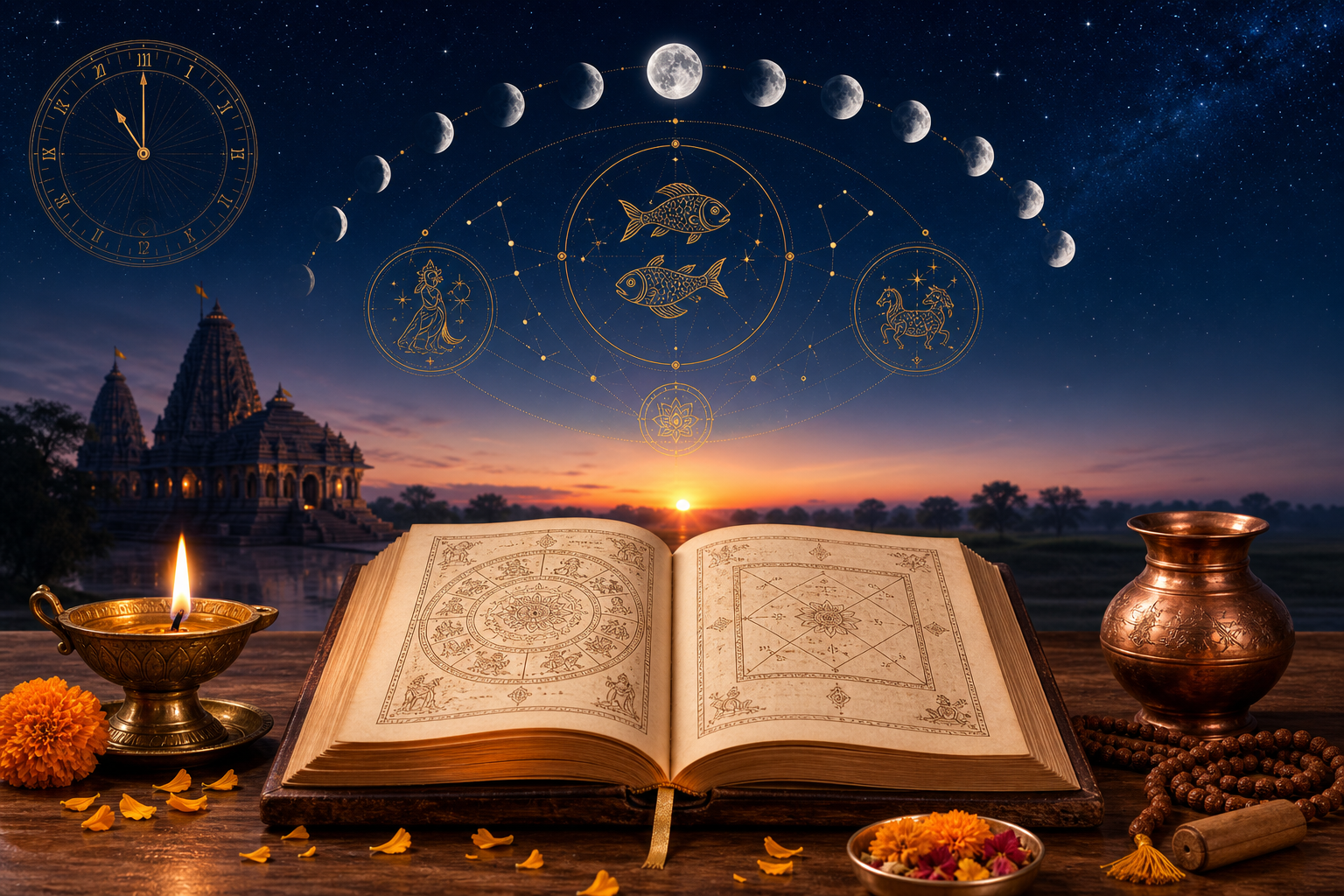
Tuesday, July 7, 2026, falls under Krishna Paksha in the Hindu calendar, making it a day shaped by the waning movement of the Moon. The supplied Panchang entry records Krishna Paksha Saptami tithi, the seventh lunar day of the dark fortnight, until 8:34 AM, after which Krishna Paksha Ashtami begins. This makes the day useful not merely as a date marker, but as a precise spiritual and cultural reference point for vrata planning, puja timing, travel decisions, and daily discipline.
In Panchang usage, the date should always be read with an important technical caution: tithi, nakshatra, yoga, karana, sunrise, sunset, Rahu Kaal, and other muhurta values are location-sensitive. A tithi is not tied to the civil midnight-to-midnight day; it is based on the angular distance between the Sun and the Moon. Therefore, the same July 7, 2026 civil date can show slightly different ending times in different cities, and serious ritual observance should be confirmed with the local Panchang followed by the family, temple, or sampradaya.
The core tithi for the day is Krishna Paksha Saptami. In the traditional lunar count, Saptami is the seventh tithi, and in Krishna Paksha it occurs after the full moon as lunar brightness gradually decreases. The passage from Saptami to Ashtami on this date marks a subtle shift in the quality of the day: Saptami retains a measured, reflective character, while Ashtami is often treated with greater ritual intensity in many Hindu traditions.
Technically, each tithi represents a 12-degree change in the longitudinal distance between the Sun and the Moon. When the Moon has moved through the appropriate seventh segment of the waning half, Krishna Paksha Saptami is in operation; once that segment is complete, Krishna Paksha Ashtami begins. This astronomical foundation is one reason the Hindu calendar remains both devotional and mathematically sophisticated. It connects household observance with celestial motion rather than reducing sacred time to a fixed printed date.
For many observant households, this distinction matters in a practical way. A morning puja, a sankalpa, a vrata rule, or an ancestral remembrance may be aligned with the tithi prevailing at the time of performance. If a family follows the entry that places Saptami until 8:34 AM, then Saptami-related observances should be completed before that time, while Ashtami-related practices are considered only afterward. Where a local Panchang gives a different ending time, that local calculation should prevail.
Krishna Paksha, the waning fortnight, has a distinctive place in Hindu timekeeping. It is not treated as negative simply because the Moon is decreasing in visible form. Rather, it often supports inwardness, restraint, study, mantra japa, ancestral reflection, and quiet correction of habits. The emotional rhythm is familiar: after a period of fullness, public activity, and outward expression, there is a natural turn toward review, simplification, and inner steadiness.
Saptami itself is widely associated in Hindu tradition with order, vitality, and disciplined movement. Although Shukla Paksha Saptami is especially prominent in several solar observances, Krishna Paksha Saptami can still be approached as a day for measured worship, routine purification, scriptural reading, and health-conscious discipline. Its value lies in proportion: it encourages action without agitation and devotion without excessive display.
After the Saptami portion ends, Krishna Paksha Ashtami begins. Ashtami is a stronger tithi in ritual culture and is frequently associated with deeper forms of worship, tapas, and protective devotions. Some regional Panchangs may mark related observances such as Kalashtami or monthly Krishna Ashtami depending on local rules, sunrise conditions, and the specific tradition being followed. This is why the transition time is not a minor detail; it determines how the day is interpreted.
Nakshatra and Rashi add another layer to the July 7, 2026 Panchang. A location-specific New Delhi calculation lists the Moon in Meena Rashi, with Uttara Bhadrapada Nakshatra continuing into the afternoon and Revati Nakshatra following afterward. This is a useful interpretive frame because both nakshatra and rashi describe the lunar field of the day, influencing how many families select timings for worship, study, travel, naming, and other routine decisions.
Uttara Bhadrapada is traditionally associated with depth, restraint, steadiness, and the capacity to remain composed beneath the surface of events. When this nakshatra is active, the day may be treated as suitable for contemplative work, spiritual study, disciplined planning, and duties requiring patience. It has a serious tone, but not a harsh one; it supports the kind of inner organization that often becomes visible only over time.
Revati, which follows Uttara Bhadrapada, is the final nakshatra of the lunar zodiac. It is often connected with nourishment, safe completion, travel, protection, and gentle transitions. If the Moon moves from Uttara Bhadrapada into Revati during the day in the local Panchang, the emotional and ritual reading changes from depth and steadiness toward completion, care, and closure. Such shifts are one reason daily Panchang study remains more nuanced than a simple good-day or bad-day label.
Meena Rashi, the Moon sign indicated in many calculations for this date, reinforces a contemplative and devotional tone. Meena is linked with sensitivity, surrender, imagination, compassion, and spiritual absorption. In daily life, this can be read as encouragement to handle duties with softness rather than force, especially in family conversations, temple service, and personal sadhana.
The weekday is Tuesday, known traditionally as Mangalawara. Tuesday is associated with Mangala, discipline, courage, strength, and decisive action. When Tuesday combines with Krishna Paksha Saptami and then Ashtami, the day can be approached with a balance of restraint and resolve. It is suitable for clearing delayed duties, renewing personal discipline, and approaching conflict with steadiness rather than impulsiveness.
Good time, or shubh muhurat, should be understood carefully. A general daily Panchang may identify broad auspicious intervals such as Brahma Muhurta, Abhijit Muhurta, Amrit Kalam, Vijaya Muhurta, or Sarvartha Siddhi Yoga, but these are not automatically interchangeable. The appropriate timing depends on the activity: worship, study, travel, business, vrata, marriage-related work, medical treatment, and house ceremonies each require different filters in traditional muhurta practice.
For ordinary spiritual discipline on July 7, 2026, the early morning remains especially meaningful. Brahma Muhurta and the period before sunrise are traditionally valued for japa, meditation, svadhyaya, and quiet prayer because the mind is usually less scattered. If Saptami is ending in the morning according to the followed Panchang, this pre-transition period becomes particularly important for those who wish to honor the Saptami tithi itself.
Abhijit Muhurta, when available and not otherwise restricted by local rules, is often treated as a resilient midday window for necessary work. It is not a replacement for specialized muhurta selection, but it is respected in many Panchang traditions as a generally supportive interval. Readers should still check the local calendar because sunrise, sunset, and the duration of the day directly affect these calculations.
Rahu Kaal, Yamaganda, Gulika Kalam, Dur Muhurtam, and Varjyam are commonly avoided for new beginnings in many Hindu households. These periods are not meant to create fear; they function as a traditional discipline of timing. The deeper principle is attentiveness. Instead of treating all hours as identical, the Panchang trains the mind to act with awareness, sequence, and respect for inherited wisdom.
Regional calendar systems can describe the same day differently. In the Purnimanta system used widely in North India, this period falls in Ashadha Krishna Paksha. In the Amanta system followed in many other regions, the lunar month naming may differ. This variation is not a contradiction; it reflects the rich diversity of Hindu calendrical traditions across India while preserving the same underlying lunar logic.
The Panchang also carries cultural value beyond technical astrology. It teaches that time is relational: the day is connected to the Sun, Moon, nakshatra, season, weekday, and local horizon. This worldview has helped Hindu communities preserve ritual continuity through temples, family traditions, festivals, vrata observances, and regional customs. It also offers a shared framework of sacred time that can be appreciated across Dharmic traditions with respect for their distinct calendars and practices.
Jain, Buddhist, Sikh, and Hindu communities do not use the Panchang in identical ways, yet many Dharmic traditions share a sensitivity to lunar phases, disciplined observance, sacred remembrance, and community rhythm. A day such as July 7, 2026, therefore becomes more than a technical listing. It becomes an invitation to recognize how calendars shape ethical life, family memory, and spiritual continuity without erasing regional or sectarian diversity.
From a practical standpoint, the most useful way to approach this day is to separate routine activity from ritual activity. Ordinary work, study, household duties, and service can continue with mindfulness. For specific pujas, vratas, temple visits, or sankalpas, the relevant tithi and nakshatra should be checked at the time of performance. The transition from Saptami to Ashtami is the key point to note.
For readers following the supplied timing, the concise daily summary is as follows: July 7, 2026, Tuesday, begins with Krishna Paksha Saptami tithi, which continues until 8:34 AM, followed by Krishna Paksha Ashtami. The day belongs to the waning phase of the Moon and should be read through the local Panchang for exact nakshatra, rashi, Rahu Kaal, sunrise, sunset, and shubh muhurat details.
A location-specific comparison for New Delhi can be checked through Drik Panchang at https://www.drikpanchang.com/panchang/day-panchang.html?date=07/07/2026, which illustrates why Panchang values are best verified by place. Such references are useful for cross-checking, but the final authority for observance should remain the local temple, family tradition, or trusted regional almanac.
In academic terms, July 7, 2026 demonstrates the layered intelligence of the Hindu calendar: astronomy provides the structure, ritual tradition provides the meaning, and lived practice gives the day its emotional depth. Krishna Paksha Saptami moving into Ashtami is not merely a change of label. It is a reminder that sacred time is dynamic, and that discipline, devotion, and clarity can be renewed even in the ordinary flow of a weekday.
Inspired by this post on Hindu Blog.


Leave a Reply
You must be logged in to post a comment.