
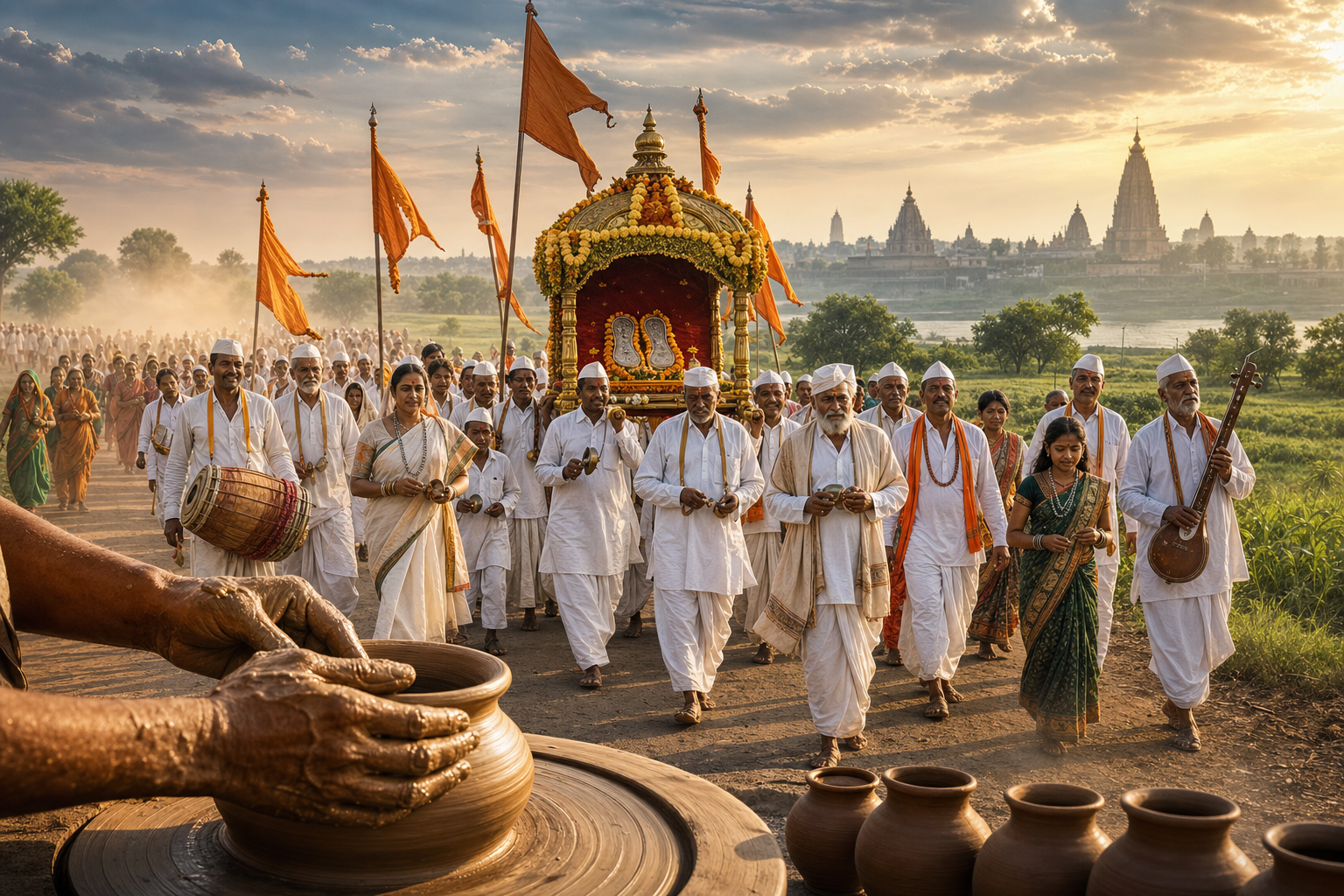
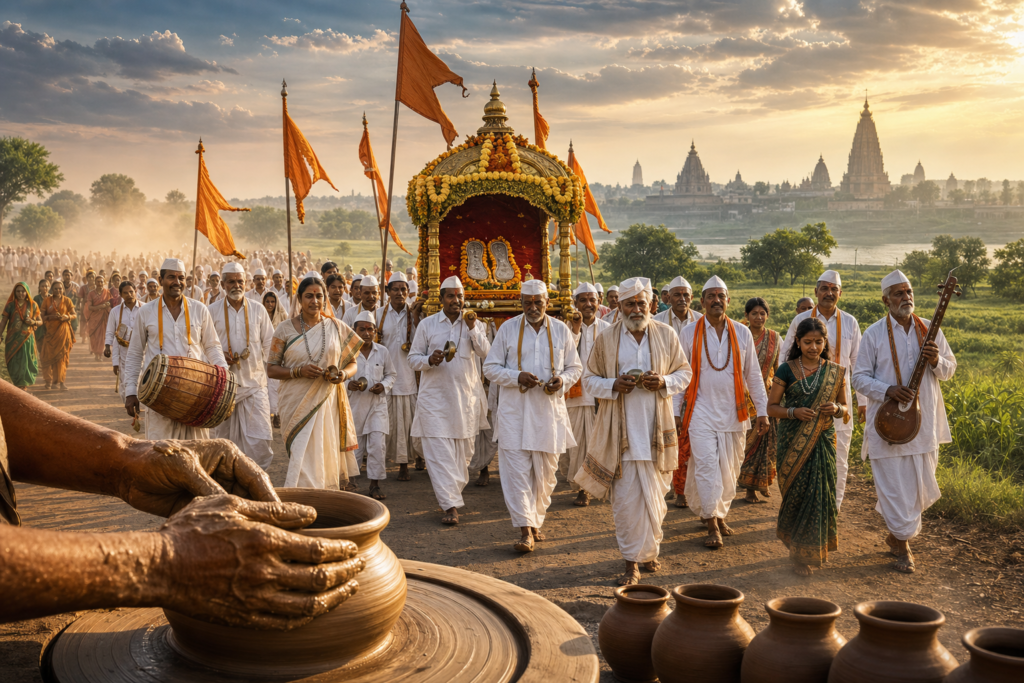
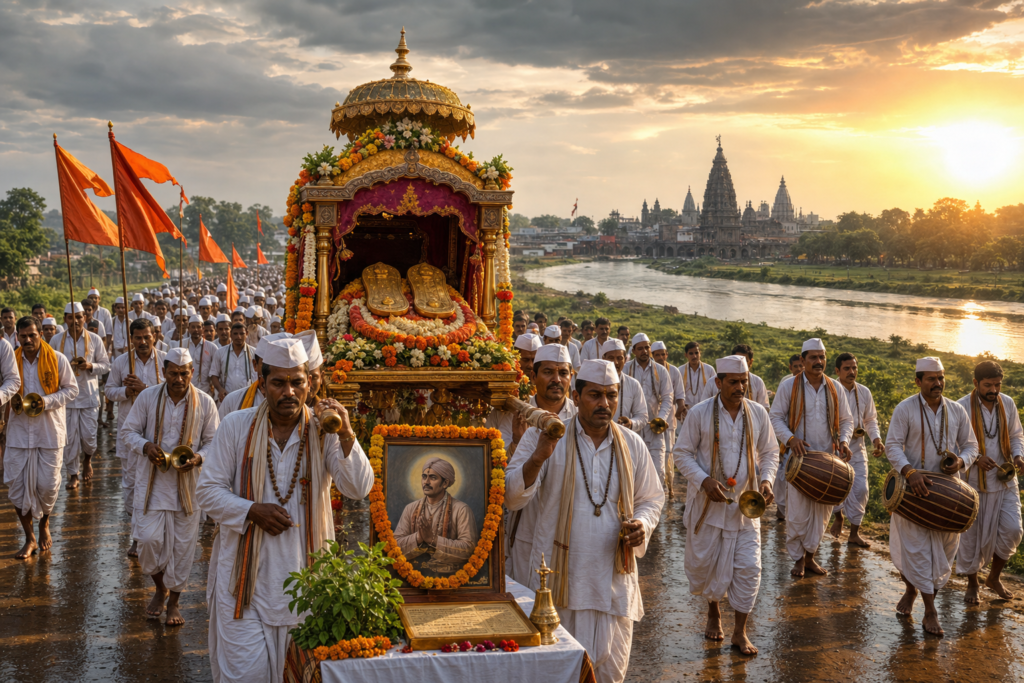
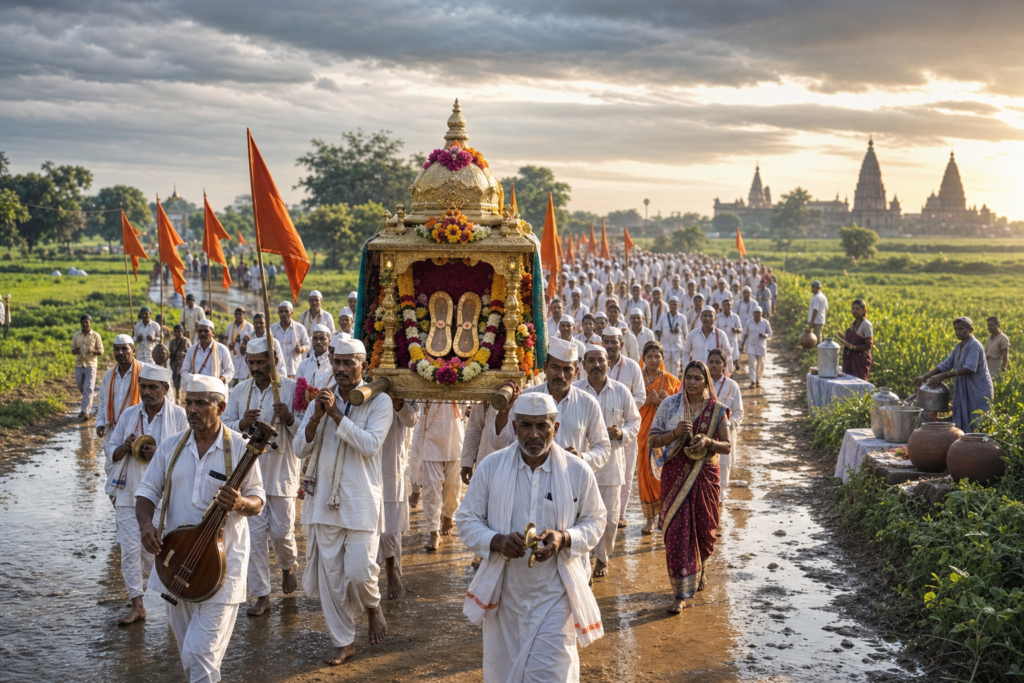
Sant Goroba Kaka Palkhi 2026 is more than a dated religious procession; it is a living expression of Marathwada devotion, Varkari discipline, and the enduring spiritual memory of Sant Goroba Kumbhar, affectionately remembered as Goroba Kaka. The Palkhi carries the devotional presence of a saint whose life joined work, humility, and bhakti into a single path, moving from the soil of Ter and the wider Marathwada region toward the sacred landscape of Pandharpur, where Vithoba and Rakhumai remain the emotional and theological center of the Wari tradition.
The 2026 observance gains special importance because Ashadhi Ekadashi, also known as Devshayani Ekadashi, falls on 25 July 2026. In the Varkari calendar, this is not merely a festival date but a culmination point: pilgrims, dindis, kirtankars, families, and village communities move toward Pandharpur with the shared intention of darshan, remembrance, and inner purification. The exact local halt schedule of Sant Goroba Kaka Palkhi is generally managed by the concerned Palkhi organizers and regional devotional committees, but its spiritual direction remains clear: it links the memory of Goroba Kaka with the ancient pilgrimage current flowing toward Pandharpur.
Sant Goroba Kumbhar belongs to the medieval bhakti tradition of Maharashtra and is associated with the Varkari sampradaya. Tradition remembers him as a potter by profession and a devotee of Vithoba by temperament, discipline, and total surrender. His occupational identity is central to his spiritual symbolism. The potter works with earth, water, pressure, patience, and fire; likewise, the Varkari path shapes the human personality through nama-smarana, seva, restraint, pilgrimage, and community life. In this sense, Goroba Kaka represents a theology of grounded devotion, where liberation is not separated from daily labor.
Ter, traditionally associated with Sant Goroba Kumbhar, is not only a devotional site but also a historically layered settlement in the Deccan. The region carries memories of trade, settlement, religious encounter, and saint tradition. When the Palkhi moves from this cultural geography toward Pandharpur, it is not simply transporting sacred sandals or symbolic memory; it is carrying the accumulated faith of farmers, artisans, householders, singers, temple servants, and ordinary devotees who see the road itself as a form of worship.
The Palkhi tradition functions as a mobile sacred institution. It organizes movement, song, discipline, food-sharing, rest, hospitality, and devotional education across towns and villages. Unlike pilgrimage understood only as individual travel, the Palkhi is collective and rhythmic. The pilgrim does not walk alone as an isolated seeker; the pilgrim becomes part of a dindi, a disciplined devotional unit in which chanting, walking, listening, serving, and sharing become repeated practices of character formation.
In the Sant Goroba Kaka Palkhi, the symbolism of the potter remains especially powerful. Clay has no final form until it is centered, turned, pressed, and fired. Human life, in the Varkari imagination, is similarly unfinished without divine remembrance and ethical refinement. Goroba Kaka therefore becomes a saint of spiritual craftsmanship. His memory teaches that devotion is not an escape from the world but a method of transforming the ordinary into the sacred.
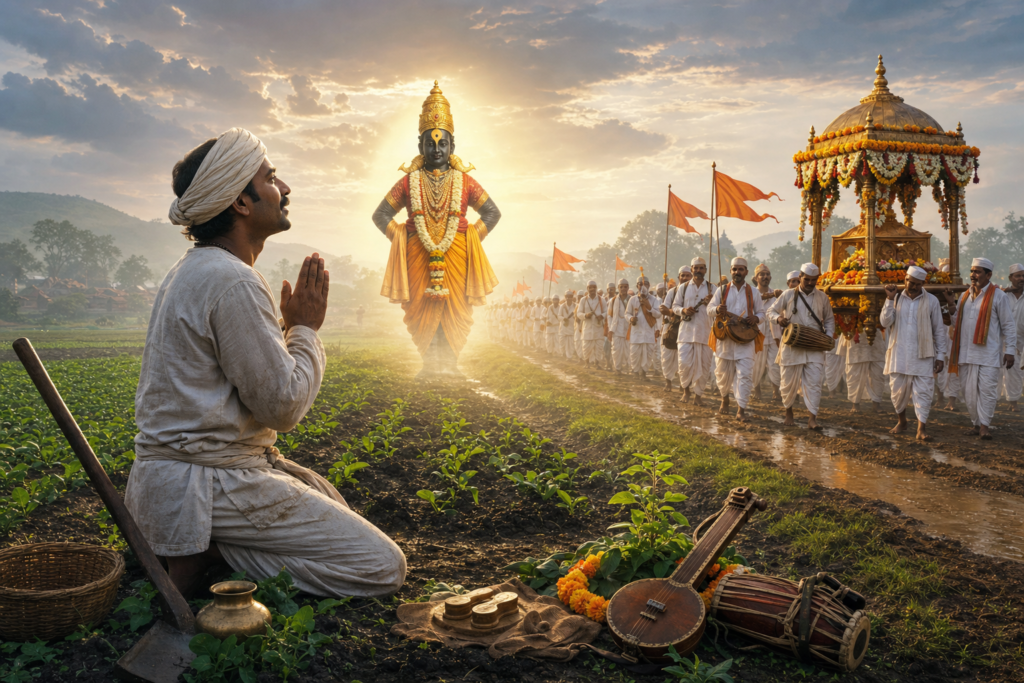
This is why the Palkhi speaks strongly to rural Maharashtra and especially to Marathwada. The region has long known hardship, drought, migration, agrarian uncertainty, and social endurance. A procession rooted in the memory of a working saint gives dignity to laboring lives. It reminds communities that bhakti does not belong only to scholars, rulers, or monastic elites. It belongs equally to the person who shapes clay, tills land, sings abhangas, serves pilgrims, cleans the route, cooks for strangers, or walks barefoot with the name of Vithoba on the lips.
Theologically, Sant Goroba Kaka Palkhi stands within the broad Varkari vision of devotion to Vithoba, a form of Krishna-Vishnu worship centered in Pandharpur. Yet the Varkari movement has never been a narrow sectarian current. Its great strength lies in the way it binds together saints from different social locations: Dnyaneshwar, Namdev, Chokhamela, Janabai, Tukaram, Eknath, Savata Mali, and Goroba Kumbhar are remembered not merely as individuals but as a fellowship of devotion. Their collective memory supports unity within Sanatana Dharma and offers a model of spiritual dignity across social boundaries.
The Palkhi also illustrates how Hindu pilgrimage can preserve social memory without reducing it to museum-like heritage. A saint is remembered through walking, singing, carrying, feeding, bowing, and listening. The tradition remains embodied. Older devotees often transmit stories to younger participants not through formal lectures but through lived participation: how to join a dindi, how to observe discipline, how to respect fellow pilgrims, how to chant, how to receive prasadam, and how to see service as worship.
Ashadhi Wari has a distinctive emotional grammar. The road to Pandharpur is tiring, dusty, crowded, and physically demanding, yet it is also full of affection. Villages welcome pilgrims, households offer water, and community kitchens turn hospitality into sacred duty. The Sant Goroba Kaka Palkhi participates in this moral economy of care. It teaches that devotion is not only an inward feeling but an outward arrangement of society around compassion, patience, and mutual support.
The 2026 Palkhi should therefore be understood at three levels. At the ritual level, it is a procession connected with the annual Pandharpur pilgrimage season. At the cultural level, it preserves the devotional identity of Marathwada and the memory of a potter-saint. At the philosophical level, it communicates a powerful bhakti principle: the divine is approached not through pride of status but through surrender, humility, discipline, and love.
The route to Pandharpur is also a route through sound. Abhangas, tal, mridanga, veena, and collective chanting create a moving soundscape in which theology becomes memorable. The repeated invocation of Vithoba is not ornamental; it is a method of mental alignment. The pilgrim body may be walking on a physical road, but the inner discipline is the steady redirection of attention from anxiety, ego, and fragmentation toward nama, darshan, and community.
From an academic perspective, the Sant Goroba Kaka Palkhi can be studied as devotional mobility, regional identity, performative memory, and social integration. It gathers people across caste, class, gender, and age. It connects village shrines with a major pilgrimage center. It converts roads into temporary sacred corridors. It also renews a shared Marathi devotional vocabulary in which words such as bhakti, seva, wari, dindi, abhang, Vithoba, Rakhumai, and Pandharpur continue to carry lived meaning.
The emotional appeal of Goroba Kaka lies in his accessibility. The image of a potter-saint does not intimidate the devotee; it welcomes the devotee. Clay, wheel, hands, and kiln are familiar symbols, especially in agrarian and artisan communities. Through Goroba Kaka, spiritual excellence appears not as distance from ordinary life but as depth within it. This is a crucial contribution of the bhakti movement: it sacralizes the ordinary without romanticizing hardship.
For contemporary readers, Sant Goroba Kaka Palkhi 2026 also offers a practical lesson in resilience. Modern life often separates work from worship, community from mobility, and tradition from relevance. The Palkhi refuses these separations. It shows that walking can become meditation, labor can become offering, memory can become social renewal, and a regional saint can speak to universal concerns of humility, patience, equality, and devotion.
The dharmic significance of this Palkhi also aligns with the wider goal of unity among Hinduism, Buddhism, Jainism, and Sikhism. While the procession is specifically rooted in the Varkari Hindu tradition, its ethical grammar is widely resonant across dharmic paths: discipline, remembrance, compassion, humility, self-control, service, and reverence for the realized ones. Such shared values allow traditions to retain their distinctiveness while contributing to a broader civilizational culture of spiritual practice.
In 2026, those who observe or participate in the Sant Goroba Kaka Palkhi may find its deepest message in the saint’s own symbolic world. Clay becomes meaningful only when handled with care. A community becomes sacred only when shaped by mutual responsibility. A pilgrimage becomes transformative only when the outer journey is accompanied by inner refinement. Goroba Kaka’s Palkhi, therefore, is not merely a movement toward Pandharpur; it is a disciplined movement toward humility, unity, and Vithoba-centered devotion.
As the Palkhi advances toward Pandharpur for Ashadhi Ekadashi 2026, it carries more than memory. It carries Marathwada’s faith, the dignity of work, the poetry of abhangas, the warmth of community service, and the continuing relevance of the Varkari path. Sant Goroba Kaka remains a reminder that the highest spiritual truths often appear in the simplest human forms: a potter’s hand, a pilgrim’s step, a shared meal, a sung name, and a heart made steady by devotion.
Inspired by this post on Hindu Pad.





Leave a Reply
You must be logged in to post a comment.