
Sacred Sound and the Subtle Body in Tantric Hinduism
In Tantric Hinduism, sound is treated as far more than an audible event produced by the vocal cords and carried through the air. It is understood as a subtle force that links speech, consciousness, ritual, body, and cosmos. The older Sanskritic idea of Nada, the primordial and unstruck sound, expresses a profound metaphysical insight: existence is not merely material structure, but patterned vibration, intelligible rhythm, and living awareness. This view gives sacred sound a central role in Hindu spirituality, especially in mantra sadhana, Kundalini Yoga, and the yogic understanding of chakras.
The Tantric traditions developed an especially refined account of how sound acts upon the human person. A mantra is not viewed simply as a meaningful phrase, prayer, or poetic formula. It is a disciplined arrangement of sound, intention, breath, and consciousness. When repeated with proper attention, it is believed to shape the mind, purify the subtle body, stabilize prana, and awaken deeper levels of awareness. This is why mantra is often described as both a spiritual instrument and a living presence.
The bija mantra, or seed syllable, occupies a particularly important place in this tradition. The term bija means seed, and the metaphor is precise. A seed appears small, but it contains the concentrated potential of a tree. In the same way, a bija mantra is brief, often only one syllable, yet it is understood to carry a condensed spiritual potency. Rather than communicating through ordinary grammar, it works through resonance, repetition, breath, memory, and symbolic association.
Among the most widely known bija mantras is Om, revered across Hindu, Buddhist, Jain, and Sikh-influenced contemplative cultures in different ways and contexts. In Hindu thought, Om is often associated with the totality of existence, the waking, dreaming, and deep sleep states, and the silent awareness beyond them. Its importance in the Upanishads, Yoga, Vedanta, and Tantric practice makes it one of the most enduring symbols of Indian spirituality. The sound is not merely recited; it is contemplated as a doorway into the relation between the individual self and ultimate reality.
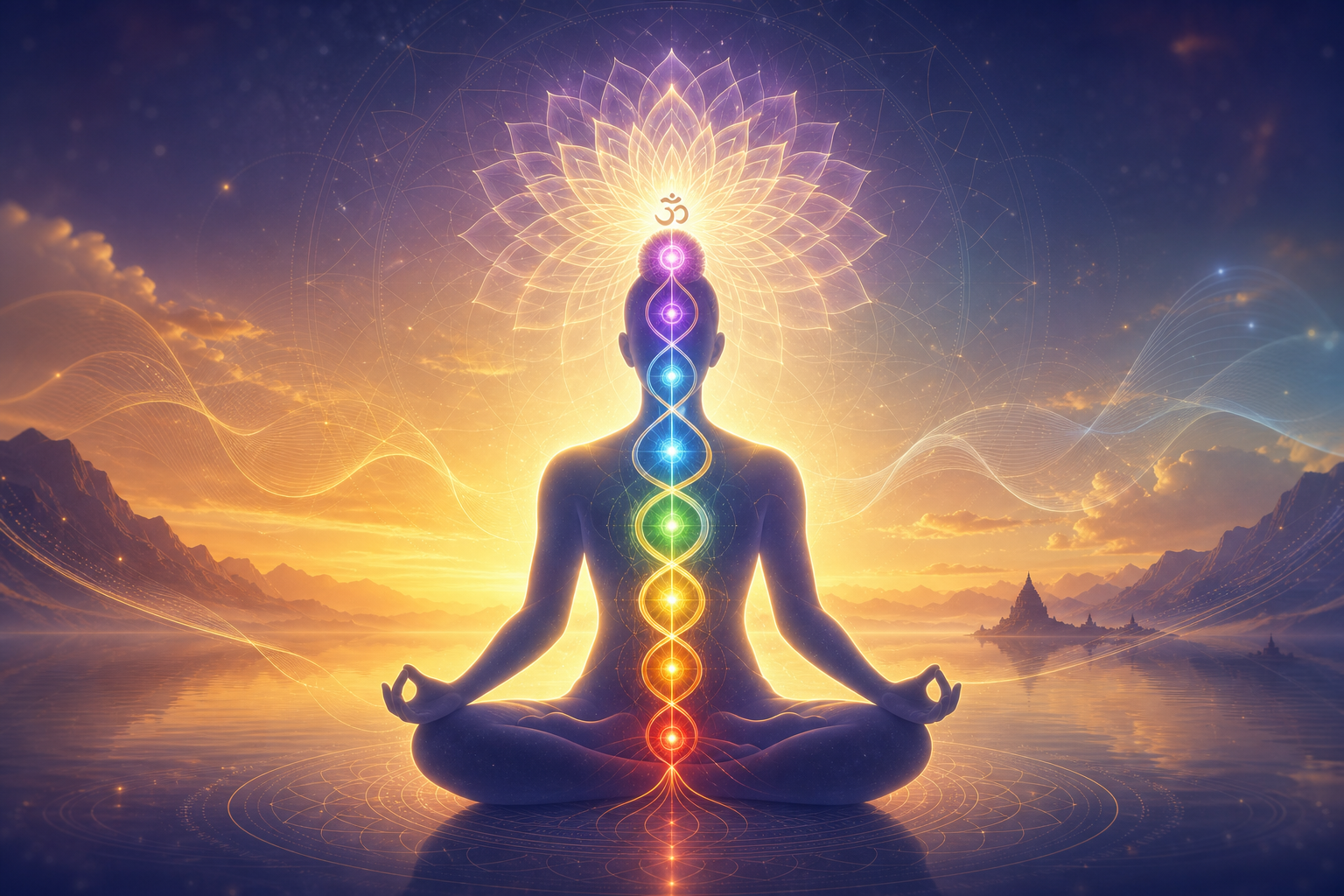
Tantric Hinduism also presents the human body as a sacred field of practice. The body is not rejected as an obstacle to spiritual realization. Instead, it is studied as a subtle instrument through which consciousness can be refined. This view is one reason the chakra system became so influential in later Yoga philosophy and meditation traditions. Chakras are described as subtle centers within the yogic body, associated with prana, psychological tendencies, elemental principles, and stages of spiritual ascent.
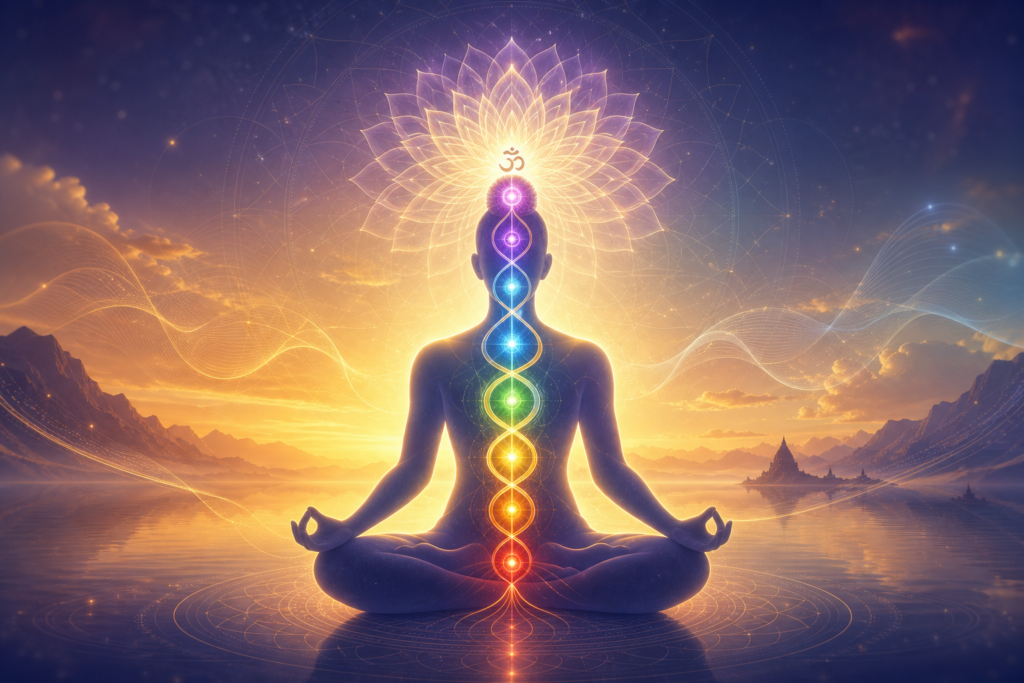
The most familiar system describes seven principal chakras aligned along the central channel known as sushumna nadi. These are commonly named muladhara, swadishtana, manipura, anahata, visudha, ajna, and sahasra. Traditional sources and lineages do not always present these centers in identical ways, and modern popular accounts often simplify them. Yet the core idea remains consistent: the subtle body is an organized field in which sound, breath, attention, and consciousness interact.
Muladhara, the root center, is associated with stability, embodiment, the earth principle, and the foundational energy of life. Its commonly taught bija mantra is Lam. In spiritual practice, attention to this center is not merely about physical grounding. It is also about confronting fear, insecurity, and fragmentation. The root must become steady before higher forms of concentration can mature. In a practical sense, this reflects a truth recognized by many contemplative traditions: spiritual aspiration needs psychological steadiness and ethical discipline.
Swadishtana, often associated with the water principle, creativity, emotion, and relational life, is commonly linked with the bija mantra Vam. In Tantric interpretation, this center concerns the transformation of desire rather than its denial. Desire, emotion, and imagination can bind the mind when left unconscious, but they can also be refined into devotion, creative power, and compassionate sensitivity. This is one of the important contributions of Tantra: it seeks transformation rather than mere suppression.
Manipura, the navel or solar center, is linked with fire, vitality, digestion, will, and disciplined action. Its bija mantra is usually given as Ram. The symbolism of fire is especially meaningful in Hindu ritual and Yoga. Fire consumes, transforms, illuminates, and carries offerings upward. At the level of inner practice, manipura represents the disciplined conversion of scattered energy into clarity, courage, and purposeful effort.
Anahata, the heart center, is associated with air, devotion, compassion, balance, and the subtle sound implied in its name: the unstruck. Its bija mantra is commonly Yam. The heart chakra is often romanticized in modern spirituality, but in a classical setting it demands maturity. Compassion is not sentimentality. It requires steadiness, humility, and the capacity to hold difference without hatred. This is especially relevant to dharmic traditions, where Hinduism, Buddhism, Jainism, and Sikhism have each cultivated profound paths of compassion, restraint, service, and liberation.
Visudha, the throat center, is connected with space, purification, speech, listening, and sacred expression. Its bija mantra is usually Ham. This center is particularly important for mantra practice because it joins sound and consciousness through voice. Speech can wound, confuse, flatter, or liberate. Tantric discipline treats speech as a sacred responsibility. The mantra practitioner learns that sound should not be careless, because language shapes the mind of the speaker as much as the listener.
Ajna, the brow center, is associated with insight, concentration, discrimination, and the directing power of awareness. It is often connected with Om or related seed sounds, depending on lineage. Ajna is not merely a symbol of intuition in the vague modern sense. It points toward disciplined perception, the capacity to see mental patterns clearly, and the refinement of attention through dhyana. Without ethical preparation and mental steadiness, the language of inner vision can easily become fantasy. In classical practice, insight must be joined to humility and discernment.
Sahasra, the crown center, is described as the thousand-petalled lotus and is often placed beyond ordinary elemental classification. It symbolizes the culmination of spiritual ascent, where the individual current of awareness is absorbed into a higher realization of consciousness. Unlike the lower centers, it is not usually reduced to a single operational seed syllable in the same way. It points toward silence, transcendence, and the completion of the movement that begins with embodied life at muladhara.
The relationship between bija mantras and chakras is therefore not arbitrary. Each sound is treated as a key that resonates with a particular subtle center. This does not mean that the syllable is a mechanical switch. Traditional practice is never merely acoustic. The sound, breath, intention, visualization, posture, initiation, and ethical discipline together form the practice. A bija mantra without attention is only noise; with disciplined awareness, it becomes a means of interior alignment.
Kundalini is central to this discussion. In Tantric Hinduism, Kundalini is often described as the latent spiritual power resting at the base of the subtle body. The imagery of a coiled power is symbolic, not a crude anatomical claim. It expresses the idea that the deepest capacity for realization lies within the embodied person. Through sadhana, mantra, pranayama, meditation, devotion, and guidance, this latent power is gradually awakened and led through the subtle channels toward higher consciousness.
The awakening of Kundalini has often been sensationalized, especially in modern global spirituality. Traditional Tantric sources are more disciplined and cautious. They emphasize preparation, purity of intention, guru guidance, steadiness of mind, and the integration of experience into dharmic life. Kundalini is not a spectacle and not a shortcut. It is a sacred way of describing the transformation of consciousness, energy, perception, and identity.
The subtle anatomy of nadis also helps explain the role of sound. The sushumna nadi is the central channel, while ida and pingala are commonly described as complementary currents associated with lunar and solar tendencies. Yogic breathing, mantra japa, and meditative concentration seek to balance these currents and draw awareness inward. When prana becomes steady, the mind becomes steadier. When the mind becomes steady, mantra can be heard more deeply, not only as outer speech but as inner vibration.
This layered view of sound is important. Tantric and Sanskritic traditions often distinguish different levels of speech, from gross articulated language to subtler forms of inner sound and undifferentiated awareness. The spoken mantra is only the visible surface of a deeper process. Repetition begins in the mouth, becomes mental, becomes subtle, and finally resolves into silence. In that silence, the purpose of mantra is fulfilled: sound leads beyond ordinary sound.
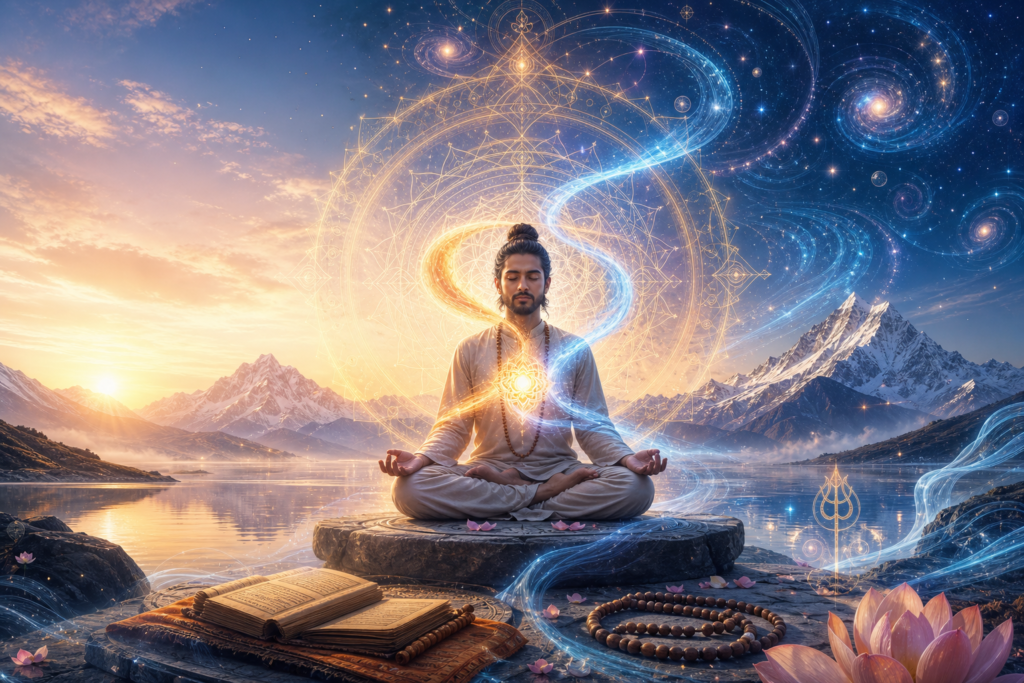
For many practitioners, this is the most relatable aspect of mantra sadhana. A repeated sacred sound can steady the mind when thought becomes restless. It can bring rhythm to the breath when the nervous system feels unsettled. It can create a sense of continuity between daily life and spiritual aspiration. Even outside advanced Tantric practice, the disciplined repetition of a mantra can become a quiet form of inner return, especially when joined to devotion, ethical conduct, and self-observation.
At the same time, academic clarity requires distinguishing traditional claims from modern therapeutic language. Chakras are not identical to nerves, glands, or psychological categories, although modern teachers often draw analogies. Such comparisons may be helpful when used carefully, but they should not erase the original religious and philosophical context. The chakra system belongs to a sacred anthropology in which body, cosmos, language, deity, and consciousness mirror one another.
The connection between mantra and deity is equally important. In many Tantric traditions, a mantra is not simply about self-improvement. It is linked to a devata, a form of divine presence. The seed syllable may be understood as the sonic body of that deity. This makes mantra practice devotional as well as contemplative. It bridges bhakti, Yoga, and ritual, showing that Hindu spirituality does not always separate emotion, metaphysics, and embodied discipline into isolated compartments.
The unity of dharmic traditions can be appreciated through this broader lens. Hindu mantra, Buddhist dharani and mantra, Jain meditative recitation, and Sikh remembrance of the Divine Name each arise from distinct histories and theologies, yet all recognize that disciplined sound can purify attention and reorient human life. Their differences should not be flattened, but their shared reverence for sacred utterance reveals a deep civilizational respect for speech, memory, rhythm, and realization.
In Hindu practice, bija mantras are often transmitted through a lineage. This matters because mantras are not treated as casual sound experiments. Initiation, pronunciation, rhythm, mental purity, and intention are all considered important. Some mantras are public and widely recited, while others are restricted to particular traditions. This distinction preserves the sanctity of practice and protects the practitioner from approaching powerful disciplines with impatience or ego.
Pronunciation also has theological and practical significance. Sanskrit sound theory places great emphasis on articulation, resonance, and the placement of sound in the mouth and body. The Sanskrit alphabet itself is traditionally arranged according to points of articulation, moving from guttural to palatal, retroflex, dental, and labial sounds. This reflects a sophisticated awareness of speech as embodied vibration. In mantra practice, sound is not abstract; it is felt, shaped, breathed, and internalized.
The emotional power of mantra should not be overlooked. While academic study can analyze texts, symbols, and systems, lived practice often begins with a simple human need: fear, grief, longing, devotion, confusion, or the desire for inner steadiness. A mantra becomes meaningful because it gives form to aspiration. It allows the practitioner to return, again and again, to a sacred center. This return is not sentimental escape; it can become a disciplined way of living with greater awareness.
Tantric Hinduism therefore offers a deeply integrated vision. The cosmos is vibration; the body is a sacred field; speech is a vehicle of transformation; the chakras are subtle centers of awakening; Kundalini is the latent power of consciousness; and bija mantras are concentrated seeds of spiritual force. Together, these ideas form one of the most sophisticated sound-based spiritual psychologies in world religious history.
Yet the tradition also calls for caution. Without humility, mantra can become performance. Without discipline, chakra language can become fantasy. Without ethical grounding, talk of Kundalini can encourage spiritual pride. The classical dharmic approach insists that inner power must be joined to dharma, compassion, truthfulness, self-control, and service. Spiritual awakening is not measured by unusual experiences alone, but by clarity, steadiness, responsibility, and reverence for life.
The enduring value of chakra and bija mantra practice lies in this union of sound and self-transformation. Sacred sound begins as vibration, becomes concentration, deepens into meditation, and finally points toward silence. In that movement, Tantric Hinduism preserves a profound insight: the path to the highest reality may begin with something as simple and intimate as a single syllable, repeated with faith, knowledge, and disciplined attention.
Inspired by this post on Hindu Blog.


Leave a Reply
You must be logged in to post a comment.