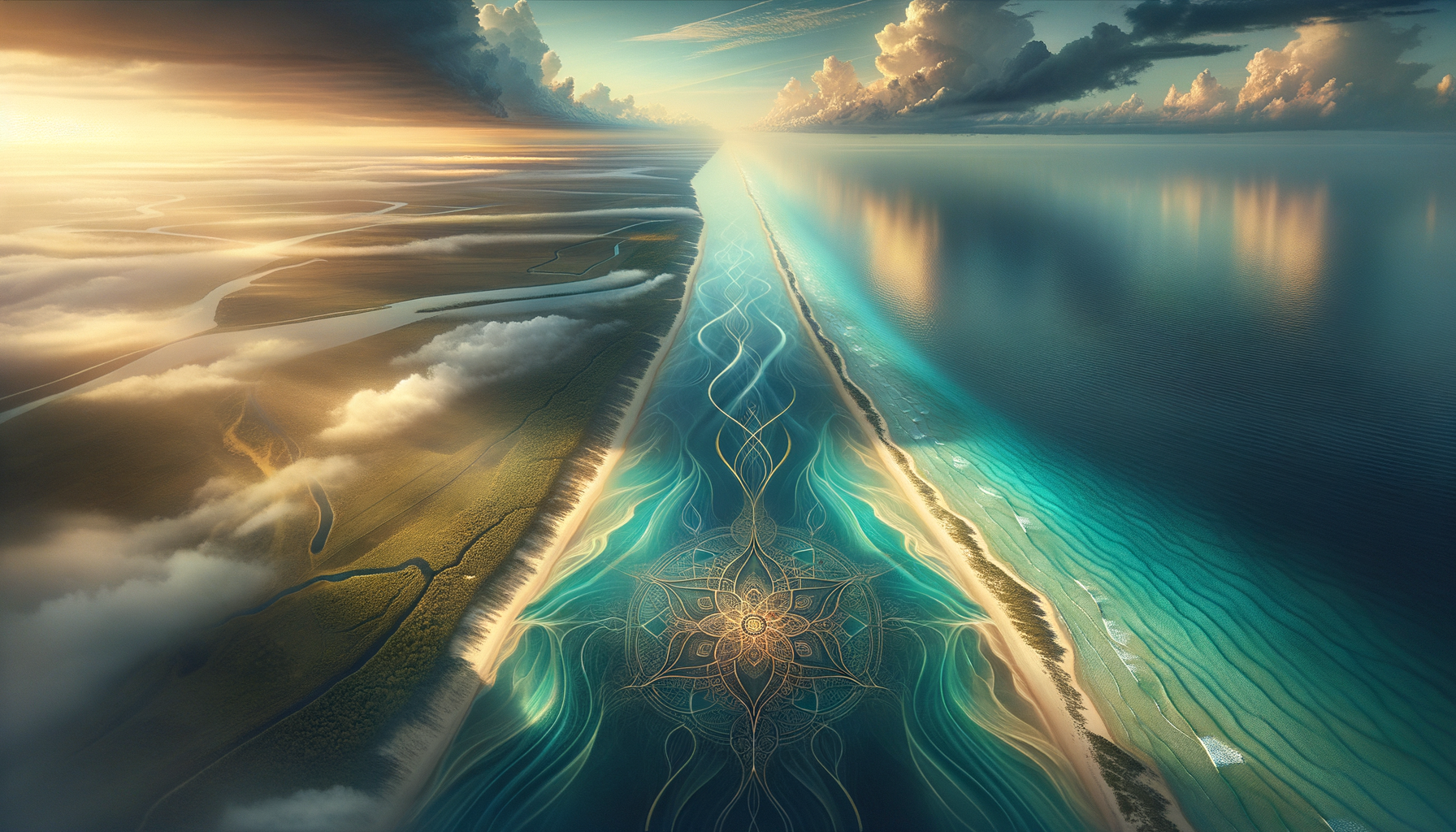
Nadi Samudra Nyaya, the “Maxim of the River and the Ocean,” occupies a central place in Hinduismespecially within Advaita Vedantaas a lucid teaching device to convey how the individual self (jiva) relates to the ultimate reality (Brahman). By pairing a familiar natural image with subtle metaphysics, the maxim renders non-dual insight more accessible to students of Hindu philosophy and seekers reflecting on the nature of self, unity, and moksha.
In this analogy, a river represents the jiva and the ocean represents Brahman. A river bears contours, a name, and a story as it moves through varied terrain; yet at the ocean’s edge, distinctions of name and form lose their functional force. Advaita Vedanta employs this image to indicate that at the culmination of self-knowledge, where Atman is realized as non-different from Brahman, the apparent separation dissolves. What seemed many is understood as one, not by destroying difference but by transcending misidentification.
Upanishadic statements such as “Tat Tvam Asi” and the insight “Atman is Brahman” provide the scriptural ground for this teaching. In this view, avidya (ignorance) superimposes limitation upon the self, much as mist can veil a vast horizon. The fruit of knowledgemokshaarrives as this veil lifts, revealing the underlying unity Advaita identifies as Brahman. Nadi Samudra Nyaya thus serves as a bridge between terse mahavakyas and lived realization.
Many practitioners describe experiential moments that mirror the metaphor. In meditation (dhyana) and attentive breathwork, a softening of the boundary between observer and observed often arises, akin to a river meeting the sea. Others recount standing at a confluence and feeling an intuitive sense of belonging to something immeasurably larger. Such reports, while personal, align with the maxim’s pedagogical aim: to direct attention from the transient surface toward the abiding ground of being.
Although rooted in Hinduism and Advaita Vedanta, the river–ocean image resonates across dharmic traditions. In Buddhist reflection, ocean imagery often points to the cessation of clinging to a separate self. Jain thought, through Anekantavada, affirms many-sided truth, much like many rivers converging toward a shared fullness while retaining valid perspectives along the way. Sikh teachings in Gurbani frequently evoke the union of the finite with the Infinite, comparable to a river merging with the ocean, to express alignment with the Divine. Read together, these parallels encourage unity in spiritual diversity without erasing doctrinal nuance.
Philosophically, Nadi Samudra Nyaya does not imply the annihilation of identity in a literal sense; rather, it indicates the sublation of egoic misidentification. As the false sense of isolation recedes, ethical clarity emerges: compassion, humility, and seva become natural expressions of non-dual understanding. This ethical flowering supports social harmony and interfaith respect, echoing the dharmic commitment to coexistence.
Pedagogically, the maxim exemplifies how nyayas (teaching maxims) translate abstract Vedantic principles into memorable, testable insights. Students and practitioners can contemplate the metaphor during svadhyaya, in mindfulness at riverbanks or shorelines, or in guided inquiryasking what, precisely, separates the drop from the ocean when both are water. Such reflection integrates scripture (Upanishads), reasoned analysis, and contemplative practice.
In sum, Nadi Samudra Nyaya offers a concise, elegant articulation of non-duality central to Advaita Vedanta and illuminating for the broader family of dharmic traditions. By explaining the journey of jiva toward recognition of Brahman, it highlights the possibility of moksha while fostering unity across Hinduism, Buddhism, Jainism, and Sikhism. As a living metaphor, it invites sustained inquiry, ethical refinement, and a shared appreciation of spiritual wisdom within India’s plural heritage.
Inspired by this post on Hindu Blog.