
The question beneath the question
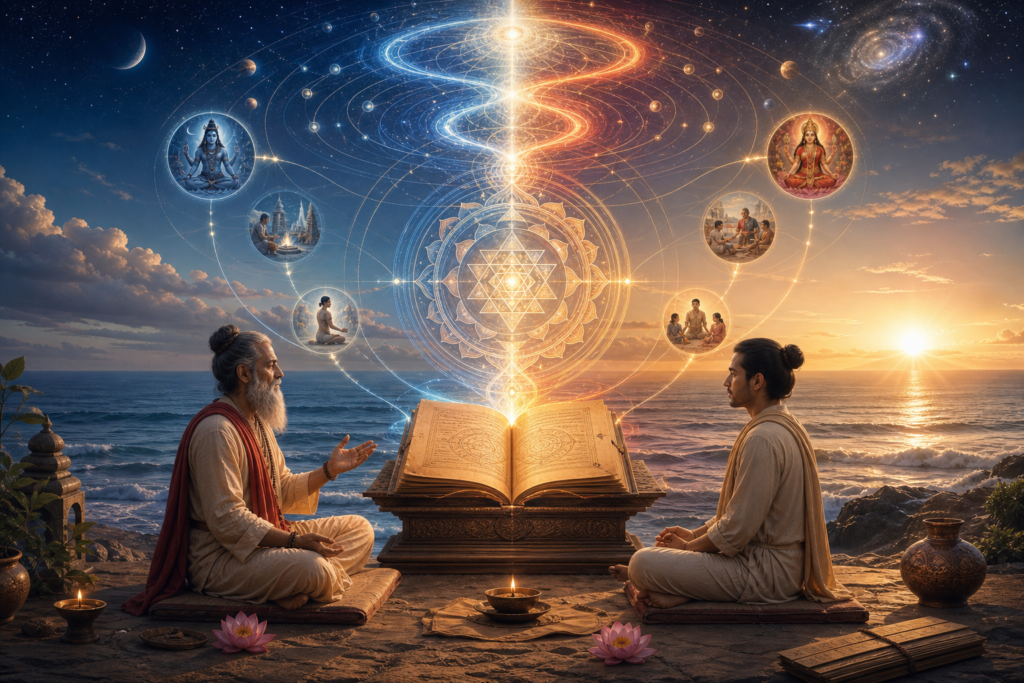
Who should be worshipped first—God or Guru? The question appears to ask for a simple ranking, yet it touches several distinct dimensions of Hindu philosophy: ritual sequence, the transmission of spiritual knowledge, devotional loyalty, and the relationship between the individual self and ultimate reality. Confusion arises when these dimensions are compressed into a contest between two supposedly competing objects of reverence.
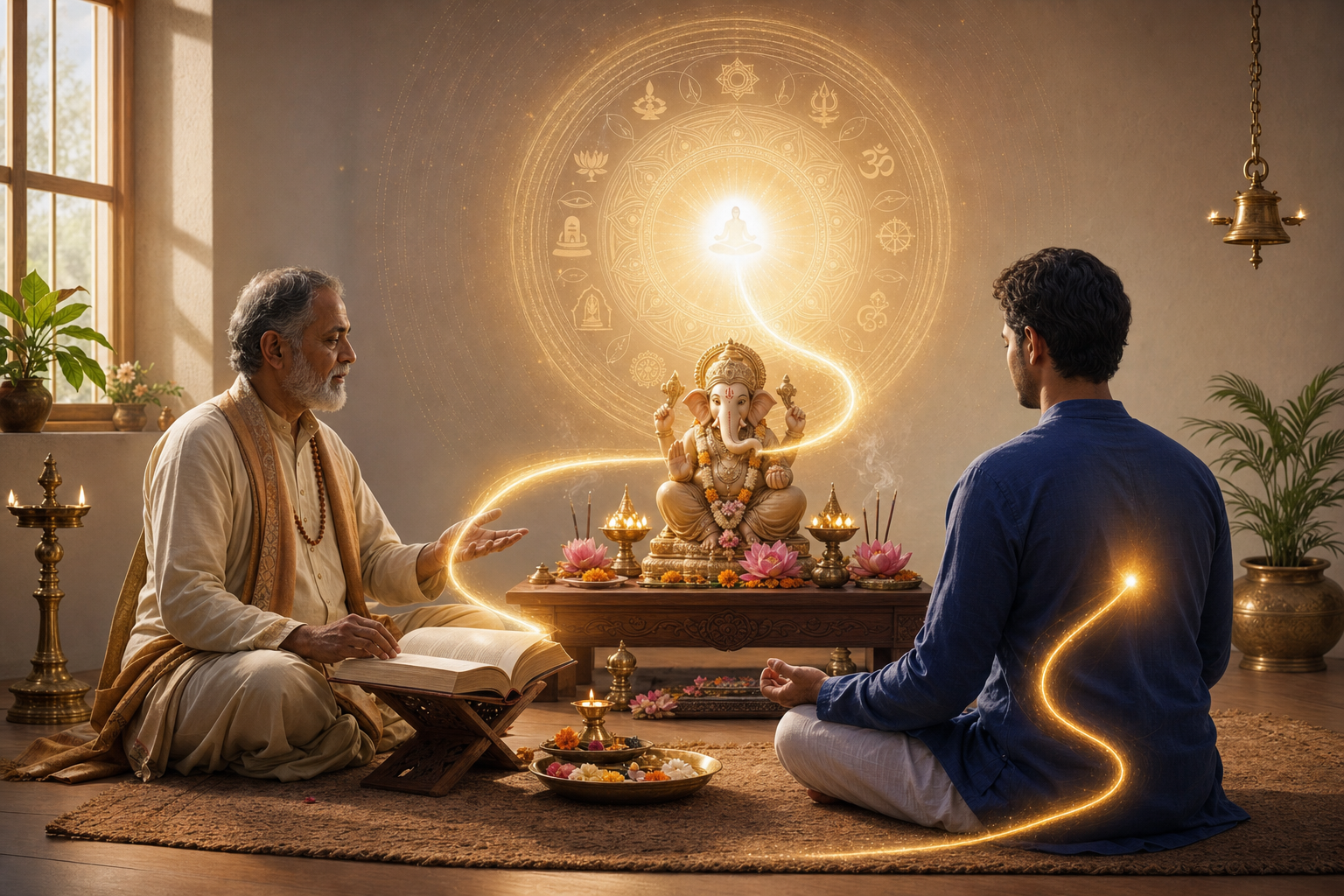
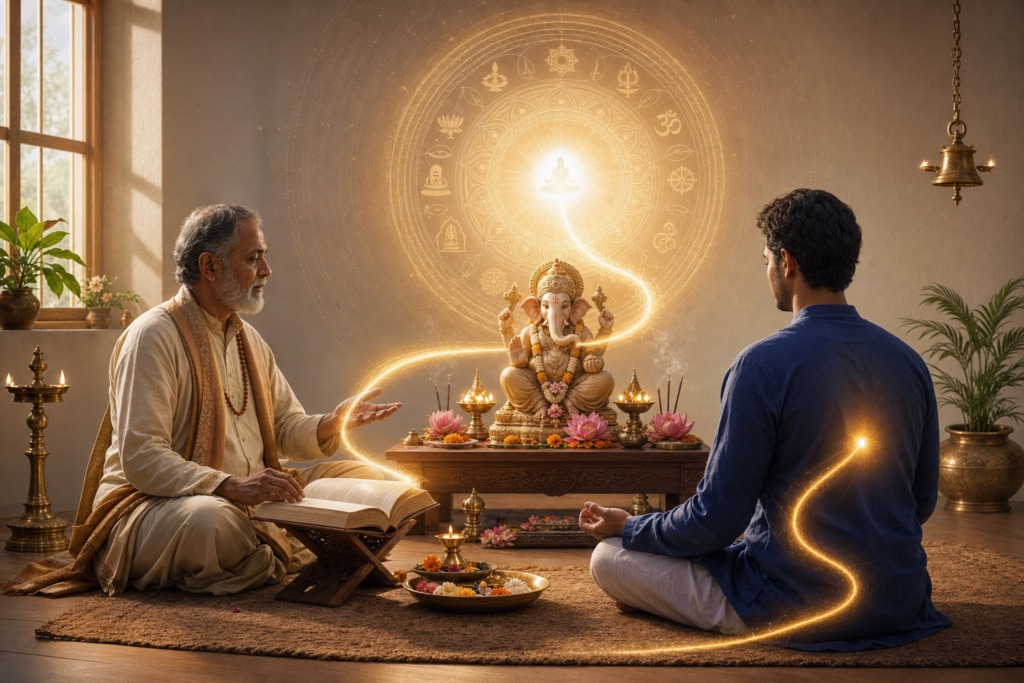
The concise answer is that, in the ritual framework presented in the source teaching, the Guru is remembered and honoured first, Lord Ganesha is then invoked, and worship proceeds toward the chosen deity and finally into meditation on the divinity within. This order does not necessarily declare that a human teacher is metaphysically greater than God. It expresses gratitude toward the source through which sacred knowledge, mantra, discipline, and a reliable method of worship become intelligible.
A necessary qualification must accompany that answer. Hinduism contains many sampradayas, regional customs, temple systems, household practices, and philosophical schools. There is no single ritual manual governing every Hindu. Some traditions begin with Guru-smaraṇa, some emphasize Gaṇeśa-vandana, some invoke a lineage and an iṣṭa-devatā together, and others follow a sequence established by a particular Āgama, Tantra, Vedic śākhā, or family custom. The governing principle is therefore fidelity to an authentic tradition rather than the invention of a universal hierarchy.
The teaching that generated the question is attributed to Sri Sri Ravi Shankar and was reproduced from a satsang. A bhajan mentioned in that exchange says, “Do not see any difference between God and the Guru”. The discourse then adds, “You should not see any difference between God, Guru and your soul.” These statements are most coherent when read through a nondual and contemplative lens. They should not be converted into the careless proposition that every person who adopts the title of Guru is literally God or entitled to unquestioned obedience.
Four meanings of placing the Guru first
The word first can describe at least four different relationships. It can indicate who is remembered first in a ceremony, who first makes knowledge of God possible, who receives devotion comparable to devotion toward God, or who is ultimately understood as non-different from divine consciousness. These are related claims, but they are not interchangeable.
Ritual precedence concerns the order of a specific practice. A lineage may prescribe remembrance of the Guru before the principal deity because the worshipper has received the mantra, procedure, and theological understanding through that lineage. The opening salutation acknowledges the source of the method before the method is used.
Epistemic precedence concerns knowledge. A person may feel devotion spontaneously, but complex teachings require explanation, correction, and disciplined application. Sacred literature often employs technical language, layered symbolism, and apparently divergent viewpoints. The Guru functions as an interpretive guide who helps the disciple distinguish a text’s intended meaning from projection, wishful thinking, or literalism.
A familiar human experience illustrates this point. A student may read every word in a difficult text and still fail to grasp its central argument. A skilled teacher does not create the truth contained in the text; the teacher removes the obstacles preventing its recognition. In the same way, Guru-reverence honours the person or lineage that makes transformative understanding possible.
Devotional equivalence means that service and reverence offered to a genuine Guru are treated as service to the divine purpose represented by the Guru. This is a relational and theological claim. In many bhakti traditions, the teacher is cherished as the bearer of grace, yet worship ultimately reaches Bhagavān rather than terminating in an independent personality.
Metaphysical identity is the strongest formulation and belongs especially to nondual interpretation. From this perspective, God, Guru, and Ātman are not three independently existing realities. The external teacher points toward the consciousness in which the apparent divisions between knower, knowledge, and known are resolved. Even here, the ultimate unity of consciousness does not eliminate ordinary ethical distinctions between teacher and disciple.
The apparent rivalry therefore dissolves. God is the goal and ground of spiritual life; the Guru illuminates the path; the receptive self undertakes the discipline; and realization reveals the deeper relation among all three. The sequence is pedagogical before it is competitive.
What the foundational texts actually establish
The Taittirīya Upaniṣad instructs the departing student to regard the ācārya with deva-like reverence. The teaching places respect for the teacher beside reverence for mother, father, and guest. In context, this is an ethic of gratitude and responsible conduct. It gives the teacher exceptional honour without granting every teacher immunity from moral evaluation.
The Muṇḍaka Upaniṣad 1.2.12 offers a more technical standard. A seeker of liberating knowledge is directed toward a Guru who is both śrotriya and brahmaniṣṭha: grounded in a transmitted body of sacred learning and established in the reality being taught. Scriptural competence without realization can become sterile, while claims of realization without disciplined knowledge can become arbitrary. The traditional ideal requires both. The relevant passage can be consulted in the Muṇḍaka Upaniṣad text and commentary.
Bhagavad Gītā 4.34 presents the teacher-disciple relationship through three coordinated practices: respectful approach, searching inquiry, and service. The inclusion of sustained questioning is crucial. The verse does not describe passive submission; it describes disciplined receptivity joined to intelligent examination. The wise teachers are qualified because they have seen the truth, not merely because they possess status. The verse and multiple traditional commentaries are available through the IIT Kanpur Gita Supersite.
Śvetāśvatara Upaniṣad 6.23 states that the meanings of the teaching become luminous for the person who has supreme devotion to Deva and corresponding devotion to the Guru. This verse supplies a strong scriptural basis for parallel reverence. It need not be interpreted as a universal declaration that the Guru and God are numerically identical in every school of Vedānta. Its direct emphasis is that transformative understanding requires devotion to both the divine and the preceptor. The Sanskrit text and translation are available in the Śvetāśvatara Upaniṣad.
Taken together, these passages establish a coherent structure. The Guru is worthy of profound honour, must be qualified by learning and realization, should be approached through humility and inquiry, and serves as the medium through which teachings become inwardly intelligible. None of the passages supplies a blank cheque to charisma, inherited rank, institutional power, or personal demands.
Why Guru remembrance can precede Lord Ganesha
Pūjā is a broad and internally diverse category. It can range from a householder lighting a lamp and offering flowers to an elaborate temple rite governed by specialist manuals. Academic study consequently describes Hindu pūjā as both highly structured and sensitive to regional, sectarian, and domestic contexts. This diversity is summarized in the Oxford Bibliographies overview of pūjā.
Within the sequence described in the source discourse, a practitioner begins with “Sri Gurubhyo Namaha, Hari Om!” The phrase is commonly understood as a reverential salutation to the Gurus or teaching lineage, followed by the sacred remembrance of Hari and Om. Its plural form allows the act to honour more than one individual: the immediate teacher, preceding teachers, ancient seers, and the entire current of transmitted wisdom.
The Guru is remembered first because even the knowledge that Lord Ganesha should be invoked has arrived through teaching. The ritual gestures, pronunciation, symbolism, and inward attitude have also been preserved by teachers. Remembering the lineage is therefore an act of intellectual honesty and sacred gratitude: it acknowledges that spiritual knowledge has not appeared in isolation.
Lord Ganesha is then honoured as the traditional remover of obstacles and patron of auspicious beginnings, wisdom, and ordered action. His precedence among deities serves a different function from the Guru’s precedence. The Guru authorizes and explains the path; Ganesha sanctifies its commencement and removes impediments; the principal deity becomes the focus of the main worship. The roles complement rather than displace one another.
The iṣṭa-devatā, or personally cherished form of the divine, normally receives the central devotion in a personal practice. Depending on the sampradaya, that form may be Shiva, Vishnu, Krishna, Rama, Devi, Ganesha, Surya, another deity, or a formless conception of the Supreme. Hindu religious diversity allows these forms to function as distinct devotional relationships without requiring that every practitioner adopt an identical liturgical order.
Ritual order should not be mistaken for a league table of divine importance. A lamp may be lit before a sacred text is read, but the lamp is not therefore declared superior to the teaching. Similarly, Guru remembrance can precede deity worship because it prepares understanding and attention. The first act supplies orientation to everything that follows.
A person without an initiated human Guru need not manufacture a relationship or suspend all spiritual practice. Such a person may respectfully remember parents, schoolteachers, saints, scriptural commentators, ancestral teachers, and the divine as the universal Guru. Public devotional practices—such as sincere prayer, ethical conduct, nāma-japa, scriptural study, and simple offerings—remain accessible. Practices requiring formal dīkṣā should, however, be learned from a competent lineage rather than reconstructed from fragments found online.
Atma Puja: the movement from outward ritual to inward realization
The source teaching places Atma Puja after honouring the Guru and the deities. This transition reveals the architecture of the practice. Worship begins with gratitude, proceeds through sacred forms, and then becomes contemplative. The external altar gradually directs attention toward the interior field of awareness.
Atma Puja should not be reduced to admiration of the personality, body, preferences, or ego. Ātman in Vedāntic discourse refers to the deepest self or witnessing consciousness, not the socially constructed identity that seeks praise and possession. Honouring the Ātman therefore challenges egocentrism rather than endorsing it.
Several technical practices can participate in this inward movement, although their meanings should not be collapsed. Dhāraṇā is the disciplined placement of attention; dhyāna is sustained meditation; and nyāsa is a ritual placement of mantras, syllables, or divine powers upon parts of the body through touch and visualization. The source’s instruction to remember deities in different parts of the body closely resembles the contemplative logic of nyāsa, but exact procedures differ among lineages.
In many Āgamic and Tantric settings, nyāsa transforms the practitioner’s relation to embodiment. The body is no longer treated as an obstacle standing outside sacred reality. It becomes a ritually consecrated field in which mantra, deity, elements, senses, and consciousness are correlated. A concise technical definition is provided by the Concise Oxford Dictionary of World Religions entry on nyāsa.
This symbolic mapping does not ordinarily mean that miniature anthropomorphic gods are physically located in bodily organs. It expresses a sacred anthropology: sight, speech, breath, cognition, and action participate in a cosmos permeated by divine order. The worshipper learns to regard embodiment with responsibility rather than contempt.
Meditation becomes the culmination of pūjā because it gathers the dispersed mind. Flowers, incense, mantra, gesture, image, and offering have trained attention through the senses. When those supports are inwardly assimilated, the practitioner can rest more steadily in awareness. The joy described in the source is not merely sensory excitement; it is the quiet coherence that may arise when devotion, attention, and self-understanding converge.
External and internal worship should therefore be understood as complementary. External ritual cultivates reverence, memory, precision, and embodied participation. Internal worship cultivates concentration, subtle discernment, and direct contemplation. The mature practice neither despises sacred form nor remains dependent on mechanical performance.
The ethical test remains decisive. A meditation that produces no greater honesty, compassion, restraint, or responsibility has not yet fulfilled the purpose attributed to it. Recognition of divinity within should make the dignity of other beings harder to ignore, not provide a spiritual vocabulary for self-importance.
How major Hindu schools interpret God, Guru, and self
Advaita Vedānta: At the ultimate level, Ātman and Brahman are non-different. The Guru removes ignorance through teaching, enabling recognition of a reality that was never absent. God, Guru, and self may therefore be described as one in consciousness. At the empirical level, however, teacher, student, instruction, and ethical duties remain meaningful. Nonduality cannot legitimately be used to erase consent, accountability, or ordinary moral distinctions.
Viśiṣṭādvaita Vedānta: The individual soul is real and entirely dependent upon the Supreme, while sharing an inseparable relation with Brahman as part of an organically unified reality. The Guru guides the soul toward knowledge, devotion, and surrender. Reverence can be exceptionally elevated, yet the Guru’s greatness derives from service to the Supreme rather than from an independent claim to supremacy.
Dvaita Vedānta: God, individual souls, and matter remain genuinely distinct. The Guru is indispensable as a teacher of correct knowledge and devotion, but does not become ontologically identical with Vishnu. In this framework, treating Guru and God as absolutely identical would require careful qualification: the Guru represents divine authority and grace while remaining a dependent soul.
Vaiṣṇava bhakti traditions: Many Vaiṣṇava communities honour the Guru as a transparent representative of Bhagavān, a bearer of compassion, or the visible channel of the Lord’s instruction. The principal worship remains directed toward Bhagavān, while service to the Guru is cherished because it nurtures devotion. Precise formulations vary among Śrī Vaiṣṇava, Mādhva, Gauḍīya, Vallabha, Ramanandi, Swaminarayan, and other lineages.
Shaiva and Shakta traditions: These traditions span dualist, qualified-nondual, and strongly nondual theologies. In many initiatory systems, the Guru communicates mantra, performs dīkṣā, and guides the practitioner through ritual technologies that are not safely separated from lineage. Some traditions identify the realized Guru closely with Shiva or Devi; others emphasize the Guru as their authorized servant. General statements must therefore remain subordinate to the relevant Āgama, Tantra, and sampradaya.
Smarta and household traditions: Guru remembrance, Ganesha invocation, worship of an iṣṭa-devatā, and contemplation of one underlying Brahman can coexist naturally. Yet household routines are often shorter and shaped by family inheritance. A simple lamp, a remembered verse, and silent meditation may embody the same theological movement found in a much longer formal pūjā.
These differences explain why the statement that Guru, God, and soul are one can sound self-evident in one setting and require substantial qualification in another. Dharmic unity is best served by accurate comparison, not by forcing every school into a single doctrine.
The wider Dharmic family: shared reverence without erased differences
Hinduism, Buddhism, Jainism, and Sikhism all recognize the transformative importance of teaching, disciplined communities, and exemplars. They do not, however, define God, liberation, revelation, or Guru in identical ways. A respectful comparison should identify genuine common ground while preserving the integrity of each tradition.
Buddhism: The God-versus-Guru question does not transfer directly because most Buddhist traditions do not posit a creator God. Early Buddhist practice is organized around refuge in Buddha, Dhamma, and Saṅgha, while the kalyāṇa-mitta, or admirable spiritual friend, supports development of the Noble Eightfold Path. Saṁyutta Nikāya 45.2 gives spiritual friendship an exceptionally important place, as shown in the SuttaCentral translation. Vajrayāna traditions give the Guru or lama a more explicitly central initiatory role, governed by their own teachings and commitments.
Jainism: Jain philosophy does not depend upon a creator deity. The Navkār Mantra bows to Arihants, Siddhas, Āchāryas, Upādhyāyas, and Sādhus—the five supreme categories of spiritually accomplished or exemplary beings. Significantly, the veneration is directed toward their perfected qualities rather than toward a creator’s intervention. The roles of Āchārya and Upādhyāya show the high place given to discipline and instruction. This structure is outlined in the Compendium of Jainism.
Sikhism: Sikh discipline directs worship toward the One Timeless Being and accords central authority to the ten Gurus, the Guru Granth Sahib, and the Guru’s Word. Mainstream Sikh practice does not install a contemporary personality as a successor human Guru. The Shabad-Guru forms and transforms consciousness while directing devotion toward the One. These principles are stated in the Sikh Rehat Maryada published by the Shiromani Gurdwara Parbandhak Committee.
The unifying insight is not that all Dharmic traditions secretly teach the same metaphysics. It is that wisdom must be learned, embodied, tested in conduct, and carried through disciplined communities. Teacher-reverence reaches its highest purpose when it produces humility, clarity, non-harm, service, and liberation from narrow self-absorption.
Guru devotion requires discernment
The traditional qualifications of śrotriya and brahmaniṣṭha provide a demanding standard. A spiritual teacher should understand the relevant teachings, belong to or responsibly represent a recognizable tradition, demonstrate disciplined conduct, and embody the principles being communicated. Eloquence, popularity, supernatural claims, social-media reach, wealth, or an impressive title cannot substitute for these qualities.
Bhagavad Gītā 4.34 also balances three responsibilities. Humility protects the student from arrogance; inquiry protects the student from credulity; and service protects knowledge from becoming merely intellectual. Removing any one of the three produces distortion. Humility without inquiry can become submission, inquiry without humility can become vanity, and service without understanding can become dependency.
Healthy spiritual guidance normally displays consistency between teaching and conduct, respect for appropriate questions, financial and interpersonal boundaries, freedom from coercion, and concern for the disciple’s long-term maturity. A sound Guru makes the disciple less dependent on manipulation and more capable of ethical judgment, disciplined practice, and compassionate action.
Serious warning signs include demands for secrecy that conceal misconduct, pressure to surrender money or property, sexual exploitation, isolation from family and independent counsel, punishment for reasonable questions, fabricated claims of exclusive salvation, or assertions that spiritual status places the teacher above law and dharma. Such behaviour should not be sanctified as a test of devotion.
When harm occurs, protecting the vulnerable takes priority over preserving an institution’s reputation. Affected persons may seek help from trusted family members, responsible community authorities, qualified professionals, or civil authorities as circumstances require. Reverence for the Guru principle does not oblige anyone to remain exposed to abuse.
The disciple also carries responsibilities: to study carefully, observe conduct over time, avoid projecting perfection onto a personality, distinguish instruction from personal preference, and remain anchored in dharma. Trust may deepen gradually. Instant emotional intensity is not the same as tested spiritual confidence.
Multiple teachers need not create disloyalty. Indian traditions frequently distinguish an initiating Guru from teachers who provide scriptural explanation, music, ritual training, meditation instruction, or ethical counsel. Gratitude can extend to many sources while formal commitments remain clear. Confusion is best resolved through transparent discussion within the relevant sampradaya.
A practical daily order for a simple home practice
The following framework is a general contemplative model, not a replacement for lineage-specific instructions. A practitioner who has received dīkṣā should follow the sequence, mantra, pronunciation, and restrictions given by the initiating tradition. A beginner may use simple, public prayers without attempting advanced nyāsa, bīja-mantras, or ritual procedures requiring formal transmission.
1. Prepare the place and intention. The space may be made clean and quiet, a lamp or incense may be offered if appropriate, and the body may be settled. The intention should be ethical and specific: gratitude, clarity, remembrance of the divine, or dedication to responsible action. Preparation marks the transition from distraction to sacred attention.
2. Remember the Guru and lineage. The practitioner may inwardly remember all genuine sources of wisdom and recite “Sri Gurubhyo Namaha, Hari Om!” where this accords with the inherited practice. The central emotion is gratitude. Even a difficult day can become spiritually intelligible when the mind pauses to remember those who taught it how to seek truth.
3. Invoke Lord Ganesha. A brief prayer may request clarity, steadiness, and the removal of obstacles. This stage represents more than the hope that external difficulties will disappear. It also directs attention toward internal obstacles such as haste, forgetfulness, pride, fear, and fragmented concentration.
4. Worship the iṣṭa-devatā. The principal prayer, mantra, image, or contemplation may now receive full attention. Offerings can be simple. Their spiritual value lies less in expense than in the quality of awareness, lawful acquisition, cleanliness, and sincerity with which they are made.
5. Study or listen. A short passage from an appropriate scripture or a recognized teaching can connect devotion with understanding. Study prevents emotion from becoming vague, while devotion prevents study from becoming cold. A single passage examined carefully may be more valuable than many pages read without attention.
6. Enter Atma Puja and meditation. Attention may move gently from the external form toward breath, heart, awareness, or another focus taught by the tradition. The senses and parts of the body may be regarded with reverence without improvising restricted ritual formulas. The practitioner then rests in silent awareness, allowing the distinction between sacred space and ordinary embodiment to soften.
7. Conclude through dedication and action. The benefit of the practice may be dedicated to the welfare of all beings. A concrete act of patience, service, truthfulness, generosity, or reconciliation can carry worship into daily life. This final movement ensures that devotion does not end at the altar.
When time is limited, the entire structure can be expressed in a few minutes: settle the mind, remember the teaching lineage, invoke Ganesha, offer a prayer to the chosen form of the divine, sit briefly in silence, and resolve to act ethically. Ritual complexity is valuable when understood, but sincerity and disciplined continuity are more important than anxious performance.
Common questions and careful answers
Can God be worshipped without a living Guru? Yes. Hindu traditions contain many accessible forms of prayer, remembrance, pilgrimage, scriptural listening, and ethical devotion. A qualified Guru can deepen understanding, correct mistakes, and transmit initiatory disciplines, but sincere devotion does not become worthless merely because a formal relationship has not yet been established.
Is the Guru greater than God? The question is often a category error. In many traditions, the Guru is honoured first because the Guru reveals the path to God. In nondual traditions, both are expressions of one consciousness. In dualist traditions, God remains supreme and the Guru is the most honoured guide or servant. The answer therefore depends upon what greater is intended to mean.
What happens when a Guru’s demand conflicts with dharma? Spiritual status does not transform harmful conduct into righteousness. A disciple should pause, examine the relevant teaching, consult trustworthy and independent sources, and refuse actions that are abusive, illegal, exploitative, or clearly adharmic. Authentic reverence is compatible with moral courage.
Should Ganesha or the Guru be remembered first? The source discourse places the Guru first and Ganesha immediately afterward. Another inherited procedure may arrange preliminary invocations differently. Following a legitimate family or sampradaya practice with understanding is more important than condemning another valid sequence.
Is Atma Puja a form of self-worship? It is not worship of vanity. Properly understood, it honours the deepest consciousness and the sacred responsibility of embodied life. The practice becomes distorted if it encourages narcissism; it becomes fruitful when it produces steadiness, humility, and recognition of the same dignity in others.
Can a departed or distant Guru still be honoured? Yes. A teaching lineage is not limited to physical proximity. Scripture, remembered instruction, authorized successors, community practice, and faithful application can sustain the relationship. The test is whether the teaching continues to generate understanding and ethical transformation rather than sentimental attachment alone.
The final synthesis
In the tradition articulated by the original satsang, the Guru is honoured first, Lord Ganesha follows as the guardian of auspicious beginnings, the chosen deity receives the central worship, and Atma Puja turns the entire movement inward. This sequence carries the practitioner from gratitude to clarity, from sacred form to meditation, and from meditation to responsible life.
The deepest answer is therefore not that God defeats Guru or Guru displaces God. The Guru gives language and method to spiritual longing; God supplies its transcendent ground and goal; and the Ātman is the interior depth in which the teaching is realized. When these dimensions are held together, worship becomes less anxious, devotion becomes more intelligent, and reverence matures into wisdom.
For an individual standing before a small home altar after an exhausting day, this teaching can remain profoundly practical. Remembering the Guru cultivates gratitude, invoking Ganesha gathers courage, worshipping the divine awakens love, and sitting in silence restores inward orientation. The ritual order then ceases to be an abstract dispute and becomes a disciplined journey from fragmentation toward wholeness.
Sources and scope
The central sequence and quoted phrases derive from the HinduPad article on worshipping God or Guru first. That page identifies its material as an excerpt from a satsang by Sri Sri Ravi Shankar. The fuller exchange is preserved in an Art of Living transcript containing the original question and response. Promotional and fundraising material associated with the source pages has not been reproduced.
The expanded interpretation draws principally upon Taittirīya Upaniṣad 1.11, Muṇḍaka Upaniṣad 1.2.12, Śvetāśvatara Upaniṣad 6.23, and Bhagavad Gītā 4.34. These texts support reverence for the teacher, define qualifications for spiritual instruction, and unite humility with inquiry. The comparative sections use primary or community-standard references for Buddhist, Jain, and Sikh teachings while preserving their distinct theological frameworks.
Inspired by this post on Hindu Pad.






Leave a Reply
You must be logged in to post a comment.