
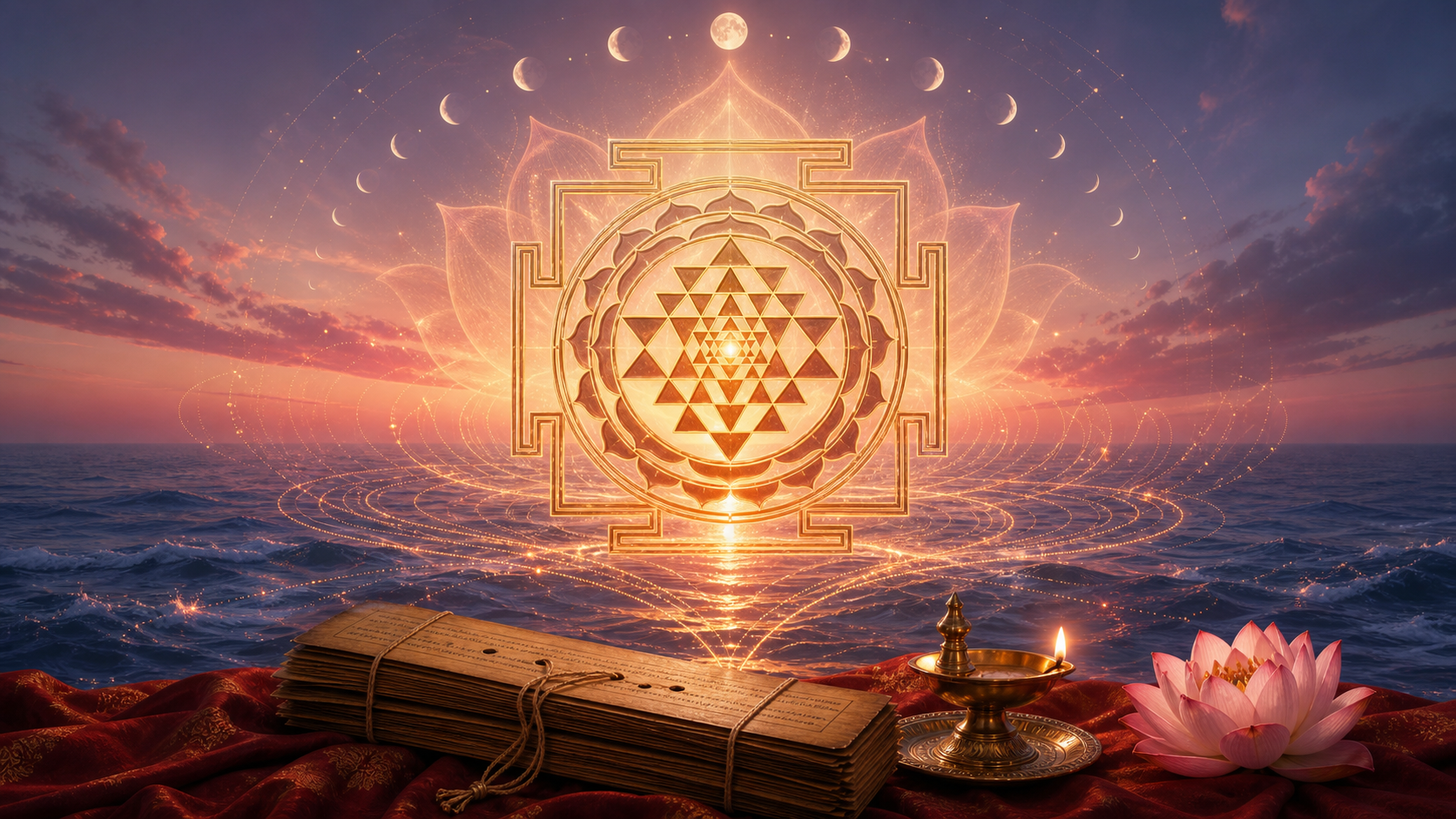
The Sri Vidyarnava Tantra, also written as Śrīvidyārṇava Tantra, stands among the most expansive Sanskrit compendia associated with Sri Vidya, the Shakta tradition centered on Lalita Mahatripurasundari. It brings together theology, mantra theory, sacred geometry, initiation, meditation, ritual embodiment and the worship of numerous divine forms. Its scale explains why practitioners frequently approach it as an authoritative reference work, while scholars value it as evidence for the organization and transmission of medieval tantric knowledge.
The first encounter with the text can feel like standing at the shore of an ocean whose currents move simultaneously through philosophy, liturgy, cosmology and contemplative experience. Its details are demanding, but a coherent vision gradually emerges: bodily form, sacred sound, geometric pattern and consciousness are not treated as separate domains. They are mutually corresponding expressions of Shakti.
What the title Sri Vidyarnava means
The title combines Sri, suggesting auspiciousness, radiance and the supreme Goddess; vidya, meaning knowledge but also a sacred formula associated with a goddess; and arnava, meaning ocean. “Ocean of Sri Vidya” is therefore the most natural general translation. “Ocean of Mnemonic Formulae” reflects the specialized tantric sense of vidya, although “mnemonic formula” alone does not convey the theological force of a mantra understood as the sonic body of a deity.
Traditional editorial discussions offer a second nuance: the title can mean an ocean of Sri Vidya as a complete tradition or an ocean of individual vidyas connected with Mahatripurasundari and other goddesses. Both interpretations suit the work. It expounds a central Sri Vidya system while preserving a remarkable range of mantra lineages, ritual classifications and divine forms.
What kind of book is it?
Calling the Sri Vidyarnava Tantra a “textbook” is useful only if the word is understood in a premodern sense. It is not a beginner’s course with definitions, exercises and a simple progression. It is closer to an encyclopedic ritual digest: a layered repository intended for readers who already possess a conceptual vocabulary, access to a living lineage and the ability to distinguish general doctrine from restricted ritual instruction.
Many Tantras employ a sustained revelatory dialogue between Shiva and Parvati. The Sri Vidyarnava retains inherited dialogical and scriptural idioms, yet its dominant character is compilatory. It gathers, arranges and reconciles material associated with multiple streams of tantric worship. This helps explain abrupt transitions, repeated procedures and chapters whose contents do not always correspond to modern expectations of a neatly bounded subject.
The word Tantra should also be read carefully. In this setting it denotes a scripture, a regulated system and a body of practical knowledge. The text cannot be reduced to occultism, sexuality or spectacular rites. Its central concerns include disciplined worship, the transformation of perception, the relation between sound and manifestation, and the recognition of consciousness as inseparable from divine power.
Sri Vidya and Mahatripurasundari
Sri Vidya is an initiatory Shakta tradition in which the supreme reality is contemplated as Lalita Tripurasundari or Mahatripurasundari, the beautiful and sovereign Goddess of the threefold cosmos. She is not merely one deity within a larger pantheon. In the tradition’s highest theological register, she is consciousness, creative freedom and the power through which the universe appears, endures and returns to its source.
The name Tripura, literally “three cities” or “three realms,” supports many correlated interpretations. Sri Vidya exegetes connect it with creation, preservation and dissolution; waking, dream and deep sleep; knower, knowledge and known; body, speech and mind; or will, knowledge and action. These correspondences are not arbitrary puzzles. They train the practitioner to recognize a single consciousness operating through apparently different levels of experience.
Shiva and Shakti consequently represent distinguishable but inseparable dimensions of reality. Shiva signifies luminous awareness, while Shakti signifies awareness as self-manifesting power. The distinction is pedagogical rather than an ultimate division. Sri Vidya worship seeks not the rejection of the world but a transformed vision in which manifestation is recognized as dependent upon, and pervaded by, consciousness.
The architecture of thirty-six “breaths”
The work is traditionally divided into two halves, the Purvardha and Uttarardha. Each contains eighteen chapters, producing a total of thirty-six. The chapters are called shvasas, or “breaths.” The designation is symbolically appropriate for a tradition in which revelation, mantra and breath are intimately related, but the divisions do not always mark clean changes of topic. A discussion may begin in one breath and continue into the next.
The Purvardha concentrates on Mahatripurasundari and the three interrelated levels of her worship: sthula, the gross or visible form; sukshma, the subtle or sonic form; and para, the supreme form as consciousness. Its subjects include the Sri Chakra, mantra structures, deities of the enclosures, the Nityas, forms of nyasa, qualifications of guru and disciple, initiation, and the ritual correspondences linking the body with the cosmos.
The Uttarardha broadens the field to other gods and goddesses and to practices inherited from multiple tantric sources. Editorial descriptions specifically note attention to Ekajata, Tara, Nilasarasvati and Mañjughosha, divine forms important in Buddhist tantric environments as well as in wider Indic religious history. Its concluding material returns to instruction concerning Mahatripurasundari, reinforcing her position as the compendium’s organizing center.
This structure makes the text both focused and inclusive. It is devoted primarily to Sri Vidya, yet it presents that tradition within a broader tantric universe rather than as an isolated sectarian island. References to Shaiva, Shakta, Vaishnava, Ganapatya, Saura and Buddhist forms reveal patterns of transmission, adaptation and shared ritual vocabulary without erasing the doctrinal differences among those communities.
Authorship and the problem of dating
Printed editions and library catalogues traditionally attribute the compilation to Sri Vidyaranya Yati. The internal presentation emphasizes a guru lineage more clearly than a personal biography. The compiler does not provide the kind of information that would satisfy modern historical expectations regarding parentage, birthplace or a securely datable career. The name Vidyaranya, moreover, functioned as a monastic or honorific name and was not unique to one individual.
Some traditional circles identify the compiler with the celebrated fourteenth-century Vidyaranya associated with the Sringeri Sharada Peetham and the Vijayanagara period. Other accounts distinguish the tantric compiler from that historical figure and connect him with a lineage descending through Pragalbhacharya and Vishnu Sharma. Dates proposed for the work consequently range from approximately the eleventh century to the later medieval period. The evidence does not justify presenting any one identification as universally settled.
The academically responsible formulation is therefore precise but modest: the received Sanskrit text is attributed to Vidyaranya Yati, belongs to a medieval tantric intellectual environment, and preserves materials that may be older than the final compilation. Determining the age of an individual passage is a different problem from dating the compilation as a whole.
Publication and manuscript history
A major printed edition was prepared by Ram Chandra Kak and Harabhatta Shastri and issued in Srinagar in parts during the 1930s. Deccan College records identify the first-volume material with a 1932 publication date, while bibliographic records also document the completed 1937 edition. A later Sanskrit edition edited by Ram Kumar Rai appeared from Prachya Prakashan in Varanasi in 1986 as part of the Varanasi Tantra Texts Series.
The location of the early printed edition does not establish a Kashmiri origin for the entire work. It demonstrates that manuscripts were available to the editors and that Kashmir’s scholarly institutions played an important role in preserving and publishing tantric literature. Manuscript transmission frequently crosses the geographic boundaries that modern readers are tempted to treat as origins.
Modern Sanskrit-Hindi editions may extend across several physical volumes because they include the root text, translation and explanation. Telugu reproductions and digital scans also circulate. Their pagination and textual accuracy are not always identical. A citation should therefore name the edition, volume, chapter and, where possible, verse rather than relying on a page number taken from an unidentified PDF.
The three levels of worship: form, sound and consciousness
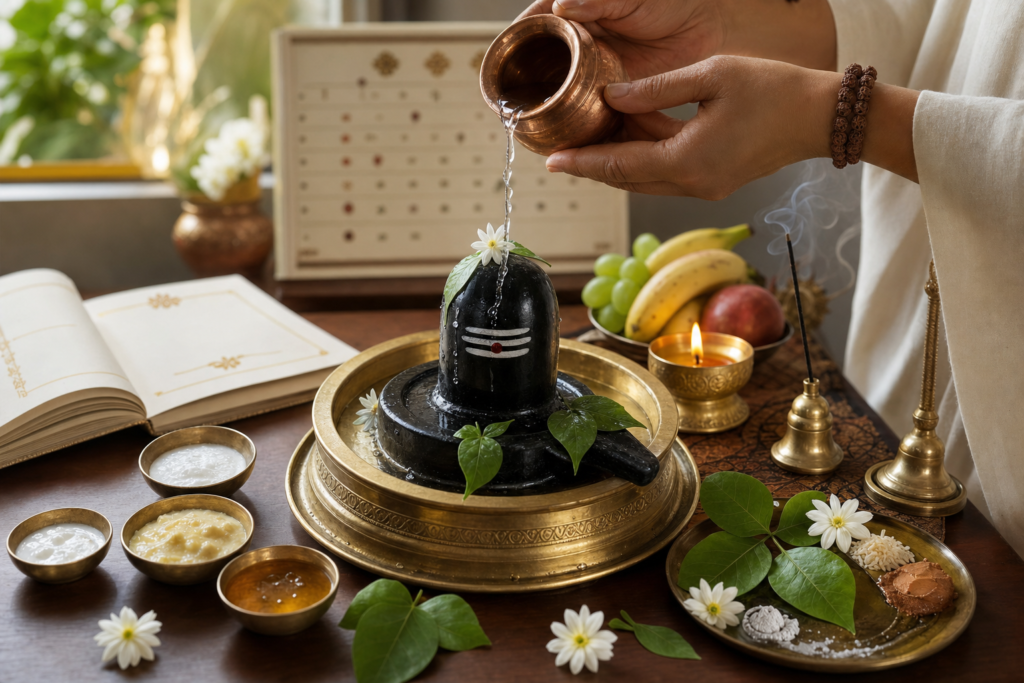
Sthula worship addresses the perceptible level. It includes the iconographic form of the Goddess, physical offerings, ritual implements, the drawn Sri Chakra and the three-dimensional Meru. “Gross” does not mean spiritually inferior or crude. It means accessible to the senses. Matter becomes a disciplined support for attention when its colors, proportions, directions, substances and gestures are organized according to sacred correspondences.
Sukshma worship concerns mantra, seed syllables, phonemic powers and interior visualization. At this level, the deity is approached as sound before she is approached as an external image. Sanskrit letters are treated as matrikas, “mothers” from which articulated language and differentiated manifestation arise. A mantra is consequently not regarded as an ordinary sentence about the Goddess; it is a disciplined sonic form through which her presence is contemplated.
Para worship concerns the supreme identity of the Goddess with universal consciousness. External worship and mantra are internalized until the apparent separation among worshipper, act of worship and worshipped deity is understood as provisional. This movement does not necessarily abolish ritual. It reveals the nondual meaning that ritual was designed to embody.
The three are best understood as nested modes rather than mutually exclusive schools. Form gives stability to attention, sound refines that attention, and contemplation reveals the consciousness within which both appear. The sophistication of the Sri Vidyarnava Tantra lies in its insistence that these modes can be correlated without being confused.
Sri Chakra: sacred geometry as a map of reality
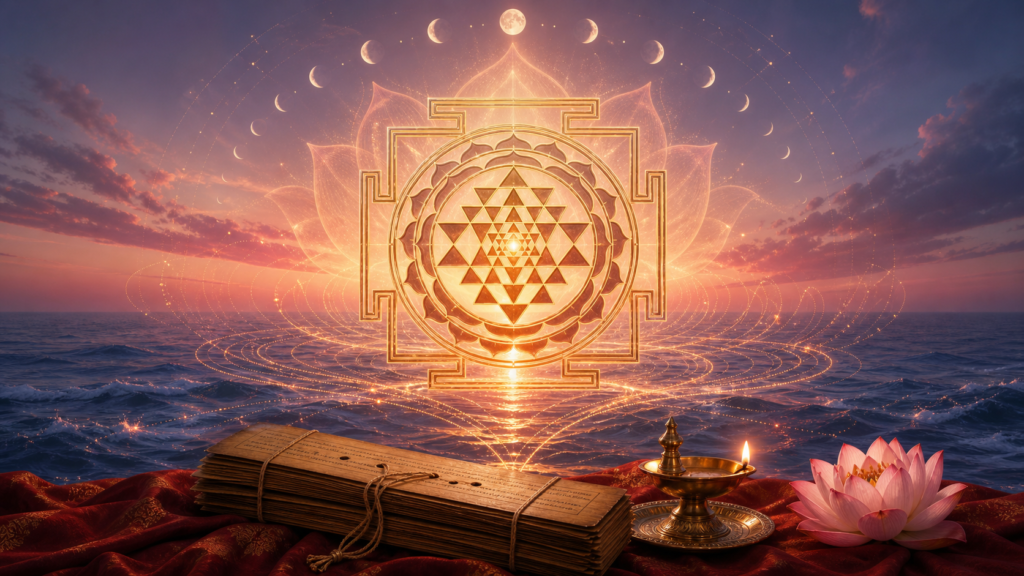
The Sri Chakra, also called the Sri Yantra, is the best-known visual expression of Sri Vidya. It contains an outer square or bhupura, lotus circles, interpenetrating triangles and a central bindu. Four principal triangles are associated with Shiva and five with Shakti. Their intersection generates the field of smaller triangles through which the unity of consciousness appears as an ordered cosmos.
Standard accounts identify nine enclosures or avaranas. From the exterior inward, these are Trailokyamohana, the enclosure that enchants the three worlds; Sarvashaparipuraka, associated with the fulfillment of aspirations; Sarvasamkshobhana, the power of transformative stirring; Sarvasaubhagyadayaka, the bestower of auspiciousness; and Sarvarthasadhaka, the accomplisher of meaningful aims.
The inward progression continues through Sarvarakshakara, associated with protection; Sarvarogahara, associated with the removal of affliction; Sarvasiddhiprada, the bestower of accomplishment; and Sarvanandamaya, the locus of complete bliss at the bindu. Transliteration and the wording of English glosses vary among editions and lineages, but the centripetal movement remains fundamental.
The familiar statement that nine large triangles produce forty-three smaller triangles is geometrically standard. Some popular explanations speak of forty-four constituent loci by counting the bindu separately. The difference is usually one of counting convention, not a dispute over the basic diagram. Greater variation occurs in the exact construction, orientation and ritual population of the enclosures, which is why lineage-specific diagrams should not be treated as interchangeable.
The text also discusses flat bhupresthara forms and raised Meru forms. Their materials, dimensions and elevation are ritually significant in the transmitted system. Such prescriptions show that a yantra is not merely decorative geometry. It is a consecrated matrix whose lines, levels, deities, mantras and acts of attention form a single ritual environment.
At the contemplative level, the Sri Chakra can be read simultaneously as cosmos, divine body and human body. Moving inward represents the withdrawal of attention from multiplicity toward its source; moving outward represents manifestation from the bindu into differentiated experience. Sri Vidya traditions may call these movements samhara and srishti, with a stabilizing sthiti sequence between them.
Mantra, vidya and the three kutas
An influential editorial explanation distinguishes mantra as a sacred formula associated with a male deity from vidya as one associated with a goddess. That distinction is useful within this textual setting, although Sanskrit tantric literature does not enforce it consistently. In many sources, mantra remains the broad category and vidya designates a particular goddess mantra or the awakened knowledge embodied by it.
The best-known Sri Vidya formula is the fifteen-syllable Panchadashi, arranged in three sections called kutas: Vagbhava, Kamaraja and Shakti. These are correlated with speech and knowledge, desire and sustaining power, and the culmination of divine energy. They are also connected with divine pairs and with multiple triads operating across the body and cosmos. The Sri Vidyarnava gives particular prominence to Kamaraja-related transmission.
The compendium’s editorial tradition identifies twenty-five major variants associated with Manu, Chandra, Kubera, Lopamudra, Kamaraja, Agastya, Nandi, Surya, Vishnu, Kumara, Shiva, Durvasas, Shakra, Unmani, Varuna, Dharmaraja, Anala, Nagaraja, Vayu, Budha, Ishana, Rati, Narayana, Brahma and Brihaspati. The list demonstrates the text’s encyclopedic ambition and the plurality preserved within Sri Vidya rather than a single universally standardized formula.
The restricted syllables themselves need not be reproduced in a general introduction. Traditional practice treats pronunciation, accent, sequence, visualization and initiation as an integrated transmission. A string copied from an unreliable scan is not equivalent to a mantra received and interpreted within its ritual grammar.
Matrika, nada, bindu and the theology of sound
The matrikas are letters contemplated as generative powers. Technical studies citing the Sri Vidyarnava Tantra identify a large number of Matrika and nyasa systems connected with Tripura, Ganesha, Yoginis, sacred seats, the Mahavidyas and other divine forms. The alphabet is therefore treated not as a neutral instrument imposed on reality but as a graded manifestation of sound-consciousness.
Tantric sound theory commonly moves through concepts such as nada, subtle vibratory emergence; bindu, concentrated potential; and bija, a seed syllable in which a divine power is ritually condensed. These categories connect metaphysics with practice. Creation, language, mantra recitation and the return of thought to silence become different scales of one process.
Nyasa and the transformed ritual body
Nyasa literally indicates placing or installation. In tantric worship it generally means placing mantras, letters or divine powers upon designated regions of the body through recitation, touch and visualization. The aim is not theatrical symbolism. Nyasa reconstructs ordinary bodily awareness as a sacred field and prepares the practitioner to approach the Sri Chakra as something already reflected within embodied consciousness.
The many forms of nyasa documented in the text show how carefully Sri Vidya correlates phonemes, deities, limbs, directions, cosmic principles and ritual functions. Anga-nyasa installs power in the limbs, while Matrika forms map the alphabet onto the body. Other systems encode specific deities or lineages. Their complexity is one reason that the work cannot responsibly be converted into a short, universal do-it-yourself ritual.
Mudra, meditation, breath regulation, purification of the elements, mantra recitation, offerings and fire ritual appear within the same ritual ecology. A mudra is not merely a hand sign, nor is visualization an optional imaginative supplement. Each functions as one channel through which body, speech and mind are aligned with the invoked divine pattern.
Guru, disciple and seven modes of initiation
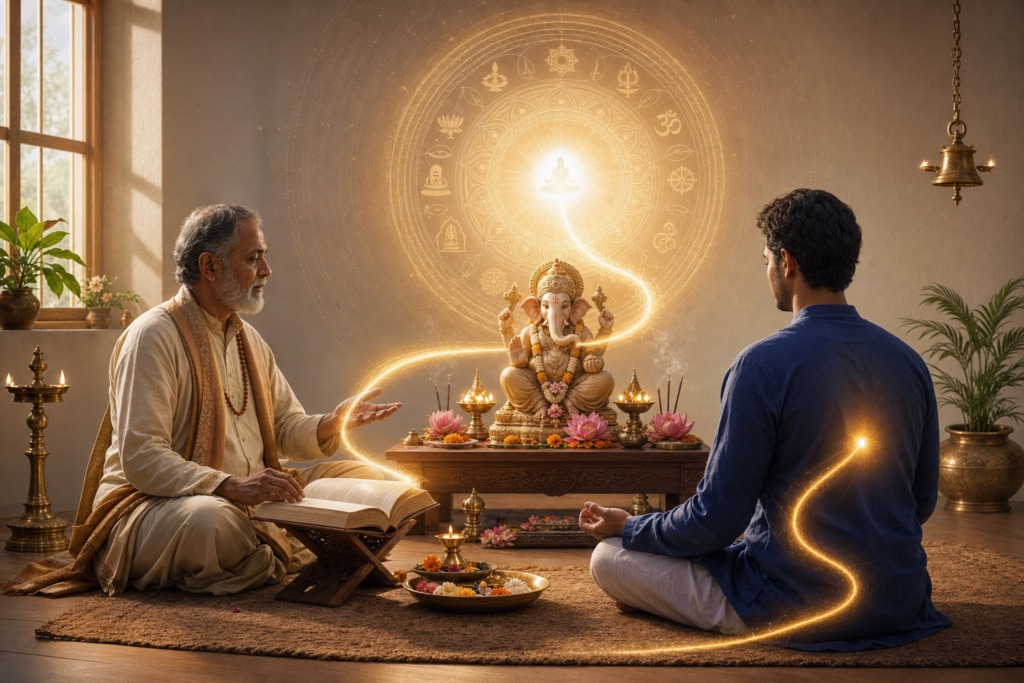
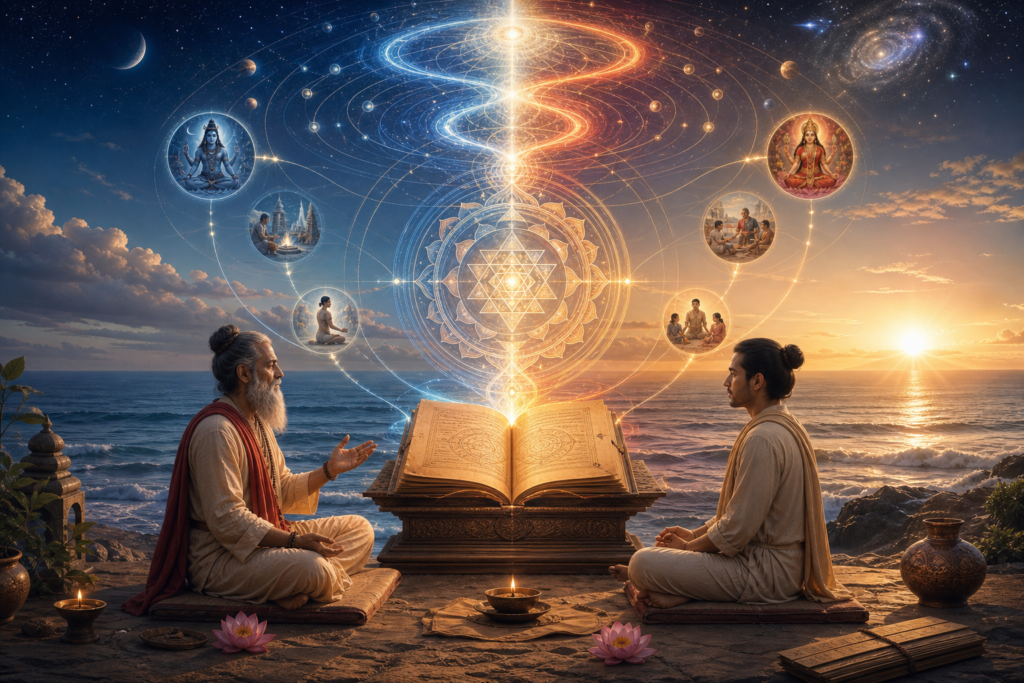
The Sri Vidyarnava Tantra treats the guru-disciple relationship as structurally essential. A qualified guru is expected to possess knowledge, disciplined practice and competence in mantra, meditation, worship and instruction. The disciple is likewise assessed for steadiness, ethical preparation and capacity. Initiation, or diksha, makes a mantra part of a transmitted discipline rather than an isolated verbal object.
A modern academic study citing the thirteenth chapter identifies seven modes of initiation: varna-diksha, kala-diksha, vedha-diksha, sparsha-diksha, vak-diksha, drishti-diksha and shambhavi-diksha. These employ, respectively, such principles as letters, cosmic powers, inward penetration, touch, speech, sight and direct contemplative transmission. Their presence indicates a highly developed theory of how sacred knowledge is embodied and communicated.
Traditional guidance also protects textual integrity. Seed syllables are unusually vulnerable to copying errors, and ritual instructions often presuppose information supplied orally. The need for guidance should therefore be understood not simply as social gatekeeping but as a method of preserving pronunciation, sequence, context and ethical accountability.
The Nityas and the sacralization of time
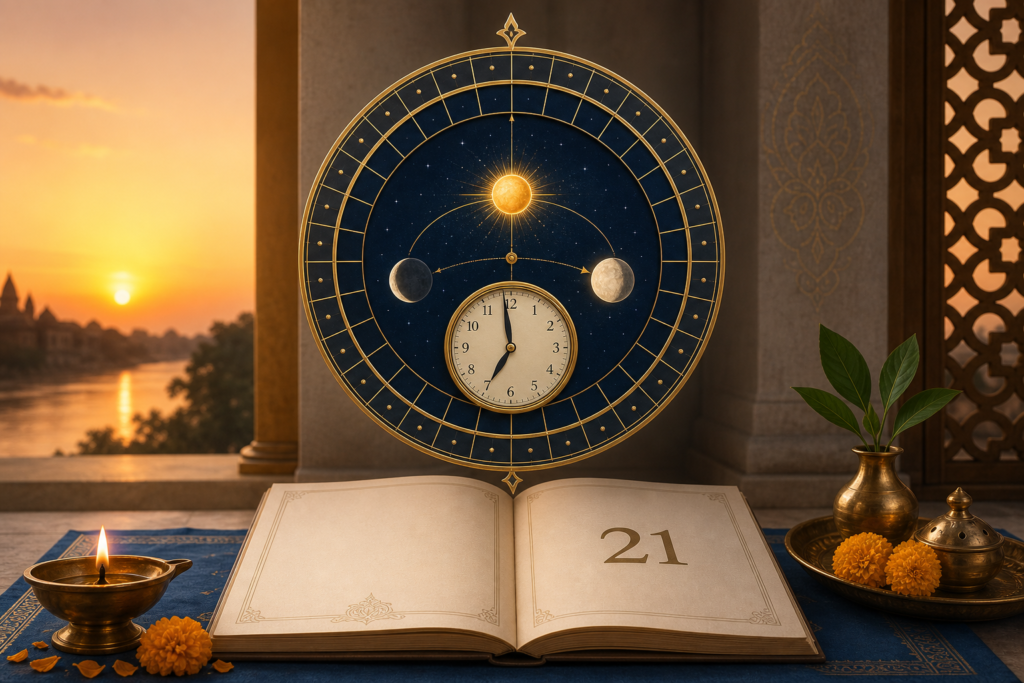
The Nityas are lunar goddesses associated with the tithis, or lunar days. Sri Vidya commonly recognizes fifteen Nityas corresponding to the waxing phases, with Lalita representing the sixteenth fullness beyond their sequence. Each Nitya may possess a mantra, yantra, visualization, attendants and ritual context. Time is thereby personified and contemplated as the rhythmic unfolding of Shakti.
The lunar cycle also corresponds to breath, phonemic power and the Sri Chakra. Such correspondences do not function as modern scientific equations. They create a contemplative system in which bodily rhythm, celestial time and ritual order become mutually illuminating. The practitioner is invited to experience time not merely as depletion but as a recurring manifestation of the eternal Goddess.
The broad ritual sequence
Although individual procedures vary, the compendium reflects a recognizable tantric architecture. Preparation and purification establish ritual fitness; the guru lineage and obstacle-removing powers are honored; the body is sacralized through nyasa; the deity and her retinue are invoked in a suitable support; offerings, mantra and meditation intensify the relationship; and the invoked form is finally interiorized or respectfully concluded.
External and internal worship are not rivals within this architecture. External worship trains precision, reverence and attention through material forms. Internal worship relocates the same altar, offerings and divine assembly within consciousness. The highest interpretation recognizes that the capacity to worship, the object of worship and the awareness joining them all arise through Shakti.
A pantheon wider than one goddess
The Sri Vidyarnava contains or cites material connected with Ganesha, planetary powers, constellations, Yoginis, sacred seats, Matrikas, the Nityas and numerous goddess traditions. Technical catalogues also cite it for forms associated with the ten Mahavidyas, including Kali, Tara, Shodashi, Bhuvaneshvari, Bhairavi, Chinnamasta, Dhumavati, Bagalamukhi and Matangi. This breadth supports its reputation as a major compendium of tantric sadhana.
Modern teachers sometimes describe its range through the categories Kaula, Mishra and Samaya, or through right-hand, mixed and left-hand orientations. These labels are useful only with caution. Their meanings change across periods and lineages, and they should not be converted into a simplistic scale from respectable to disreputable. The text’s importance lies partly in preserving distinctions that later summaries often flatten.
Premodern prescriptions and responsible interpretation
Like many premodern scriptures, the transmitted text contains social assumptions that modern readers may find restrictive. Academic studies cite passages differentiating access to mantras according to caste, gender and social status. The same body of material can also assign unusual authority to a female preceptor in particular contexts. These tensions should be documented rather than concealed or treated as timeless mandates.
A historically informed reading distinguishes description from endorsement. Contemporary spiritual communities committed to dignity and unity may study such passages as evidence of their period while interpreting practice through non-harm, equality, consent and respect for all persons. Fidelity to a tradition does not require pretending that every social regulation found in every recension has remained unchanged.
Some tantric compendia also preserve rites directed toward control, hostility or extraordinary worldly aims. Their historical presence should not be sensationalized, but neither should it be converted into operational instruction. No sacred text justifies coercion, abuse, unlawful conduct or harm. The enduring philosophical and contemplative value of Sri Vidya is most coherently approached through self-discipline, clarity, compassion and responsibility.
What the text reveals about Dharmic plurality
The attention given to Tara, Ekajata, Nilasarasvati and Mañjughosha is especially valuable for comparative study. Hindu and Buddhist tantric communities shared regions, technical vocabularies, pilgrimage networks and ritual technologies while maintaining distinct philosophical frameworks. The evidence points to historical exchange and creative adaptation, not to the claim that all traditions were identical.
This distinction supports genuine unity among Dharmic traditions. Respect becomes stronger when similarities are acknowledged without appropriating differences. Buddhism is directly relevant to the textual comparison; Jainism and Sikhism are not principal subjects of the Sri Vidyarnava Tantra and should not be inserted artificially into its ritual history. Their ethical and spiritual contributions can be honored without making unsupported claims of textual dependence.
Related texts and essential distinctions
The Sri Vidyarnava Tantra should be studied beside, but not confused with, the Tantraraja Tantra, Yogini Hridaya, Nityashodashikarnava, Bhavanopanishad, Parashurama Kalpasutra, Kamakalavilasa and Lalita Sahasranama. These works illuminate overlapping dimensions of Sri Vidya, including the Sri Chakra, Nityas, internal worship, mantra and the identity of body with sacred geometry. Each nevertheless has its own textual history and ritual emphasis.
It must also be distinguished from Tantratattva, translated into English as Principles of Tantra. That work is associated with the modern Bengali Shakta scholar Shiva Chandra Vidyarnava Bhattacharya. In his name, “Vidyarnava” is an honorific; it does not make Principles of Tantra an English translation of the medieval Sri Vidyarnava Tantra.
Similar titles such as Kularnava Tantra, Jnanarnava Tantra and Tripurarnava also use the ocean metaphor. A digital search that omits the complete Sanskrit or English title can easily merge unrelated works. Accurate cataloguing requires attention to title, attributed compiler, editor, language, volume and publication date.
How to study the Sri Vidyarnava Tantra intelligently
A productive academic reading operates on four levels. The philological level examines vocabulary, grammar, variant readings and citations. The ritual level reconstructs the sequence and function of practices. The symbolic level studies correspondences among deity, body, sound and diagram. The historical level asks how materials from different schools were collected and how manuscripts moved across regions.
The first practical tool is a glossary. Terms such as vidya, mantra, bija, nyasa, avarana, mudra, diksha, bhavana, kuta, bindu and Nitya carry specialized meanings. Translating each with a single English word can obscure relationships that become visible only after repeated use.
The second tool is a diagram keyed to the relevant edition. The Sri Chakra’s enclosures, lotus petals, triangles and bindu become more intelligible when the reader tracks their names, resident powers and ritual order visually. A diagram should assist textual study, not replace it, because attractive modern images may silently combine features from different lineages.
The third tool is source comparison. When the compendium cites or parallels another Tantra, the reader should inspect that source where possible. This reveals whether the compiler quoted, abbreviated, rearranged or reinterpreted earlier material. It also prevents every idea appearing in the anthology from being attributed uncritically to a single historical moment.
The fourth tool is textual caution. OCR frequently misreads Devanagari ligatures, diacritical marks and seed syllables. A searchable PDF is useful for discovery but insufficient for establishing a mantra or difficult verse. The scan, a printed edition and, when available, a second manuscript or scholarly edition should be compared before drawing conclusions.
Can the rituals be practiced directly from the book?
The text can be read for history, philosophy and comparative religion without ritual initiation. Performing its advanced practices is a different matter. Traditional Sri Vidya regards initiation and competent guidance as necessary because instructions may be abbreviated, lineage-specific or deliberately dependent upon oral explanation. Reading establishes familiarity; it does not automatically confer ritual authority or proficiency.
General devotional acts such as respectful prayer, ethical self-discipline and non-secret contemplation should not be confused with the specialized installation of mantras and deities. A responsible teacher should be able to explain lineage, prerequisites, aims, boundaries and ethical obligations without using secrecy to demand money, obedience, sexual access or isolation from trusted relationships.
Is the Sri Vidyarnava Tantra a scientific manual?
It is a sophisticated technical work, but “technical” does not mean scientific in the modern experimental sense. Its classifications of sound, body, lunar time and consciousness belong to a ritual and contemplative knowledge system. Claims concerning supernatural accomplishments or guaranteed material results are matters of traditional belief and have not been established as reproducible scientific findings.
This distinction does not diminish the text’s intellectual value. It permits a clearer appreciation of its actual achievements: systematic ritual classification, intricate symbolic reasoning, preservation of multiple lineages, a powerful theory of embodied worship and a sustained attempt to integrate plurality within a unified vision of consciousness.
Why the text remains important
The Sri Vidyarnava Tantra remains important because it records how Sri Vidya turns theology into a complete discipline of perception. The Goddess is contemplated through image, diagram, sound, breath, teacher, body, lunar rhythm and finally consciousness itself. No single element is allowed to stand alone; each points toward the same sacred center.
For historians, the work preserves evidence of textual compilation, ritual plurality and exchange across Indic traditions. For students of Sanskrit, it offers a demanding vocabulary of mantra and liturgy. For practitioners, it demonstrates the precision expected of a serious sadhana. For general readers, it corrects the misconception that Tantra is an irrational collection of exotic rites detached from philosophy.
Its deepest lesson is structural rather than sensational. Diversity need not imply fragmentation. Many deities, formulas, diagrams and methods can be arranged around a unifying insight without losing their distinctive functions. That insight gives the “ocean” metaphor its enduring force: countless currents remain visible, yet all belong to a larger body of sacred knowledge.
Research and textual basis
This overview expands upon the original Sri Vidyarnava Tantra introduction and checks its principal claims against bibliographic and scholarly resources. Edition details are documented by CiNii Books, Google Books and the Deccan College digital repository. Technical discussions of mantra, yantra, Matrika worship, initiation and the Nityas may be compared with the University of Mumbai study Devi Tantra, Mantra, Yantra. These resources should supplement, rather than replace, consultation of the Sanskrit text and its traditional commentarial setting.
Inspired by this post on Hindu Pad.



Leave a Reply
You must be logged in to post a comment.