
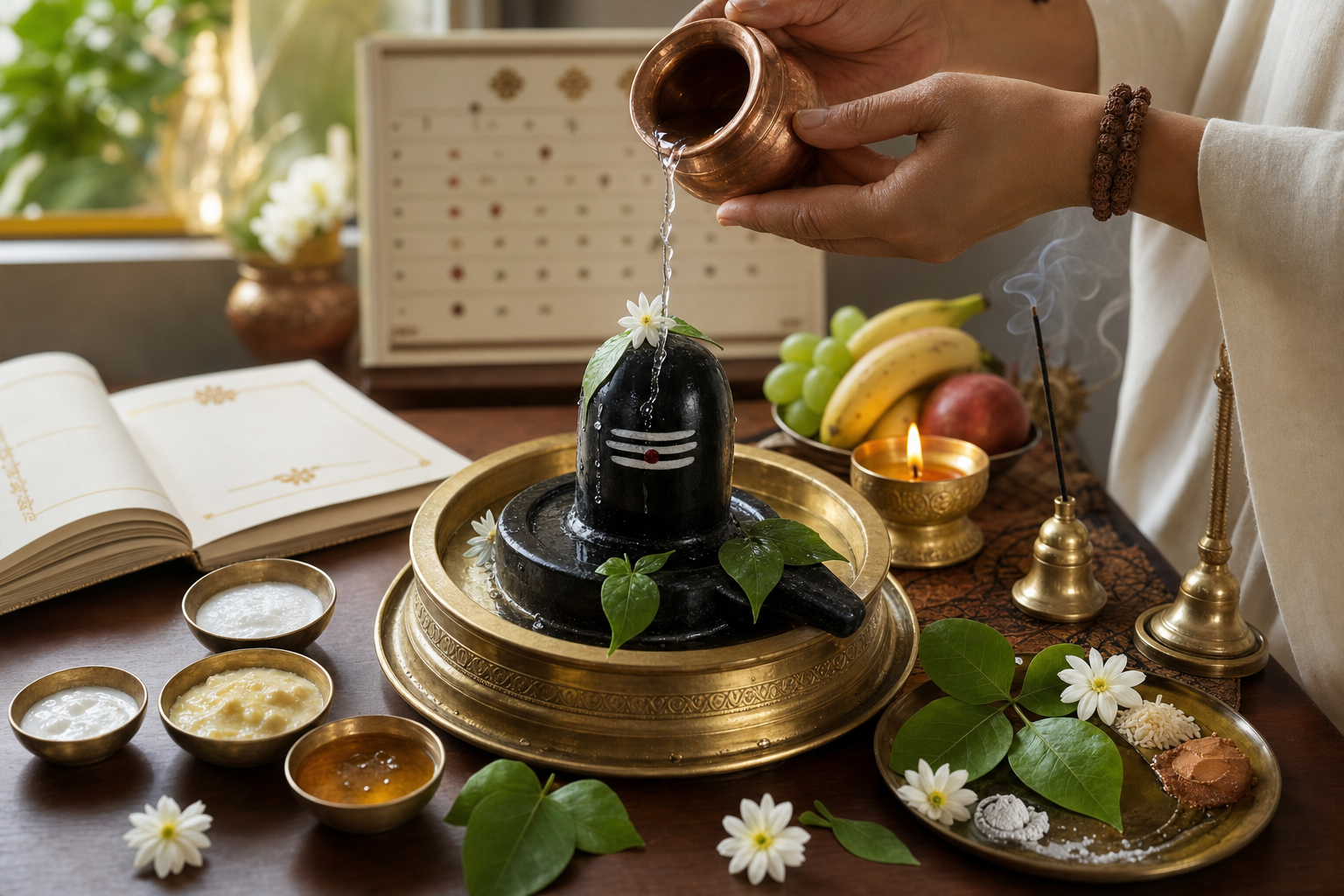
Shravan Somvar Vrat is a devotional observance dedicated to Lord Shiva on the Mondays that fall within Shravan, or Shravana, month. Across many Hindu communities, these Mondays bring together upavasa, Shiva puja, mantra recitation, ethical restraint, charity, and quiet reflection. The practice is especially prominent in North India and is also observed through Marathi, Gujarati, Telugu, and Kannada calendrical traditions. Its visible forms vary, but its central purpose remains remarkably consistent: attention is withdrawn from routine distractions and directed toward Shiva through disciplined devotion.
For many households, Shravan Somvar is emotionally memorable because its rituals are simple enough to enter ordinary life. The sound of water falling over a Shivalinga, the fragrance of incense, the cool touch of bilva leaves, and the repetition of a familiar mantra can transform an otherwise busy Monday into a period of composure. Such experiences help explain why the vrata continues across generations even when families move between regions, languages, or countries.
What this guide covers
This guide develops the brief source post into a complete Shravan Somvar Shiva Puja procedure for household use. It explains the calendar, vrat options, required and optional materials, ritual sequence, mantras, symbolism, safety considerations, regional variation, and the proper use of the accompanying PDF. It does not claim that one standardized procedure governs every Shaiva, Smarta, regional, family, or temple tradition. Where a family sampradaya or qualified purohita supplies a different vidhi, that inherited practice normally takes precedence.
Shravan, Shravana, Sawan, Somvar, and Somavara
Shravan, Shravana, and Sawan are regional forms of the lunar month name, while Somvar and Somavara refer to Monday. Consequently, Shravan Somvar Vrat, Sawan Somvar Vrat, and Shravana Somavara Vratham can describe closely related observances expressed through different linguistic traditions. Variations in spelling do not necessarily indicate different vows, although the detailed rites and dietary rules may differ by region and lineage.
Why the dates differ between calendars
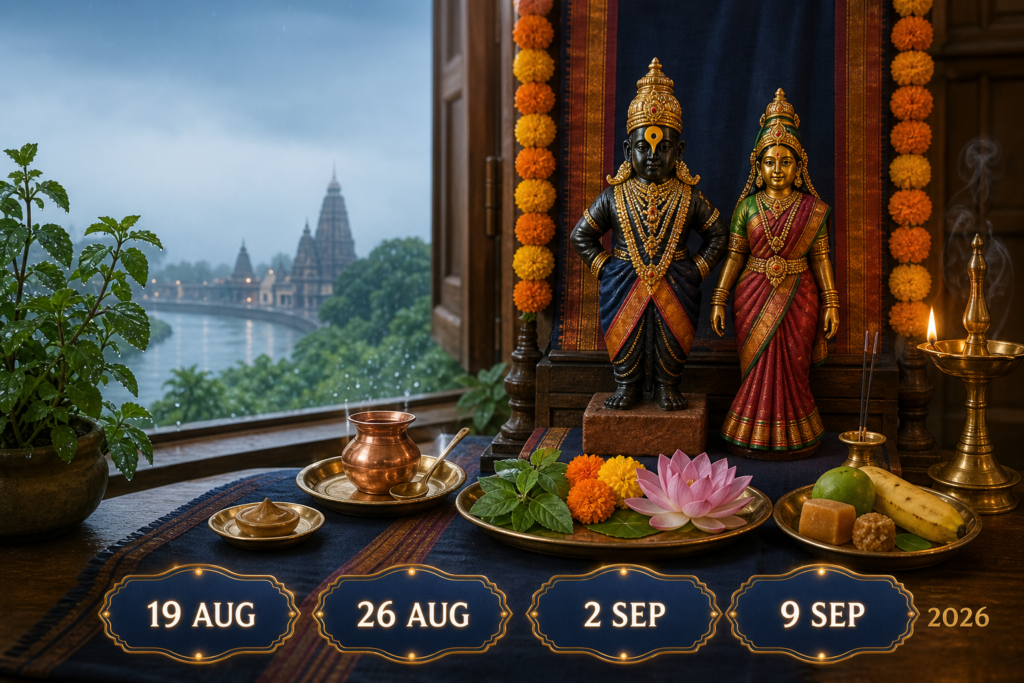
The dates must be determined through a location-specific panchang rather than copied uncritically from a general article. In the purnimanta system, widely followed in much of North India, a lunar month concludes at the full moon. In the amanta system, followed in Maharashtra, Gujarat, Karnataka, Andhra Pradesh, Telangana, and several other regions, it concludes at the new moon. Shravan may therefore begin roughly a fortnight apart in the two systems, even though both calculations belong to established Hindu calendrical traditions. A solar-month convention can create further regional differences. A current location-adjusted Shravan Somvar calendar should be checked for the applicable year and place.
A reliable practical rule is to identify the calendar used by the household or temple and observe the Mondays that fall within its recognized Shravan month. Sunrise, lunar tithi, and local time zone can affect a date, particularly outside India. A calendar prepared for Delhi, Mumbai, Toronto, London, or another city should not automatically be applied everywhere else.
Vrat as more than food restriction
The Sanskrit concept of vrata denotes a chosen religious discipline or vow. Upavasa, commonly translated as fasting, literally carries the sense of dwelling near and is traditionally understood as drawing the mind closer to the sacred. Food restraint can support that purpose, but hunger by itself does not complete the observance. Truthfulness, moderation, non-harm, patience, cleanliness, study, japa, and compassion are equally meaningful dimensions of Shravan Somvar Vrat.
Devotional literature commonly associates sincere Shiva worship with grace, peace, prosperity, purification, or liberation. These are theological and experiential claims within the tradition, not measurable guarantees that a particular ritual will produce wealth, marriage, employment, or another desired result. A mature sankalpa may include a legitimate personal aspiration while remaining open to wisdom, ethical conduct, and the welfare of others.
Choosing an appropriate level of observance
Some devotees undertake nirjala upavasa without food or water; others take water, milk, fruit, or a simple phalahara diet; still others eat one sattvic meal after worship. Another valid household approach is to avoid intoxicants, anger, harsh speech, and indulgent food while maintaining medically necessary meals. No single fasting pattern should be presented as universally obligatory. Family custom, spiritual guidance, age, occupation, climate, medication, pregnancy, and health all require consideration.
Religious enthusiasm should never be used to conceal physical distress. People with diabetes, kidney disease, eating disorders, recurrent fainting, pregnancy-related concerns, or medicines affected by meal timing should consult a qualified healthcare professional before fasting. The United States National Institute of Diabetes and Digestive and Kidney Diseases notes that fasting can expose people with diabetes to hypoglycemia, hyperglycemia, dehydration, and medication-related complications; advance planning is therefore important. Its medical guidance on fasting safely provides useful background. Breaking a fast to protect health is not a devotional failure.
Core puja materials
A simple home puja requires a clean image or household Shivalinga, a stable tray, clean water, a small vessel or spoon for abhisheka, a lamp, a safe fuel or candle appropriate to the household, flowers or bilva leaves when available, incense if ventilation permits, and a modest vegetarian naivedya. A clean cloth, sandalwood paste, vibhuti, akshata, a bell, and a separate cup for achamana or offering water may also be kept ready. Materials should be arranged before the sankalpa so that the worship can proceed without hurried interruptions.
Panchamrita may be prepared in a very small quantity. The source PDF describes milk, ghee, curd, honey, and coconut water, while many other traditions use sugar in place of coconut water. This variation illustrates why panchamrita should not be treated as a chemically fixed recipe across all regions. Plain clean water remains sufficient for a simple jalabhisheka, and costly ingredients are not a measure of devotion.
Optional materials include a cotton yajnopavita or garland, betel leaf and nut, camphor, additional fruits, and flowers for archana. Gauri Puja may use a small turmeric form in traditions where this is customary. Worship of Nandishwara, Veerabhadra, Kartikeya, Kubera, Keerthimukha, or Sarpa is identified as optional in the source procedure. A newcomer need not acquire every item or reproduce a temple-scale ritual at home.
Hygiene, conservation, and household safety
Abhisheka materials are sacred offerings, but their use should also be hygienic and proportionate. A few spoonfuls are adequate for home worship. Dairy mixtures should not be allowed to remain at room temperature for extended periods, poured over electrical decorations, or sent in large quantities into plumbing. Only uncontaminated, safely handled offerings should be consumed. Local temple rules should be followed, and materials placed on a public or consecrated murti should be handled only by authorized temple personnel.
The lamp should rest on a heat-resistant surface away from fabric, children, and animals. Incense requires ventilation and may be omitted when smoke aggravates asthma or another respiratory condition. Camphor must never be left unattended. Any toxic plant traditionally associated with Shiva should remain outside the reach of children and animals and must not be eaten merely because it has been offered ritually.
Preparatory discipline on Monday
The devotee ordinarily bathes, wears clean clothing, and cleans the worship area. The altar may be oriented according to household custom, but physical direction is less important than a stable, dignified arrangement. The Shivalinga is placed in a tray that can collect liquids safely. The practitioner sits quietly, regulates the breath, and allows the purpose of the vrat to become clear before beginning.
Morning worship is common, although some households perform the principal puja in the evening after work or before breaking the fast. When an inherited rule is absent, a consistent time that permits unhurried attention is preferable to an elaborate ceremony performed anxiously. Families with children may divide responsibilities: one person prepares the lamp, another arranges bilva leaves, and another recites a name or prayer. Shared participation can preserve the vrata without turning it into a test of ritual memory.
Shravan Somvar Shiva Puja procedure: the complete sequence
Step 1 — Centering and purification: The practitioner sits before the altar, silences unnecessary devices, and takes several steady breaths. Hands are washed, and a small amount of clean water may be used for customary purification. This initial pause marks the movement from ordinary activity into ritual attention.
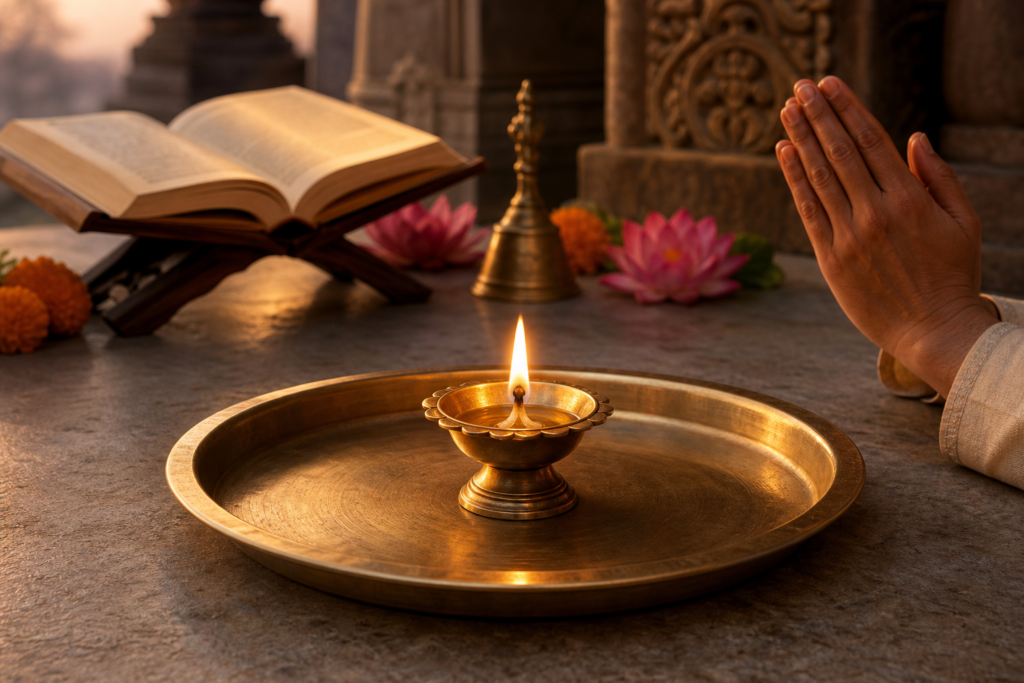
Step 2 — Deeparadhana: A lamp is lit safely to signify clarity and sacred presence. The source guide supplies the following lines exactly as written:
Sajyam cha varthi samyuktam vahnina yojitham mayaa
Deepam gruhaana devesha trilokya thimirapaham
Pari the dhanvano hethirasmaan vrunakthu vishvathah
Atho ya ishudisthavaare asmanni dehi tham
Sri sambashivaya namah deepam darshayami..
A person unable to pronounce this transliteration confidently may light the lamp with a simple prayer in a familiar language. Accuracy is worth learning patiently, but anxiety over pronunciation should not displace reverence and comprehension.
Step 3 — Sankalpam: The sankalpa states what is being undertaken, by whom, where, and for what purpose. A formal version may identify place, gotra, name, lunar tithi, vara, nakshatra, and the intended spiritual fruit. Someone unfamiliar with the full formula may state the name, location, date, and intention in a familiar language. This is preferable to reciting technical calendar details that have not been verified.
An important textual caution applies to the downloadable guide. Although it is titled as a Shravana Somavara procedure, it reproduces a formula explicitly labeled “Shivaratri Puja Sankalpa” and refers to chaturdashi and a Shivaratri fast:
“Shivaratri Vratham hyethath karishyeham mahaphalam
nirvighnam kuru devatra twatprasadath jagatpathe
chaturdashyam nirahaaro bhuthwa shambho pare hani
bhokshye ham bhukti mukthyartham saranam mebhaveshwara”
That formula should not be treated as a universal Shravan Monday sankalpa when the observance is not Shivaratri or chaturdashi. The PDF also gives the following personalized household formula:
Mama Sreeman (your gothra)….. Gothrodhbhavasya, (your name) namadeyasya, darmapathni samethasya saha kutumbaanaam dharmartha kaama moksha chaturvidha phala purushartha sidhyartham shatru jayaartham Shri samba sadashiva preethyartham bhagavatah sri sambasada shivasya pujaana maham karishye..
This wording assumes particular biographical and household details and may not fit every practitioner. A local purohita, guru, or trustworthy panchang can provide a Shravan Somvar-specific sankalpa. In the absence of such guidance, a concise statement of sincere intention is both clearer and less likely to introduce calendrical errors.
Step 4 — Guru Puja and Ganesh Puja: The source treats Guru Puja and Ganapati Puja as important preliminaries. The guru principle is remembered with gratitude for the transmission of knowledge, and Ganesha is invoked for the removal of obstacles. A brief prayer, a flower, or a small mental offering is sufficient in a simplified household procedure.
Step 5 — Gauri Puja: Some households worship Gauri or Parvati before the principal Shiva Puja. The source proposes shaping approximately five grams of turmeric into a small cone and respectfully regarding it as Gauri during the prayer. It also explicitly notes that some devotees omit this step. The instruction should therefore be understood as a regional option, not a universal requirement.
Step 6 — Optional associated devata worship: Nandishwara, Veerabhadra, Kartikeya, Kubera, Keerthimukha, and Sarpa Puja may be included according to lineage. Their omission does not invalidate a simple Shiva puja. This distinction between core and optional acts is valuable for beginners who may otherwise confuse ritual completeness with the accumulation of objects and invocations.
Step 7 — Dhyanam and inward invocation: The principal worship begins by contemplating Shiva. The source opens with the following verse:
Om Vande Shambhu Umaapatim Surgurum Vande Jagad Kaaranaam |
Vande Pannag Bhushanaam Mrigadharam Vande Pashunaam Patim|
Vande Surya Shashaak Vahninayanam Vande Mukundapriyam|
Vande Bhakta Janaashrayan Chavardham Vande Shivam Shankaram||
Dhyanam is not merely visual imagination. It gathers attention around qualities associated with Shiva: stillness, fearlessness, compassion, disciplined power, and freedom from possessiveness. A flower or akshata may be offered after contemplation. Where a tradition formally distinguishes dhyana, avahana, and asana, those steps can be performed under appropriate guidance.
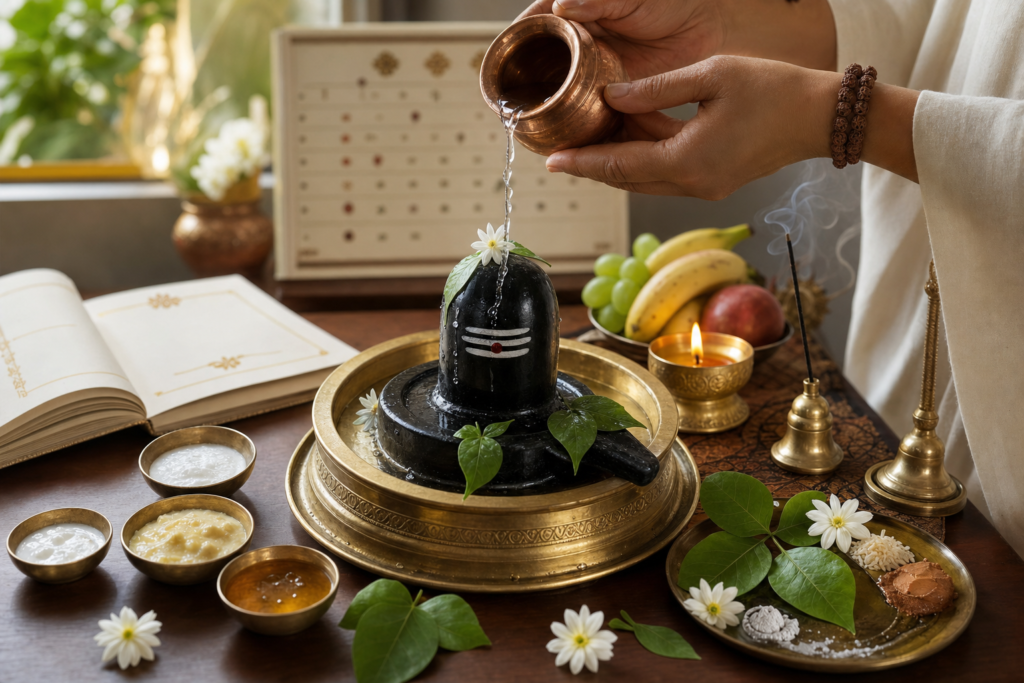
Step 8 — Shuddodaka Snanam: Clean water, Ganga water where responsibly available, or water sanctified through prayer is gently offered over the household Shivalinga. A spoon or small vessel provides better control than a large container. Water is offered slowly rather than as a display of abundance.
Step 9 — Panchamrita Snan: A small quantity of panchamrita may be poured over the Shivalinga. Each ingredient can be approached as an expression of nourishment, sweetness, refinement, and gratitude, but symbolic explanations vary among teachers. Panchamrita is optional in a simplified puja; plain water is adequate when dietary, financial, environmental, or practical concerns make dairy offerings unsuitable.
Step 10 — Second Shuddodaka Snanam and Jalabhishekam: Clean water is offered again to rinse the panchamrita. Jalabhishekam then continues slowly, often alongside japa. “Om Namah Shivaya” is a widely accessible Shiva mantra, while initiated practitioners should follow the mantra discipline received from their guru. Eleven, twenty-one, or 108 repetitions may be used as practical counts, but no numerical target should eclipse attentiveness.
Step 11 — Yagnopaveetham: The source describes the offering of a cotton yajnopavita or cotton garland, noting its particular appearance in South Indian procedures. This is optional and should follow local practice. It need not be improvised when the practitioner does not understand its role.
Step 12 — Vibhuti, Gandha, Kumkum, and Akshata: The guide lists bhasma or vibhuti, sandalwood paste, kumkum, and akshata. Customs differ regarding what may be applied directly to a Shivalinga, especially in temples. Some Shaiva traditions emphasize vibhuti and sandalwood while treating kumkum or turmeric differently. A household should follow its sampradaya, and a temple visitor should never apply substances without permission.
The source associates gandha with the following formula:
‘Lam’ Pruthvi tatwatmane Sri Sri Samba sadashiva Swamiye namah – Gandham Parikalpayami
Step 13 — Pushpam and Bilva Puja: Fresh, clean flowers and bilva leaves are offered respectfully. Damaged leaves are not a moral failure when no alternative is available, but deliberate care expresses attentiveness. Bilva is especially associated with Shiva worship, and its three leaflets have received several theological interpretations. Since these interpretations vary, the leaf is best treated as an inherited sacred offering rather than reduced to one universal symbolic equation.
The flower formula in the source reads:
‘Ham’ akasha tatwatmane Sri Sri Samba sadashiva Swamiye namah – pushpam parikalpayami
Flowers and akshata may then be offered with:
Sri Sambasadashiva swamiye namah – Naanavidha pushpakshatan samarpayami
Bilvashtakam or Shiva Ashtottara Shatanamali may accompany this phase. Reciting 108 names is an optional archana, not a minimum threshold for sincere worship. A person with limited time may offer one bilva leaf and repeat a single understood prayer.
Step 14 — Dhupam: Incense is offered as fragrance, subject to respiratory and fire safety. The PDF gives:
‘Yam’ Vayu tatwatmane Sri Samba sadashiva Swamiye namah – Dhupam parikalpayami
Step 15 — Deepam: The lamp is shown before Shiva with slow, controlled movement. The source gives:
‘Ram’ tejastatwatmane Sri Samba sadashiva Swamiye namah – Deepam darshayami
Step 16 — Naivedyam: Fruit, a simple sattvic preparation, or another food accepted in the household tradition is placed before Shiva. The offering should be fresh and obtained ethically. A token portion is sufficient, and ostentation is unnecessary. The source mantra is:
‘Vam’ amrutha tatwatmane namah – amrutha naivedyam parikalpayami
A little water may be offered with naivedya according to custom. Food is not considered prasada merely because it has been displayed; it is first offered with attention and then received gratefully after the completion of worship. Normal food-safety rules continue to apply.
Step 17 — Tambulam: Betel leaf and nut may be offered in traditions that use them. This is optional, particularly where the materials are unavailable or medically inappropriate for later consumption. The source reads:
‘Sam’ sarvatatwatmane Sri Samba sadashiva Swamiye namah – Tambulam samarpayami
Step 18 — Neerajanam and Shiva Aarti: Camphor or the lamp is shown before Shiva while an aarti is sung. The source provides:
Sri sambasada shiva swamiye namah – Ananda mangala karpura neerajana deepam darshayami
Neerajanam expresses the offering of light and the recognition of sacred presence. Its emotional force often comes from collective participation: people who cannot conduct the complete puja may still join the aarti, listen, and bow. This shared moment helps make the rite accessible across age and ability.
Step 19 — Aatma Pradakshina, namaskara, and kshamapana: The source concludes with Aatma Pradakshina, described as self-circumambulation. Anyone with balance or mobility limitations may instead fold the hands, bow mentally, or remain seated. The closing prayer acknowledges that a humanly performed ritual may contain omissions:
Mantraheenam kriyaheenam bhakti heenam Sri samba sadashiva swamiye yatpujitham mayaadeva paripurnam thadasthume
Anayaa dhyanaa vahanadi shodashopachara pujaaya cha bhagavathi sarvatmaka sri samba sadashiva swamiye suprasanno varado bhavathu
Akshata and a little water may be released through the palms as indicated in the source. Prasada is then received with:
Sri Samba Sadashiva swamiye namah Prasadam shirasa gruhnami
The worship closes with:
Om Shanti Shanti Shanti
Tirtha and prasada may then be received, and flowers or akshata may be placed respectfully on the head according to family custom. The worship area is cleaned, liquid is handled responsibly, and usable prasada is shared rather than wasted.
Panchopachara and Shodashopachara: understanding ritual scale
Household puja manuals often move between two frameworks. Panchopachara condenses worship into five principal offerings, commonly gandha, pushpa, dhupa, deepa, and naivedya. Shodashopachara expands hospitality to sixteen services, with lists varying by tradition and including acts such as invocation, seat, water for the feet, water for respectful reception, bathing, clothing, fragrance, flowers, incense, lamp, food, and concluding honors.
The source PDF invokes shodashopachara in its closing prayer but does not fully document every one of the sixteen services as a technical ritual manual would. It is therefore best understood as a concise household guide that combines a simple sequence with selected formal mantras. Practitioners seeking a fully lineage-specific shodashopachara should obtain instruction from a competent teacher rather than infer missing actions from the abbreviated PDF.
The ritual grammar of the elemental formulas
The sequence ‘Lam’, ‘Ham’, ‘Yam’, ‘Ram’, ‘Vam’, and ‘Sam’ connects offerings with an elemental or comprehensive ritual vocabulary: earth, space, air, fire, nectar, and the totality of principles as described in the guide. Such bīja-linked formulations belong to a broader ritual grammar and should not be interpreted as ordinary descriptive sentences. Pronunciation and metaphysical explanation differ among traditions, so the supplied transliteration is useful as a reference but not a substitute for oral teaching.
The meaning of abhisheka
Abhisheka is a ritual bathing or anointing of the sacred form. At the household level, it organizes several forms of attention at once: measured movement, mantra, sensory focus, and the voluntary offering of something valued. Water is especially suited to this role because it cleans, cools, flows, and can be offered without extravagance. The external bathing of the Shivalinga is conventionally paired with an internal aspiration to reduce agitation, pride, resentment, and possessiveness.
The rite should not be described as a mechanical transaction in which a larger quantity produces a larger blessing. One spoonful offered attentively has greater ritual coherence than wasteful quantities handled without care. This principle also makes Shravan Somvar accessible to devotees living in apartments, dormitories, hospitals, regions experiencing water stress, or places where traditional ingredients are difficult to obtain.
Bilva, vibhuti, light, and naivedya
Bilva leaves mark the rite as recognizably Shaiva, but their devotional importance should not encourage destructive harvesting. Leaves may be collected responsibly where lawful, purchased from an ethical source, or omitted when unavailable. Vibhuti evokes the transience of material forms and the discipline of remembering what endures beyond possession. Sandalwood suggests coolness and composure, while the lamp presents knowledge as an answer to confusion.
Naivedya introduces reciprocity into the puja. Food is first regarded as received through a network of soil, rain, labor, animals, plants, family, and society; it is then offered before being consumed. Prasada is therefore not simply a dessert following worship. It embodies gratitude and can encourage sharing with family, visitors, or people in need, provided dignity and food safety are maintained.
A practical vrat schedule
On the preceding evening, materials can be assembled and the intended form of fasting decided realistically. On Monday morning, the practitioner bathes, makes the sankalpa, performs a short puja or japa, and begins the day with restrained speech and conduct. During work or study, brief repetitions of “Om Namah Shivaya” can restore attention without disrupting responsibilities. The principal abhisheka and aarti may be performed in the morning or evening according to household practice.
The fast may be concluded after the evening worship, after sighting the appropriate time indicated by family custom, or through another inherited rule. A modest meal is preferable to compensatory overeating. Those observing only dietary restraint can still complete the vrata through japa, study, service, or an act of generosity. Devotion remains meaningful when adapted honestly to the practitioner’s capacities.
Three workable versions for different households
A ten-minute puja: The practitioner lights a lamp, states a simple sankalpa, remembers Ganesha and the guru, offers clean water to Shiva while repeating “Om Namah Shivaya”, places a flower or bilva leaf, offers fruit, performs a brief aarti, asks forgiveness for omissions, and receives prasada. This version is appropriate when work, caregiving, disability, or travel limits time.
A thirty-minute puja: The sequence adds Gauri remembrance, dhyanam, a small panchamrita abhisheka, a second water rinse, vibhuti or gandha, bilva archana, incense where safe, deepam, naivedya, aarti, pradakshina, and closing prayers. This is a balanced household form requiring preparation but no specialist ritual equipment.
An extended puja: A trained practitioner may add formal purification, complete avahana, a verified calendrical sankalpa, all shodashopachara offerings, Shiva Ashtottara, Bilvashtakam, longer japa, scriptural recitation, and lineage-specific worship of associated devatas. Technical expansion is appropriate only when it deepens understanding and does not produce competition, exhaustion, or waste.
Common mistakes and how to avoid them
The most consequential error is using the wrong date or calendar. A location-specific panchang resolves this more reliably than a social-media graphic. Another error is copying the Shivaratri sankalpa from the PDF onto every Shravan Monday. Since that text explicitly mentions chaturdashi and Shivaratri, it should be replaced with a suitable Shravan Somvar intention unless those conditions genuinely apply.
A second group of errors comes from treating optional customs as universal commands. Gauri Puja, subsidiary devata worship, yajnopavita, panchamrita, betel, camphor, and a 108-name archana can be meaningful without being mandatory for every household. Similarly, one region’s rules about fasting, flowers, or substances applied to the Shivalinga should not be used to dismiss another recognized tradition.
A third mistake is allowing perfectionism to dominate the experience. Mantra pronunciation deserves respectful study, but fear of a minor error can make worship inaccessible. The closing kshamapana exists precisely because ritual action is performed by imperfect human beings. A short, understood prayer is preferable to a long recitation delivered without attention.
Material excess is another avoidable problem. Large quantities of milk, honey, flowers, plastic packaging, and disposable decorations do not make a household puja more authentic. Small offerings, reusable vessels, locally available leaves, and responsible cleanup better express restraint. Shravan’s devotional discipline is strengthened when reverence extends to water, food, animals, plants, and the people who produce ritual materials.
Home puja and temple worship are not interchangeable
A household Shivalinga maintained for personal worship differs from a consecrated temple murti governed by agama, temple administration, and priestly responsibility. Temple visitors should not pour liquids, touch the murti, apply substances, cross barriers, or place offerings wherever they choose. The correct procedure is to follow the temple’s instructions and entrust formal abhisheka to authorized personnel.
At home, the altar should likewise be treated consistently rather than assembled carelessly for a single photograph. Containers used for puja are kept clean, the Shivalinga is handled respectfully, and leftover substances are removed promptly. Digital participation in a streamed temple puja can support devotion, but it does not require pretending that a screen and a consecrated image have identical ritual status.
Frequently asked questions
Is milk compulsory for Shravan Somvar abhisheka? No universal rule makes milk indispensable to every household observance. The source includes panchamrita, but clean water is adequate for a simple jalabhisheka. Family or lineage instructions may prescribe additional offerings.
Must the devotee remain without water? Nirjala fasting is one form, not the only form. Water, fruit, one sattvic meal, or non-dietary restraint may be more appropriate depending on tradition and health. Medication should never be altered without medical advice.
Can someone worship without knowing Sanskrit? Yes. Sanskrit mantras can be learned gradually and respectfully, while a clear prayer in another language can communicate the sankalpa and devotion. Initiated mantras, however, should be practiced according to the instruction under which they were received.
Is the vrat limited by gender or marital status? Shravan Somvar is observed in practice by people of different genders and marital situations, although particular household vows may carry specific customs or intentions. It should not be reduced to a guaranteed technique for obtaining a spouse. A family tradition may be consulted without turning social expectations into universal theology.
What if a Monday is missed? There is no single answer for every vrata. A person may resume the following Monday, perform a simpler prayer, or seek guidance if a formal sankalpa prescribed a fixed sequence. Illness, emergency, caregiving, and unavoidable work should be approached with honesty rather than guilt.
Are bilva leaves essential? They are highly characteristic of Shiva worship but may be unavailable in many countries or seasons. A flower, water, or mental offering can be used in a simple puja. Protected plants should not be damaged and property rules should not be violated to obtain leaves.
Does the PDF contain a complete Shravan-specific liturgy? It is a useful five-page outline, but it combines a seventeen-step household Shiva puja with selected offering mantras and a Shivaratri-specific sankalpa. It should be read critically and adapted rather than followed mechanically on every Shravan Monday.
A dharmic and plural perspective
Devotion to Shiva need not be expressed through the denigration of Vishnu, Shakti, Ganesha, Surya, another Hindu form of the divine, or any other spiritual path. Shaiva, Vaishnava, Shakta, Smarta, and regional traditions have developed distinct ritual languages while sharing a long history of interaction. Respecting those distinctions is more accurate than forcing every practice into a single mold.
The wider dharmic traditions of Hinduism, Buddhism, Jainism, and Sikhism should likewise be approached as related yet distinct traditions, not collapsed into identical theology. Shravan Somvar remains specifically a Hindu observance centered on Shiva. Its disciplines of self-restraint, compassion, mindful action, non-waste, and inner examination can nevertheless support respectful dialogue and solidarity across dharmic communities.
How to use the PDF responsibly
The original Shravan Somvar source page provides a direct five-page Shravana Somavara Shiva Puja PDF. It can be saved as a reference or printed for personal use subject to the source’s terms. Before worship, the relevant pages should be read in full, the mantras should be marked clearly, and the Shivaratri-specific sankalpa should be distinguished from a normal Shravan Monday sankalpa.
A useful printed copy may include handwritten notes identifying which steps are core, which are optional, what the family traditionally offers, and which mantra has been verified by a teacher. This turns the PDF from a generic checklist into a responsible household aid. It also prevents the common experience of searching through a phone with wet hands during abhisheka.
Final perspective
The most coherent Shravan Somvar Vrat unites ritual precision with humane judgment. Calendar accuracy matters; so do health, environmental restraint, family tradition, temple boundaries, and respect for regional diversity. Sankalpa gives the observance direction, abhisheka gives it embodied rhythm, mantra gathers the mind, naivedya cultivates gratitude, and prasada returns the worshipper to shared life.
A complete puja may contain many offerings, yet the central movement is simple: distraction gives way to attention, possession gives way to offering, and agitation gives way to stillness. When performed with sincerity, proportion, and understanding, Shravan Somvar becomes more than a Monday fast. It becomes a repeatable discipline through which devotion to Lord Shiva is joined with ethical conduct, self-knowledge, and care for the wider world.
Inspired by this post on Hindu Pad.







Leave a Reply
You must be logged in to post a comment.