
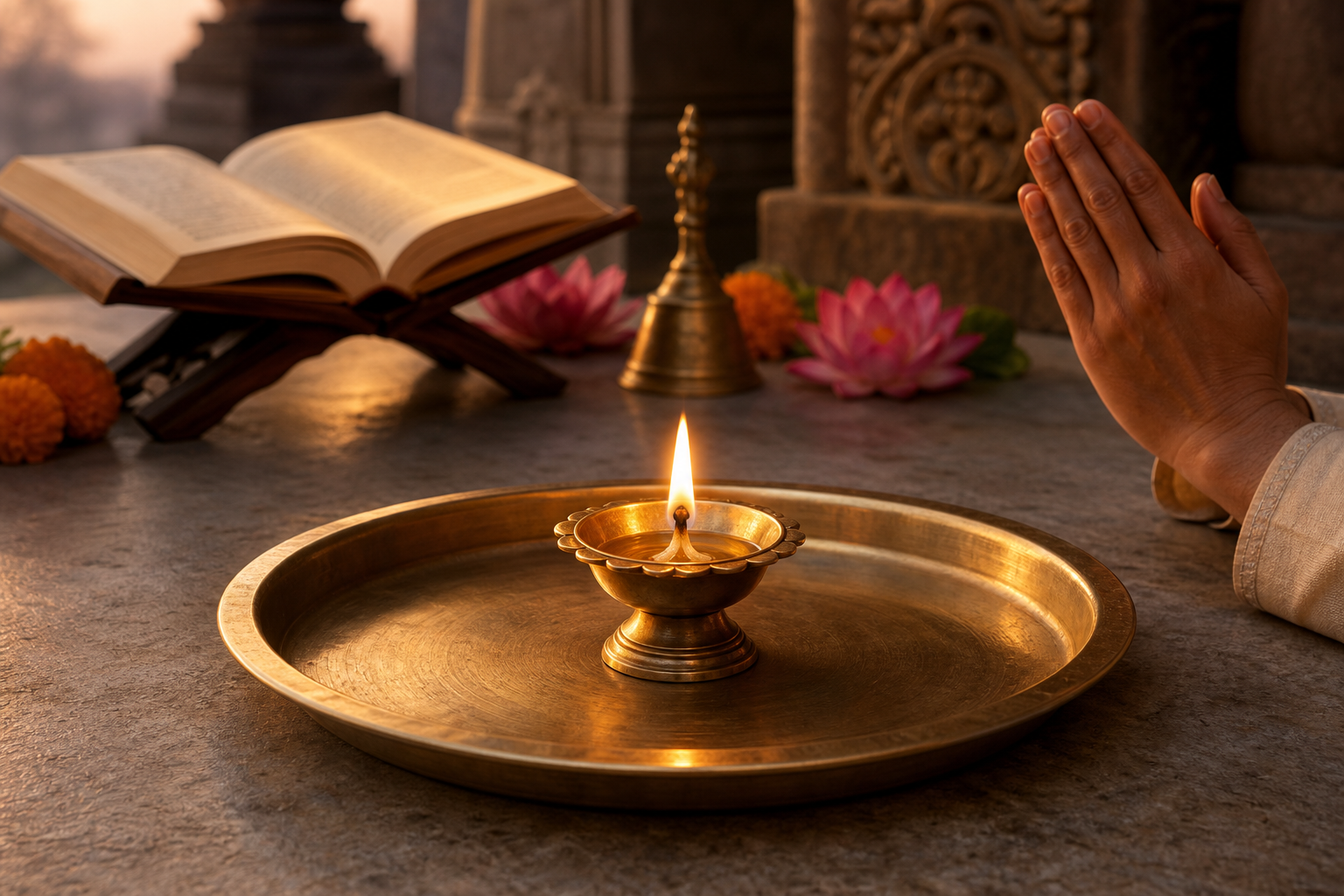
A small diya can transform the atmosphere of a shrine with remarkably little material: a vessel, a wick, fuel, and flame. In Hindu ritual life, this act is known in several regional forms as Deeparadhana, dīpārādhana, or deepa aradhana. It may open a puja, remain illuminated during worship, or become the moving light offered during arati. Its importance lies not merely in producing brightness, but in making light an embodied language of knowledge, presence, attention, and devotion.
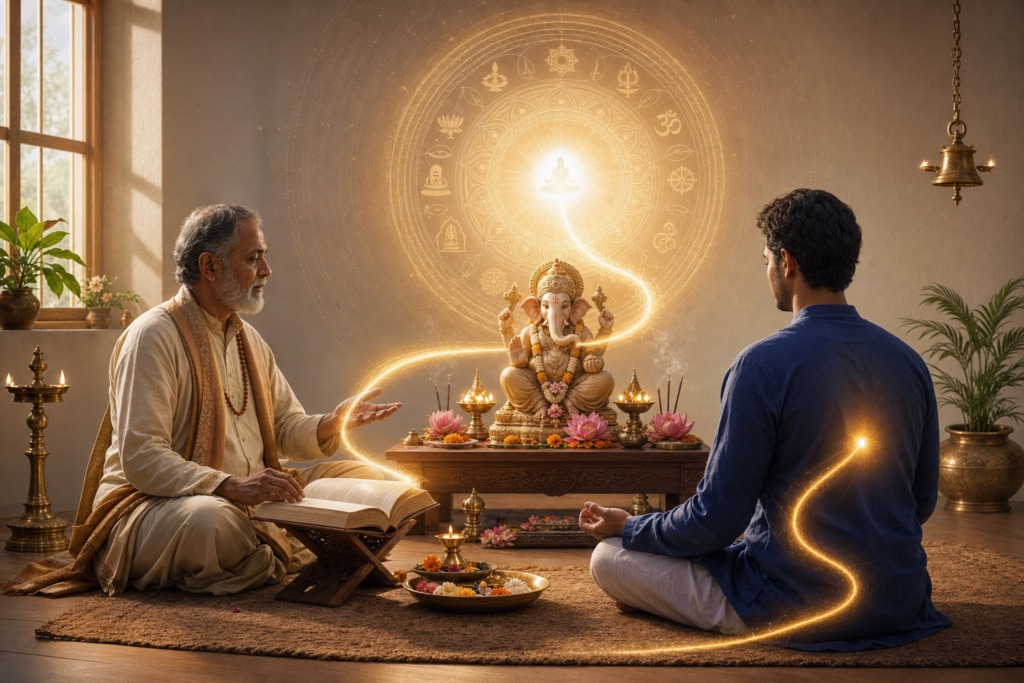
For many families, the emotional meaning of lighting diyas begins long before any formal explanation. The fragrance of warm ghee, the careful twisting of cotton, the ring of a bell, and the sight of an elder shielding a new flame from a draft often become enduring memories. Such experiences reveal how ritual transmits knowledge: theology is communicated not only through scriptures and discourse, but also through repeated gestures performed in a shared sacred space.
What Deeparadhana means
The Sanskrit word dīpa denotes a lamp or light, while ārādhana conveys worship, honouring, or devoted attendance. Deeparadhana may therefore be understood as reverential worship through light, or as the worshipful offering of a lamp. Everyday speech often uses diya, deepam, deepa, and lamp interchangeably, although vocabulary and pronunciation vary across languages, regions, and sampradayas.
Deeparadhana and arati are closely connected but not always identical. A stationary lamp may be lit before or during puja as a continuing sacred presence. In arati, a flame is commonly moved before a murti, sacred image, scripture, guru, person, river, or other revered focus while prayers, bells, or devotional songs accompany the offering. Some traditions use the terms broadly, whereas others preserve precise liturgical distinctions between dīpa, nīrājana, and arati.
Historical depth without historical exaggeration
The controlled use of fire is prehistoric, but this fact does not establish that Deeparadhana existed as a defined Hindu ritual during the Stone Age. Fire used for warmth, cooking, protection, or illumination cannot automatically be classified as ritual worship. An academically responsible history distinguishes the antiquity of human fire use, the archaeological history of lamps, the Vedic theology of Agni, and the later development of recognizable lamp offerings.
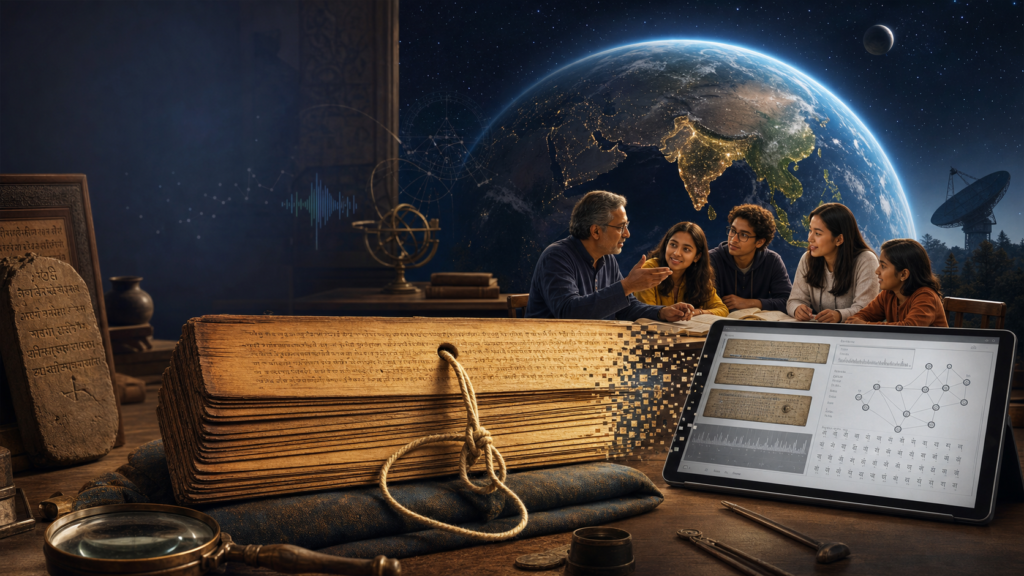
Archaeology nevertheless demonstrates that oil lamps have deep roots in the Indian subcontinent. A National Museum catalog record, for example, identifies a terracotta lamp from Nal as Harappan. Such objects confirm ancient lighting technologies, but an excavated vessel alone cannot reveal the prayers, doctrines, or ritual intentions once associated with it. Material continuity and religious continuity must be studied together rather than assumed to be identical.
The Vedic tradition supplies a more explicit sacred framework for fire. The opening hymn of the Rigveda addresses Agni as the priestly power of sacrifice and the mediator of offerings. Agni is not simply another name for a household diya, and the elaborate Vedic fire altar should not be collapsed into domestic lamp worship. Even so, the Vedic understanding of fire as luminous, transformative, and capable of carrying an offering provides an important theological background for later practices involving sacred flame.
References to lamps, light offerings, and festival illumination become increasingly visible across ritual manuals, Puranic literature, temple traditions, inscriptions, and regional devotional practice. Upanishads, Samhitas, Brahmanas, Puranas, Agamas, and later paddhatis do not present one uniform ceremony. They preserve a layered ritual culture in which Vedic fire theology, temple worship, household custom, festival observance, and local practice interact without becoming completely interchangeable.
Why light became a scriptural language
One of the most influential expressions of this symbolism appears in the Bṛhadāraṇyaka Upaniṣad: tamaso mā jyotir gamaya, conventionally understood as a movement from darkness toward light. The surrounding commentary connects darkness with ignorance and mortality, and light with knowledge and the imperishable. The text and traditional commentary therefore support a philosophical interpretation deeper than the simple replacement of night by physical illumination.
The Bhagavad Gita employs the lamp with equal precision. Verse 6.19 compares the disciplined mind of a yogin to a lamp that does not flicker in a windless place. As shown in the Gita Supersite translations and commentaries, the image communicates steadiness, collected attention, and uninterrupted illumination. It also explains why a quiet flame can become a natural focus for prayer, japa, or contemplative stillness.
A frequently circulated English rendering attributed to the Skanda Purana states, “among the light of fire, the light of the Sun, the light of the Moon, the lamp is the best of lights.” Sections of the Skanda Purana concerning Dīpāvalī do praise lamps and connect illumination with Lakṣmī, auspicious observance, and sacred time. Because the Purana survives in extensive recensions and translations, exact wording and verse numbering should be identified before a popular English sentence is treated as a universally fixed quotation.
No single passage exhausts the significance of Deeparadhana. The lamp can represent knowledge, divine presence, auspiciousness, hospitality, disciplined awareness, protection, or the offering of human effort. Different meanings become prominent in Shaiva, Vaishnava, Shakta, Smarta, and regional settings. This plurality is characteristic of Hindu ritual tradition and should be treated as interpretive richness rather than inconsistency.
The anatomy and science of a diya
A conventional diya has three functional components: a reservoir, a combustible fuel, and a porous wick. The reservoir may be made from unglazed clay, brass, bronze, copper, silver, stone, or another heat-resistant material. The fuel may be liquid oil or ghee that melts as it warms. The wick is usually cotton, although particular ritual traditions may prescribe special fibres, shapes, or arrangements.
The wick does not primarily burn like a dry piece of string. Its fibres draw liquid fuel upward by capillary action. Heat near the wick tip vaporizes the arriving fuel, and the vapour reacts with oxygen in a diffusion flame. The reaction converts stored chemical energy into heat and light while producing mainly carbon dioxide and water under efficient conditions; incomplete combustion can also produce soot, carbon monoxide, and other compounds. This basic mechanism is explained in scientific discussions of wick-fed flame combustion.
A diya flame is not chemically uniform. The darker region near the wick contains comparatively unburned fuel vapour. A faint blue zone can appear where combustion is relatively oxygen-rich, while the familiar yellow or orange luminosity is largely produced by hot soot particles glowing before they are consumed. Flame colour changes with the fuel, wick length, airflow, temperature, oxygen supply, and the observer’s surroundings.
Scientific and devotional descriptions answer different questions. Physics describes a flame as a region of reacting gases that transfers thermal and radiant energy. Devotional speech may call Jyoti a manifestation of divine power or consciousness. The latter is a theological interpretation, not a measurable category of physical energy. Recognizing that distinction protects both domains from unnecessary confusion: combustion science need not invalidate sacred meaning, and sacred meaning need not be presented as laboratory physics.
The symbolic grammar of lamp worship
The most widespread interpretation presents darkness as ‘Agnana’ and light as ‘Gnana’. The lamp thus stages a visible transition from confusion to understanding. This symbolism does not condemn night, which also possesses sacred meanings in Hindu traditions. Instead, it uses the ordinary human need for illumination as an analogy for discernment: just as light makes forms visible, knowledge makes right action and deeper reality intelligible.
Many devotional explanations assign meaning to every component. The vessel may represent the embodied person, the fuel accumulated tendencies or dedicated effort, the wick the mind or ego, and the flame awakened knowledge. As the fuel is consumed, the lamp becomes an image of self-offering. These readings are spiritually suggestive, but they are interpretive teachings rather than one standardized code binding every Hindu lineage.
Some teachings perceive white, red, and blue within the flame and associate them respectively with Goddess Saraswati as ‘Gnana’ or wisdom, Goddess Lakshmi as ‘poshana’ or nourishment, and Goddess Parvati as ‘dhairya’ or strength. This triadic reading can serve as a memorable devotional meditation. It should not be mistaken for a universal scriptural rule or a scientific explanation of flame colour, which depends on combustion conditions rather than a fixed theological spectrum.
The association with Goddess Lakshmi is especially prominent during Deepavali and in household worship centred on auspiciousness, nourishment, continuity, and prosperity. Yet prosperity in dharmic thought is not merely the mechanical acquisition of money. Lakshmi is also linked with order, generosity, beauty, fertility, responsibility, and the ethical stewardship of resources. Lighting a lamp can express welcome, but it cannot replace work, integrity, charity, or prudent judgment.
The gesture of receiving arati is sometimes explained through the siddhanta of Aatma and Paramatma. The individual turns toward a light understood as divine and then symbolically receives that offered radiance. Vedanta schools interpret the relation between self and ultimate reality differently, so the act should not be reduced to a single metaphysical formula. Its shared ritual force lies in directing the embodied person toward a reality regarded as greater than ordinary self-preoccupation.
Where the lamp belongs within puja
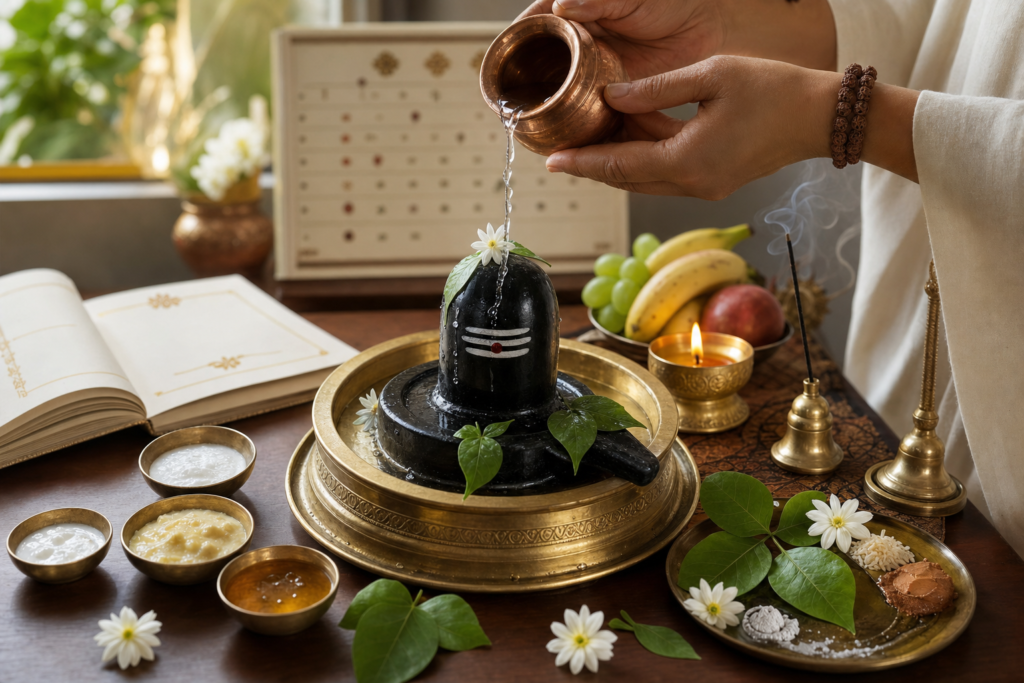
In formal worship, dīpa commonly appears as an upachara, an act of reverential service offered to the deity. It belongs among the familiar sequence of fragrance, flowers, incense, light, food, water, garments, and other forms of sacred hospitality. Both concise panchopachara worship and more elaborate shodashopachara worship may include the lamp, although sequence, mantra, and ritual detail vary among manuals and communities.
During arati, moving the lamp before a murti makes light part of darshan. The flame illuminates the sacred form, while the devotee’s gaze becomes attentive and receptive. Darshan is more than inspecting an object; it is traditionally understood as a charged encounter of seeing and being seen. The lamp therefore supports both visibility and relationship, especially in a sanctum where controlled illumination can reveal the deity’s form gradually and dramatically.
After arati, many devotees place their palms near the flame and bring them toward the eyes, forehead, or crown. The gesture ritually receives the offered blessing and returns sacred light to the body. It should not be described as a proven transfer of physical divine energy. Its significance is embodied and theological: reverence is expressed through warmth, sight, movement, and touch rather than through words alone.
A stationary lamp can also mark ritual time. Once lit, an ordinary room is experienced as a place of worship, and an otherwise hurried morning or evening acquires a deliberate rhythm. A person returning from a demanding day may find that preparing the wick, pausing before the flame, and reciting a familiar prayer creates a threshold between public pressure and inward attention. That experiential effect helps explain the durability of domestic Deeparadhana.
Choosing the vessel, fuel, wick, direction, and time
Clay lamps are valued for simplicity, earth symbolism, affordability, and festival use. Brass and bronze lamps are durable, stable when well designed, and suited to repeated household or temple worship. Silver, copper, stone, and elaborate standing lamps appear in specific regional and institutional settings. The best vessel is one that accords with the tradition, remains physically stable, tolerates heat, and can be cleaned safely.
Ghee is highly esteemed in many traditions, and some ritual guides explicitly prefer it. Sesame oil is also widely respected, while coconut, mustard, castor, and other plant oils occur in regional or deity-specific practices. No scientifically or textually responsible account can declare one fuel universally correct for every puja. Purity, availability, local ecology, family custom, temple procedure, and the instructions of a qualified guru or priest all affect the choice.
Wick number is equally contextual. One wick is sufficient for many forms of daily worship; two, five, or larger arrangements may carry particular liturgical meanings or serve ceremonial visibility. Lotus-shaped wicks and other specialized forms belong to distinct vratas and regional practices. More wicks do not automatically produce greater spiritual merit, and an impressive flame is not inherently more sacred than a small, carefully tended one.
Rules concerning the direction in which a wick should face are not uniform across Hinduism. Directions can be interpreted through temple architecture, deity orientation, domestic custom, festival purpose, or regional ritual manuals. Instructions found in one household or online chart should not be universalized. When a ceremony has a formal prescription, the relevant sampradaya or paddhati provides the appropriate authority.
Morning and evening are common times for household lamps, particularly around dawn and dusk when daily activity naturally changes pace. Temples may perform several aratis according to the deity’s liturgical schedule, while festivals and vratas establish their own timings. Regularity is often more important for domestic practice than anxiety about an allegedly perfect minute, unless a particular observance explicitly requires a defined muhurta.
The widespread statement that earthen lamps and ghee are the finest materials should therefore be read as a respected preference, not a rule that invalidates other established customs. A modest lamp lit according to inherited practice can be more appropriate than an expensive vessel selected without understanding. Ritual integrity rests on attention, cleanliness, right intention, and fidelity to context rather than material display.
A careful method for household Deeparadhana
1. Prepare the place. The shrine surface should be clean, level, heat-resistant, and free from loose cloth, paper, dried flowers, curtains, and other combustible material. The lamp should stand on a broad metal or ceramic plate capable of containing spilled fuel. Long hair, flowing sleeves, and scarves should be secured before ignition.
2. Prepare the lamp. A clean wick should be shaped with enough exposed fibre to sustain a steady flame without producing excessive height or soot. The reservoir should receive only a manageable quantity of the chosen fuel. A ghee lamp may require gently softened ghee around the wick so that the initial flame can establish a continuing fuel supply.
3. Establish intention. The lamp may be lit after a brief sankalpa, prayer, remembrance of the deity, or silent commitment to clarity and dharmic conduct. A lineage-specific mantra should be used exactly as taught. When no formal mantra is known, respectful silence is preferable to casually combining fragments from unrelated ritual systems.
4. Offer the light. A stationary diya can remain before the sacred focus while other offerings proceed. If the lamp is used for arati, its movement, number of circles, accompanying mantra, and order of presentation should follow the relevant custom. The motion should remain controlled, and the plate should be held in a manner that prevents hot oil or ghee from spilling.
5. Receive and conclude. Devotees may receive the arati according to customary practice, offer pranam, and sit briefly in prayer or contemplation. The lamp should remain supervised until it is safely extinguished or has gone out. Residual fuel, wick, ash, and flowers should be handled respectfully without creating litter, blocked drains, or fire risk.
This method is a safety-conscious framework rather than a replacement for living tradition. A family elder, temple priest, guru, or authoritative ritual manual may specify different materials and sequences. Hindu practice allows meaningful variation, but variation does not mean that every improvised claim has equal textual or traditional standing.
Where open flames are prohibited—such as some dormitories, hospitals, care facilities, workplaces, aircraft, or rented buildings—safety rules should be honoured. Depending on the tradition, a small electric light, an unlit symbolic lamp, a flower offering, or mānasa puja may preserve the intention of worship. Such adaptations should be approached humbly and should never be used to shame people whose health, housing, disability, or legal circumstances limit conventional practice.
Health claims: what evidence supports and what it does not
A flame is hot enough to destroy microorganisms that directly enter its combustion zone, but a household diya is not a room disinfectant. There is no sound basis for claiming that one small lamp sterilizes indoor air, prevents infection, or functions as a general germicide. Effective infection control depends on evidence-based ventilation, hygiene, sanitation, vaccination where appropriate, and medical guidance—not on exposure to ritual smoke.
Combustion also has environmental consequences indoors. Even natural fuels can emit fine particles and other products when burning is incomplete. The United States Environmental Protection Agency identifies candles and other combustion activities as indoor particulate sources. A diya differs from a paraffin candle in fuel composition, but it remains an open combustion source; “natural” does not mean emission-free.
Exposure depends on the number of lamps, fuel and wick quality, flame condition, burn duration, room volume, and ventilation. A single small lamp used briefly in a ventilated room is not equivalent to prolonged burning of many smoky flames in a confined space. People with asthma, chronic lung disease, chemical sensitivity, or smoke-triggered symptoms may need greater ventilation, shorter use, or a flameless adaptation based on medical advice.
Ritual can nonetheless support psychological organization without becoming a medical cure. Predictable gestures may structure attention, mark transitions, and provide a sense of continuity. A preregistered experimental study of ritualized behaviour found reductions in anxiety across conditions, with only modest differences attributable to ritualized action itself. Research on Marathi religious practices in Mauritius also suggests that ritual structure can interact with anxiety, culture, and community. Neither study proves that lighting a diya treats an anxiety disorder.
Concentrating on a flame may help some practitioners settle their attention, but ordinary Deeparadhana should not be confused with prolonged trataka. Sustained unblinking gazing can cause discomfort or irritation and is unnecessary for lamp worship. Anyone with an eye condition, migraine sensitivity, photosensitivity, or related concern should avoid strenuous visual practices unless appropriately advised.
Environmental responsibility and sacred materials
No lamp material is automatically the most sustainable in every context. A reusable brass lamp carries manufacturing impacts but may serve for generations. A clay diya uses an abundant material but requires firing energy and may become single-use waste when coated with paint, glitter, plastic, or synthetic decoration. A responsible practice uses an appropriately sized lamp, avoids unnecessary packaging, chooses traceable fuel where possible, and disposes of residues without contaminating soil or water.
Environmental care is not external to ritual ethics. A lamp offered as a symbol of knowledge should not create avoidable pollution through excessive smoke, discarded plastic cups, toxic pigments, or mass litter. Restraint can itself be devotional: one steady flame, a reusable vessel, a well-fitted wick, and a clean space often express greater care than a large display whose materials are poorly managed.
Essential fire-safety principles
Every diya is an open flame and should be treated accordingly. It should remain on a stable, noncombustible surface and at least 30 centimetres from anything capable of burning. The National Fire Protection Association’s candle-safety guidance supports this minimum separation and emphasizes constant supervision.
A burning lamp should never be left unattended, placed where a child or animal can reach it, or positioned beneath a shelf. Windows and fans should not create strong drafts capable of spreading flame or hot fuel. Multiple lamps require additional spacing because neighbouring flames can heat one another and make a tray difficult to handle.
Fuel should never be poured into a burning or hot lamp. If an oil flame spreads, water must not be thrown onto it because water can disperse burning oil. The safe response is to cut off oxygen with an appropriate lid or fire blanket when this can be done without personal danger, evacuate if necessary, and contact emergency services. A suitable extinguisher should be accessible wherever larger ceremonial flames are used.
When the ceremony requires extinguishing the flame, a snuffer or heat-resistant cover reduces splashing and smoke. Local custom may prefer allowing a small lamp to expire naturally, but that preference never justifies leaving it unwatched. Safety is not a lack of devotion; it is an expression of responsibility toward the household, community, and sacred space.
Five common misconceptions
Misconception 1: Deeparadhana can be dated directly to the Stone Age. Human fire use is prehistoric, and lamps are archaeologically ancient, but a specific ritual identity requires textual, material, and contextual evidence. The history of the diya is deep without needing an unsupported chronological claim.
Misconception 2: A diya purifies all indoor air and kills harmful germs. A flame can destroy organisms that pass through its hottest zone, yet it cannot sterilize an ordinary room. Combustion may instead add particulate matter, especially when a wick smokes or ventilation is poor.
Misconception 3: One fuel, wick count, direction, or metal is correct for every puja. Hindu ritual systems contain genuine regional and sectarian rules, but their authority is contextual. A prescription for one vrata or deity should not be detached from that setting and imposed on all households.
Misconception 4: The flame’s colours scientifically prove its association with three goddesses. Saraswati, Lakshmi, and Parvati provide a meaningful devotional interpretation of wisdom, nourishment, and courage. Flame colours themselves arise from fuel chemistry, oxygen, temperature, and glowing particles.
Misconception 5: Lighting a lamp mechanically guarantees wealth or removes every difficulty. Deeparadhana can orient intention, strengthen discipline, and express devotion, but dharmic life also requires ethical action, knowledge, service, courage, and responsible decision-making. Ritual bears fruit through a larger moral and spiritual ecology.
Light as a bridge among Dharmic traditions
Light and illumination carry profound ethical and spiritual resonance across Hinduism, Buddhism, Jainism, and Sikhism. Each tradition develops those images through its own doctrines, scriptures, festivals, and ritual forms; their differences should not be erased. The shared aspiration toward wisdom, compassion, freedom from ignorance, disciplined conduct, and service nevertheless offers a constructive basis for mutual respect. Deeparadhana remains specifically rooted in Hindu worship while participating in a broader Dharmic appreciation of awakened understanding.
The enduring importance of Deeparadhana
The lamp endures because it joins several dimensions of human life in one concise act. It is material yet symbolic, domestic yet scriptural, technically simple yet philosophically rich. Its flame demonstrates transformation in physical terms while inviting transformation in moral and contemplative terms. It illuminates a murti while asking whether perception itself has become clearer.
The deepest value of lighting diyas during puja does not depend on exaggerated history, unsupported medical promises, or rigid internet formulas. It rests in attentive offering: darkness gives way to visibility, distraction yields briefly to steadiness, and an ordinary substance becomes part of sacred hospitality. When performed with textual humility, environmental awareness, and fire safety, Deeparadhana remains a powerful expression of Hindu spirituality and a living discipline of knowledge, reverence, and responsibility.
Selected references: Deeparadhana and the importance of lighting lamps during puja; Bhagavad Gita 6.19 with translations and commentaries; Bṛhadāraṇyaka Upaniṣad and commentary; National Museum terracotta lamp record; EPA guidance on indoor particulate sources; and United States Fire Administration guidance on open-flame safety.
Inspired by this post on Hindu Pad.


Leave a Reply
You must be logged in to post a comment.