
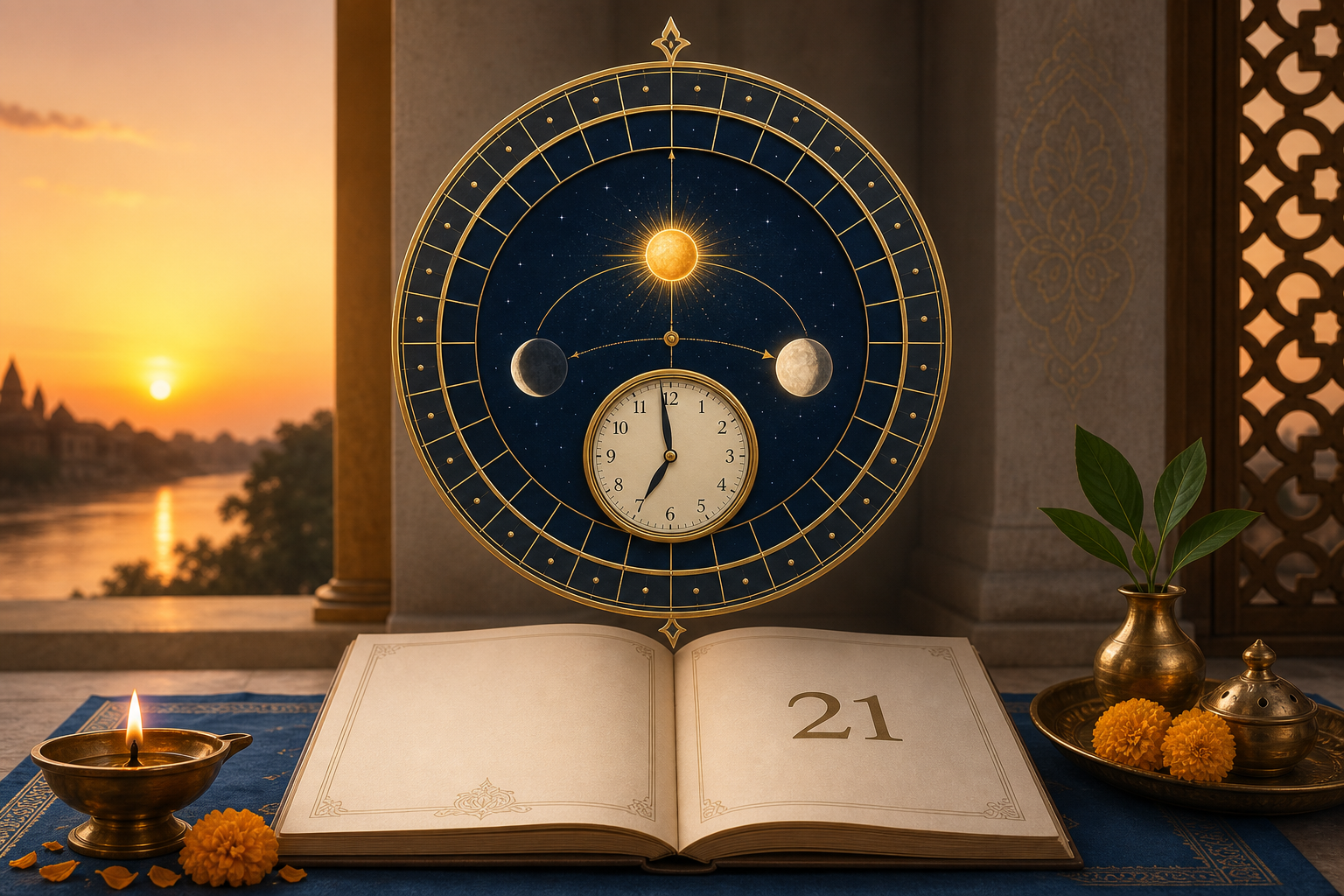
July 21, 2026 Panchang at a glance
Tuesday, July 21, 2026, begins under Shukla Paksha Saptami in the Hindu calendar for most regions covered by the supplied Panchang entry. Saptami is the seventh lunar day of the waxing half of the month. The tithi continues until 6:59 AM, after which Shukla Paksha Ashtami, the eighth lunar day of the waxing phase, begins.
For a household checking the daily Hindu calendar before prayer, travel, study, or a religious observance, this early-morning transition is the most important confirmed detail. It also illustrates why a Panchang cannot be read like an ordinary Gregorian calendar: a tithi does not necessarily begin at sunrise or midnight, and more than one tithi can occur during the same civil date.
The stated transition time should be interpreted according to the location and time standard used by the original calendar. Because the supplied extract does not identify that reference location, readers in other cities or countries should verify the corresponding local time before using it for a vrata, puja, samskara, or muhurta. This qualification is especially important near sunrise, when even a modest geographical difference can change which tithi governs a particular observance.
How the Saptami–Ashtami transition is calculated
A tithi is an astronomical division based on the changing angular separation between the Moon and the Sun as viewed from Earth. It is not a fixed 24-hour weekday. Traditional and modern Panchang calculations divide the synodic lunar month into 30 tithis, with 15 belonging to Shukla Paksha, the waxing phase, and 15 belonging to Krishna Paksha, the waning phase.
In technical terms, the relevant quantity is the Moon’s geocentric ecliptic longitude minus the Sun’s geocentric ecliptic longitude, reduced to a value between 0° and 360°. Every increase of 12° completes one tithi. Shukla Paksha Saptami occupies the elongation interval from 72° to 84°, while Shukla Paksha Ashtami occupies the interval from 84° to 96°. The transition reported at 6:59 AM therefore marks the calculated moment at which the Sun–Moon elongation reaches the next 12° boundary.
The average tithi lasts approximately 23 hours and 37 minutes, but its actual duration varies because neither the Moon nor Earth moves at a perfectly uniform apparent speed. A tithi may consequently be considerably shorter or longer than its average length. This variable motion explains why tithi-ending times shift from day to day and why a lunar date cannot reliably be estimated by adding 24 hours to the previous day’s result.
Why sunrise matters
Many Hindu calendars identify a civil day by the tithi prevailing at local sunrise. Under that widely used convention, a place where sunrise occurs before 6:59 AM would experience Saptami at sunrise on July 21, followed by Ashtami later that morning. If sunrise occurs after the stated transition in the relevant local calculation, Ashtami may already prevail when the day begins ritually.
The sunrise rule is important, but it is not universal for every festival or vrata. Some observances require a tithi to prevail during sunrise, while others depend on moonrise, midday, sunset, midnight, or a prescribed part of the day. Certain traditions also consider whether a tithi touches two sunrises or is absent at sunrise altogether. The applicable dharmic rule should therefore be checked alongside the astronomical ending time.
This distinction helps resolve a common source of confusion. A calendar may describe July 21 as a Saptami day because Saptami is present at sunrise, even though Ashtami begins at 6:59 AM and occupies most of the remaining civil day. Both statements can be correct because they answer different questions: one identifies the sunrise tithi, while the other records the exact astronomical transition.
The five parts of a Panchang
The Sanskrit term Panchang refers to five calendrical limbs: vara, tithi, nakshatra, yoga, and karana. A complete daily assessment considers these elements together rather than treating any one of them as an isolated prediction. The date Tuesday supplies the vara, while the lunar phase supplies the transition from Saptami to Ashtami. Nakshatra, yoga, and karana require their own calculations.
Vara is the weekday, measured from one local sunrise to the next in many traditional applications. July 21, 2026 falls on a Tuesday. Weekday associations may influence devotional routines in particular regions or sampradayas, but Tuesday alone does not determine whether every activity performed that day is auspicious or inauspicious.
Tithi describes the relative angular relationship of the Sun and Moon. It is especially important for fasting, monthly worship, festival dates, ancestral rites, and several samskaras. On this date, the confirmed sequence is Shukla Paksha Saptami until 6:59 AM, followed by Shukla Paksha Ashtami.
Nakshatra identifies the lunar mansion occupied by the Moon. The standard system divides the sidereal zodiac into 27 equal sectors of 13°20′ each. Because the Moon usually crosses a nakshatra boundary in roughly one day, a civil date can contain one or two nakshatras. An exact nakshatra and its ending time must come from a properly calculated ephemeris; they cannot be deduced from the tithi alone.
Rashi, in this context, usually refers to the Moon’s sidereal zodiac sign. The zodiac is divided into 12 rashis of 30° each, and the Moon remains in a rashi for approximately two and a quarter days. Tithi measures the Moon’s longitude relative to the Sun, whereas Rashi depends on the Moon’s absolute sidereal longitude. The Saptami–Ashtami transition therefore does not, by itself, reveal the Moon’s Rashi.
Yoga is obtained from the combined sidereal longitudes of the Sun and Moon and is divided into 27 segments. Karana is half a tithi, corresponding to 6° of Sun–Moon elongation; two karanas ordinarily occur within each tithi. These elements are frequently evaluated when selecting a muhurta, although their application varies among regional and textual traditions.
Nakshatra and Rashi accuracy for July 21
The supplied source extract does not provide the day’s named Nakshatra, its transition time, or the Moon’s Rashi. Assigning either value from the tithi alone would be technically unsound. A reliable location-specific Panchang should be consulted for those details, preferably using the same ephemeris, ayanamsha, time zone, and sunrise convention throughout the calculation.
This caution protects readers from a subtle but consequential error. Two moments can share the same tithi even when the Moon occupies different nakshatras or rashis, because the Sun has also moved. Conversely, a Nakshatra transition need not coincide with a tithi transition. Each boundary represents a different astronomical quantity and must be calculated independently.
How “good time” should be understood
A good time in a Panchang generally refers to a muhurta or another interval traditionally considered supportive for a specified activity. It is not a single universal period suitable for every purpose. Marriage, travel, education, property transactions, worship, medical procedures, and routine household work can involve different selection rules, and major undertakings may also require an individual horoscope assessment.
Common daily tables may include Abhijit Muhurta and may separately mark Rahu Kaal, Yamaganda, Gulika Kala, Dur Muhurta, or Varjyam. These periods are calculated through different traditional methods. Rahu Kaal, for example, is derived by dividing the interval from local sunrise to local sunset into eight equal portions and assigning one portion according to the weekday. Its clock time changes with daylight length and location.
The supplied extract contains no verified good-time interval for July 21, 2026. Consequently, no exact muhurta should be inferred or invented from the 6:59 AM tithi change. A person planning an important ceremony should obtain the local sunrise and sunset, confirm the relevant tithi and Nakshatra, review any traditionally avoided intervals, and apply the rule appropriate to that ceremony.
Traditional muhurta indicators are best understood as elements of a living calendrical discipline rather than guarantees of a particular outcome. Preparation, ethical conduct, competence, health, safety, and practical circumstances remain essential. The Panchang supplies a sacred framework for timing; it does not replace responsible judgment.
Traditional significance of Shukla Paksha Saptami
Shukla Paksha denotes the brightening half of the lunar month, extending from the new moon toward the full moon. Within many Hindu traditions, this gradual increase in visible moonlight is associated symbolically with growth, clarity, disciplined effort, and the unfolding of intention. Such meanings are devotional interpretations rather than astronomical properties, but they give the lunar calendar much of its cultural and emotional resonance.
Saptami is widely associated with Surya in several ritual traditions, although the specific importance of any monthly Saptami depends on the lunar month, regional calendar, and vrata being observed. The early portion of July 21 may therefore carry significance for practitioners following a Saptami discipline. The mere presence of Saptami, however, should not be treated as proof that a major named festival occurs on this date.
Traditional significance of Shukla Paksha Ashtami
Ashtami is the eighth tithi and begins after 6:59 AM according to the supplied entry. It appears in numerous devotional calendars, including traditions connected with Devi and forms of Vishnu or Krishna, but the applicable observance changes with the month and sampradaya. The accurate conclusion for July 21 is therefore limited to the tithi transition unless a complete regional festival calendar supplies additional information.
The movement from Saptami to Ashtami can nevertheless offer a meaningful daily rhythm. A practitioner may begin the morning with one lunar quality and continue the day under another, experiencing sacred time as a continuous astronomical cycle rather than a sequence of rigid midnight boundaries. For families accustomed to consulting the Hindu calendar together, this awareness often turns an ordinary weekday into an occasion for attentiveness and continuity.
Why Panchang results can differ by region
The astronomical instant of a tithi boundary is global, but its displayed clock time depends on the local time zone. The ritual date assigned to that boundary can also depend on local sunrise and the observance rule being followed. A transition shown as early morning in India may appear on the previous civil date in North America, while the underlying celestial event remains the same.
Regional calendars may follow amanta or purnimanta month reckoning, apply different festival decision rules, or use different conventions for sunrise and day division. Panchangas may also differ slightly because of ephemeris data, ayanamsha selection for sidereal quantities, atmospheric assumptions used for sunrise, coordinate precision, and rounding. A difference of a few minutes does not necessarily indicate that one calendar is careless; it may reflect a documented methodological choice.
Consistency is therefore more useful than mixing isolated values from several calendars. The tithi, Nakshatra, Rashi, yoga, karana, sunrise, sunset, and muhurta intervals should ideally be taken from the same location-specific Panchang. This keeps the calculations internally coherent and reduces the risk of combining incompatible conventions.
A practical method for using the July 21 Panchang
First, the reader should confirm the city, country, and time zone used by the calendar. Second, the local sunrise should be compared with the 6:59 AM tithi boundary. Third, the rule for the intended observance should be identified: sunrise prevalence, midday prevalence, moonrise, sunset, or another prescribed period. Fourth, the locally calculated Nakshatra, Rashi, yoga, karana, and daily muhurta intervals should be checked from the same source.
For an ordinary daily practice without a festival-specific rule, the confirmed timeline may be recorded simply: Shukla Paksha Saptami continues until 6:59 AM on Tuesday, July 21, 2026, and Shukla Paksha Ashtami follows. If a prayer or sankalpa occurs close to the transition, the locally calculated tithi at the actual time should be used rather than relying only on the tithi printed as the day’s heading.
For a major samskara or legally and financially significant undertaking, a generic daily good-time table may be insufficient. Traditional muhurta practice can consider the nature of the activity, weekday, tithi, Nakshatra, yoga, karana, lunar strength, Tara Bala, Chandra Bala, Lagna, and individual circumstances. Not every household applies this full framework, but its existence explains why a brief Panchang entry should not be mistaken for a complete electional astrology assessment.
Respecting diversity across Dharmic traditions
The Panchang described here belongs to a Hindu calendrical framework, and its practices vary among Hindu communities themselves. Buddhist, Jain, and Sikh communities also preserve distinctive calendars, sacred anniversaries, fasting practices, and methods of communal remembrance. A unity-oriented understanding respects those differences without collapsing them into a single system. Shared commitments to disciplined living, ethical responsibility, learning, compassion, and community can be appreciated alongside each tradition’s independent teachings.
This plural perspective is historically and practically important. Regional names, observance rules, and ritual priorities may differ while still participating in the broader cultural experience of sacred time. Variation does not automatically signify contradiction; it often reflects geography, lineage, language, textual authority, and the needs of particular communities.
Frequently asked question: What is the tithi on July 21, 2026?
According to the supplied Panchang entry, Shukla Paksha Saptami continues until 6:59 AM on July 21, 2026. Shukla Paksha Ashtami begins from that point onward. The clock time must be interpreted in the source calendar’s reference time zone and verified locally when ritual precision is required.
Frequently asked question: Does the tithi change at midnight?
No. A tithi changes when the angular separation between the Moon and Sun crosses the next 12° boundary. That astronomical event can occur at any hour of the day or night, which is why the July 21 transition occurs at 6:59 AM rather than at midnight.
Frequently asked question: Is July 21 a Saptami or Ashtami day?
It contains both tithis. Saptami remains in effect until 6:59 AM, and Ashtami follows. A calendar may label the date according to the tithi prevailing at local sunrise, while a particular vrata may use a different period of prevalence. The correct ritual answer therefore depends on location and the observance rule.
Frequently asked question: Can the Nakshatra or Rashi be obtained from Saptami?
No. Tithi measures the relative longitude of the Moon and Sun, Nakshatra measures the Moon’s position within one of 27 sidereal sectors, and Rashi measures its position within one of 12 sidereal signs. Their transition times are independent and require separate calculations.
Frequently asked question: What is the best time for important work?
The supplied extract does not contain a verified good-time interval. An exact recommendation would require a location-specific Panchang and the nature of the proposed activity. Readers should not treat the 6:59 AM tithi transition itself as a universal muhurta.
Essential conclusion
The central Panchang fact for Tuesday, July 21, 2026 is clear: Shukla Paksha Saptami lasts until 6:59 AM, after which Shukla Paksha Ashtami begins. The deeper lesson is equally useful. Tithi, Nakshatra, Rashi, and good-time calculations describe different aspects of sacred and astronomical time, and each must be interpreted with attention to location, sunrise, methodology, and tradition. Read in that disciplined way, the daily Hindu calendar becomes both a precise technical instrument and a meaningful guide to continuity, reflection, and devotional life.
Inspired by this post on Hindu Blog.



Leave a Reply
You must be logged in to post a comment.